
Air compressors are among the most energy-intensive assets in any industrial facility, often consuming more electricity than any other single piece of equipment on site. Despite this, compressed air systems are frequently overlooked in reliability programs, leading to chronic inefficiency, unplanned downtime, and inflated operating costs. At Forge Reliability, we help facilities transform their air compressor maintenance from reactive firefighting into a structured, data-driven program that delivers measurable improvements in uptime and energy performance.
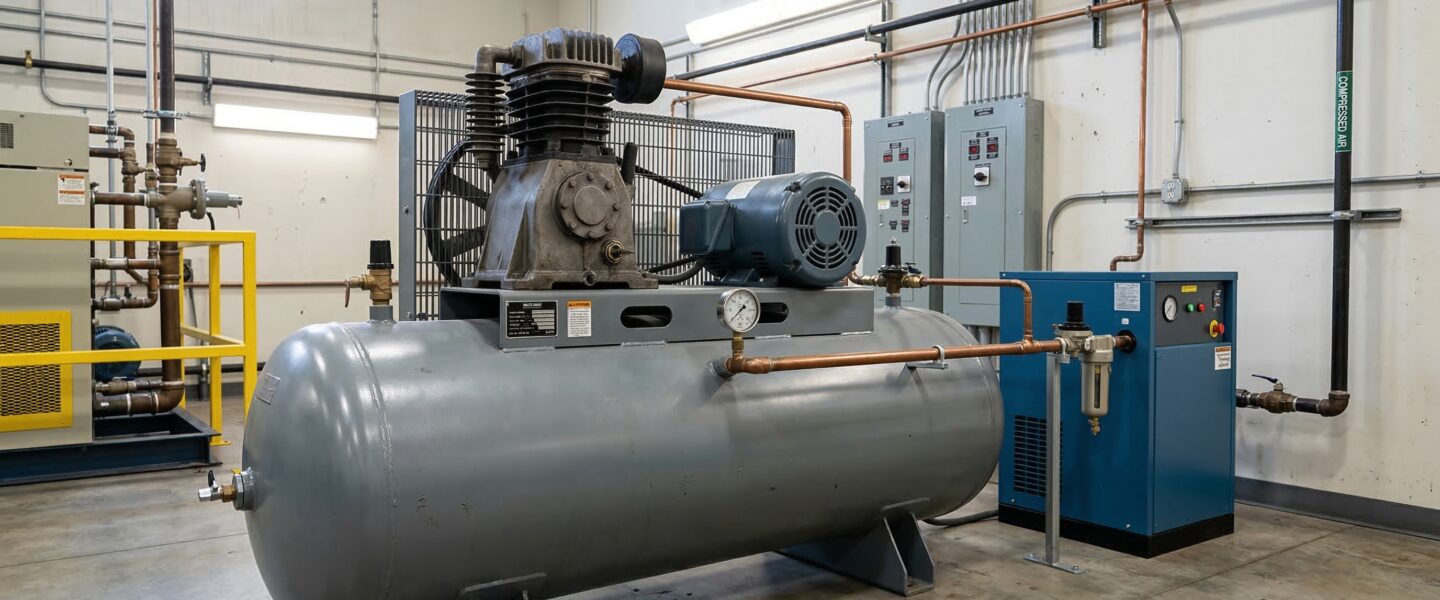
Why Does Air Compressor Reliability Matter?
Compressed air is often called the fourth utility, and for good reason. Manufacturing plants, food processing facilities, and heavy industry all depend on a continuous, clean supply of compressed air to power tools, actuate valves, operate packaging lines, and support critical process controls. When a compressor goes down unexpectedly, the consequences ripple across the entire operation.
The challenge with air compressors is that degradation often happens gradually. A slow decline in discharge pressure, a creeping increase in operating temperature, or a gradual rise in energy consumption can go unnoticed for months. By the time a failure occurs, the damage is often far more extensive and expensive than it would have been with early intervention. Facilities that rely solely on time-based maintenance or run-to-failure approaches frequently spend 20 to 30 percent more on compressed air than those with proactive reliability programs.
Compressed air systems account for approximately 10 percent of all industrial electricity consumption in North America. Even modest improvements in compressor reliability and efficiency can yield substantial energy savings across a facility.
What Are the Common Reliability Challenges?
Air compressors face a range of reliability challenges that vary by type and application. Rotary screw compressors, the most common in industrial settings, are susceptible to issues with their airend bearings, oil separation systems, and inlet valve assemblies. Reciprocating compressors contend with valve wear, piston ring degradation, and crankshaft bearing fatigue. Regardless of compressor type, several challenges appear consistently across facilities.
Bearing Degradation
Bearings in compressor airends and drive motors are subjected to continuous loading and high rotational speeds. Lubricant contamination, misalignment, and thermal cycling all accelerate bearing wear. Left unchecked, bearing degradation leads to increased vibration, elevated noise levels, and eventually catastrophic failure that can destroy the airend itself.
Oil System Contamination
Oil-flooded rotary screw compressors depend on their lubricant for sealing, cooling, and bearing protection. Contamination from moisture ingress, particulate matter, or chemical breakdown of the oil degrades all three functions simultaneously. Facilities that extend oil change intervals without monitoring oil condition frequently experience accelerated wear and premature component failures.
Air Leak Proliferation
While not a compressor failure per se, air leaks throughout the distribution system force compressors to work harder, cycle more frequently, and operate at higher loads than necessary. A typical industrial compressed air system loses 25 to 30 percent of its output to leaks. This excess demand accelerates wear on every compressor in the system and significantly increases energy costs.
Control System Inefficiencies
Poorly configured sequencing, inappropriate pressure setpoints, and mismatched compressor staging waste energy and create unnecessary mechanical stress. Compressors that short-cycle or operate in inefficient load-unload patterns experience accelerated wear on valves, seals, and drive components.
How Does Condition Monitoring Apply to Air Compressors?
Condition monitoring transforms air compressor maintenance from a calendar-based activity into an intelligence-driven process. By continuously tracking key parameters, maintenance teams can identify developing problems weeks or months before they cause failures, allowing repairs to be planned and executed during scheduled downtime windows.
Vibration Analysis
Vibration monitoring is one of the most effective tools for air compressor reliability. Accelerometers mounted on bearing housings, airend casings, and drive motors capture data that reveals bearing defects, misalignment, looseness, and rotor imbalance. Trending vibration data over time allows analysts to track degradation rates and predict remaining useful life with high confidence. For critical compressors, online vibration monitoring systems provide continuous protection and immediate alerts when conditions change.
Oil Analysis
Regular oil sampling and analysis reveals contamination, wear metal trends, and lubricant degradation before they cause problems. Elevated iron and copper levels indicate bearing or bushing wear. High moisture content signals cooler or separator issues. Tracking viscosity and oxidation levels ensures oil changes happen when actually needed rather than on an arbitrary schedule.
Thermal Monitoring
Infrared thermography identifies hot spots in electrical connections, motor windings, and discharge piping. Temperature monitoring at the airend discharge, intercooler outlets, and oil system components provides early warning of cooling system degradation, valve leakage, and abnormal operating conditions.
Facilities that implement comprehensive condition monitoring on their compressed air systems typically reduce unplanned compressor downtime by 50 to 70 percent while extending major overhaul intervals by 25 percent or more.
Maintenance Strategies That Work
Effective air compressor maintenance combines multiple strategies tailored to the criticality and operating context of each machine. At Forge Reliability, we design programs that balance reliability with cost-effectiveness, ensuring that maintenance resources are directed where they deliver the greatest return.
Condition-Based Maintenance
For critical compressors, condition-based maintenance driven by vibration analysis, oil analysis, and performance monitoring provides the best balance of reliability and cost. This approach eliminates unnecessary maintenance tasks while catching developing problems early. Condition-based programs are particularly effective for airend bearings, oil system components, and drive motor health.
Preventive Maintenance Optimization
Time-based tasks still play a role in air compressor maintenance, particularly for consumable items like air filters, oil filters, and separator elements. However, many facilities over-maintain these items based on conservative OEM recommendations. By analyzing actual operating conditions and filter differential pressures, maintenance intervals can be optimized to reduce waste without compromising reliability.
System-Level Optimization
Compressor reliability does not exist in isolation. Addressing system-level issues like air leaks, pressure drop across piping and treatment equipment, storage capacity, and control sequencing reduces the mechanical demand on compressors and extends their operating life. A comprehensive reliability program addresses the entire compressed air system, not just individual machines.
What Results Can You Expect?
Facilities that partner with Forge Reliability to implement structured air compressor maintenance programs consistently achieve significant, measurable improvements. Energy costs typically decrease by 15 to 25 percent through leak reduction, control optimization, and improved compressor efficiency. Unplanned downtime drops dramatically as condition monitoring catches problems early. Maintenance spending shifts from emergency repairs to planned activities, reducing both costs and production disruption.
Perhaps most importantly, a well-designed reliability program provides visibility into the true condition of every compressor in the system. Maintenance managers gain confidence in their equipment, operations teams experience fewer disruptions, and leadership sees clear returns on their reliability investment. For most facilities, the payback period on a comprehensive compressed air reliability program is less than 12 months.
Whether you are dealing with chronic compressor failures, rising energy costs, or simply want to move beyond reactive maintenance, Forge Reliability has the expertise and proven methodologies to deliver results. Our team brings deep experience across all compressor types and industries, supported by advanced diagnostic technologies and a commitment to practical, sustainable solutions.