
Positive displacement pump maintenance requires a different mindset than centrifugal pump maintenance, yet many facilities apply the same maintenance practices to both — and pay for it with shortened pump life, unexpected failures, and chronic performance problems. Positive displacement pumps move fluid by trapping a fixed volume and forcing it through the discharge, which means they generate flow proportional to speed regardless of system pressure. This fundamental operating principle creates mechanical loading patterns, wear mechanisms, and failure modes that are distinct from centrifugal machines. At Forge Reliability, we design maintenance programs specifically for positive displacement pump applications — gear pumps, screw pumps, lobe pumps, vane pumps, progressive cavity pumps, piston pumps, and diaphragm pumps — because these machines demand purpose-built reliability strategies.
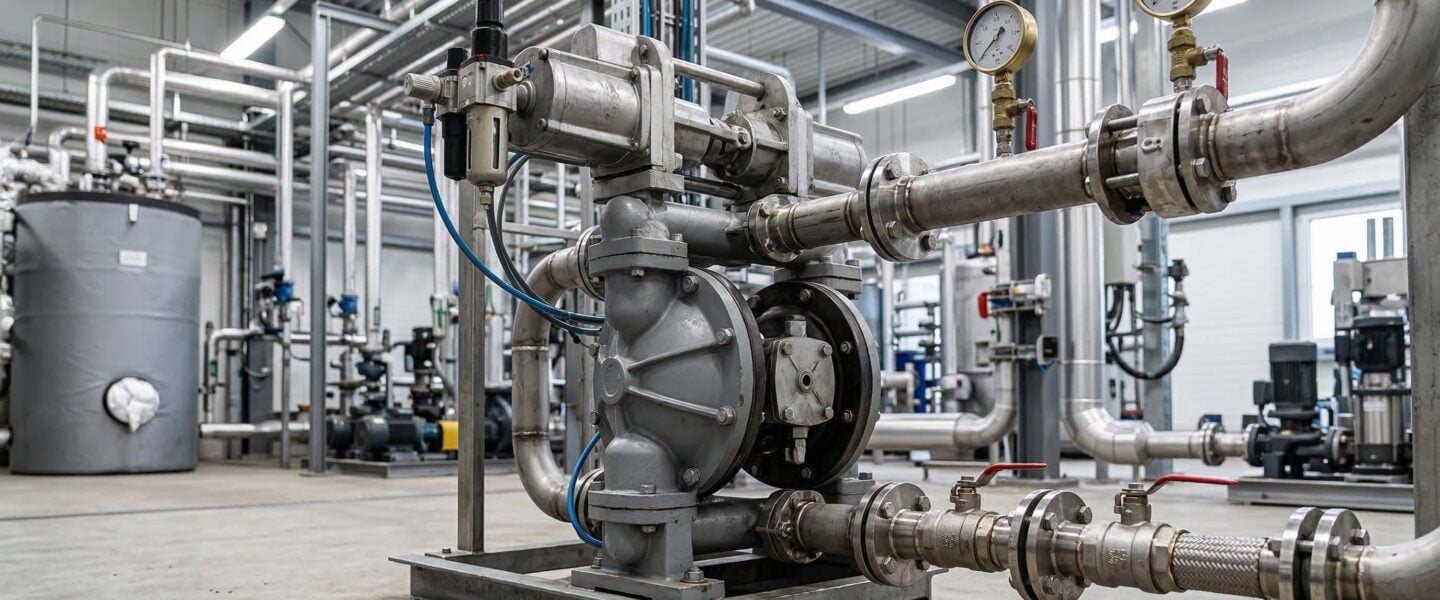
The diversity of positive displacement pump types is matched by the diversity of applications they serve. A sanitary lobe pump transferring yogurt operates under entirely different conditions than a high-pressure triplex piston pump feeding a boiler system or a progressive cavity pump moving a viscous polymer slurry. Each pump type has characteristic wear patterns, preferred monitoring techniques, and critical maintenance requirements that must be addressed on their own terms. A one-size-fits-all PM checklist will not deliver the reliability these machines are capable of achieving.
Understanding the Reliability Challenges Unique to Positive Displacement Pumps
Positive displacement pumps face a set of reliability challenges that stem directly from their operating principle — the close-clearance, metal-to-metal or elastomer-to-metal interfaces that trap and move fluid are inherently subject to wear, and the forces involved increase with system pressure.
Internal Clearance Wear and Performance Loss
Every positive displacement pump relies on tight internal clearances to minimize slip — the internal leakage of fluid from the high-pressure discharge side back to the low-pressure suction side. As internal surfaces wear, clearances increase and slip grows. The pump must turn faster to deliver the same net flow, which accelerates wear further. This progressive degradation is often invisible to operations because the pump continues to run — it simply delivers less flow per revolution. In many facilities, the first indication of internal wear is a process complaint about low flow or slow transfer times, by which point the pump may have lost 15-25% of its volumetric efficiency.
The rate of internal wear depends heavily on the pumped fluid properties. Clean, well-lubricated fluids allow internal surfaces to operate for years with minimal wear. Abrasive slurries, fluids with entrained solids, or poorly lubricated liquids can accelerate wear dramatically, reducing pump life from years to months. Understanding the relationship between fluid properties and wear rate is essential for setting realistic maintenance intervals and monitoring triggers.
Volumetric efficiency testing — measuring actual flow output against theoretical displacement at a known speed and pressure — is the single most diagnostic performance test for positive displacement pumps, yet fewer than 20% of facilities perform it as part of their routine monitoring program.
Pressure Pulsation and System Effects
Positive displacement pumps inherently produce pulsating flow — a characteristic that creates reliability challenges not only for the pump but for the entire piping system downstream. The magnitude of pulsation depends on pump type and the number of pumping elements. A simplex piston pump produces 100% flow variation per revolution, while a triplex reduces this to roughly 23% and a quintuplex to roughly 7%. These pressure pulsations create dynamic loads on piping, fittings, instrumentation, and connected equipment that can cause fatigue failures, vibration-related loosening, and instrument inaccuracy.
Pulsation dampeners, properly sized and maintained, attenuate pressure fluctuations to acceptable levels. However, dampener bladders and diaphragms are consumable components that degrade over time. A dampener that has lost its gas precharge or has a ruptured bladder provides no pulsation attenuation — and the resulting uncontrolled pressure spikes may be the root cause of chronic piping fatigue failures, gauge damage, or check valve hammering downstream of the pump. Including pulsation dampener inspection and precharge verification in the pump maintenance program eliminates a common and frequently overlooked source of system-wide reliability problems.
Seal and Packing Failures
Shaft sealing on positive displacement pumps presents unique challenges compared to centrifugal applications. Many positive displacement pumps operate at lower speeds but higher pressures than centrifugal pumps, which changes the seal operating regime. Packing is still widely used on reciprocating pumps where the shaft moves linearly rather than rotating, and packing adjustment and replacement is a routine maintenance requirement. Mechanical seals on rotary positive displacement pumps (gear, lobe, screw, vane) face challenges from pressure pulsation, shaft deflection under load, and in some cases, the abrasive or chemically aggressive nature of the pumped fluid.
Condition Monitoring for Positive Displacement Pumps
Positive displacement pumps respond well to condition monitoring, but the monitoring techniques and interpretation approaches differ from those used on centrifugal equipment. The most effective programs combine performance monitoring with mechanical condition assessment.
Volumetric Efficiency Testing
Volumetric efficiency is the definitive health indicator for any positive displacement pump. By measuring actual output flow at a known speed and discharge pressure and comparing it to the theoretical displacement, the internal condition of the pumping elements can be assessed quantitatively. A new or rebuilt pump in good condition typically operates at 90-97% volumetric efficiency depending on type and operating pressure. As internal clearances increase from wear, efficiency drops. Trending volumetric efficiency over time provides a clear, quantitative measure of internal wear progression and a reliable basis for planning rebuild timing.
The test is straightforward for pumps with accessible flow measurement points and stable operating conditions. For pumps without installed flow meters, temporary ultrasonic flow measurement can provide the data needed. We establish volumetric efficiency baselines for each pump after installation or rebuild and track efficiency at defined intervals — quarterly for critical pumps, semi-annually for general service — so that wear trends are visible well before performance becomes unacceptable.
Vibration Analysis Adapted to PD Pumps
Vibration analysis on positive displacement pumps requires interpretation approaches that account for the inherently pulsating forces these machines produce. The normal vibration signature of a gear pump includes strong components at gear mesh frequency and its harmonics. A lobe pump shows dominant vibration at the lobe pass frequency. A reciprocating pump produces vibration at the plunger rate and its multiples. These are normal signatures — not faults — and the analyst must distinguish between the expected pulsation-related vibration and abnormal signatures indicating bearing wear, shaft problems, or cavitation.
Despite these interpretation challenges, vibration monitoring is highly effective for detecting bearing degradation, drive coupling problems, and structural looseness on positive displacement pumps. High-frequency enveloping analysis is particularly valuable for early-stage bearing defect detection in gear and screw pump applications where the gear mesh or screw frequency vibration can mask bearing signatures in conventional spectral analysis.
Integrating volumetric efficiency trending with vibration analysis on positive displacement pumps typically provides four to eight months of advance notice before internal wear or bearing degradation forces an unplanned pump removal — enough time to procure parts, plan the rebuild, and schedule the work during a production window.
Oil Analysis for Gear and Screw Pumps
For positive displacement pumps that handle lubricating fluids — hydraulic pumps, lubrication system pumps, and fuel transfer pumps — the pumped fluid itself carries diagnostic information about the pump’s internal condition. Wear metal analysis of the fluid reveals the rate and severity of internal wear. Elevated iron, bronze, or chromium levels indicate that gear teeth, bearings, or wear plates are degrading. Particle counting tracks the generation of wear debris over time. In closed-loop hydraulic systems, a sudden increase in particle counts or wear metals from a specific pump isolates the problem source without disassembling anything.
Maintenance Strategies for Positive Displacement Pump Reliability
Effective positive displacement pump maintenance combines condition monitoring data with application-specific maintenance practices that address each pump type’s characteristic failure modes.
Rebuild Planning Based on Condition Data
Positive displacement pumps are designed to be rebuilt — rotors, gears, lobes, vanes, pistons, and wear plates are replaceable components that restore the pump to near-original performance when installed correctly. The key maintenance decision is timing the rebuild: too early wastes remaining component life and incurs unnecessary cost, while too late risks a failure that may cause secondary damage to housings, shafts, or other non-replaceable components. Condition-based rebuild planning, driven by volumetric efficiency trends and vibration data, optimizes this timing by providing objective evidence of how much wear has occurred and how quickly it is progressing.
We establish rebuild trigger points for each pump based on the minimum acceptable volumetric efficiency for the application, the observed wear rate, and the lead time needed to procure parts and schedule the work. A pump showing 1-2% efficiency loss per quarter can be projected forward to determine when it will cross the performance threshold, giving the maintenance team months of planning time rather than reacting to a process complaint.
Installation and Alignment Quality
Many positive displacement pump reliability problems trace back to installation practices. Pipe strain — excessive forces transmitted to the pump casing through misaligned piping — distorts the pump housing and tightens internal clearances unevenly, accelerating wear on one side while creating excessive clearance on the other. Coupling misalignment between the pump and driver creates bearing loads that exceed design assumptions. Inadequate suction conditions — insufficient NPSH, high suction line losses, or air entrainment — cause cavitation that erodes internal surfaces and generates destructive pressure spikes. Verifying these conditions at installation and after every maintenance event that disturbs the piping or mounting is essential for achieving the pump’s designed service life.
Expected Results from a Structured Program
Facilities that implement condition-based maintenance programs for positive displacement pumps see consistent improvements in pump reliability and maintenance cost efficiency. Mean time between rebuilds typically extends by 20-35% as condition monitoring allows pumps to operate safely through their full useful life rather than being rebuilt on conservative time-based schedules. Emergency pump failures decline as monitoring catches developing wear and bearing problems before they reach a critical state. Rebuild quality improves as installation practices are standardized and post-rebuild performance baselines confirm that each rebuilt pump meets performance specifications before being returned to service.
The combined effect is a pump fleet that delivers reliable, predictable performance at a lower total cost per operating hour. The maintenance team shifts from chasing failures and managing chronic pump problems to planned rebuilds executed on their schedule, with parts on hand and the work properly planned. That shift is the difference between a pump maintenance program that consumes resources and one that creates value.