
Why Does Reciprocating Compressor Maintenance Demand a Different Approach?
Reciprocating compressors are among the most mechanically complex rotating machines in any industrial facility, and they are also among the most failure-prone when maintenance programs rely on fixed schedules rather than actual equipment condition. Every stroke of a reciprocating compressor involves dozens of moving components subjected to cyclic loading, pressure reversals, thermal gradients, and gas forces that vary with process conditions. The result is a machine where multiple failure modes develop simultaneously on different timelines, and where a single missed indicator can cascade into damage that costs ten times what the original repair would have required. Effective reciprocating compressor maintenance is not about following a standard checklist — it is about understanding which degradation mechanisms are active in your specific operating context and monitoring the right parameters at the right frequency to intervene before failures compound.
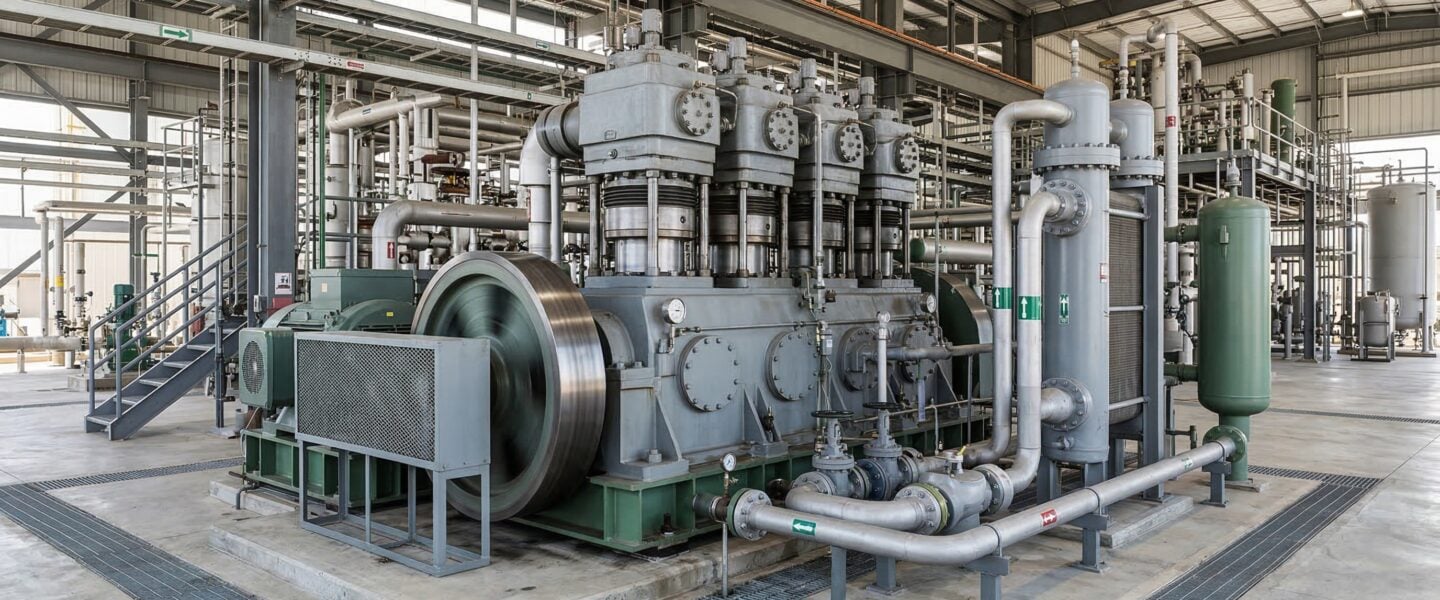
At Forge Reliability, we work with facilities that operate reciprocating compressors across a wide range of services — natural gas gathering and transmission, process gas boosting, hydrogen and synthesis gas compression, refrigeration, and instrument air supply. Despite the diversity of applications, the reliability challenges share common patterns. Valve degradation, packing wear, lubrication breakdown, and alignment-related bearing distress account for the majority of unplanned downtime events. The difference between facilities that manage these issues effectively and those that struggle with chronic compressor problems almost always comes down to the quality of their condition monitoring program and the discipline of their maintenance planning process.
Industry data shows that over 60% of reciprocating compressor failures originate in valves and packing — two components where degradation is highly detectable through condition monitoring weeks or months before functional failure occurs.
What Are the Common Reliability Challenges in Reciprocating Compressor Operations?
The fundamental reliability challenge with reciprocating compressors is that they have an unusually high number of wear components relative to other machine types. A single double-acting cylinder may contain eight to twelve individual valve assemblies, each with plates, springs, and seats that degrade independently. Multiply that across a multi-stage, multi-cylinder compressor, and the total number of wear components that require monitoring attention can exceed a hundred per machine. This component density is why calendar-based maintenance strategies consistently underperform — the probability that all components will reach their wear limits on the same schedule is effectively zero.
Valve Failures and Efficiency Loss
Compressor valve failures are the single largest contributor to reciprocating compressor downtime across virtually every industry sector. Valve degradation follows a predictable progression: springs weaken or break, sealing elements develop leakage paths, and valve plates crack or fragment. Each stage produces measurable changes in cylinder pressure profiles, discharge temperatures, and compressor efficiency that a structured monitoring program can detect. The critical insight is that a leaking valve does not just reduce compressor throughput — it creates a recirculation path that generates localized heating, accelerates wear on adjacent components, and increases power consumption. A valve that could have been replaced during a planned shutdown for $500 to $2,000 in parts can generate secondary damage costing $15,000 to $50,000 if allowed to run to failure.
Packing Degradation and Emissions Exposure
Piston rod packing serves as the primary seal between the pressurized cylinder and the crankcase environment. As packing rings wear, process gas leaks past the rod, creating both a reliability issue and an environmental compliance exposure. In facilities handling hazardous or regulated gases, packing leakage can trigger reportable emissions events, safety alarms, and regulatory scrutiny. Monitoring packing condition through rod drop measurements, packing case temperature trending, and distance piece pressure tracking allows maintenance teams to schedule packing replacements during planned outages rather than responding to leakage events that may require emergency shutdown.
Bearing and Crosshead Distress
Main bearings, connecting rod bearings, and crosshead components experience cyclic loading that produces fatigue-related degradation over thousands of operating hours. Unlike valve and packing issues, bearing distress often develops more gradually but carries higher consequence when it reaches the failure threshold. A failed main bearing or connecting rod bearing can cause catastrophic crankcase damage with repair costs exceeding $100,000 and downtime measured in weeks or months rather than days. Vibration monitoring, oil analysis, and bearing temperature trending provide complementary detection capabilities that, when combined, offer reliable early warning of bearing degradation.
How Does Condition Monitoring Apply to Reciprocating Compressors?
Reciprocating compressors require a multi-technology monitoring approach because no single measurement captures all of the active failure modes. The dynamic forces, pressure events, and thermal effects generated by reciprocating motion produce complex diagnostic signatures that require different measurement techniques to isolate and interpret. At Forge Reliability, our reciprocating compressor maintenance programs typically integrate four to six monitoring technologies depending on the criticality of the machine and the operating context.
Cylinder Pressure Analysis
Pressure-volume (PV) and pressure-time (PT) analysis provides the most direct insight into cylinder condition. By measuring dynamic pressure inside each cylinder end, analysts can identify valve leakage, ring wear, incorrect valve timing, and capacity control system malfunctions. PV diagrams reveal volumetric efficiency losses, re-expansion anomalies, and pressure drop patterns that directly correlate to specific mechanical faults. This technique is particularly valuable because it detects efficiency degradation in the early stages — often identifying problems that have not yet produced noticeable changes in throughput or discharge temperature at the process instrumentation level.
Vibration and Ultrasonic Monitoring
Vibration analysis on reciprocating machines requires specialized techniques that account for the inherently impulsive nature of piston motion. Unlike centrifugal machinery where spectral analysis dominates, reciprocating compressor diagnostics rely heavily on time-domain waveform analysis, synchronous averaging, and envelope detection to separate mechanical faults from normal operational signatures. Crosshead knock, loose connecting rod bearings, and valve impact events each produce characteristic waveform patterns that experienced analysts can identify and trend over time. Ultrasonic monitoring complements vibration data by detecting high-frequency emissions from valve leakage and gas blow-by that may not appear in lower-frequency vibration measurements.
Thermographic and Oil Analysis Integration
Infrared thermography applied to valve covers, cylinder walls, and packing cases reveals temperature anomalies associated with internal leakage, inadequate cooling, and lubrication breakdown. A valve cover running 30 to 50 degrees above its neighbors indicates internal leakage that warrants investigation. Oil analysis — including wear metals, particle counting, viscosity trending, and contamination analysis — provides insight into bearing wear rates, cylinder lubrication effectiveness, and process gas contamination of the lubricant that can accelerate wear across multiple components simultaneously.
Facilities that combine cylinder pressure analysis with vibration monitoring and oil analysis on reciprocating compressors typically detect 85-90% of developing failures with enough lead time to plan corrective maintenance without production interruption.
Maintenance Strategies That Deliver Results
The most effective reciprocating compressor maintenance programs combine condition-based intervention with strategic time-based activities for components where monitoring technology cannot provide adequate warning. This hybrid approach acknowledges that while most high-frequency failure modes are detectable through monitoring, certain degradation mechanisms — particularly internal corrosion, elastomer aging, and fatigue in non-instrumented components — still benefit from periodic inspection at defined intervals.
Condition-Based Valve Management
Moving valve replacements from fixed intervals to condition-based triggers is typically the highest-impact change a facility can make in its reciprocating compressor maintenance program. Instead of replacing all valves at a predetermined hour count — which invariably means replacing some valves too early and others too late — condition-based valve management uses pressure analysis and temperature trending to identify which specific valves require attention and when. This approach reduces valve-related parts consumption by 20-35% while simultaneously reducing valve-related forced outages because no valve is allowed to operate beyond its actual degradation threshold.
Structured Overhaul Planning
Major overhauls on reciprocating compressors — involving piston and rod replacement, cylinder re-boring, crankshaft inspection, and bearing renewal — represent significant capital expenditure and extended downtime. Condition monitoring data accumulated between overhauls enables maintenance planners to develop accurate work scopes based on actual component condition rather than conservative assumptions. This scoping precision reduces overhaul duration by eliminating unnecessary work, ensures that all components requiring attention are addressed in a single intervention, and minimizes the risk of infant mortality failures from unnecessary component disturbance.
Results to Expect
Facilities that implement structured, condition-based reciprocating compressor maintenance programs consistently achieve measurable improvements across several performance indicators. Unplanned downtime reductions of 40-55% within the first 18 months are typical, driven primarily by the elimination of run-to-failure valve and packing events. Maintenance cost reductions of 15-25% follow as parts consumption decreases and emergency labor premiums are replaced by planned maintenance execution. Compressor efficiency improvements of 3-8% are common as monitoring identifies and corrects conditions — valve leakage, ring wear, and incorrect clearance settings — that waste energy without producing obvious symptoms at the process control level. Perhaps most importantly, the mean time between forced outages extends significantly, giving operations teams the predictability they need to plan production commitments with confidence.