Home Equipment Heat Exchangers Shell & Tube Heat Exchangers

Shell & Tube Heat Exchangers

Eddy current inspection, thermal performance monitoring, and tube integrity management for shell and tube exchangers.

Why Does Heat Exchanger Maintenance Demand Proactive Monitoring?

Shell and tube heat exchangers are among the most widely deployed pieces of static equipment in industrial facilities, and their reliability directly affects process efficiency, energy consumption, and production throughput. Unlike rotating machinery where failures announce themselves through vibration, noise, and obvious performance changes, heat exchanger degradation is insidious — it progresses gradually, hidden inside a pressure vessel, producing symptoms that operators often attribute to process variability rather than equipment condition. Fouling builds layer by layer. Corrosion thins tube walls milligram by milligram. Thermal fatigue opens cracks that grow cycle by cycle. By the time heat exchanger performance degradation becomes unmistakable at the process level, the facility has typically been losing energy efficiency for months and the scope of the required intervention has grown well beyond what early action would have required. Effective heat exchanger maintenance is fundamentally about measuring what you cannot see and acting before degradation crosses the threshold from manageable to expensive.
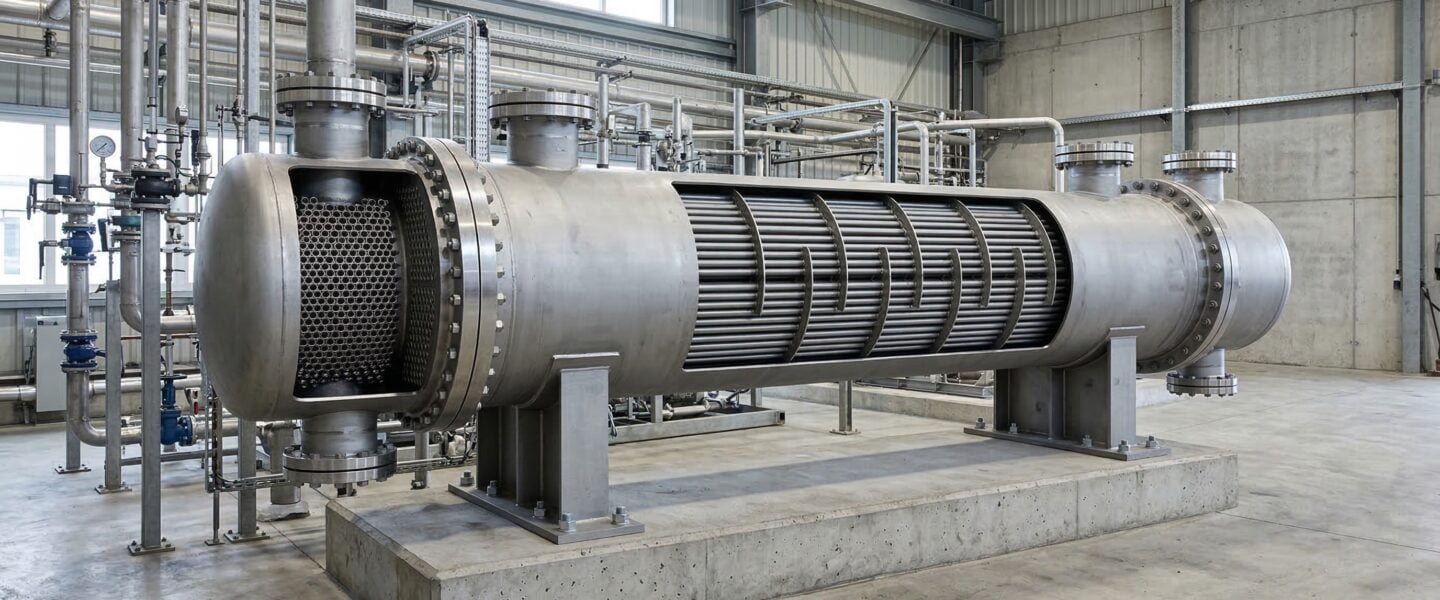
Shell & Tube Heat Exchanger Reliability & Maintenance — industrial maintenance and reliability services

At Forge Reliability, we approach heat exchanger maintenance as a discipline that bridges the gap between rotating equipment reliability programs and static equipment inspection strategies. Heat exchangers are not rotating machines, but they share a critical characteristic with them: their condition can be assessed through systematic measurement and trending, and maintenance decisions based on condition data consistently outperform those based on fixed intervals. Whether the application involves cooling water service, process-to-process heat recovery, condensing, reboiling, or feedwater heating, the principles of condition-based heat exchanger maintenance apply — monitor the parameters that reveal degradation, trend them over time, and intervene when the data indicates action is needed rather than when the calendar says it is due.

Industry studies indicate that fouling-related efficiency losses in shell and tube heat exchangers cost industrial facilities an estimated $14 billion annually worldwide in excess energy consumption — making fouling management one of the highest-return maintenance activities available.


What Are the Common Reliability Challenges in Heat Exchanger Operations?

Heat exchanger reliability challenges fall into several categories that interact with each other in ways that complicate both diagnosis and maintenance planning. Fouling reduces heat transfer and increases pressure drop. Corrosion thins tubes and compromises pressure containment. Vibration causes tube fatigue and leakage. Thermal cycling stresses tube-to-tubesheet joints. Each mechanism operates on its own timeline, but they share a common characteristic: by the time they produce obvious process symptoms, they have already caused significant damage or efficiency loss that earlier intervention could have prevented.

Fouling and Its Cascading Effects

Fouling — the accumulation of deposits on heat transfer surfaces — is the most pervasive reliability challenge in shell and tube heat exchangers. The nature of fouling varies by application: biological growth in cooling water systems, scaling from mineral-laden fluids, particulate deposition from dirty process streams, corrosion product accumulation, and chemical reaction fouling in high-temperature services. Regardless of the mechanism, fouling produces the same fundamental effects: it insulates the heat transfer surface, reducing the overall heat transfer coefficient, and it restricts flow passages, increasing pressure drop across the exchanger. The process consequence is that the exchanger cannot maintain its design duty, forcing the facility to compensate with increased utility consumption, reduced throughput, or both. A heat exchanger operating at 70% of its clean heat transfer coefficient requires the process to compensate through increased steam consumption, additional cooling water flow, or reduced feed rate — all of which carry direct cost implications that accumulate every hour the fouled condition persists.

Tube Corrosion and Erosion

Tube wall thinning from corrosion and erosion represents the most consequential integrity threat in shell and tube heat exchangers because it leads directly to tube leakage and the mixing of shell-side and tube-side fluids. In many applications, this cross-contamination has severe process consequences — cooling water leaking into a hydrocarbon stream, process chemicals contaminating a utility system, or toxic fluids reaching the environment through a cooling water discharge. Corrosion mechanisms include general wall loss from incompatible metallurgy, pitting corrosion from chloride or microbiological attack, stress corrosion cracking in susceptible alloys, and galvanic corrosion at dissimilar metal junctions. Erosion adds mechanical wall removal at tube inlets, at impingement zones opposite shell-side nozzles, and in areas where suspended particles in the fluid concentrate their energy. Monitoring tube wall thickness over time through eddy current testing, ultrasonic testing, or remote field testing provides the data needed to predict remaining tube life and schedule retubing or replacement before a leak occurs in service.

Tube Vibration and Mechanical Fatigue

Flow-induced vibration is a significant reliability concern in heat exchangers with high shell-side flow velocities, long unsupported tube spans, or two-phase flow conditions that create oscillating forces on the tube bundle. Tube vibration leads to fatigue cracking — typically at the tubesheet joint or at baffle support locations — and to fretting wear where tubes contact baffle holes. Both mechanisms produce tube leaks that may be difficult to locate and repair. Vibration-related failures are particularly challenging because they can affect multiple tubes in the same region of the bundle, and the failure pattern may repeat after individual tube plugging if the root cause flow condition is not addressed. Facilities experiencing recurring tube leaks in specific bundle zones should evaluate whether flow-induced vibration is the driving mechanism rather than simply plugging tubes and returning the exchanger to service.


Condition Monitoring and Inspection Techniques for Heat Exchangers

Heat exchanger condition assessment combines process-side performance monitoring with periodic physical inspection techniques to build a comprehensive picture of equipment condition. The two approaches are complementary — performance monitoring reveals functional degradation in real time while the exchanger operates, and physical inspection reveals the specific damage mechanisms responsible for that degradation during maintenance windows.

Thermal Performance Monitoring

Continuous monitoring of heat exchanger thermal performance provides the earliest indication of fouling development and efficiency degradation. By tracking inlet and outlet temperatures on both the shell and tube sides along with flow rates, the overall heat transfer coefficient (U-value) can be calculated and trended over time. Comparing the current U-value to the clean baseline value quantifies the fouling resistance and its trend rate. This approach transforms heat exchanger maintenance from a calendar-based cleaning schedule to a condition-based program where cleaning is triggered by measured efficiency loss rather than arbitrary time intervals. Facilities that implement thermal performance monitoring typically find that some exchangers need cleaning more frequently than their scheduled interval while others could safely operate much longer — and both findings produce cost savings by directing maintenance effort where it is actually needed.

Eddy Current and Ultrasonic Tube Inspection

Eddy current testing (ECT) is the primary inspection technique for assessing tube wall condition in shell and tube heat exchangers. ECT probes inserted through the tube length detect wall thinning, pitting, cracking, and deposit buildup with resolution sufficient to quantify remaining wall thickness as a percentage of nominal. A comprehensive ECT inspection of an exchanger with 500 to 2,000 tubes can typically be completed in one to three days, providing a complete condition map that identifies which tubes require plugging, which zones show the highest degradation rates, and what remaining life the tube bundle can be expected to deliver. For ferromagnetic tube materials where standard ECT has limitations, remote field testing (RFT) and near-field testing (NFT) provide alternative inspection capabilities. Ultrasonic testing supplements ECT for specific damage mechanisms — particularly stress corrosion cracking and localized pitting — where the higher resolution of UT examination adds diagnostic confidence.

Shell-Side Inspection and Baffle Assessment

While tube-side inspection receives the most attention, shell-side condition assessment is equally important for long-term heat exchanger reliability. Visual inspection of the shell interior reveals corrosion patterns, erosion damage, deposit accumulation, and baffle condition that affect both thermal performance and mechanical integrity. Baffle damage — including baffle hole enlargement from tube vibration, baffle plate corrosion, and baffle spacer deterioration — changes the shell-side flow distribution in ways that reduce heat transfer effectiveness and can exacerbate tube vibration problems. Documenting shell-side condition during each maintenance opening provides trending data that supports remaining life assessments and informs decisions about bundle replacement timing.

Facilities that transition from calendar-based to condition-based heat exchanger cleaning schedules typically reduce cleaning frequency by 20-35% on some exchangers while identifying others that require more frequent attention — improving overall efficiency while reducing total maintenance interventions.


Maintenance Strategies and What to Expect

Effective heat exchanger maintenance programs integrate performance monitoring with inspection data to make informed decisions about cleaning timing, repair scope, and replacement planning. The goal is to maximize the useful life of each heat exchanger while maintaining the thermal performance the process requires and protecting the mechanical integrity that prevents leakage and cross-contamination.

Optimized Cleaning Programs

Cleaning timing based on measured fouling resistance rather than fixed intervals ensures that each heat exchanger receives attention when it actually needs it. Performance monitoring data determines the optimal cleaning trigger — the fouling level at which the cost of continued operation with degraded efficiency exceeds the cost of taking the exchanger offline for cleaning. This economic optimization typically reduces total cleaning events across a facility’s heat exchanger population while simultaneously improving average thermal performance because no exchanger operates in a severely fouled condition waiting for its next scheduled cleaning date. Cleaning method selection — hydroblasting, chemical cleaning, mechanical cleaning, or a combination — should be guided by the fouling mechanism identified through inspection, as the wrong cleaning method can be ineffective or even damage tube surfaces.

Tube Life Management and Retubing Decisions

Eddy current inspection data, trended across multiple inspection intervals, enables tube remaining life calculations that support capital planning for bundle replacement or retubing. Rather than reacting to increasing tube leak frequency with repeated plugging campaigns, facilities can project when the tube bundle will reach its plugging limit — the point at which the number of plugged tubes reduces the exchanger’s effective surface area below the minimum required for process duty — and plan the retubing or replacement accordingly. This forward planning enables budget allocation, material procurement, and outage scheduling on timelines that avoid emergency spending and expedited fabrication premiums that can increase project costs by 30-50%.

Expected Results

Facilities that implement structured, condition-based heat exchanger maintenance programs typically realize measurable improvements across several dimensions. Energy costs decrease as thermal performance monitoring ensures exchangers operate closer to their clean efficiency throughout their run cycle. Maintenance costs decrease as cleaning and inspection activities are directed by condition data rather than conservative schedules. Unplanned shutdowns from tube leaks decrease as inspection data identifies and addresses tube degradation before it progresses to through-wall failure. Process reliability improves as heat exchangers consistently deliver their design duty rather than operating in degraded conditions that constrain upstream and downstream operations. Across a facility with dozens to hundreds of heat exchangers, these improvements compound into substantial annual savings in energy, maintenance, and production value that typically deliver return on monitoring investment within the first year.

Failure Modes

Common Shell & Tube Heat Exchanger Reliability & Maintenance Failure Modes

Engineers often arrive searching for specific failures. Here are the most common issues we diagnose and resolve.

Tube Fouling and Scaling

Deposit accumulation on tube surfaces from scaling, biological growth, and particulate fouling reduces heat transfer coefficient and increases pressure drop, degrading thermal performance and increasing energy consumption.

Key symptom: Declining heat transfer effectiveness with increasing approach temperatures

Get Help With This →

Tube Corrosion and Erosion

Internal and external tube surfaces corrode from chemical attack, galvanic interaction, and under-deposit corrosion, while erosion from high-velocity fluid or entrained particulate thins tube walls, eventually causing leakage.

Key symptom: Unexpected fluid contamination on clean side indicating tube leakage

Get Help With This →

Tube-to-Tubesheet Joint Failure

Tube-to-tubesheet joints fail from differential thermal expansion stress, vibration-induced fatigue, and crevice corrosion at the joint interface, allowing cross-contamination between shell and tube side fluids.

Key symptom: Increasing pressure drop across tube or shell side

Get Help With This →

Baffle and Support Plate Damage

Baffle plates and tube support plates wear from tube vibration and fluid-induced erosion, enlarging tube holes that allow increased tube movement and accelerating vibration-induced fatigue damage.

Key symptom: Audible vibration or water hammer during operation

Get Help With This →

Diagnostic Methods

Diagnostic Techniques We Use

Eddy Current Tube Inspection

Eddy current testing of individual tubes detects wall thinning, pitting, cracking, and deposit mapping along the full tube length, enabling selective tube plugging and planning future tube bundle replacement timing.

Thermal Performance Monitoring

Continuous monitoring of inlet and outlet temperatures, flow rates, and calculated heat transfer coefficients tracks fouling rates and cleaning effectiveness, optimizing cleaning intervals for cost-effective thermal performance maintenance.

Shell Side Pressure Testing

Hydrostatic pressure testing of the shell side with tube side open to atmosphere (or vice versa) identifies leaking tubes and tubesheet joints that allow cross-contamination between process streams.

Tube Vibration Assessment

Engineering analysis of tube natural frequencies versus flow-induced excitation frequencies identifies susceptibility to destructive vibration from vortex shedding, turbulent buffeting, and fluid elastic instability mechanisms.

Services

Services for Shell & Tube Heat Exchanger Reliability & Maintenance

Service

Asset Management for Shell & Tube Heat Exchangers

Asset Management programs for Shell & Tube Heat Exchangers, targeting common failure modes and degradation mechanisms.

Learn More →
Service

CMMS Implementation for Shell & Tube Heat Exchangers

CMMS implementation for shell and tube exchangers with tube integrity testing records, fouling rate trending fields, and TEMA type classification data.

Learn More →
Service

Condition Monitoring for Shell & Tube Heat Exchangers

Condition Monitoring programs for Shell & Tube Heat Exchangers, targeting common failure modes and degradation mechanisms.

Learn More →
Service

Dynamic Balancing for Shell & Tube Heat Exchangers

We balance circulation pump impellers and motors serving shell and tube heat exchangers to reduce vibration that causes seal failures and tube fatigue.

Learn More →
Service

Equipment Condition Assessment for Shell & Tube Heat Exchangers

Condition assessment for shell and tube exchangers including tube integrity testing, fouling evaluation, and tubesheet NDE inspection report findings.

Learn More →
Service

Equipment Maintenance Programs for Heat Exchangers

Forge Reliability delivers structured maintenance programs for heat exchangers, targeting tube fouling, corrosion under deposits, tube vibration fatigue...

Learn More →
Service

FMEA for Shell & Tube Heat Exchangers

Our FMEA for shell and tube exchangers identifies corrosion, fouling, and vibration failure modes with detection ratings matched to NDE capabilities.

Learn More →
Service

Maintenance Outsourcing for Heat Exchangers

Forge Reliability delivers outsourced maintenance for heat exchangers, targeting tube fouling, corrosion under deposits, tube vibration fatigue through...

Learn More →
Service

Maintenance Planning for Shell & Tube Heat Exchangers

Maintenance planning for shell and tube heat exchangers with job plans for tube bundle pulls, leak testing procedures, and fouling management programs.

Learn More →
Service

Motor Current Analysis for Shell & Tube Heat Exchangers

We monitor heat exchanger circulation pump motors with MCSA to detect impeller erosion, bearing wear, and fouling-induced load changes in your systems.

Learn More →
Service

Oil Analysis for Shell & Tube Heat Exchangers

Our oil analysis detects lubricant cross-contamination through heat exchanger tube leaks and verifies thermal fluid condition in oil-cooled systems.

Learn More →
Service

Plant Optimization for Heat Exchangers

Forge Reliability delivers plant-level optimization for heat exchangers, targeting tube fouling, corrosion under deposits, tube vibration fatigue through...

Learn More →
Service

Precision Shaft Alignment for Shell & Tube Heat Exchangers

We align shell and tube heat exchanger circulation pump drives and verify exchanger nozzle-to-piping alignment to minimize pump and flange stress loads.

Learn More →
Service

Predictive Maintenance for Shell & Tube Heat Exchangers

We use thermal performance monitoring, eddy current tube inspection, and corrosion tracking to predict shell and tube heat exchanger degradation.

Learn More →
Service

Preventive Maintenance for Shell & Tube Heat Exchangers

We optimize shell and tube exchanger PM by setting cleaning, inspection, and gasket replacement intervals based on fouling rates and corrosion data.

Learn More →
Service

RCM for Shell & Tube Heat Exchangers

RCM analysis for shell and tube heat exchangers evaluating tube wall degradation, fouling mechanisms, gasket failure, and baffle wear modes per SAE JA1011.

Learn More →
Service

Reliability Consulting for Shell & Tube Heat Exchangers

We provide reliability consulting for shell and tube exchangers with tube failure analysis, fouling rate prediction, and risk-based inspection planning.

Learn More →
Service

Root Cause Analysis for Shell & Tube Heat Exchangers

We investigate heat exchanger tube failures using metallurgical analysis, corrosion mechanism identification, and process data review per API 571 methods.

Learn More →
Service

Thermographic Inspection for Shell & Tube Heat Exchangers

We use infrared imaging to detect tube fouling patterns, bypass leakage, and insulation failures on shell and tube heat exchangers during normal service.

Learn More →
Service

Ultrasonic Testing for Shell & Tube Heat Exchangers

Our ultrasonic testing measures tube wall thickness, detects tubesheet weld flaws, and identifies internal erosion patterns in shell and tube exchangers.

Learn More →
Service

Vibration Analysis for Shell & Tube Heat Exchangers

We detect tube bundle vibration, flow-induced resonance, and support plate looseness in shell and tube heat exchangers via operational vibration surveys.

Learn More →

Industries

Industries That Rely on Shell & Tube Heat Exchanger Reliability & Maintenance

Industry

Chemical Processing Shell & Tube Heat Exchangers Reliability

We address corrosion-driven tube failures, fouling, and thermal performance loss on shell and tube exchangers in corrosive chemical process service.

Learn More →
Industry

Food & Beverage Shell & Tube Heat Exchangers Reliability

We address fouling, tube leaks, and CIP effectiveness on shell and tube heat exchangers used for pasteurization and process heating in food plants.

Learn More →
Industry

Manufacturing Shell & Tube Heat Exchangers Reliability

We solve fouling, tube leaks, and thermal performance loss in manufacturing shell and tube exchangers on cooling, heating, and heat recovery systems.

Learn More →
Industry

Oil & Gas Shell & Tube Heat Exchangers Reliability

We address corrosion, fouling, and tube bundle failures on shell and tube heat exchangers in refinery, upstream production, and gas processing service.

Learn More →
Industry

Power Generation Shell & Tube Heat Exchangers Reliability

We address tube fouling, leakage, and thermal performance loss on shell and tube heat exchangers in power plant feedwater heating and condenser systems.

Learn More →
Industry

Shell & Tube Heat Exchanger Reliability in Automotive Plants

Forge Reliability provides shell and tube exchanger monitoring for automotive plants, targeting coolant systems, hydraulic oil cooling, and HVAC chillers.

Learn More →
Industry

Shell & Tube Heat Exchangers Reliability for Cement & Aggregates

Forge Reliability manages shell and tube heat exchanger performance in cement plant compressor cooling, lube oil cooling, and waste heat recovery systems.

Learn More →
Industry

Shell & Tube Heat Exchangers Reliability for Industrial Refrigeration

Forge Reliability monitors shell and tube heat exchangers in ammonia condensers, oil coolers, and glycol systems critical to refrigeration efficiency.

Learn More →
Industry

Shell & Tube Heat Exchangers Reliability for Logistics & Distribution

Forge Reliability manages shell and tube heat exchanger performance in refrigeration systems, HVAC, and process cooling at distribution center facilities.

Learn More →
Industry

Shell & Tube Heat Exchanger Reliability in Metals & Steel Plants

Forge Reliability provides shell and tube exchanger monitoring for metals and steel plants, targeting EAF cooling, caster mold cooling, and oil coolers.

Learn More →
Industry

Shell & Tube Heat Exchanger Reliability in Mining Process Plants

Forge Reliability provides shell and tube exchanger monitoring for mining, targeting autoclave heat recovery, process cooling, and acid plant exchangers.

Learn More →
Industry

Shell & Tube Heat Exchanger Reliability in Pharmaceutical Plants

Forge Reliability provides shell and tube exchanger monitoring for pharma, targeting tube fouling, leak detection, and thermal performance drift.

Learn More →
Industry

Shell & Tube Heat Exchangers Reliability for Plastics & Rubber

Forge Reliability manages shell and tube heat exchanger performance in mold cooling, hydraulic oil cooling, and thermal oil systems at plastics processing.

Learn More →
Industry

Shell & Tube Heat Exchanger Reliability in Pulp & Paper Mills

Forge Reliability provides shell and tube exchanger monitoring for pulp and paper mills, targeting black liquor heaters, evaporator preheaters, and more.

Learn More →
Industry

Shell & Tube Heat Exchangers Reliability for Water & Wastewater

Forge Reliability manages shell and tube exchanger performance in digester heating, biogas cooling, and heat recovery systems at treatment facilities.

Learn More →

Technical Reference

Technical Overview

Eddy current testing per ASME Section V detects tube wall thinning, pitting, and cracking — inspect a minimum of 20% of tubes per outage and increase sampling if defects exceed 5% of tested tubes. Fouling resistance trending using approach temperature deviation provides early warning: a 5 degree F approach increase at constant flow conditions warrants planning a cleaning outage. Tube-to-tubesheet joint integrity should be verified with hydrostatic testing at 1.3 times MAWP per ASME Section VIII. Baffle hole clearance exceeding 1/32 inch above nominal causes tube vibration that accelerates fretting wear at support points.

Common Questions

FAQ

Fouling rate is monitored by tracking the overall heat transfer coefficient (U-value) calculated from process temperatures and flow rates over time. The rate of U-value decline from the clean baseline indicates fouling accumulation rate and predicts when cleaning is required to maintain thermal performance. Automated monitoring systems calculate fouling resistance in real-time and generate cleaning alerts when fouling reaches economically optimal cleaning thresholds.

Limited Availability
We onboard a limited number of new facilities each quarter. Secure your assessment slot before our current availability closes. Reserve Your Spot →

Get Started

Request a Free Reliability Assessment

Tell us about your equipment and facility. Our reliability team will review your situation and recommend a tailored reliability program — no obligation.

Free initial assessment
Response within 1 business day
No obligation or commitment

No obligation. Typical response within 24 hours.

Track Fouling Rates and Schedule Cleaning Before Thermal Capacity Drops

Reach out to discuss how our reliability programs can optimize your heat exchanger inspection intervals and prevent tube failures.

Claim Your Free Assessment →