Home Equipment Compressors Rotary Screw Compressors

Rotary Screw Compressors

Oil analysis, vibration trending, and element efficiency tracking for rotary screw compressor maintenance.

Why Is Rotary Screw Compressor Maintenance Frequently Underestimated?

Rotary screw compressors have earned a reputation for reliability that, paradoxically, often leads to their neglect. Because they run smoothly, produce less vibration than reciprocating machines, and can tolerate a surprising amount of internal degradation before obvious symptoms appear at the process level, many facilities operate their screw compressors with minimal monitoring until a catastrophic rotor contact event or bearing seizure forces an unplanned shutdown. The reality is that rotary screw compressors degrade gradually and continuously from the moment they enter service, and the cost of that degradation accumulates silently in the form of increased energy consumption, reduced output capacity, and shortened component life — long before anyone notices a problem on the control room screen. Effective rotary screw compressor maintenance requires looking beyond the surface-level perception of smooth operation and measuring the parameters that reveal what is actually happening inside the compression chamber.
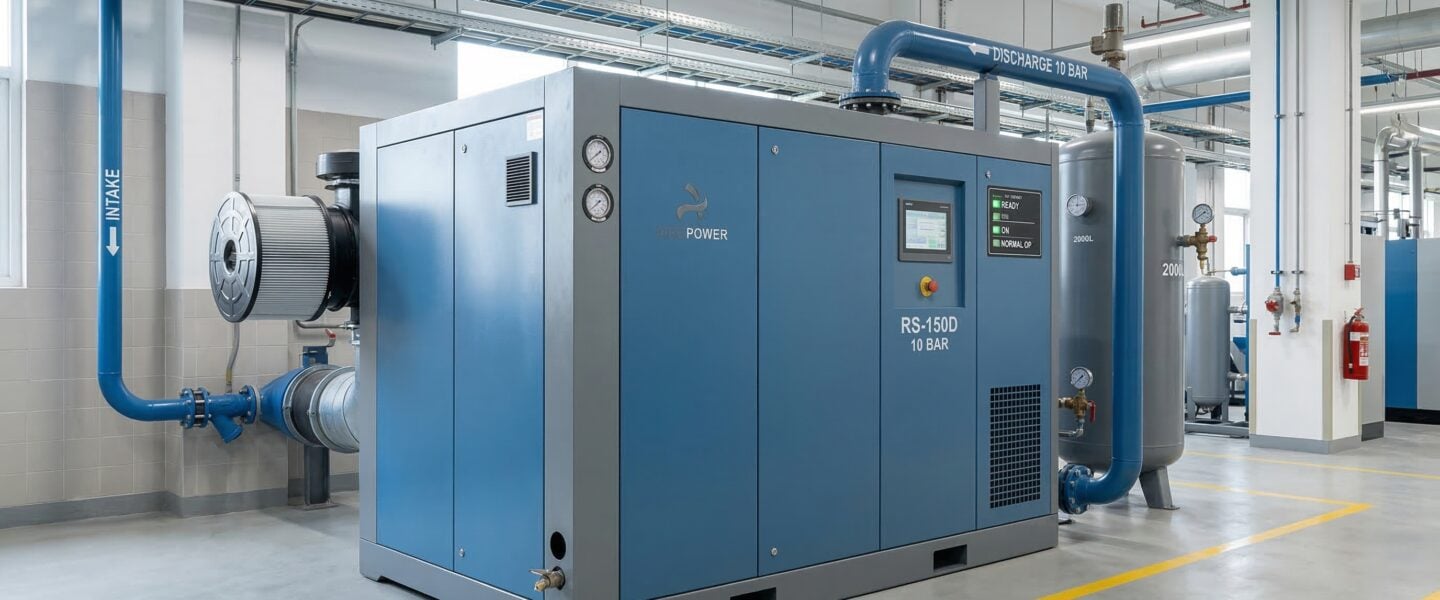
Rotary Screw Compressor Reliability & Maintenance — industrial maintenance and reliability services

At Forge Reliability, we encounter rotary screw compressors in nearly every industrial sector we serve — from plant air systems and process gas applications to refrigeration and vacuum service. The machines range from small packaged units producing 25 horsepower to large process compressors exceeding 3,000 horsepower, but the underlying reliability principles remain consistent. Internal clearances, bearing condition, lubricant quality, and thermal management determine how long a screw compressor runs between interventions and how much energy it consumes along the way. Facilities that monitor these parameters systematically and act on early indicators of change consistently outperform those that wait for alarms or failures to drive maintenance decisions.

Studies across industrial compressed air systems show that energy accounts for 70-80% of a rotary screw compressor’s total lifecycle cost — meaning that efficiency degradation from poor maintenance often costs more than the repairs themselves.


What Are the Common Reliability Challenges in Rotary Screw Compressor Operations?

Rotary screw compressors present a different reliability profile than reciprocating machines. Where reciprocating compressors have numerous discrete wear components that fail individually, screw compressors concentrate their failure risk in a smaller number of high-consequence areas: the rotor bearings, the rotor clearances, the lubricant system, and the capacity control mechanism. Each of these areas degrades on its own timeline, influenced by operating conditions, load patterns, and maintenance practices — and the interactions between them can accelerate degradation in ways that are not obvious without systematic monitoring.

Bearing Degradation and Rotor Positioning

The bearings in a rotary screw compressor do more than support the rotors — they maintain the precise clearances between the male and female rotor lobes and between the rotors and the housing bore. These clearances are measured in thousandths of an inch, and even small changes in bearing condition translate directly into increased internal leakage, reduced volumetric efficiency, and elevated discharge temperatures. As bearings wear, the rotors shift position incrementally, and the internal slip path grows. This internal recirculation wastes energy without producing useful output. In oil-flooded machines, the lubricant partially compensates for clearance growth by sealing the leakage paths, which masks the underlying bearing degradation until it progresses to the point where thermal or vibration symptoms become unmistakable. By that point, bearing replacement alone may not restore performance — the rotors and housing may have sustained contact damage requiring a complete element rebuild at three to five times the cost of a bearing replacement.

Lubricant Degradation and Thermal Runaway Risk

In oil-flooded rotary screw compressors, the lubricant serves four simultaneous functions: sealing internal clearances, removing heat of compression, lubricating bearings and rotor surfaces, and protecting against corrosion. When lubricant quality degrades — through oxidation, contamination, thermal breakdown, or moisture absorption — all four functions deteriorate simultaneously. The most dangerous failure sequence begins with lubricant breakdown reducing heat transfer effectiveness, which raises discharge temperature, which accelerates further lubricant breakdown in a self-reinforcing cycle that can culminate in a thermal event damaging the rotor element. Lubricant-related failures account for a significant portion of major screw compressor rebuilds, and nearly all of them are preventable through oil analysis and thermal trending.

Separator and Filtration System Failures

The oil separator in a flooded screw compressor recovers lubricant from the compressed gas stream before it enters the downstream system. A degraded separator element increases oil carryover into the air or gas system, wasting lubricant, contaminating downstream processes, and potentially causing problems in pneumatic equipment, instrumentation, or product contact applications. Separator differential pressure trending provides direct indication of element condition, but many facilities only check this parameter during scheduled service rather than monitoring it continuously. Similarly, inlet air filter condition directly affects compressor cleanliness and component wear rates. A facility operating in a dusty environment with quarterly filter inspections may be introducing abrasive contamination for weeks between checks — contamination that accelerates rotor and bearing wear every hour the compressor runs.


Condition Monitoring Technologies for Rotary Screw Compressors

Rotary screw compressor maintenance benefits substantially from condition monitoring because the dominant failure modes — bearing wear, lubricant degradation, and thermal management breakdown — all produce measurable changes well before they reach the failure threshold. The challenge is selecting the right combination of technologies and establishing meaningful alarm thresholds for machines that may operate across a wide range of loads, ambient temperatures, and process conditions throughout the year.

Vibration Analysis for Bearing and Rotor Condition

Vibration monitoring on rotary screw compressors focuses primarily on detecting bearing degradation and rotor contact. The spectral signatures associated with rolling element bearing defects — inner race, outer race, ball or roller, and cage faults — are well established and reliably detectable in screw compressors because the machines operate at relatively stable speeds with minimal process-induced vibration variability. Envelope analysis and high-frequency demodulation techniques are particularly effective for early bearing fault detection, often identifying defects three to six months before they progress to the point of requiring immediate action. Rotor contact events — where bearing wear allows the rotors to touch the housing or each other — produce characteristic broadband vibration increases and impulsive signatures that demand immediate investigation.

Oil Analysis and Fluid Condition Monitoring

Oil analysis is arguably the single most valuable monitoring technology for oil-flooded rotary screw compressors. A comprehensive oil analysis program tracks wear metal concentrations to identify bearing and rotor wear, monitors viscosity and oxidation to assess lubricant health, measures contamination levels to evaluate filtration effectiveness, and tests for moisture content that indicates seal leakage or ambient moisture ingestion. Trending these parameters over time reveals degradation patterns that allow maintenance teams to optimize oil change intervals — extending them when the lubricant is performing well and shortening them when conditions demand it. Facilities that manage lubricant changes based on condition rather than fixed intervals typically reduce lubricant consumption by 15-30% while simultaneously improving machine protection.

Thermal Monitoring and Energy Performance Tracking

Discharge temperature is the most accessible indicator of rotary screw compressor health, and yet many facilities only respond to it when it triggers a high-temperature shutdown. Trending discharge temperature over time — corrected for ambient temperature and load conditions — reveals efficiency degradation, lubricant system problems, and cooling circuit issues long before they reach alarm thresholds. Specific power consumption, measured as energy input per unit of compressed gas output, provides a direct measure of compressor efficiency that captures the cumulative effect of all internal degradation mechanisms. A compressor that is consuming 10-15% more energy per unit of output than its baseline condition is almost certainly experiencing clearance growth, lubricant degradation, or control system issues that warrant investigation.

Implementing condition-based maintenance on rotary screw compressors typically reduces unplanned downtime by 35-50% and delivers energy savings of 5-12% through early detection and correction of efficiency-robbing degradation.


Maintenance Strategies and Expected Results

The most effective rotary screw compressor maintenance strategies balance condition monitoring with targeted preventive activities for components where monitoring provides limited visibility. This means using vibration and oil data to drive bearing and lubricant decisions while maintaining scheduled inspection intervals for items like separator elements, coupling components, and control system actuators where condition monitoring data may be less definitive.

Optimizing Service Intervals Through Data

One of the most immediate benefits of implementing condition monitoring on rotary screw compressors is the ability to optimize service intervals based on actual machine condition rather than manufacturer recommendations that assume average operating conditions. A compressor running in a clean, temperature-controlled environment at moderate load may safely extend its oil change interval well beyond the standard recommendation, while a machine operating in a hot, dusty environment at full load may need more frequent attention. Oil analysis provides the objective data to make these decisions with confidence, eliminating both the waste of premature service and the risk of running too long between interventions.

Element Rebuild Planning

The airend or compression element rebuild represents the single largest maintenance expense in a rotary screw compressor’s lifecycle, often ranging from $10,000 to over $80,000 depending on compressor size. Timing this rebuild correctly is critical — performing it too early wastes remaining component life, while performing it too late risks rotor contact damage that can double or triple the rebuild cost. Vibration trending, oil analysis wear metal data, discharge temperature trends, and specific power tracking all contribute to determining when a compressor element is approaching the end of its service interval, allowing maintenance teams to plan and budget the rebuild with precision.

Results Facilities Can Expect

Facilities that transition from calendar-based to condition-based rotary screw compressor maintenance typically observe several measurable improvements within the first year. Unplanned downtime decreases as bearing and lubricant failures are detected and addressed before they force shutdowns. Energy consumption decreases as monitoring identifies compressors running with degraded efficiency that would otherwise go undetected. Lubricant and parts costs decrease as service intervals are optimized to actual operating conditions. Overall maintenance spending typically decreases by 20-30% while equipment availability increases, because every maintenance dollar is directed at actual needs rather than assumed schedules. For facilities operating multiple compressors, these improvements compound across the fleet, often producing annual savings that exceed the total cost of implementing the monitoring program within the first year of operation.

Failure Modes

Common Rotary Screw Compressor Reliability & Maintenance Failure Modes

Engineers often arrive searching for specific failures. Here are the most common issues we diagnose and resolve.

Rotor Profile Wear

Progressive wear of male and female rotor lobe profiles increases internal leakage clearances, reducing volumetric efficiency and increasing specific energy consumption while generating higher discharge temperatures.

Key symptom: Rising discharge temperature with increasing specific power consumption

Get Help With This →

Bearing Failure and Seizure

Radial and thrust bearings supporting the rotor assembly fail from contamination, inadequate lubrication, or excessive loading, causing rotor contact with the housing bore that results in catastrophic seizure.

Key symptom: Elevated vibration with audible high-frequency noise from bearing locations

Get Help With This →

Oil Separator Element Degradation

Separator elements become saturated, damaged, or plugged over time, increasing pressure differential across the separator stage and allowing excessive oil carryover into the compressed air or gas system.

Key symptom: High oil carryover in discharged air with elevated separator differential pressure

Get Help With This →

Intake Valve Malfunction

Intake modulation valves stick or fail from contamination or spring fatigue, causing the compressor to load and unload erratically or to operate at full capacity regardless of demand.

Key symptom: Erratic loading and unloading with pressure control instability

Get Help With This →

Diagnostic Methods

Diagnostic Techniques We Use

Oil Analysis and Particle Counting

Regular oil sampling with viscosity, TAN, water content, and wear metal analysis tracks lubricant condition and internal component wear, enabling oil change optimization and early fault detection.

Vibration Trending

Accelerometer-based vibration measurements on bearing housings at both drive and non-drive ends detect bearing degradation, rotor imbalance, and coupling problems through spectral analysis and trending.

Discharge Temperature Monitoring

Continuous discharge temperature monitoring detects rotor tip clearance increases, internal recirculation, valve faults, and cooling system deficiencies that cause thermal stress and oil degradation.

Airside Dewpoint and Quality Testing

Measuring compressed air quality including dewpoint, oil aerosol content, and particulate levels downstream of treatment equipment verifies system performance and compliance with ISO 8573 air quality classes.

Services

Services for Rotary Screw Compressor Reliability & Maintenance

Service

Asset Management for Rotary Screw Compressors

Asset Management programs for Rotary Screw Compressors, targeting common failure modes and degradation mechanisms.

Learn More →
Service

CMMS Implementation for Screw Compressors

CMMS implementation for screw compressors with air-end component tracking, oil analysis integration for wear trending, and separator element management.

Learn More →
Service

Condition Monitoring for Rotary Screw Compressors

Condition Monitoring programs for Rotary Screw Compressors, targeting common failure modes and degradation mechanisms.

Learn More →
Service

Dynamic Balancing for Screw Compressors

Forge Reliability balances screw compressor rotors using two-plane methods on precision balancing machines while preserving internal clearance integrity.

Learn More →
Service

Equipment Condition Assessment for Screw Compressors

Condition assessment for screw compressors including specific energy consumption analysis, oil system health evaluation, and air-end wear measurements.

Learn More →
Service

Equipment Maintenance for Rotary Screw Compressors

Equipment Maintenance programs for Rotary Screw Compressors, targeting common failure modes and degradation mechanisms.

Learn More →
Service

FMEA for Screw Compressors

We perform FMEA on screw compressors covering air-end, oil system, and capacity control failure modes with practical RPN-based task recommendations.

Learn More →
Service

Maintenance Outsourcing for Rotary Screw Compressors

Maintenance Outsourcing programs for Rotary Screw Compressors, targeting common failure modes and degradation mechanisms.

Learn More →
Service

Maintenance Planning for Screw Compressors

Maintenance planning for screw compressors with detailed job plans for rotor clearance checks, oil separator element service, and bearing replacement.

Learn More →
Service

Motor Current Analysis for Screw Compressors

Forge Reliability uses MCSA on screw compressors to detect rotor lobe wear, bearing defects, and internal leakage through current spectral signatures.

Learn More →
Service

Oil Analysis for Screw Compressors

We analyze screw compressor lubricants for rotor wear metals, fluid breakdown products, and moisture contamination to optimize oil change intervals.

Learn More →
Service

Plant Optimization for Rotary Screw Compressors

Plant Optimization programs for Rotary Screw Compressors, targeting common failure modes and degradation mechanisms.

Learn More →
Service

Precision Shaft Alignment for Screw Compressors

We deliver laser alignment for screw compressor drive couplings with thermal growth compensation specific to oil-flooded and oil-free compressor designs.

Learn More →
Service

Predictive Maintenance for Screw Compressors

We monitor screw compressor health through vibration spectrum analysis, oil quality trending, and thermal imaging to prevent rotor and bearing failures.

Learn More →
Service

Preventive Maintenance for Screw Compressors

We optimize screw compressor PM programs by aligning air-end rebuilds, separator changes, and oil service intervals with actual operating conditions.

Learn More →
Service

RCM for Screw Compressors

RCM analysis for screw compressors evaluating air-end rotor wear, oil system degradation, and capacity control valve failure modes per SAE JA1011 logic.

Learn More →
Service

Reliability Consulting for Screw Compressors

We apply reliability consulting to screw compressor fleets with efficiency degradation tracking, Weibull wear-out analysis, and rebuild optimization.

Learn More →
Service

Root Cause Analysis for Screw Compressors

We investigate screw compressor failures by examining rotor contact evidence, bearing condition, and oil system data to find the originating fault.

Learn More →
Service

Thermographic Inspection for Screw Compressors

We perform infrared surveys on screw compressors to detect bearing overheating, oil cooler fouling, and discharge temperature anomalies during operation.

Learn More →
Service

Ultrasonic Testing for Screw Compressors

We apply ultrasonic testing to screw compressors to detect internal leakage, bearing degradation, and air/gas leaks at casing joints and shaft seal areas.

Learn More →
Service

Vibration Analysis for Screw Compressors

Our vibration analysts detect rotor contact, bearing wear, and profile degradation in screw compressors through lobe-pass frequency and HFE trending.

Learn More →

Industries

Industries That Rely on Rotary Screw Compressor Reliability & Maintenance

Industry

Chemical Processing Screw Compressors Reliability

Forge Reliability maintains screw compressor performance on chemical plant refrigeration, process gas, and instrument air systems for safe operations.

Learn More →
Industry

Food & Beverage Screw Compressors Reliability

Forge Reliability optimizes rotary screw compressor performance on ammonia refrigeration and oil-free air systems in food and beverage processing.

Learn More →
Industry

Manufacturing Screw Compressors Reliability

Forge Reliability optimizes screw compressor performance and oil carryover control for manufacturing plant air and pneumatic tool supply systems.

Learn More →
Industry

Oil & Gas Screw Compressors Reliability

Forge Reliability optimizes rotary screw compressor performance on gas gathering, vapor recovery, and instrument air systems in oil and gas operations.

Learn More →
Industry

Power Generation Screw Compressors Reliability

Forge Reliability optimizes screw compressor efficiency on power plant instrument air, service air, and auxiliary compressed air systems at your station.

Learn More →
Industry

Screw Compressor Reliability in Automotive Manufacturing

We deliver screw compressor reliability for automotive manufacturing, targeting air-end wear, oil carryover into paint air, and capacity degradation.

Learn More →
Industry

Screw Compressors Reliability for Cement & Aggregates

We maintain screw compressor reliability for plant air and baghouse systems operating in extreme dust conditions at cement and aggregate facilities.

Learn More →
Industry

Screw Compressors Reliability for Industrial Refrigeration

Our engineers optimize screw compressor reliability in ammonia refrigeration systems, monitoring rotor wear, oil management, and Vi ratio performance.

Learn More →
Industry

Screw Compressors Reliability for Logistics & Distribution

Our engineers optimize screw compressor reliability for plant air and refrigeration packages at logistics distribution centers and cold storage hubs.

Learn More →
Industry

Screw Compressor Reliability in Metals & Steel Mills

We deliver screw compressor reliability for metals and steel mills, targeting air-end wear from iron dust, oil carryover, and instrument air quality.

Learn More →
Industry

Screw Compressor Reliability for Mining Site Air Systems

We deliver screw compressor reliability for mining operations, targeting dust-accelerated air-end wear, remote site logistics, and instrument air purity.

Learn More →
Industry

Screw Compressor Reliability in Pharmaceutical Facilities

We deliver screw compressor reliability for pharmaceutical facilities, addressing rotor profile wear, oil carryover risk, and ISO 8573 compliance.

Learn More →
Industry

Screw Compressors Reliability for Plastics & Rubber

Our engineers optimize screw compressor reliability for plant air, pneumatic conveying, and blow molding assist systems at plastics and rubber facilities.

Learn More →
Industry

Screw Compressor Reliability in Pulp & Paper Mills

We deliver screw compressor reliability for pulp and paper mills, addressing air-end wear from dusty environments and oil carryover into air headers.

Learn More →
Industry

Screw Compressors Reliability for Water & Wastewater

Forge Reliability monitors rotary screw compressors delivering instrument air and process air at water treatment facilities for continuous availability.

Learn More →

Technical Reference

Technical Overview

Specific power consumption should be tracked continuously — values above 20 kW per 100 CFM at full load indicate mechanical or control problems. Oil separator differential pressure should remain below 10 PSID; readings above this indicate element saturation and potential downstream oil carryover exceeding the typical 2-5 ppm target. Rotor contact produces elevated vibration at mesh frequency with modulation sidebands — trending these amplitudes monthly provides early warning of internal clearance loss. Oil analysis should track TAN values quarterly; condemn the charge when TAN exceeds 2.0 mg KOH/g above the new oil baseline.

Common Questions

FAQ

Rotor service life depends heavily on operating conditions and maintenance quality. Well-maintained oil-injected rotary screw compressors typically achieve 40,000 to 80,000 hours before rotor profile wear requires rebuilding. Oil-free designs may have shorter airend life due to the absence of lubricant film between rotors. Regular oil analysis and specific energy monitoring detect degradation early enough to plan overhauls.

Limited Availability
We onboard a limited number of new facilities each quarter. Secure your assessment slot before our current availability closes. Reserve Your Spot →

Get Started

Request a Free Reliability Assessment

Tell us about your equipment and facility. Our reliability team will review your situation and recommend a tailored reliability program — no obligation.

Free initial assessment
Response within 1 business day
No obligation or commitment

No obligation. Typical response within 24 hours.

Monitor Rotor Bearing Health Before Contact Destroys the Airend

Talk to our compressed air reliability team about implementing predictive monitoring and optimizing your screw compressor maintenance program.

Claim Your Free Assessment →