
Industrial robots have transformed manufacturing by delivering unmatched speed, precision, and repeatability across welding, assembly, material handling, painting, and inspection applications. Yet these sophisticated electromechanical systems are far from maintenance-free. Gearboxes wear, servo motors degrade, cables fatigue, and calibration drifts — all of which erode the performance advantages that justified the automation investment in the first place. A structured approach to industrial robot maintenance is essential for protecting both the productivity gains and the significant capital tied up in robotic systems.
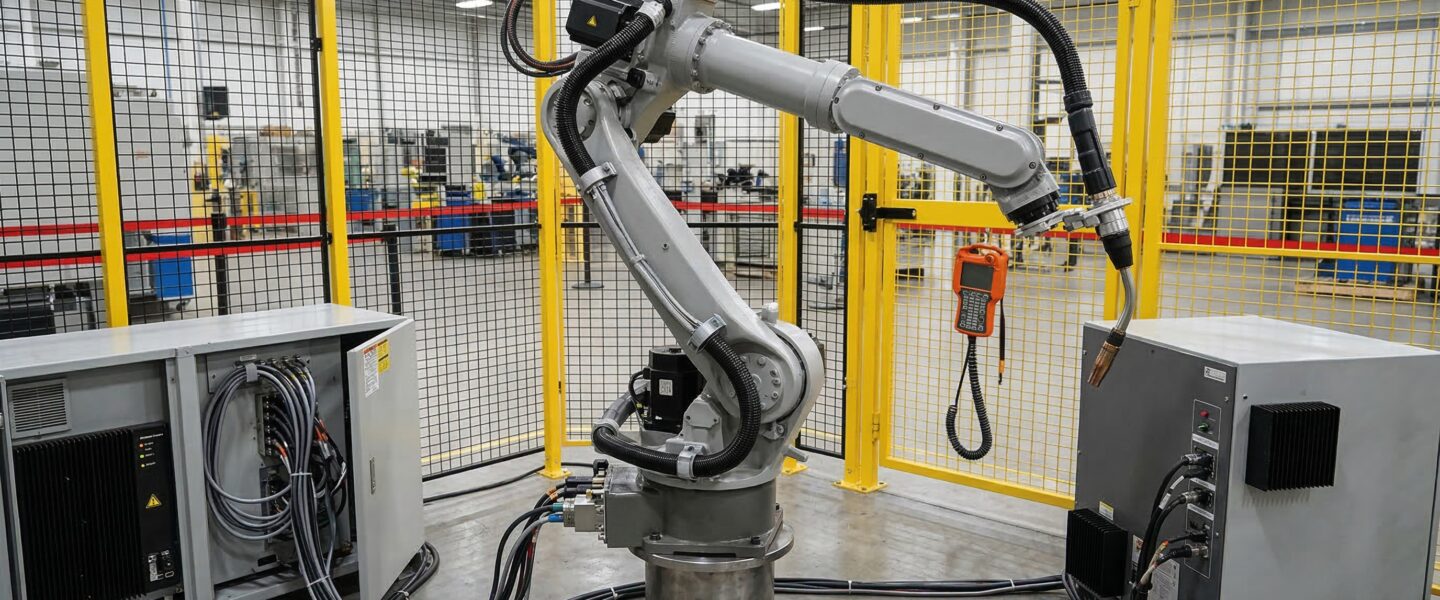
The True Cost of Robot Downtime
When a robot goes down in a modern manufacturing cell, the impact rarely stops at that single station. Robots are typically integrated into larger production systems where they serve as bottleneck operations — a welding robot feeding an assembly line, a palletizing robot at the end of a packaging line, or a material handling robot feeding a machining center. When that robot stops, everything downstream stops with it.
Automotive manufacturers estimate that unplanned robotic cell downtime costs between $10,000 and $25,000 per hour when factoring in lost production, idle labor, and schedule disruption. Even in lower-volume operations, unplanned robot failures are disproportionately expensive because they require specialized technicians, OEM parts with long lead times, and often involve complex re-teaching and recalibration before the robot can return to production.
The challenge is that many facilities still treat robots as “set and forget” assets, performing only basic cleaning and occasional backup routines. This reactive posture means problems are only discovered when they manifest as production defects, unexpected shutdowns, or catastrophic component failures. By that point, the maintenance cost is many times what a proactive approach would have required.
Unplanned robotic cell downtime can cost $10,000-$25,000 per hour in automotive manufacturing. Proactive industrial robot maintenance programs reduce these incidents by catching mechanical and electrical degradation months before failure.
What Are the Common Reliability Challenges in Robotic Systems?
Industrial robots combine precision mechanical systems, high-performance electrical drives, complex control software, and application-specific tooling. Each layer introduces distinct failure modes that require targeted monitoring approaches.
Gearbox and Reducer Wear
Every robot axis is driven through a precision gearbox — typically harmonic drives, cycloidal reducers, or planetary gear sets. These components endure continuous cyclic loading, often with frequent direction reversals, and their wear directly affects positioning accuracy and repeatability. A gearbox with excessive backlash produces parts that drift out of tolerance, weld seams that wander, or pick-and-place operations that miss their targets. Vibration analysis is the most effective tool for detecting gear wear, bearing degradation, and lubrication issues in robot reducers. Changes in vibration signature often appear 4-8 months before the gearbox reaches a failure state.
Servo Motor and Drive Degradation
Servo motors operate under demanding duty cycles with rapid acceleration, deceleration, and frequent starts. Bearing wear, winding insulation breakdown, encoder degradation, and brake wear all progress over the robot’s service life. Motor current analysis can detect winding faults and rotor bar issues in early stages. Monitoring drive fault logs and following current consumption trends reveals motors that are working harder than normal — often an indicator of mechanical binding, increased friction from gearbox wear, or process loads that have crept above design parameters.
Cable and Harness Fatigue
The cable bundles routed through a robot’s arm endure thousands of flex cycles per day. Power cables, signal wires, encoder cables, and application-specific connections (welding cables, air lines, sensor wiring) all fatigue over time. Intermittent cable faults are among the most frustrating problems to diagnose because they may only manifest under specific arm positions or during particular motion sequences. Cable resistance monitoring and periodic insulation testing can identify degradation before intermittent faults begin disrupting production.
Calibration and Accuracy Drift
Over time, mechanical wear, thermal effects, and minor collisions cause a robot’s actual tool center point (TCP) position to drift from its programmed position. In high-precision applications — such as laser cutting, adhesive dispensing, or electronics assembly — even 0.5 millimeters of drift can produce scrap. Periodic accuracy verification using laser trackers, ball-bar testing, or touch-sensing routines quantifies drift and triggers recalibration when tolerances are approached.
Condition Monitoring for Robotic Assets
An effective industrial robot maintenance program uses a combination of monitoring techniques to track the health of mechanical, electrical, and performance parameters across the robot fleet.
Vibration Analysis
Vibration measurements taken at each axis during standardized test motions provide a repeatable baseline for tracking gearbox and bearing health over time. Spectrum analysis reveals specific defect frequencies associated with gear mesh, bearing races, and rolling elements. Trending overall vibration levels against baseline values provides a straightforward indicator of mechanical health that maintenance teams can act on with confidence.
Oil Analysis for Gearboxes
Gear oil sampling and analysis reveals wear metal generation rates, lubricant condition, and contamination levels. Elevated iron and chromium particles indicate gear and bearing wear. Moisture contamination accelerates corrosion and lubricant degradation. For robots with sealed-for-life gearboxes, oil analysis at specified intervals provides the only window into internal condition without disassembly. Many facilities discover that “sealed for life” actually means “sealed until failure” unless proactive oil management is implemented.
Electrical and Thermal Monitoring
Thermographic inspection of servo drives, power supplies, and controller cabinets identifies overheating components, loose connections, and cooling system degradation. Motor current trending tracks changes in electrical load that correlate with mechanical condition. Insulation resistance testing on motor windings and power cables catches degradation before it causes a ground fault or short circuit.
Vibration analysis can detect robot gearbox degradation 4-8 months before failure, providing ample time to plan component replacement during scheduled production breaks rather than reacting to emergency breakdowns.
Performance Trend Monitoring
Modern robot controllers log extensive data on axis positions, speeds, torques, and faults. Mining this data for trends — increasing axis torque at specific positions, growing following errors, rising motor temperatures — provides condition indicators that complement physical measurements. Many robot OEMs now offer remote monitoring platforms, but the data is only valuable if someone is actively analyzing it and connecting trends to maintenance decisions.
Maintenance Strategies for Robot Reliability
A practical industrial robot maintenance program addresses mechanical, electrical, and performance aspects while respecting the reality that production schedules leave limited windows for maintenance access.
Tiered Maintenance Scheduling
Effective programs organize maintenance tasks into tiers based on frequency and complexity. Daily operator checks (visual inspection, unusual noises, cycle time monitoring) provide a first line of defense. Monthly or quarterly tasks (vibration measurements, thermal surveys, backup verification) build the condition monitoring database. Annual or condition-triggered tasks (oil changes, cable inspections, accuracy verification, major component replacement) are planned during scheduled shutdowns using data gathered throughout the year. This tiered approach maximizes the value of every maintenance minute.
Spare Parts Strategy
Robot spare parts — particularly gearboxes, servo motors, and controller boards — can have lead times of 8-16 weeks from OEMs. A well-managed spare parts strategy uses condition monitoring data to anticipate upcoming needs and maintain critical spares on-site. This strategy eliminates the agonizing wait for parts during an unplanned failure while avoiding the cost of overstocking components that may never be needed.
Lubrication Management
Proper lubrication is fundamental to gearbox and bearing longevity, yet it is frequently overlooked in robot maintenance programs. Each axis has specific lubricant requirements, quantities, and intervals that must be followed precisely. Over-greasing bearings is nearly as damaging as under-greasing. Documenting lubrication requirements for each robot model and integrating them into the maintenance management system ensures consistency across shifts and technicians.
Software and Backup Management
Robot programs, calibration data, and configuration parameters represent significant intellectual property and operational investment. Regular backup verification — confirming that backups are complete, current, and restorable — is a critical but often neglected maintenance activity. A controller failure without a current backup can add days to what would otherwise be a straightforward board swap.
What Results Can You Expect?
Facilities that implement comprehensive industrial robot maintenance programs report substantial and measurable improvements. Robot availability typically increases by 8-15% as unplanned failures decrease. Product quality improves as positioning accuracy is monitored and maintained. Gearbox and motor life extends significantly when lubrication and condition monitoring programs are in place — many facilities see component life improve by 30-50% compared to run-to-failure approaches.
Maintenance costs become more predictable and often decrease in total, even with increased monitoring activity, because the cost of planned replacements is a fraction of emergency repair costs when factoring in expedited parts, overtime labor, lost production, and potential collateral damage. The maintenance team develops deeper expertise in robotic systems, improving both first-time fix rates and the quality of maintenance planning.
Forge Reliability helps manufacturing facilities build robot maintenance programs that are practical, data-driven, and scaled to the size and criticality of their robotic fleet. Whether you operate a handful of welding robots or hundreds of units across multiple facilities, we provide the condition monitoring expertise and maintenance engineering support to maximize the return on your automation investment.