
Why Can’t Steam Turbine Maintenance Afford to Be Reactive?
Steam turbines are high-value, long-life assets that occupy a unique position in industrial reliability consulting. They operate at rotational speeds, temperatures, and pressures that place extraordinary demands on materials, bearings, seals, and control systems — and when they fail, the consequences cascade through the entire facility. A steam turbine driving a generator, compressor, or pump is typically positioned at a critical node in the process where its loss immediately constrains or eliminates production capacity. Replacement lead times for major steam turbine components — rotors, blading, diaphragms, and casings — are measured in months, not days, meaning that a catastrophic failure can leave a facility operating at reduced capacity for an extended period with no way to accelerate recovery. This combination of high consequence, long recovery time, and gradual internal degradation makes steam turbine maintenance one of the most consequential reliability disciplines in any industrial operation. The facilities that manage their steam turbines well plan outages years in advance, monitor condition continuously, and make data-driven decisions about when to intervene. The facilities that struggle treat turbine maintenance as an event rather than a process and are consistently surprised by problems that were entirely predictable.
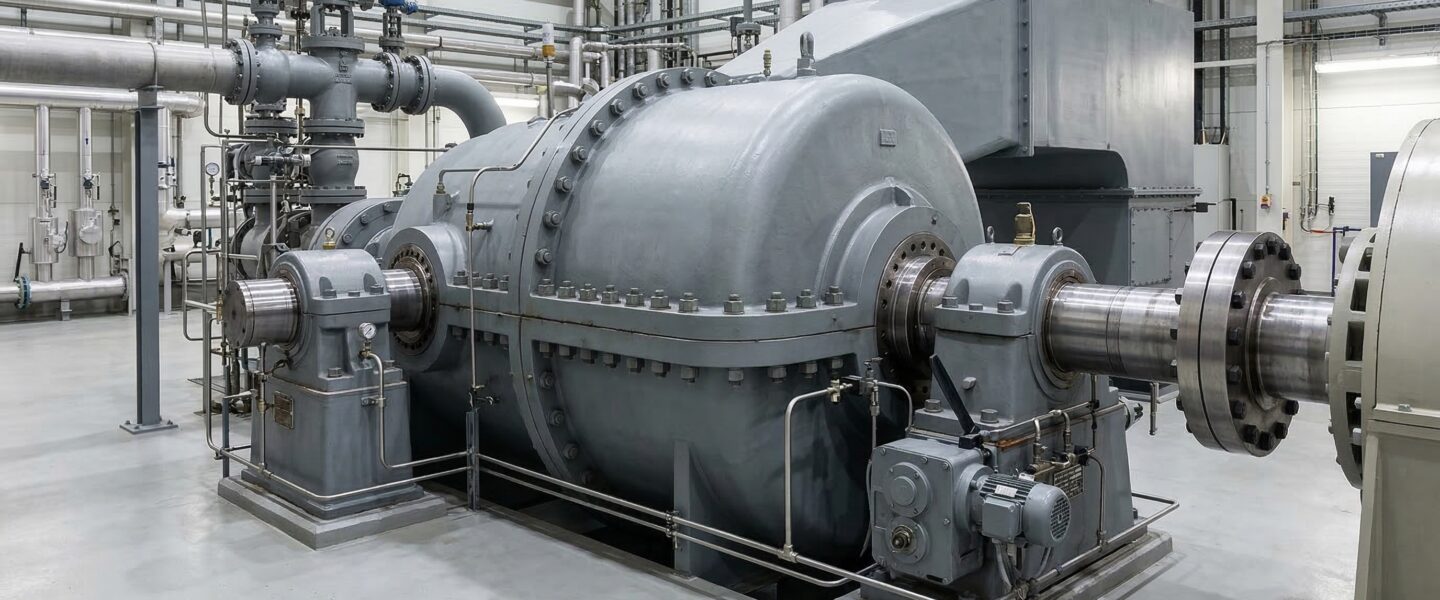
At Forge Reliability, we support steam turbine maintenance programs across power generation, refining, chemical processing, pulp and paper, and food and beverage operations. The turbines range from small single-stage mechanical drive units producing a few hundred horsepower to large multi-stage extraction and condensing turbines generating tens of megawatts. Despite the diversity in size and application, the reliability principles are consistent: understanding the dominant degradation mechanisms, monitoring the parameters that reveal their progression, and maintaining the discipline to act on early indicators rather than waiting for conditions to deteriorate to the point where emergency intervention is the only option.
A single unplanned steam turbine failure in a continuous process facility typically costs $500,000 to $2 million in combined repair expenses, lost production, and emergency response — compared to a planned outage for the same repair scope that typically costs one-third to one-half as much.
What Are the Common Reliability Challenges in Steam Turbine Operations?
Steam turbines degrade through a combination of mechanisms that reflect the extreme operating conditions inside the machine. High-temperature steam interacts with blade materials, rotor surfaces, and sealing components over thousands of operating hours, producing gradual changes in geometry, metallurgy, and performance that are invisible from the outside but measurable through the right monitoring approach. The challenge for maintenance teams is that most steam turbine degradation cannot be directly observed during operation — it must be inferred from external measurements and confirmed during internal inspections.
Blade and Nozzle Degradation
Turbine blading and nozzle partitions are the aerodynamic components that extract energy from the steam, and their condition directly determines turbine efficiency and power output. Blade degradation takes several forms depending on the steam conditions and blade material: solid particle erosion from boiler carryover, moisture erosion in wet stages, deposit accumulation from impurities in the steam, stress corrosion cracking in susceptible environments, and creep deformation in high-temperature stages. Each mechanism reduces the aerodynamic efficiency of the stage, increases internal leakage, and — if allowed to progress far enough — can lead to blade liberation events that cause catastrophic damage to downstream stages and the turbine casing. Blade condition assessment during inspections uses techniques including dimensional measurement, surface replication for metallurgical evaluation, and non-destructive examination for cracking. Between inspections, performance monitoring that tracks stage efficiency and exhaust conditions provides indirect indication of blade and nozzle condition.
Rotor and Bearing Issues
The turbine rotor operates at high speed in a thermally dynamic environment, and its condition determines the fundamental mechanical integrity of the machine. Rotor degradation concerns include shaft fatigue from cyclic thermal stresses during startup and shutdown, disc bore cracking from centrifugal and thermal loading, coupling face wear and alignment shift, and journal surface deterioration that affects bearing performance. Bearing condition — both the journal bearings that support the rotor and the thrust bearing that maintains axial position — is critical because bearing degradation directly affects rotor position, which in turn affects sealing clearances, blade tip clearances, and the risk of internal contact. Bearing metal temperature monitoring, shaft vibration monitoring, and axial position measurement provide continuous indication of rotor and bearing condition. A bearing metal temperature increase of just 10 to 15 degrees above established baseline can indicate oil supply restriction, bearing surface damage, or increased loading from rotor condition changes that warrant investigation.
Sealing and Efficiency Losses
Internal steam seals — including labyrinth seals at shaft penetrations, interstage seals between turbine stages, and blade tip seals — degrade over time through erosion, rub contact, and thermal distortion. As seal clearances increase, internal leakage rises, reducing the amount of steam energy converted to mechanical work. This efficiency loss is particularly insidious because it accumulates gradually and produces no dramatic symptoms — the turbine simply uses more steam to produce the same output, or produces less output from the same steam supply. In a facility where steam has a defined cost per thousand pounds, seal degradation translates directly into increased operating expense. A turbine with seal clearances that have opened to twice their design values may be losing 3-7% of its rated efficiency, representing tens of thousands of dollars annually in wasted steam energy on a medium-sized machine and potentially hundreds of thousands on a large unit.
Condition Monitoring Technologies for Steam Turbines
Steam turbine maintenance relies on a layered monitoring approach that combines continuous online measurements with periodic offline assessments to build a comprehensive picture of machine condition. The continuous measurements detect acute changes that require near-term response, while periodic assessments track gradual trends that inform long-range maintenance planning and outage scoping.
Vibration and Shaft Position Monitoring
Vibration monitoring is the cornerstone of steam turbine condition surveillance. Proximity probes mounted adjacent to the turbine journals measure shaft vibration amplitude, phase, and orbit shape — parameters that reflect rotor balance condition, bearing health, alignment, seal rub, and thermal response characteristics. Changes in vibration amplitude or phase during steady-state operation indicate developing mechanical issues, while changes in vibration response during speed transitions or load changes can reveal rotor bow, coupling problems, or thermal sensitivity. Axial position monitoring tracks the rotor’s position relative to the casing, detecting thrust bearing wear or loading changes that affect interstage clearances and can lead to internal contact if not addressed. The combination of radial vibration and axial position data provides a comprehensive mechanical condition assessment that operates continuously and detects most developing problems weeks or months before they reach critical severity.
Performance Monitoring and Heat Rate Tracking
Thermodynamic performance monitoring measures the turbine’s efficiency by comparing actual steam consumption and power output against design values corrected for operating conditions. Key parameters include inlet and exhaust steam conditions, extraction pressures and temperatures, flow rates, and mechanical output. Tracking these parameters over time reveals efficiency degradation from blade fouling, seal wear, and nozzle erosion that may not produce vibration changes but directly affect operating cost. For turbines driving generators, heat rate trending — the energy input required per unit of electrical output — provides a single metric that captures the cumulative effect of all internal degradation mechanisms. A heat rate increase of 2-3% on a 20 MW turbine generator can represent more than $150,000 per year in additional fuel cost, making performance monitoring one of the highest-return activities in steam turbine maintenance.
Oil Analysis and Lube System Monitoring
The lubrication system supports every bearing in the steam turbine train and is involved in a disproportionate number of turbine reliability incidents. Oil analysis tracks wear metal concentrations from bearing surfaces, monitors lubricant condition through viscosity and oxidation testing, detects water contamination from steam seal leakage, and identifies varnish and sludge formation potential that can restrict oil flow passages and degrade bearing cooling. Lube system condition monitoring — including oil pressure, temperature, filter differential pressure, and reservoir level — provides continuous indication of system health. A lube oil system failure that interrupts oil supply to turbine bearings, even briefly, can cause bearing damage that requires a major outage to repair. Maintaining the reliability of the lube system is therefore as critical as monitoring the turbine itself.
Facilities that implement comprehensive condition monitoring on steam turbines typically extend mean time between major overhauls by 25-40% while reducing the scope and cost of each overhaul through precise, data-driven work scoping.
Maintenance Strategies and Expected Outcomes
Steam turbine maintenance programs operate on two timescales simultaneously: the continuous monitoring and minor maintenance activities that occur during operation, and the major inspections and overhauls that require the turbine to be taken offline and opened. Effective programs use the continuous monitoring data to inform the planning and scoping of major outages, ensuring that each outage addresses actual equipment needs rather than performing blanket refurbishment based on generic time-based recommendations.
Outage Scoping and Planning
The highest-value application of condition monitoring data in steam turbine maintenance is outage scope optimization. A major turbine overhaul can range from a focused bearing and seal replacement completed in two to three weeks to a comprehensive rotor removal, blading replacement, and casing refurbishment requiring six to eight weeks or more. The difference in cost between a focused outage and a comprehensive overhaul can exceed $500,000 on a single machine. Vibration data, performance data, oil analysis trends, and previous inspection findings together build the evidence base that determines which components require attention during each outage, which can be deferred to the next interval, and what spare parts must be procured in advance. This data-driven scoping eliminates both the risk of under-scoping an outage — and discovering additional work requirements after the turbine is opened — and the waste of over-scoping by replacing components that still have significant remaining life.
Blade and Seal Life Management
Managing blade and seal life across multiple operating intervals requires tracking degradation rates established through successive inspections and projecting remaining life based on anticipated operating conditions. Blade erosion rates, deposit accumulation rates, and seal clearance growth rates all vary with steam quality, operating regime, and startup/shutdown frequency. Facilities that track these parameters quantitatively can make informed decisions about blade refurbishment timing, seal replacement scope, and the operating practice modifications — such as improved water treatment or modified startup procedures — that can extend component life between overhauls. This proactive approach to component life management reduces the frequency of major interventions while ensuring that no component is allowed to degrade to the point where it creates safety risk or forces an unplanned shutdown.
What Results to Expect
Facilities that implement comprehensive steam turbine maintenance programs built on condition monitoring data consistently achieve results that justify the investment many times over. Unplanned turbine trips decrease as developing mechanical and control system issues are identified and addressed before they reach trip severity. Overhaul costs decrease as work scopes are optimized to actual component condition rather than worst-case assumptions. Turbine efficiency improves as performance monitoring identifies and corrects efficiency-robbing conditions between overhauls rather than allowing them to accumulate over an entire run cycle. Overhaul intervals extend as condition data provides confidence that the turbine can safely continue operating beyond conservative time-based limits. For a facility operating one or more steam turbines in critical service, the combined value of reduced unplanned downtime, optimized overhaul spending, improved operating efficiency, and extended run lengths typically delivers annual savings of $200,000 to over $1 million per turbine — making steam turbine condition monitoring one of the highest-return reliability investments available in industrial operations.