
Extruders are the central production assets in plastics, rubber, food processing, and pharmaceutical manufacturing — machines where raw material enters as powder, pellets, or dough and exits as a continuous, precisely shaped product. Whether it is a single-screw plastics extruder producing pipe and profile, a twin-screw compounder blending polymers with additives, or a food-grade extruder forming cereal and snack products, the reliability of the extruder directly determines production throughput, product quality, and operating cost. Effective extruder maintenance requires understanding the specific mechanical, thermal, and process-related degradation mechanisms that these machines experience and applying monitoring strategies that detect problems while corrective action is still straightforward and affordable.
Why Does Extruder Reliability Demand Special Attention?
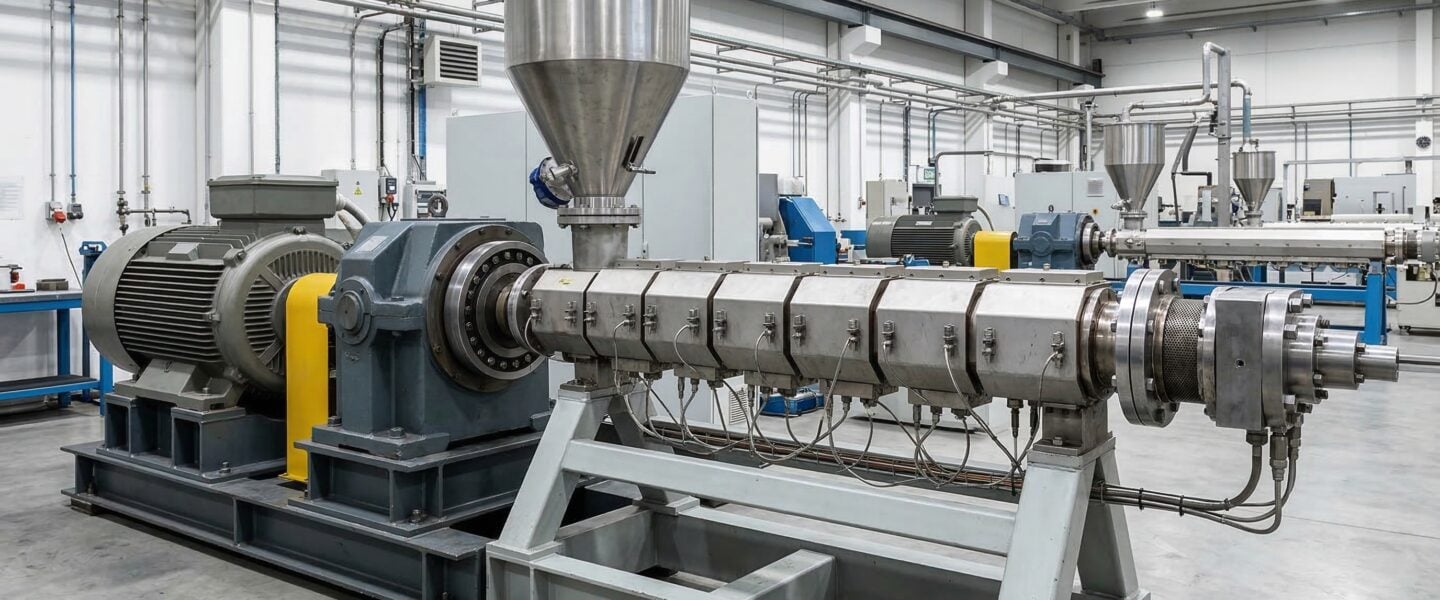
Extruders operate under a combination of mechanical loads, thermal stresses, and corrosive/abrasive process conditions that few other industrial machines experience simultaneously. The screw and barrel — the core components of any extruder — operate in direct contact with the process material at temperatures ranging from 150 to over 600 degrees Fahrenheit depending on the application, under pressures that can exceed 5,000 PSI at the die. The screw rotates within the barrel at close clearances, and any wear that increases the screw-to-barrel clearance reduces the machine’s ability to develop pressure and convey material efficiently. This wear is progressive and directly reduces product quality and throughput.
The gearbox — typically a heavy-duty helical or planetary reduction unit — transmits the full torque load from the drive motor to the screw. Extruder gearboxes operate at high continuous torque loads with minimal speed variation, which creates sustained stress on gear teeth, bearings, and seals. Unlike many industrial gearboxes that operate at partial load much of the time, extruder gearboxes frequently run at 80-95% of rated torque for extended production campaigns, making them susceptible to fatigue-related gear tooth failures and bearing degradation that develops gradually under constant high loading.
Industry data shows that unplanned extruder downtime costs between $5,000 and $50,000 per hour depending on the product and market, making extruder reliability one of the highest-leverage maintenance investments in any extrusion operation.
Thermal System Challenges
The barrel heating and cooling system maintains the precise temperature profile that the process requires. Electric barrel heaters, cooling fans or water-cooled jackets, and temperature controllers must work in coordination to hold each barrel zone within tight tolerances — often plus or minus 2-3 degrees of setpoint. Heater band failures, thermocouple degradation, cooling channel blockages, and controller drift all disturb the temperature profile and affect product quality before they are obvious to operators. A single failed heater band in a multi-zone barrel may be partially compensated by adjacent zones, masking the failure while creating localized cold spots that affect melt homogeneity and increase screw torque.
Condition Monitoring Strategies for Extruders
Effective extruder maintenance combines process parameter monitoring with mechanical condition monitoring to provide complete visibility into machine health. The process parameters often provide the earliest indication that something has changed mechanically, while mechanical monitoring techniques identify the specific component that is degrading.
Process Parameter Trending
Extruders generate a wealth of process data that, when properly trended, reveals mechanical degradation long before it causes a failure. The most valuable parameters for maintenance purposes include melt pressure at the die and along the barrel, screw drive motor current or torque, melt temperature at multiple locations, and specific energy consumption (energy per unit of throughput). Increasing motor current at constant screw speed and throughput indicates higher resistance to screw rotation — potentially from barrel wear increasing backflow, contamination or material buildup on the screw, or bearing degradation in the gearbox increasing mechanical drag. Declining melt pressure at constant speed and throughput indicates reduced pumping efficiency, which points directly to screw and barrel wear. Trending these parameters weekly and comparing them against baseline values established when the screw and barrel were new provides a continuous, non-intrusive measure of extruder mechanical condition.
Vibration Analysis on Gearbox and Drive
The extruder gearbox and drive motor are accessible for conventional vibration monitoring and represent high-value monitoring targets. Gearbox vibration analysis detects gear tooth wear, pitting, and cracking through gear mesh frequency analysis and sideband pattern interpretation. Bearing defect detection using envelope analysis provides months of advance warning for bearing replacements. Because extruder gearboxes operate at relatively low speeds and high torques, low-frequency vibration measurement capability below 10 Hz is often necessary to capture the fundamental gear mesh and bearing frequencies. Monthly vibration data collection with high-resolution spectral analysis is the recommended minimum for critical extruder gearboxes.
Oil Analysis for Gearbox Health
Gearbox oil analysis complements vibration monitoring by detecting wear metals, contamination, and lubricant degradation that vibration analysis may not identify in early stages. Ferrography and spectrometric oil analysis reveal the type, size, and quantity of wear particles being generated — distinguishing between normal operational wear and abnormal degradation patterns. Water contamination from cooling system leaks, oxidation from thermal degradation, and additive depletion from extended oil service intervals are all detectable through routine oil sampling. For extruder gearboxes, quarterly oil sampling combined with monthly vibration analysis provides comprehensive gearbox health monitoring that catches both sudden-onset and gradual-progression failure modes.
Screw and barrel wear monitoring through process parameter trending can detect efficiency losses of as little as 3-5%, allowing planned replacement during scheduled shutdowns rather than emergency repairs that can idle a production line for days.
Building an Effective Extruder Maintenance Program
A successful extruder maintenance strategy addresses three distinct maintenance domains: the mechanical drivetrain (motor, gearbox, thrust bearing assembly), the process-contact components (screw, barrel, die), and the thermal management system (heaters, cooling, controllers). Each domain has different failure modes, different monitoring approaches, and different maintenance intervals.
Drivetrain Maintenance
The drivetrain requires the same condition-monitoring-driven maintenance approach applied to any critical rotating equipment. Vibration analysis, oil analysis, thermographic inspection of motor and gearbox, and motor current analysis combine to provide comprehensive health monitoring. The thrust bearing assembly deserves particular attention in extruder applications — this bearing absorbs the full axial load generated by the screw’s pumping action, and its failure can allow the screw to shift axially within the barrel, causing contact damage that requires both screw and barrel repair. Monitoring thrust bearing condition through axial vibration measurement and temperature trending prevents this costly cascade failure.
Screw and Barrel Management
Screw and barrel wear is inevitable in any extruder, but the rate of wear varies enormously depending on the process material, operating conditions, and metallurgy of the components. Filled and reinforced materials containing glass fiber, mineral fillers, or carbon fiber accelerate wear dramatically — barrel life on a glass-filled nylon compound can be 3-5 times shorter than on unfilled material. Managing screw and barrel wear requires establishing baseline process performance metrics when components are new, trending those metrics over time to track degradation, and defining replacement criteria based on product quality requirements and efficiency thresholds rather than arbitrary time intervals. Many operations replace screws and barrels too late — after product quality has already suffered — because they lack the trending data to identify the optimal replacement point.
Thermal System Maintenance
Barrel heater bands have a limited service life that depends on operating temperature, cycling frequency, and the quality of installation. Heater band failures are common and individually minor, but cumulative heater failures degrade temperature control and increase energy consumption. A structured extruder maintenance program includes periodic heater resistance measurements to identify degrading heaters before they fail open, thermocouple calibration verification to ensure accurate temperature readings, cooling system inspection for blockages and leaks, and controller output trending to detect sensors and heaters that are drifting out of specification. Infrared thermography of barrel zones under operating conditions provides a rapid, non-contact assessment of heater band condition and identifies hot spots or cold spots that indicate failed or degraded heaters.
Operational Practices That Extend Extruder Life
Maintenance strategy alone does not determine extruder reliability — operating practices play an equally important role. Startup and shutdown procedures have a significant impact on screw and barrel life. Cold-starting an extruder without adequate barrel preheat forces the screw to rotate against solidified material, generating extreme torque loads and mechanical stress on the gearbox and thrust bearing. Proper startup procedures require preheating all barrel zones to operating temperature, allowing sufficient soak time for heat to penetrate the barrel wall uniformly, and then starting the screw at low speed before gradually increasing to production speed.
Material changeovers present another reliability risk. Incompatible material transitions — particularly when moving from a higher-temperature material to a lower-temperature one — can result in degraded or carbonized material remaining in the barrel that contaminates subsequent production and increases screw torque. Establishing documented purge procedures for each material transition protects both product quality and machine condition. Screen pack management at the breaker plate affects die pressure and motor load — running screens beyond their useful life increases head pressure and energy consumption while risking screen rupture that sends contamination downstream.
What Results Can You Expect?
Implementing a comprehensive extruder maintenance program that combines condition monitoring with structured preventive maintenance and operational discipline delivers measurable improvements. Based on our experience with extrusion operations across plastics, rubber, and food processing applications, the following results are achievable within 12-18 months of program implementation.
- Unplanned extruder downtime reduced by 45-60% through early detection of gearbox, bearing, and drive faults that provides sufficient lead time for planned repairs
- Screw and barrel life extended by 20-35% through process parameter trending that optimizes replacement timing and operating practice improvements that reduce abnormal wear
- Gearbox overhaul costs reduced by 30-45% by detecting gear and bearing degradation early enough to perform targeted repairs rather than complete rebuilds necessitated by cascading damage
- Energy consumption reduced by 5-10% through maintained thermal system efficiency, optimized screw and barrel clearances, and corrected mechanical conditions that increase parasitic losses
- Product quality reject rates reduced by 15-25% as temperature control stability, melt pressure consistency, and screw pumping efficiency are maintained at design-intent levels through proactive maintenance
- Spare parts inventory costs reduced by 15-20% through condition-based component management that provides reliable estimates of remaining useful life
Extruders reward proactive maintenance investment more generously than almost any other production asset because their output quality, throughput rate, and energy efficiency are all directly linked to mechanical condition. Every percentage point of efficiency lost to wear, every degree of temperature deviation from undetected heater failures, and every hour of unplanned downtime from preventable gearbox problems represents recoverable value. A structured extruder maintenance program captures that value systematically and sustainably.