
HVAC systems in commercial and industrial facilities do far more than keep occupants comfortable — they maintain the environmental conditions that production processes, equipment, and stored products require to function properly. A pharmaceutical cleanroom, a data center, a food processing plant, and a precision manufacturing facility all depend on HVAC performance for product quality, regulatory compliance, and asset protection. When these systems degrade, the consequences extend well beyond occupant discomfort to include product losses, equipment failures, compliance violations, and energy waste that can dwarf the cost of the HVAC system itself. Effective hvac system maintenance transforms these critical infrastructure assets from chronic sources of reactive service calls into reliable, efficient systems that support operations consistently.
Why Does HVAC Reliability Matter More Than Most Facilities Recognize?
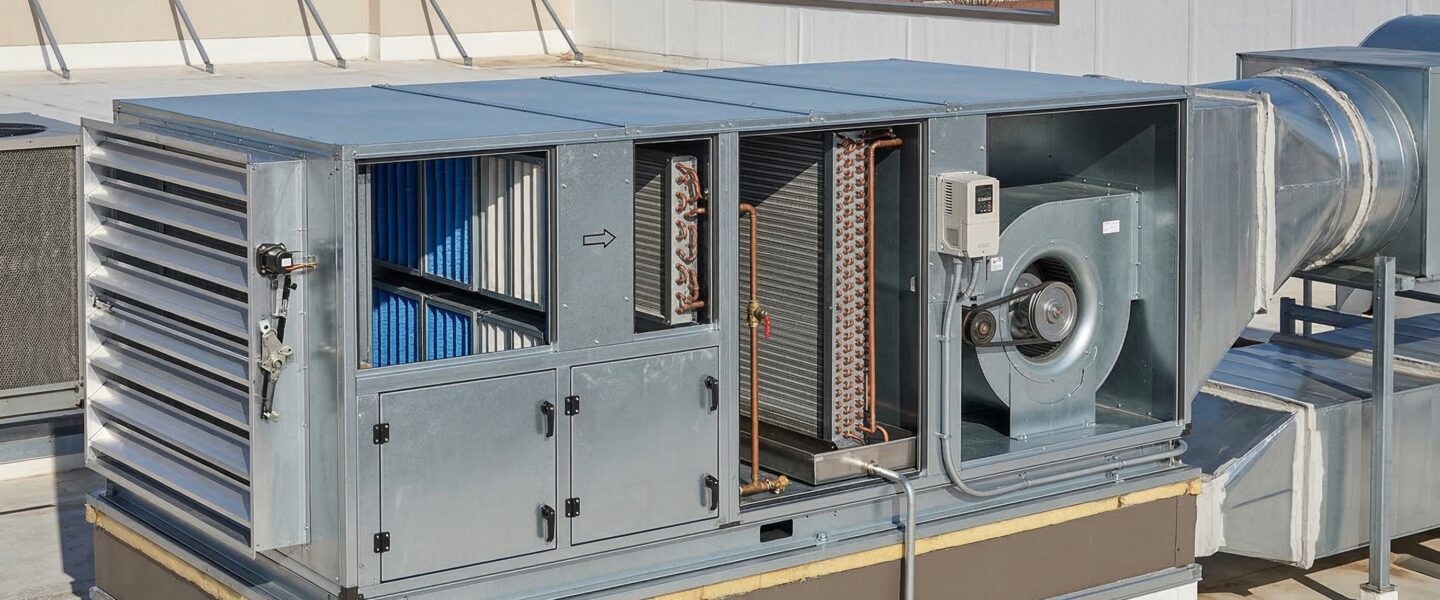
The reliability challenge with HVAC systems stems from their distributed nature, continuous operation, and the gradual way they degrade. A facility may have dozens or hundreds of individual HVAC units — rooftop units, air handlers, chillers, boilers, fan coil units, VAV boxes, exhaust fans — all operating simultaneously and all subject to independent failure modes. Unlike a production machine where failure is immediately obvious, HVAC degradation is often invisible until its effects become severe. A condenser coil losing efficiency due to fouling does not announce its condition — it simply forces the compressor to work harder, consume more energy, and degrade faster. A belt-driven supply fan losing tension does not stop — it just delivers less air, creating temperature and humidity variations that operators may attribute to setpoint issues rather than equipment degradation.
The energy impact of HVAC degradation is substantial. HVAC systems typically account for 40-60% of total facility energy consumption in commercial buildings and 15-30% in industrial facilities. Even modest efficiency losses across a large HVAC population compound into significant cost increases. A chiller operating at 10% below design efficiency may add tens of thousands of dollars to annual energy costs on a single unit. Multiplied across an entire HVAC fleet and sustained over years of gradual degradation, the cumulative energy waste from undermaintained HVAC systems represents one of the largest recoverable operating costs in most facilities.
Research consistently shows that buildings with proactive HVAC maintenance programs consume 15-25% less energy for heating and cooling than comparable buildings with reactive maintenance approaches — a difference that translates directly to operating cost savings year after year.
Condition Monitoring Approaches for HVAC Systems
Effective hvac system maintenance leverages a combination of automated monitoring through building automation systems and periodic condition assessments using portable diagnostic tools. The building automation system provides continuous performance data, while periodic inspections catch mechanical and physical degradation that automated monitoring may not detect.
Building Automation System Analytics
Modern building automation systems collect temperature, pressure, humidity, and equipment status data from hundreds or thousands of points across the facility. This data, when properly analyzed, reveals HVAC performance degradation in its earliest stages. Key analytics include supply-return temperature differential trending on air handlers and fan coil units — a declining differential indicates coil fouling, low refrigerant charge, or airflow reduction. Chiller approach temperature trending — the difference between leaving chilled water temperature and refrigerant saturating temperature — increases as condenser or evaporator tubes foul. Economizer operation verification confirms that outdoor air dampers are actually modulating to take advantage of free cooling opportunities when ambient conditions allow. Many facilities collect this data but lack the analytical framework to extract maintenance-relevant insights from it — transforming BAS data into maintenance intelligence is one of the highest-value improvements a facility can make to its hvac system maintenance program.
Vibration Analysis on Rotating Components
HVAC systems contain numerous rotating components — supply and return fans, pump motors, cooling tower fans, compressors — that benefit from vibration-based condition monitoring. While individual HVAC components may not justify the same monitoring intensity as critical production equipment, a route-based vibration monitoring program covering the major rotating components in the HVAC fleet detects bearing degradation, fan imbalance, belt deterioration, coupling misalignment, and motor faults before they cause failures. Prioritizing monitoring on central plant equipment (chillers, cooling towers, primary pumps, large air handlers) where failures have the broadest impact provides the best return on monitoring investment.
Refrigerant Circuit Analysis
For direct-expansion and chiller systems, refrigerant circuit analysis provides detailed insight into system health. Measuring superheat, subcooling, discharge pressure, suction pressure, and compressor amperage under steady-state conditions and comparing them to manufacturer specifications reveals refrigerant charge issues, expansion valve problems, compressor wear, and heat exchanger fouling. A properly charged system with clean heat exchangers and a functioning expansion device will produce superheat and subcooling values within narrow ranges of the design specifications. Deviations from these ranges point directly to specific component conditions that can be corrected before they cause comfort complaints or compressor failures.
Compressor failures account for the most expensive HVAC repair events, and approximately 80% of compressor failures are caused by conditions — low refrigerant charge, liquid slugging, overheating, contaminated oil — that are detectable and correctable through routine refrigerant circuit analysis.
Building an Effective HVAC Maintenance Strategy
The most effective hvac system maintenance programs use a tiered approach that matches maintenance intensity to equipment criticality and failure consequences. Not every rooftop unit warrants the same monitoring investment as the central chiller plant, and a well-designed program reflects this reality.
Tier 1: Central Plant Equipment
Chillers, boilers, cooling towers, primary distribution pumps, and large central air handlers represent the highest-criticality HVAC assets because their failure affects the largest portion of the facility. These assets receive the most comprehensive maintenance attention: monthly vibration monitoring, quarterly refrigerant circuit analysis on chillers, annual tube cleaning and eddy current testing on water-cooled chillers, seasonal combustion analysis on boilers, and continuous performance monitoring through the BAS. Cooling tower maintenance — including fill media inspection, basin cleaning, fan and drive maintenance, and water treatment program verification — is critical because cooling tower performance directly determines chiller efficiency and capacity.
Tier 2: Zone-Level Equipment
Rooftop units, split systems, fan coil units, and VAV air handlers serving specific zones or areas receive a structured preventive maintenance program with condition-based adjustments. Standard PM tasks include filter replacement on condition-based intervals using differential pressure monitoring rather than fixed schedules, coil cleaning based on visual inspection and performance metrics, belt inspection and tension adjustment, electrical connection verification, and seasonal refrigerant circuit checks. Establishing standard PM procedures with documented inspection criteria ensures consistent quality across a large equipment population — one of the most common failure points in HVAC maintenance programs is inconsistent execution where different technicians apply different standards to the same equipment type.
Tier 3: Terminal Units and Distribution
VAV boxes, fan-powered boxes, unit heaters, and similar terminal equipment receive annual inspection and functional testing focused on actuator operation, damper movement, heating element function, and controls calibration. These components are numerous and individually inexpensive, but their collective malfunction can cause significant comfort and energy problems. A facility with hundreds of VAV boxes where 15-20% have stuck or miscalibrated dampers — a common finding in facilities without structured terminal unit maintenance — will experience chronic comfort complaints and energy waste that central plant optimization alone cannot solve.
Indoor Air Quality and Regulatory Considerations
HVAC maintenance has direct implications for indoor air quality that extend into regulatory compliance territory for many facility types. Healthcare facilities must maintain pressure relationships between clean and contaminated spaces. Pharmaceutical manufacturing must meet FDA-specified air cleanliness classifications. Laboratory facilities must maintain fume hood face velocities within OSHA-specified ranges. Even commercial office buildings face increasing scrutiny on ventilation rates and filtration performance as awareness of airborne pathogen transmission and indoor air quality health effects grows.
Filter maintenance is the most direct connection between hvac system maintenance and indoor air quality. Operating filters beyond their useful life reduces airflow and allows bypass around loaded filter media, degrading both air quality and system performance. Conversely, replacing filters too frequently wastes money and resources. Differential pressure monitoring across filter banks provides the objective data needed to optimize replacement intervals — filters are replaced when they have captured their design dirt-holding capacity, not before and not after. For facilities requiring HEPA filtration, leak testing at annual or semi-annual intervals per IEST-RP-CC034 verifies that the filter and its gasket seal are maintaining the required filtration efficiency.
Drain pan and condensate management is another maintenance activity with significant IAQ implications. Standing water in drain pans supports microbial growth including Legionella, mold, and bacteria that can be distributed throughout the facility by the air handling system. Ensuring drain pans slope correctly, drain lines remain clear, and condensate is removed promptly is a basic hvac system maintenance task with outsized health and liability consequences when neglected.
What Results Can You Expect?
Transitioning from reactive HVAC service to a structured, condition-informed hvac system maintenance program delivers improvements across energy, reliability, comfort, and compliance metrics. Based on our experience across commercial, institutional, and industrial facilities, the following results are achievable within the first 12-24 months of program implementation.
- HVAC energy consumption reduced by 15-25% through restored equipment efficiency, optimized controls operation, and elimination of simultaneous heating and cooling conditions caused by malfunctioning components
- Emergency service call frequency reduced by 50-65% as condition monitoring and structured preventive maintenance eliminate the equipment failures that generate reactive service demand
- Compressor replacement frequency reduced by 35-50% through refrigerant circuit monitoring that detects and corrects the operating conditions responsible for the majority of compressor failures
- Comfort complaint volume reduced by 40-60% as equipment performance is maintained at design capability and terminal unit functionality is verified through systematic inspection
- Equipment service life extended by 25-40% through maintained operating conditions that reduce the thermal, mechanical, and electrical stress that accelerates component aging
- Filter costs optimized by 15-25% through condition-based replacement that eliminates both premature changeouts and extended operation with overloaded media
HVAC systems are unique among facility assets in that their degradation is distributed, gradual, and often invisible to building occupants and operators until performance has declined significantly. This characteristic makes them particularly responsive to structured maintenance programs — the gap between actual and potential performance is typically large in facilities that have relied on reactive maintenance, and closing that gap produces immediate, measurable, and sustained improvements in operating cost, occupant satisfaction, and system reliability. The investment in a proper hvac system maintenance program is among the fastest-payback reliability investments any facility can make.