
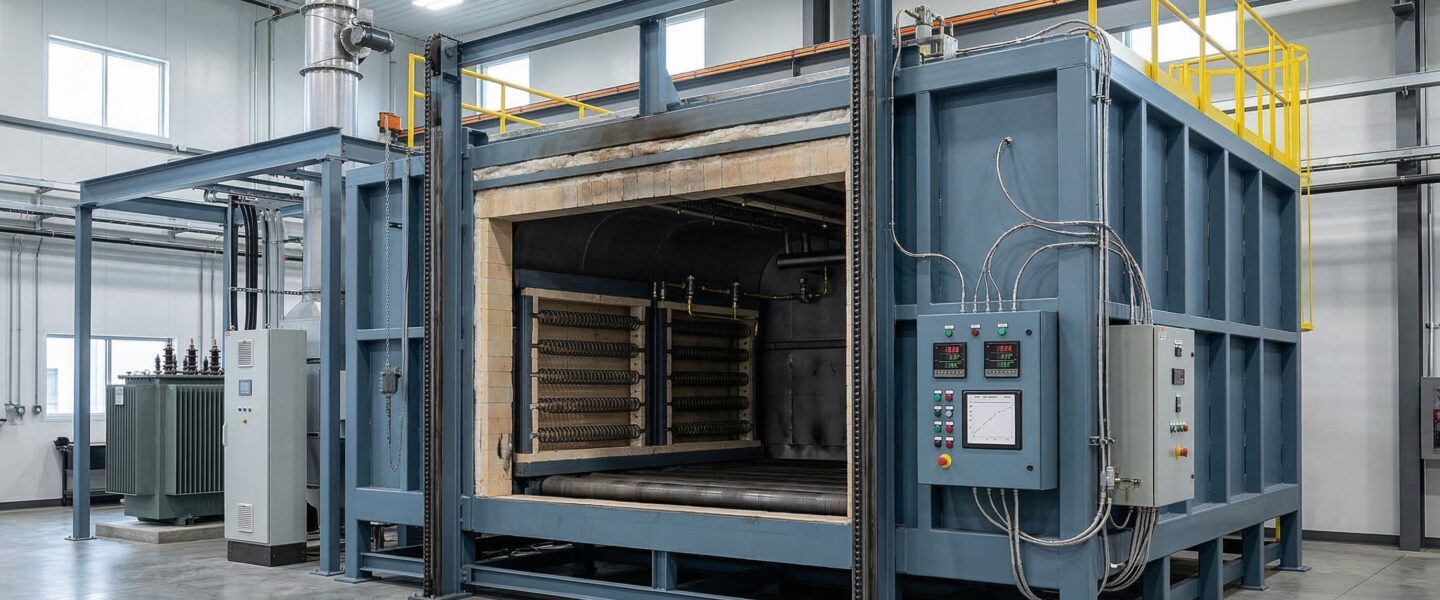
Industrial ovens and furnaces are critical thermal processing assets found across manufacturing sectors — from heat treating and curing to drying, sintering, and annealing. These systems operate at temperatures ranging from a few hundred degrees to well over 2,000 degrees Fahrenheit, and their reliability directly determines product quality, energy efficiency, and production throughput. A disciplined approach to industrial oven maintenance protects these high-value assets from the gradual degradation that leads to costly failures, quality escapes, and unsafe operating conditions.
The Reliability Stakes for Thermal Processing Equipment
Unlike many mechanical systems where a failure simply stops production, oven and furnace failures can destroy in-process product, damage refractory linings worth tens of thousands of dollars, or create serious safety hazards. A loss of temperature uniformity in a heat-treating furnace can produce an entire batch of parts with incorrect metallurgical properties — parts that may pass visual inspection but fail catastrophically in service. A combustion system malfunction can lead to gas accumulation, creating explosion risk.
The economics of unplanned thermal equipment downtime are particularly severe. Bringing a large furnace back to operating temperature after an unexpected shutdown can take 24-72 hours, depending on the refractory mass and process requirements. Every hour of that restart represents lost production capacity, wasted energy, and delayed shipments. Effective industrial oven maintenance programs focus on preventing these extended outages by catching degradation early and addressing it on scheduled terms.
An unplanned furnace shutdown can require 24-72 hours of restart time. Proactive condition monitoring helps avoid these extended outages by identifying problems well before they force an emergency shutdown.
What Are the Common Reliability Challenges?
Thermal processing equipment faces a unique set of reliability challenges driven by the extreme operating environment. Understanding these failure patterns is essential for building an effective maintenance strategy.
Refractory and Insulation Degradation
Refractory linings, ceramic fiber insulation, and brick structures are all subject to thermal cycling fatigue, chemical attack from process atmospheres, and mechanical erosion. Cracks in refractory allow heat to escape, increasing energy costs and creating hot spots on the furnace shell that accelerate structural steel degradation. In many facilities, refractory condition is only assessed during major shutdowns — by which time damage may have progressed far beyond what a timely repair could have addressed. Thermographic surveys conducted during operation can identify refractory failures through abnormal shell temperature patterns, often catching problems months before they become critical.
Combustion System Issues
Gas-fired ovens and furnaces depend on properly functioning burners, ignition systems, flame safety controls, and air-fuel ratio management. Burner degradation affects flame shape and heat distribution, leading to temperature non-uniformity. Dirty or worn flame sensors can cause nuisance shutdowns. Air-fuel ratio drift increases fuel consumption and may produce carbon monoxide or incomplete combustion byproducts. Regular combustion analysis and burner tuning are fundamental industrial oven maintenance activities that protect both efficiency and safety.
Temperature Control and Uniformity
Temperature controllers, thermocouples, and control valves must work together to maintain precise temperature profiles. Thermocouple drift — where the sensor gradually reads higher or lower than actual temperature — is a particularly dangerous failure mode because it silently shifts the process window. A thermocouple reading 25 degrees Fahrenheit low means the furnace runs hotter than intended, potentially damaging product or accelerating equipment wear. Periodic thermocouple calibration verification and temperature uniformity surveys (TUS) are essential for process-critical applications.
Conveyor and Material Handling Wear
Continuous ovens rely on belts, chains, rollers, and pushers to move product through the thermal zone. These mechanical components operate in extreme temperatures and often corrosive atmospheres, dramatically accelerating wear compared to ambient-temperature material handling. Chain elongation, roller bearing failures, and belt tracking problems can all halt production or damage product.
Condition Monitoring for Thermal Equipment
A comprehensive industrial oven maintenance program leverages several condition monitoring technologies to track equipment health without disrupting production.
Infrared Thermography
Thermal imaging is arguably the most valuable condition monitoring tool for ovens and furnaces. External shell surveys reveal refractory failures, insulation gaps, and structural hot spots. Electrical connection inspections identify loose or corroded terminations in high-amperage heating circuits. Air infiltration points become visible as cold spots during operation. A single thermographic survey can identify issues that would otherwise remain hidden until the next scheduled outage — or until they cause a failure.
Combustion Analysis
Portable combustion analyzers measure flue gas composition to assess burner performance. Oxygen, carbon monoxide, carbon dioxide, and NOx readings reveal whether burners are operating at optimal air-fuel ratios. Trending these readings over time identifies gradual degradation in burner condition, combustion air supply, or fuel delivery systems. Facilities that perform quarterly combustion analysis typically achieve 5-15% fuel savings compared to those that only tune burners during annual shutdowns.
Vibration Monitoring
Combustion air blowers, exhaust fans, recirculation fans, and conveyor drives all benefit from vibration monitoring. Bearing wear, imbalance, belt degradation, and structural looseness can be detected and trended long before failure. For high-temperature fans operating inside the furnace envelope, vibration monitoring is often the only practical way to assess condition without a shutdown.
Facilities performing regular combustion analysis and burner tuning consistently achieve 5-15% fuel savings — improvements that often fund the entire condition monitoring program within the first year.
Electrical Testing
Electric ovens and furnaces with resistance heating elements, silicon carbide elements, or induction coils require periodic electrical testing. Insulation resistance measurements, element resistance checks, and power quality monitoring help identify aging elements, failing connections, and control system issues before they cause unplanned outages or temperature control problems.
Maintenance Strategies for Long-Term Reliability
Building a sustainable industrial oven maintenance program requires balancing the need for thorough inspections against the reality that these assets often run continuously with limited shutdown windows.
Condition-Based Refractory Management
Rather than relying solely on visual inspection during annual shutdowns, condition-based refractory management uses regular thermographic surveys to track degradation trends. This approach identifies which areas need attention during the next planned outage, allows materials to be pre-ordered, and ensures repair crews are scheduled efficiently. The result is shorter, more productive maintenance shutdowns and fewer surprises.
Preventive Combustion Maintenance
A structured combustion maintenance program includes scheduled burner cleaning and inspection, flame safety system testing, ignition system verification, and air-fuel ratio optimization. These activities are relatively quick and inexpensive compared to the consequences of neglect — nuisance shutdowns, wasted fuel, inconsistent product quality, and safety incidents.
Instrumentation Calibration Programs
Temperature measurement accuracy is non-negotiable in thermal processing. Establishing a calibration program for thermocouples, controllers, and recorders — with frequencies based on application criticality and historical drift rates — prevents the silent quality erosion that occurs when temperature instruments lose accuracy. For AMS 2750-regulated heat treating operations, this is not optional; it is a compliance requirement with audit implications.
Planned Shutdown Optimization
When shutdowns do occur, maximizing the value of that downtime is critical. A well-planned shutdown uses condition monitoring data gathered during operation to create a prioritized work list. Refractory repairs, element replacements, conveyor overhauls, and instrumentation upgrades can all be coordinated to minimize total shutdown duration while addressing the highest-risk items first.
What Results Can You Expect?
Facilities that invest in structured industrial oven maintenance programs see benefits across multiple dimensions. Unplanned shutdowns decrease significantly — reductions of 40-50% are common in the first two years. Energy costs improve as combustion systems operate at peak efficiency and insulation integrity is maintained. Product quality becomes more consistent as temperature control accuracy is verified and maintained.
Refractory life often extends substantially when degradation is caught and repaired early rather than allowed to progress to the point of major failure. Heating element life improves when electrical connections are maintained and power quality issues are addressed. Overall maintenance costs typically decrease even as the maintenance program becomes more thorough, because planned repairs are dramatically less expensive than emergency responses.
Forge Reliability brings deep experience in thermal equipment reliability across heat treating, curing, drying, and process heating applications. We help facilities establish practical, effective maintenance programs that protect these critical assets while supporting production goals and energy efficiency targets.