
Industrial refrigeration systems are mission-critical assets in food processing, cold storage, pharmaceutical manufacturing, chemical production, and countless other applications where precise temperature control is non-negotiable. These complex systems — often running ammonia, CO2, or specialized refrigerants — operate continuously under demanding conditions, and their failure can result in spoiled product, regulatory violations, environmental releases, and significant safety hazards. A structured approach to industrial refrigeration maintenance is the most reliable way to protect both your cold chain integrity and your bottom line.
Why Does Refrigeration Reliability Matter More Than You Think?
The cost of a refrigeration system failure extends far beyond the repair bill. In food and beverage operations, a sustained temperature excursion can destroy hundreds of thousands of dollars in perishable inventory in a matter of hours. Pharmaceutical cold storage failures can compromise product that took months to manufacture. Even in industrial process cooling applications, losing refrigeration capacity can force production curtailments that cost far more per hour than the maintenance that would have prevented the problem.
Ammonia-based refrigeration systems add another dimension of risk. An ammonia release — even a relatively small one — triggers emergency response protocols, potential evacuation, regulatory reporting requirements, and scrutiny from OSHA and the EPA. Facilities operating systems with more than 10,000 pounds of ammonia fall under the EPA’s Risk Management Program and OSHA’s Process Safety Management standard, making equipment integrity a matter of regulatory compliance as well as operational reliability.
A single sustained temperature excursion in cold storage can destroy hundreds of thousands of dollars in product. Condition-based industrial refrigeration maintenance programs typically reduce unplanned failures by 45-55% within the first 18 months.
What Are the Common Reliability Challenges?
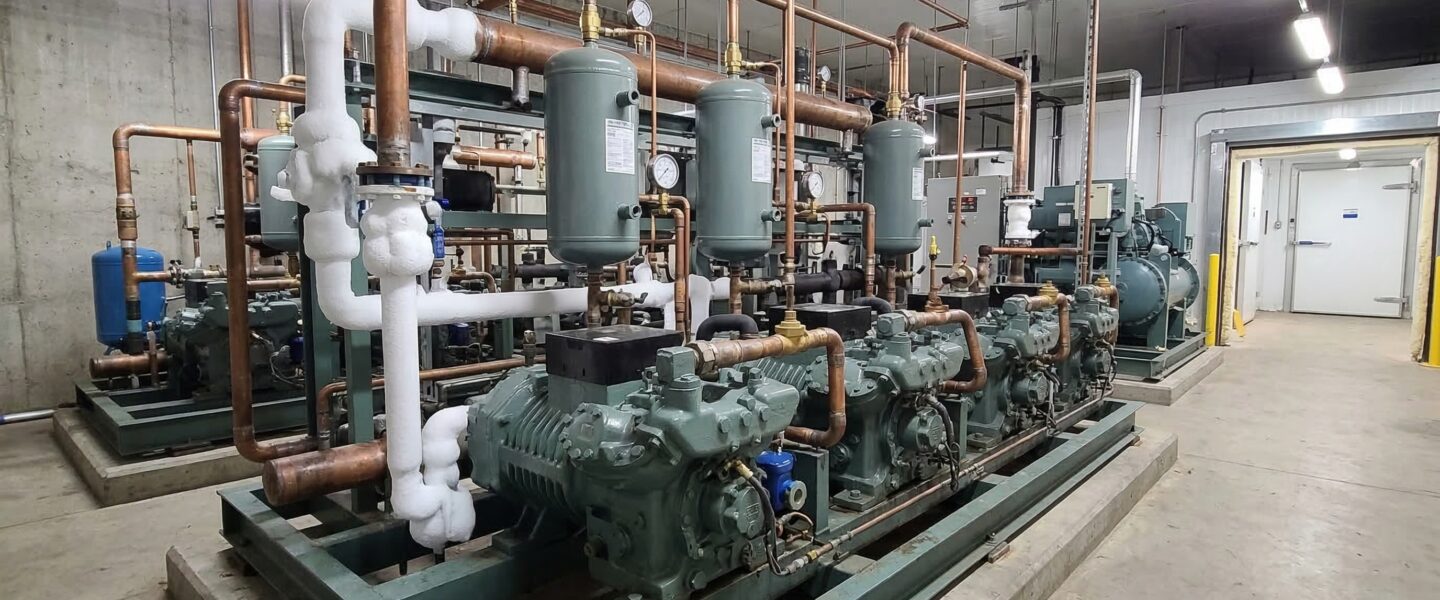
Industrial refrigeration systems are complex assemblies of compressors, condensers, evaporators, expansion devices, piping, controls, and ancillary equipment. Each subsystem has distinct failure modes that require targeted monitoring and maintenance approaches.
Compressor Degradation
Reciprocating, screw, and centrifugal compressors are the heart of the refrigeration system, and their condition largely determines system capacity and efficiency. Valve wear in reciprocating compressors reduces volumetric efficiency. Rotor wear in screw compressors increases internal leakage. Bearing degradation in any compressor type eventually leads to catastrophic failure if not detected. Oil analysis and vibration monitoring are the primary tools for tracking compressor health, and they are remarkably effective when applied consistently. Vibration trending can detect bearing degradation 3-6 months before failure in most compressor types.
Condenser and Evaporator Fouling
Heat exchanger performance is fundamental to refrigeration efficiency. Condenser fouling — whether from scale buildup in water-cooled systems, debris accumulation in air-cooled units, or biological growth — raises condensing pressure and forces compressors to work harder. Each 1-degree increase in condensing temperature above design conditions increases energy consumption by approximately 2-3%. Evaporator fouling has a similar effect on the suction side, reducing capacity and efficiency simultaneously. Regular monitoring of approach temperatures and pressure differentials identifies fouling trends before they significantly impact performance.
Refrigerant Leaks
Refrigerant leaks reduce system charge, degrade performance, increase operating costs, and — in the case of ammonia — create safety and environmental hazards. Leak detection is a critical component of any industrial refrigeration maintenance program. Modern leak detection technologies, including fixed-point sensors, portable detectors, and ultrasonic leak detection, provide multiple layers of protection when properly deployed and maintained.
Control System Issues
Modern refrigeration systems rely heavily on electronic controls for capacity management, defrost scheduling, condenser fan staging, and safety interlocks. Sensor drift, wiring degradation, and software configuration errors can all compromise system performance and safety. A temperature sensor reading 3 degrees warmer than actual conditions causes the system to overcool — wasting energy and potentially freezing product that should be held above freezing.
Condition Monitoring Technologies
Effective industrial refrigeration maintenance leverages a combination of monitoring technologies tailored to the specific equipment and risk profile of each system.
Oil Analysis
Compressor oil analysis provides direct insight into internal wear and fluid condition. Wear metal trending identifies bearing, gear, and rotor degradation. Moisture content measurement detects system contamination. Acid number testing reveals lubricant breakdown. For ammonia systems, oil analysis also monitors refrigerant dilution, which affects both lubrication quality and compressor efficiency. Quarterly sampling is standard for critical compressors, with monthly intervals for high-risk or aging units.
Vibration Analysis
Vibration monitoring on compressors, condenser fans, evaporator fans, and pump motors is one of the most reliable predictive tools available for refrigeration systems. Bearing defect frequencies, unbalance, misalignment, and looseness all produce distinctive vibration signatures that trained analysts can identify months before failure. For screw compressors specifically, vibration analysis can detect rotor contact and bearing race defects that oil analysis alone might miss.
Thermographic Inspection
Infrared surveys of electrical systems, insulated piping, and vessel insulation reveal problems invisible to the naked eye. Damaged pipe insulation allows moisture ingress and ice formation, which further degrades insulation and increases energy costs in a vicious cycle. Electrical termination hot spots in motor control centers and variable frequency drives indicate connections heading toward failure. Thermography provides fast, non-intrusive assessment across large systems.
Each 1-degree increase in condensing temperature above design raises energy consumption by 2-3%. Regular condenser maintenance and performance monitoring protect both efficiency and compressor longevity.
Performance Monitoring
Tracking key performance indicators — suction and discharge pressures, superheat and subcooling values, compressor amperage, approach temperatures — over time reveals efficiency trends that point to specific maintenance needs. A gradual rise in discharge pressure with clean condenser conditions suggests a refrigerant charge issue. Declining suction pressure with adequate load indicates evaporator problems. Performance monitoring turns operating data into actionable maintenance intelligence.
Maintenance Strategies That Protect Your Cold Chain
A comprehensive industrial refrigeration maintenance program balances preventive tasks, condition-based interventions, and system optimization to maximize reliability while controlling costs.
Compressor Maintenance Programs
Condition-based compressor maintenance uses oil analysis and vibration data to schedule valve overhauls, bearing replacements, and oil changes based on actual equipment condition rather than arbitrary time intervals. This approach eliminates both the risk of premature failure from overly extended intervals and the waste of replacing components that still have useful life remaining. Well-managed programs typically extend compressor overhaul intervals by 25-40% compared to time-based schedules.
Heat Exchanger Management
Condenser and evaporator maintenance should be driven by performance data. Monitoring approach temperatures and pressure drops tells you when cleaning is actually needed rather than guessing with calendar-based schedules. For evaporative condensers, water treatment programs must be maintained rigorously to control scale, corrosion, and biological growth — neglecting water treatment is one of the fastest ways to degrade condenser performance and shorten equipment life.
Leak Detection and Integrity Programs
For ammonia systems, a formal mechanical integrity program is both a regulatory requirement and a reliability best practice. This includes regular inspection of piping, valves, vessels, and relief devices; leak detection system calibration and testing; and documentation that demonstrates ongoing compliance. Even for non-ammonia systems, a structured approach to leak detection and repair pays dividends through reduced refrigerant costs and maintained system performance.
Controls Calibration and Optimization
Periodic verification of temperature sensors, pressure transducers, and level controls ensures the system operates as designed. Control logic review can identify optimization opportunities — adjusting defrost schedules, optimizing compressor staging, and fine-tuning condenser fan control can yield significant energy savings without any capital investment.
Measurable Results from Proactive Maintenance
Facilities that implement comprehensive industrial refrigeration maintenance programs consistently achieve significant, measurable improvements. Unplanned compressor failures typically decrease by 45-55% within the first 18 months. Energy costs improve by 10-20% as heat exchangers are maintained at peak performance and controls are optimized. Refrigerant losses decrease as leaks are detected and repaired promptly.
Regulatory compliance improves as mechanical integrity documentation becomes systematic and thorough. Product loss from temperature excursions drops dramatically when equipment reliability improves and monitoring systems are properly maintained. Maintenance costs become more predictable and often decrease overall as planned work replaces emergency repairs.
Forge Reliability works with facilities across food processing, cold storage, pharmaceutical, and industrial process cooling to build refrigeration maintenance programs that deliver these results. Our approach is practical, data-driven, and focused on the specific reliability risks and regulatory requirements of your operation. Whether you need to establish a new program or strengthen an existing one, we provide the expertise and support to protect your cold chain and improve your bottom line.