Home Equipment Monitoring Systems Vibration Monitoring Equipment

Vibration Monitoring Equipment

Portable, permanent, and wireless vibration monitoring system selection, deployment, and program optimization.

Vibration monitoring equipment forms the backbone of any serious predictive maintenance program. These instruments and systems translate the mechanical behavior of rotating and reciprocating machinery into actionable data that maintenance teams use to detect developing faults, prioritize interventions, and verify repair quality. Choosing, deploying, and maintaining vibration monitoring equipment correctly determines whether a facility gains genuine predictive capability or merely collects data that never translates into meaningful reliability improvements.
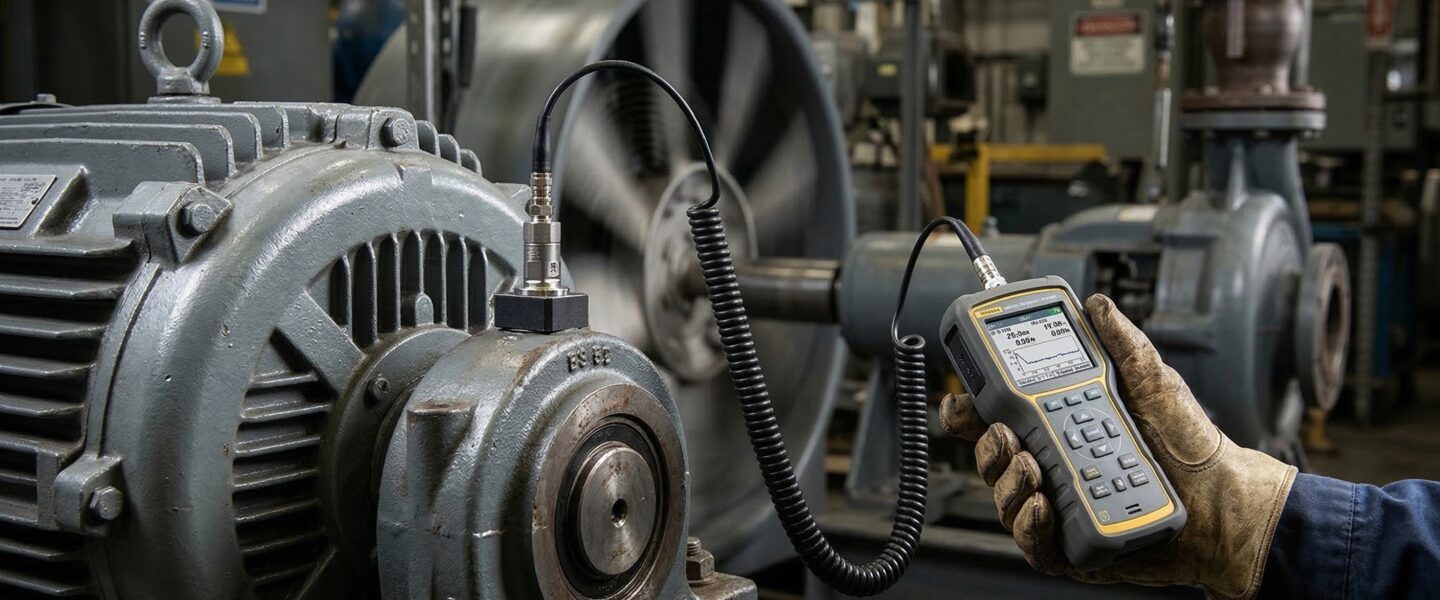
Vibration Monitoring | Forge Reliability

At Forge Reliability, we help industrial facilities select, implement, and optimize vibration monitoring equipment that matches their operational requirements and reliability objectives. Our experience spans portable data collectors, permanently installed online systems, wireless sensor networks, and integrated protection platforms across every major industry sector. We understand that the technology is only as valuable as the program wrapped around it, and we design monitoring strategies that deliver clear, measurable returns.


The Role of Vibration Monitoring in Modern Reliability Programs

Vibration analysis has been a proven predictive maintenance technology for decades, but the tools and techniques available today bear little resemblance to those of even ten years ago. Modern vibration monitoring equipment offers capabilities that were previously available only in specialized laboratories, bringing advanced diagnostics directly to the plant floor.

The fundamental principle remains unchanged: all rotating machinery generates vibration patterns that reflect its mechanical condition. Healthy equipment produces characteristic signatures that remain stable over time. As faults develop, whether in bearings, gears, couplings, shafts, or structural supports, the vibration signature changes in specific, identifiable ways. The goal of vibration monitoring equipment is to capture these changes with sufficient resolution and frequency to enable timely maintenance decisions.

Properly implemented vibration monitoring programs detect over 80% of common rotating equipment failure modes in their early stages, providing weeks to months of lead time for planned corrective action before functional failure occurs.

Portable vs. Permanent Monitoring Systems

The choice between portable route-based data collection and permanently installed online monitoring depends on equipment criticality, accessibility, and the speed of fault progression for the failure modes of concern. Portable data collectors remain the most cost-effective approach for monitoring large populations of general-purpose rotating equipment on monthly or quarterly intervals. A skilled technician with a quality portable analyzer can assess dozens of machines per shift, building trend data that reveals gradual degradation patterns.

Permanently installed online systems are justified for critical equipment where the consequences of failure are severe, where access is restricted or hazardous, or where failure modes progress too rapidly for periodic collection to detect. Continuous monitoring systems capture data at intervals measured in minutes or seconds, providing near-real-time visibility into machine condition. Online monitoring is considered essential for equipment whose failure would cause production losses exceeding $50,000 per event or where safety risks make frequent human access inadvisable.

Wireless Monitoring Technologies

Wireless vibration sensors have emerged as a middle ground between portable collection and fully wired online systems. Battery-powered sensors mounted permanently on equipment transmit data at configurable intervals, eliminating the labor cost of route-based collection while avoiding the installation expense of wired systems. These sensors are particularly valuable for equipment in remote locations, hazardous areas, or positions that are difficult to access consistently with portable instruments.


Selecting the Right Vibration Monitoring Equipment

Equipment selection must be driven by the monitoring objectives rather than by technology specifications alone. Forge Reliability evaluates several factors when recommending vibration monitoring equipment for a given application.

Measurement Requirements

The types of machinery being monitored determine the measurement capabilities required. Low-speed equipment such as paper machine rolls or cooling tower fans requires sensors with extended low-frequency response. High-speed equipment such as turbines and compressors demands high-frequency capability and wide dynamic range. Gearbox monitoring benefits from envelope demodulation and time synchronous averaging capabilities that extract weak gear and bearing signals from complex vibration environments.

Analysis and Diagnostic Capability

Raw vibration data has limited value without proper analysis. The monitoring system must support the diagnostic techniques appropriate for the equipment being monitored: spectral analysis for identifying frequency-specific fault patterns, time waveform analysis for impact detection and waveform shape assessment, envelope analysis for early bearing fault detection, and orbit analysis for journal bearing machines. The analytical capability of the system directly determines the quality and timeliness of fault detection.

Integration and Data Management

Vibration monitoring equipment must integrate with the facility’s broader asset management infrastructure. Data should flow efficiently from the point of collection into analysis software, trending databases, and maintenance management systems. Compatibility with existing platforms, data format standards, and communication protocols are practical considerations that significantly impact program sustainability. Systems that create data silos or require excessive manual intervention for data transfer inevitably fall into disuse.

Industry surveys indicate that nearly 40% of facilities that invest in vibration monitoring equipment fail to achieve their expected return because of inadequate program design, insufficient analyst training, or poor integration with maintenance decision-making processes.


Maintaining Your Vibration Monitoring Equipment

The instruments and sensors that monitor your production equipment are themselves assets that require proper care to deliver accurate, reliable data. Degraded monitoring equipment produces misleading data that can be worse than no data at all, leading to missed faults or unnecessary maintenance actions.

Sensor Calibration and Verification

Accelerometers and other vibration sensors must be verified against known references periodically to confirm they maintain their specified sensitivity and frequency response. Sensor cables and connectors are common failure points, particularly in harsh industrial environments where moisture, chemical exposure, and physical damage take their toll. A sensor that has shifted out of specification will produce trend data that appears to show changing machine condition when the actual change is in the measurement system.

System Health Monitoring

Online monitoring systems include their own infrastructure that requires attention: signal conditioners, data acquisition hardware, network components, and server or cloud platforms. Monitoring the health of the monitoring system itself, through signal quality checks, communication status verification, and database integrity assessments, ensures that gaps in data collection are identified and resolved before they compromise the program’s ability to detect equipment faults.

Software and Database Maintenance

Analysis software requires regular updates to maintain compatibility with evolving operating systems and network security requirements. Vibration databases grow continuously and require periodic maintenance including archiving of historical data, verification of machine configuration accuracy, and cleanup of orphaned measurement points. Database accuracy directly impacts trending reliability, as incorrect machine associations or measurement point configurations can invalidate trend comparisons.


Building a Vibration Monitoring Program That Delivers Results

The most sophisticated vibration monitoring equipment available will underperform a basic system operated by trained analysts within a well-designed program. Forge Reliability emphasizes program design as the foundation upon which technology selection builds.

Asset Criticality Assessment

Not every piece of rotating equipment warrants vibration monitoring. A criticality assessment identifies which assets justify the investment based on failure consequences, redundancy, repair costs, and lead time for replacement parts. This assessment determines not only which machines to monitor but also the monitoring intensity appropriate for each: continuous online, periodic route-based, or a combination.

Analyst Competency Development

Vibration analysis is a technical discipline that requires trained practitioners. Facilities that invest in equipment without corresponding investment in analyst training consistently underperform. Forge Reliability provides training programs aligned with ISO 18436 competency standards, developing internal capability that sustains the monitoring program over time. For facilities that prefer to outsource the analytical function, we provide expert remote analysis services that interpret monitoring data and deliver clear maintenance recommendations.

Vibration monitoring equipment is a proven investment that pays for itself many times over when properly implemented. Return on investment ratios of 10:1 or greater are commonly documented in well-run programs. Forge Reliability brings the expertise needed to design, implement, and sustain a vibration monitoring program that transforms raw vibration data into operational reliability. From equipment selection through program maturity, we partner with your team to ensure that every dollar invested in monitoring technology delivers measurable value to your operation.

Failure Modes

Common Vibration Monitoring Equipment Reliability & Maintenance Failure Modes

Engineers often arrive searching for specific failures. Here are the most common issues we diagnose and resolve.

Accelerometer Degradation and Failure

Piezoelectric accelerometer sensitivity drifts from thermal cycling, chemical exposure, and aging of the piezoelectric element, while cable damage, connector corrosion, and mounting looseness introduce measurement errors that corrupt vibration data.

Key symptom: Measurement readings drifting from historical baselines without corresponding machine condition changes and sensor self-test or bias voltage readings outside specification

Get Help With This →

Proximity Probe System Drift

Eddy current proximity probe systems experience sensitivity changes from probe tip wear, target surface condition changes, driver/monitor power supply aging, and extension cable impedance variations from moisture ingress, affecting shaft vibration and position measurements.

Key symptom: Gap voltage readings drifting from calibration values with shaft vibration amplitude changes not correlated to machine operating condition changes

Get Help With This →

Cable and Connector Degradation

Signal cables and connectors in industrial environments degrade from vibration-induced fatigue, chemical exposure, UV radiation, rodent damage, and moisture intrusion, introducing intermittent signal dropouts, noise injection, and ground loops that corrupt measurement data.

Key symptom: Intermittent signal dropouts or noise spikes in vibration data with connector corrosion or cable damage visible during physical inspection

Get Help With This →

Online System Communication Failures

Continuous monitoring system data paths fail from network switch failures, protocol conversion errors, database capacity limitations, and configuration management issues, creating gaps in monitoring coverage that reduce program effectiveness.

Key symptom: Missing or delayed data in monitoring system displays with network diagnostic tools showing communication errors or timeouts

Get Help With This →

Mounting System Looseness

Vibration sensor mounting pads, studs, and adhesives deteriorate from thermal cycling, chemical exposure, and mechanical loads, reducing the mechanical coupling between the sensor and the machine surface and attenuating high-frequency vibration signals.

Key symptom: Declining high-frequency vibration amplitude trends without corresponding machine condition improvement and sensor mounting torque below specification

Get Help With This →

Diagnostic Methods

Diagnostic Techniques We Use

Sensor Self-Test and Bias Voltage Monitoring

Built-in self-test functions and bias voltage measurement on ICP/IEPE accelerometers verify piezoelectric element and internal electronics functionality, detecting sensor degradation before it corrupts vibration data quality.

Calibration Verification Against Reference Standards

Periodic comparison of installed sensor output against NIST-traceable reference accelerometers and calibration exciters per ISO 16063 verifies measurement accuracy and detects sensitivity drift, cable losses, and signal conditioning errors.

Cross-Validation with Portable Instruments

Periodic collection of vibration data using portable reference instruments at permanent sensor locations validates online system measurement accuracy and detects sensor, cable, or system faults that produce incorrect data.

Cable Continuity and Insulation Testing

Megohmmeter testing of sensor cable insulation resistance and continuity testing of conductors and shields detects moisture ingress, insulation breakdown, and conductor damage that degrade signal quality before complete failure occurs.

System Health Dashboard Monitoring

Monitoring system diagnostic features including sensor health status, communication error rates, database utilization, and alarm system functionality provide continuous visibility into monitoring infrastructure health and highlight channels requiring maintenance.

Services

Services for Vibration Monitoring Equipment Reliability & Maintenance

Service

Asset Management for Vibration Monitoring Equipment

Asset Management programs for Vibration Monitoring Equipment, targeting common failure modes and degradation mechanisms.

Learn More →
Service

CMMS Implementation for Vibration Monitoring Equipment

Our team supports CMMS implementation for vibration monitoring equipment, targeting sensor degradation, cable faults, and related degradation mechanisms...

Learn More →
Service

Condition Monitoring for Vibration Monitoring Equipment

Our team establishes continuous condition monitoring programs for vibration monitoring equipment, targeting sensor degradation, cable faults, and related...

Learn More →
Service

Dynamic Balancing for Vibration Monitoring Equipment

Our team provides precision balancing for vibration monitoring equipment, targeting sensor degradation, cable faults, and related degradation mechanisms...

Learn More →
Service

Equipment Condition Assessment for Vibration Monitoring Equipment

Our team provides comprehensive condition assessments for vibration monitoring equipment, targeting sensor degradation, cable faults, and related...

Learn More →
Service

Equipment Maintenance for Vibration Monitoring Equipment

Our team delivers comprehensive maintenance programs for vibration monitoring equipment, targeting sensor degradation, cable faults, and related degradation...

Learn More →
Service

FMEA for Vibration Monitoring Equipment

Our team conducts failure mode and effects analysis for vibration monitoring equipment, targeting sensor degradation, cable faults, and related degradation...

Learn More →
Service

Maintenance Outsourcing for Vibration Monitoring Equipment

Our team provides outsourced maintenance for vibration monitoring equipment, targeting sensor degradation, cable faults, and related degradation mechanisms...

Learn More →
Service

Maintenance Planning for Vibration Monitoring Equipment

Our team develops maintenance planning and scheduling for vibration monitoring equipment, targeting sensor degradation, cable faults, and related...

Learn More →
Service

Motor Current Analysis for Vibration Monitoring Equipment

Our team applies motor current signature analysis to vibration monitoring equipment, targeting sensor degradation, cable faults, and related degradation...

Learn More →
Service

Oil Analysis for Vibration Monitoring Equipment

Our team applies oil analysis programs to vibration monitoring equipment, targeting sensor degradation, cable faults, and related degradation mechanisms...

Learn More →
Service

Plant Optimization for Vibration Monitoring Equipment

Our team drives plant optimization through improved management of vibration monitoring equipment, targeting sensor degradation, cable faults, and related...

Learn More →
Service

Precision Shaft Alignment for Vibration Monitoring Equipment

Our team provides precision alignment for vibration monitoring equipment, targeting sensor degradation, cable faults, and related degradation mechanisms...

Learn More →
Service

Predictive Maintenance for Vibration Monitoring Equipment

Our team applies predictive maintenance technologies to vibration monitoring equipment, targeting sensor degradation, cable faults, and related degradation...

Learn More →
Service

Preventive Maintenance for Vibration Monitoring Equipment

Our team builds structured preventive maintenance programs for vibration monitoring equipment, targeting sensor degradation, cable faults, and related...

Learn More →
Service

RCM for Vibration Monitoring Equipment

Our team applies RCM methodology to vibration monitoring equipment, targeting sensor degradation, cable faults, and related degradation mechanisms before...

Learn More →
Service

Reliability Consulting for Vibration Monitoring Equipment

Our team applies reliability consulting methodology to vibration monitoring equipment, targeting sensor degradation, cable faults, and related degradation...

Learn More →
Service

Root Cause Analysis for Vibration Monitoring Equipment

Our team investigates failures in vibration monitoring equipment, targeting sensor degradation, cable faults, and related degradation mechanisms before they...

Learn More →
Service

Thermographic Inspection for Vibration Monitoring Equipment

Our team applies infrared thermography to vibration monitoring equipment, targeting sensor degradation, cable faults, and related degradation mechanisms...

Learn More →
Service

Ultrasonic Testing for Vibration Monitoring Equipment

Our team applies ultrasonic testing methods to vibration monitoring equipment, targeting sensor degradation, cable faults, and related degradation...

Learn More →
Service

Vibration Analysis for Vibration Monitoring Equipment

Our team applies vibration analysis to vibration monitoring equipment, targeting sensor degradation, cable faults, and related degradation mechanisms before...

Learn More →

Industries

Industries That Rely on Vibration Monitoring Equipment Reliability & Maintenance

Industry

Vibration Monitoring Equipment Reliability for Automotive

Vibration Monitoring Equipment reliability and predictive maintenance programs designed for automotive operating environments and compliance requirements.

Learn More →
Industry

Vibration Monitoring Equipment Reliability for Cement & Aggregates

Vibration Monitoring Equipment reliability and predictive maintenance programs designed for cement & aggregates operating environments and compliance...

Learn More →
Industry

Vibration Monitoring Equipment Reliability for Chemical Processing

Vibration Monitoring Equipment reliability and predictive maintenance programs designed for chemical processing operating environments and compliance...

Learn More →
Industry

Vibration Monitoring Equipment Reliability for Food & Beverage

Vibration Monitoring Equipment reliability and predictive maintenance programs designed for food & beverage operating environments and compliance requirements.

Learn More →
Industry

Vibration Monitoring Equipment Reliability for Industrial Refrigeration

Vibration Monitoring Equipment reliability and predictive maintenance programs designed for industrial refrigeration operating environments and compliance...

Learn More →
Industry

Vibration Monitoring Equipment Reliability for Logistics & Distribution

Vibration Monitoring Equipment reliability and predictive maintenance programs designed for logistics & distribution operating environments and compliance...

Learn More →
Industry

Vibration Monitoring Equipment Reliability for Manufacturing

Vibration Monitoring Equipment reliability and predictive maintenance programs designed for manufacturing operating environments and compliance requirements.

Learn More →
Industry

Vibration Monitoring Equipment Reliability for Metals & Steel

Vibration Monitoring Equipment reliability and predictive maintenance programs designed for metals & steel operating environments and compliance requirements.

Learn More →
Industry

Vibration Monitoring Equipment Reliability for Mining

Vibration Monitoring Equipment reliability and predictive maintenance programs designed for mining operating environments and compliance requirements.

Learn More →
Industry

Vibration Monitoring Equipment Reliability for Oil & Gas

Vibration Monitoring Equipment reliability and predictive maintenance programs designed for oil & gas operating environments and compliance requirements.

Learn More →
Industry

Vibration Monitoring Equipment Reliability for Pharmaceutical

Vibration Monitoring Equipment reliability and predictive maintenance programs designed for pharmaceutical operating environments and compliance requirements.

Learn More →
Industry

Vibration Monitoring Equipment Reliability for Plastics & Rubber

Vibration Monitoring Equipment reliability and predictive maintenance programs designed for plastics & rubber operating environments and compliance...

Learn More →
Industry

Vibration Monitoring Equipment Reliability for Power Generation

Vibration Monitoring Equipment reliability and predictive maintenance programs designed for power generation operating environments and compliance requirements.

Learn More →
Industry

Vibration Monitoring Equipment Reliability for Pulp & Paper

Vibration Monitoring Equipment reliability and predictive maintenance programs designed for pulp & paper operating environments and compliance requirements.

Learn More →
Industry

Vibration Monitoring Equipment Reliability for Water & Wastewater

Vibration Monitoring Equipment reliability and predictive maintenance programs designed for water & wastewater operating environments and compliance...

Learn More →

Technical Reference

Technical Overview

Vibration monitoring equipment requires regular calibration and maintenance to ensure accurate readings. Key concerns include sensor degradation, cable damage, accelerometer mounting issues, and data collector calibration drift. A robust instrument maintenance program ensures your condition monitoring data remains trustworthy and actionable.

Common Questions

FAQ

Accelerometer calibration verification should be performed annually for sensors used in critical applications and every 2-3 years for general monitoring programs, per ISO 16063 methodology. Proximity probe systems in API 670 installations should be verified during machine outages per the API 670 requirements. The key distinction is between full laboratory calibration (which establishes a new sensitivity certificate) and field verification (which confirms the sensor is still reading within acceptable tolerance of its calibrated sensitivity). Field verification using portable reference standards catches most drift issues without removing sensors for laboratory calibration.

Limited Availability
We onboard a limited number of new facilities each quarter. Secure your assessment slot before our current availability closes. Reserve Your Spot →

Get Started

Request a Free Reliability Assessment

Tell us about your equipment and facility. Our reliability team will review your situation and recommend a tailored reliability program — no obligation.

Free initial assessment
Response within 1 business day
No obligation or commitment

No obligation. Typical response within 24 hours.

Having Problems With Your Vibration Monitoring Equipment?

Claim Your Free Assessment →