Home Equipment Fluid Systems Water Treatment Equipment

Water Treatment Equipment

Pump monitoring, aeration system diagnostics, and chemical feed equipment maintenance for water treatment reliability.

Water treatment equipment operates continuously in environments where corrosion, scaling, biological fouling, and chemical exposure relentlessly attack every mechanical and electrical component in the system. From intake pumps and aerators to membrane filtration units, chemical dosing systems, and clarifier drive mechanisms, these assets must function reliably around the clock because the consequences of failure extend beyond lost production into regulatory compliance, environmental protection, and public health. Effective water treatment equipment maintenance is essential for any facility that depends on consistent water quality, whether for municipal supply, industrial process water, or wastewater discharge compliance.
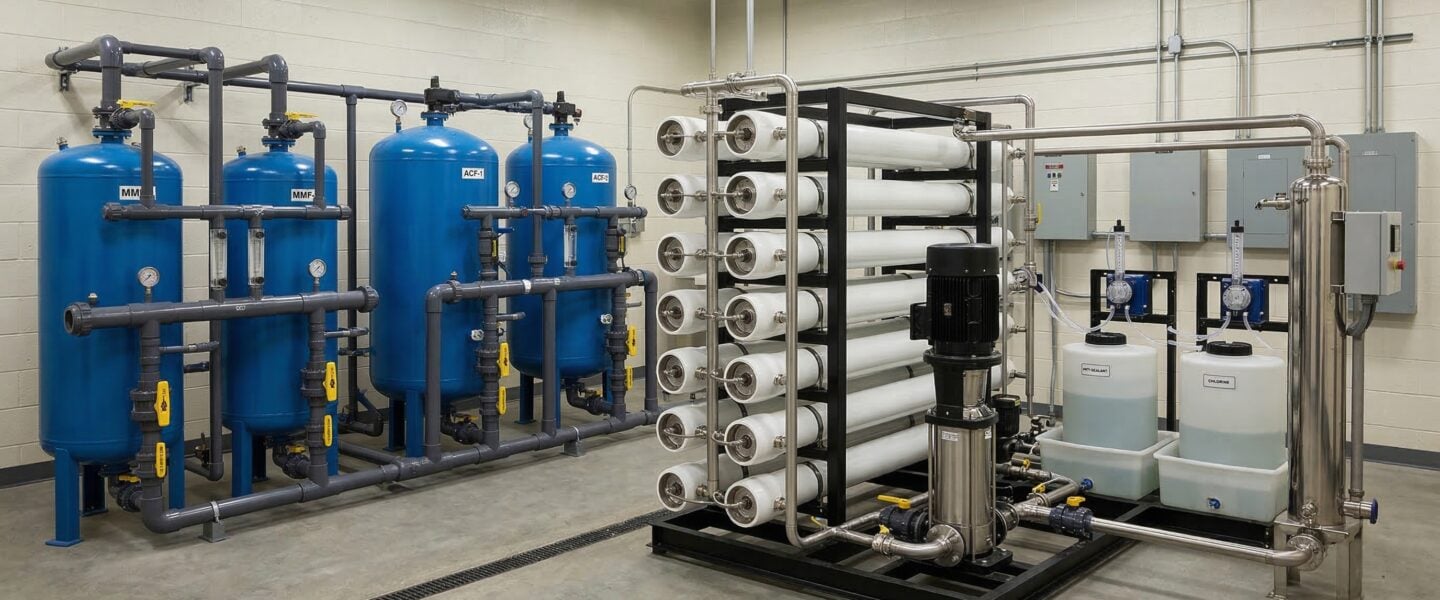
Water Treatment Equipment Reliability & Maintenance — industrial maintenance and reliability services

Forge Reliability partners with water and wastewater utilities, industrial water treatment operations, and process facilities to build maintenance programs that keep treatment equipment available and performing to specification. Our approach applies the same condition monitoring and reliability engineering principles proven in heavy industry to the unique challenges of the water treatment environment, delivering measurable improvements in equipment uptime, maintenance efficiency, and total cost of ownership.


Reliability Challenges Unique to Water Treatment Equipment

Water treatment facilities house a diverse mix of equipment types, each facing specific degradation mechanisms tied to the process environment. Understanding these mechanisms is the foundation for designing maintenance strategies that actually work.

Pump and Rotating Equipment Degradation

Pumps are the most numerous rotating assets in any water treatment facility, and they face particularly aggressive operating conditions. Raw water intake pumps contend with debris, sand, and biological growth that erode impellers and wear rings. Chemical feed pumps handling corrosive reagents like sodium hypochlorite, ferric chloride, or sulfuric acid experience accelerated material degradation that shortens component life dramatically. Sludge pumps move highly abrasive slurries that can wear through wetted parts in a fraction of the time expected for clean water service. Pump maintenance costs in water treatment applications are typically 2 to 3 times higher than comparable duty in clean industrial service.

Aeration and Mixing Equipment

Mechanical aerators and mixers operate partially or fully submerged, facing the combined effects of corrosion, biological fouling, and the mechanical loads of moving water and sludge. Gearbox failures on surface aerators are common where maintenance programs fail to account for the moisture ingress and temperature cycling these units experience. Submerged mixers in anoxic and anaerobic zones develop shaft seal failures that allow process water to enter the motor housing, a failure mode that is difficult to detect without dedicated monitoring because the equipment is below the liquid surface.

Water treatment facilities operating without structured predictive maintenance programs experience unplanned equipment downtime rates 3 to 4 times higher than those with condition-based programs, with the additional risk of permit violations during extended outages of critical treatment processes.

Membrane and Filtration Systems

Membrane filtration systems, including reverse osmosis, ultrafiltration, and microfiltration, depend on mechanical equipment (high-pressure pumps, valve actuators, clean-in-place systems) that must operate within tight parameters to protect the membranes themselves. Pump pressure pulsations can damage membrane elements, valve failures can cause hydraulic shock, and CIP system malfunctions can result in inadequate cleaning that accelerates membrane fouling. The mechanical reliability of the supporting equipment directly determines membrane life and treatment performance.

Chemical Feed and Dosing Systems

Chemical dosing accuracy depends on the reliable operation of metering pumps, control valves, analyzers, and storage systems. A metering pump that loses calibration or develops check valve leakage delivers incorrect chemical doses that compromise treatment effectiveness. Corrosion of wetted parts in chemical handling systems creates both equipment failures and safety hazards. Chemical system reliability failures are among the most common root causes of water quality excursions at treatment facilities.


Condition Monitoring Strategies for Water Treatment Facilities

The diversity of equipment in a water treatment plant requires a monitoring strategy that deploys different techniques matched to the specific failure modes of each asset category.

Vibration Monitoring for Rotating Equipment

Route-based vibration data collection on pumps, blowers, aerators, and other rotating equipment provides the foundation for detecting bearing wear, impeller damage, misalignment, and imbalance. For critical assets such as raw water intake pumps or high-service pumps where failure directly impacts the ability to deliver treated water, online continuous monitoring provides the early warning necessary to avoid unplanned outages. Vibration trending is particularly valuable for tracking the progressive wear patterns characteristic of abrasive and corrosive water treatment service.

Oil Analysis for Gearboxes and Bearings

Lubricant analysis is a powerful diagnostic tool for water treatment equipment, especially for the gearboxes on aerators, clarifier drives, and sludge collectors that operate in high-moisture environments. Water contamination in lubricating oil is a pervasive issue that accelerates bearing and gear wear. Regular oil sampling and analysis detects moisture ingress, particulate contamination, viscosity breakdown, and wear metal generation that indicate developing mechanical problems.

Ultrasonic Testing

Airborne ultrasonic testing detects compressed air and gas leaks in aeration systems, vacuum leaks in filtration systems, and electrical discharge in medium-voltage switchgear and motor control centers. Contact ultrasonic techniques assess bearing condition on slow-speed equipment such as clarifier drives and sludge collector mechanisms where traditional vibration analysis may lack sensitivity.

Facilities that deploy integrated condition monitoring across their water treatment equipment portfolio typically achieve overall equipment availability above 95% while reducing total maintenance spend by 15 to 25 percent compared to time-based maintenance approaches.


Developing a Sustainable Maintenance Program

Water treatment facilities face unique maintenance challenges beyond the technical complexity of the equipment itself. Tight operating budgets, small maintenance staffs, regulatory compliance requirements, and the inability to shut down treatment processes for extended periods all constrain how maintenance is planned and executed.

Criticality-Based Prioritization

With limited resources, maintenance efforts must focus where they deliver the greatest impact on treatment reliability and compliance. Forge Reliability works with facility operators to assess equipment criticality based on process impact, redundancy, environmental and regulatory consequences of failure, and repair complexity. This assessment creates a rational basis for allocating monitoring resources, spare parts inventory, and maintenance labor to the assets that matter most.

Integrating Predictive and Preventive Maintenance

The optimal maintenance program for water treatment equipment combines condition-based activities for major rotating equipment and electrical systems with time-based preventive tasks for items like chemical system inspections, valve exercising, and instrument calibration. Condition monitoring does not replace all preventive maintenance; rather, it ensures that the most resource-intensive maintenance activities are performed at the right time based on actual equipment condition. This integration typically reduces unnecessary preventive maintenance tasks by 20 to 30 percent while simultaneously improving fault detection rates.

Compliance and Documentation

Water treatment facilities operate under regulatory frameworks that require documented maintenance records and demonstrated equipment reliability. A well-structured maintenance program generates the documentation needed to satisfy regulatory inquiries while simultaneously providing the data foundation for continuous improvement. Condition monitoring records demonstrate that the facility is proactively managing equipment health, a strong position during compliance audits.


What Results Protect Operations and Compliance?

Water treatment facilities that partner with Forge Reliability to implement condition-based maintenance programs achieve outcomes that impact both the bottom line and regulatory standing. Equipment reliability improvements translate directly into consistent treatment performance, reducing the frequency and duration of events where treatment capacity is compromised.

Maintenance cost reductions are significant and sustained. By replacing calendar-based overhauls with condition-driven interventions, facilities avoid the waste of premature maintenance on equipment in good condition while preventing the catastrophic costs of run-to-failure events. Total maintenance cost reductions of 15 to 30 percent are achievable while simultaneously improving equipment availability.

The safety and environmental benefits of reliable water treatment equipment are perhaps the most important outcomes, even though they are difficult to quantify in dollar terms. A facility with reliable equipment and a proactive maintenance culture is inherently safer for its workers and the communities it serves. Equipment failures that release untreated or partially treated water are minimized, protecting both the environment and the facility’s operating permits.

Forge Reliability understands the operational realities of water treatment facilities and designs maintenance programs that work within your constraints while delivering measurable improvements. From initial equipment assessment through ongoing monitoring and program optimization, we provide the expertise and support needed to make your water treatment equipment a foundation of operational confidence rather than a source of recurring concern.

Failure Modes

Common Water Treatment Equipment Reliability & Maintenance Failure Modes

Engineers often arrive searching for specific failures. Here are the most common issues we diagnose and resolve.

Chemical Metering Pump Failure

Diaphragm rupture, check valve fouling, and degassing in the pump head cause loss of chemical feed or erratic dosing, resulting in water chemistry excursions that affect corrosion rates, scaling, and biological growth.

Key symptom: Chemical residual dropping below or spiking above target range with pump running at normal stroke rate

Get Help With This →

RO Membrane Fouling and Degradation

Biological growth, mineral scaling, colloidal fouling, and oxidant exposure degrade reverse osmosis membrane performance, reducing permeate flow rate and salt rejection over time.

Key symptom: Declining normalized permeate flow with increasing salt passage and rising differential pressure across membrane elements

Get Help With This →

Sensor Calibration Drift

pH, ORP, conductivity, and chlorine analyzers drift from calibration due to reference electrode aging, membrane fouling, and reagent depletion, causing chemical feed controllers to dose incorrectly.

Key symptom: Laboratory grab sample results diverging from online analyzer readings by more than acceptable tolerance

Get Help With This →

Cooling Tower Fan and Drive Failure

Cooling tower fan motor bearings, gearbox components, and belt drives degrade from continuous operation in humid, corrosive cooling tower environments.

Key symptom: Increasing vibration on fan bearings with elevated gearbox oil temperature and visible belt wear or tracking problems

Get Help With This →

Control Valve and Blowdown System Malfunction

Blowdown valves, makeup water valves, and chemical injection valves stick, leak, or fail to respond due to scaling, corrosion, and actuator faults in the water treatment environment.

Key symptom: Cooling tower conductivity or cycles of concentration drifting outside control range with valve position not matching controller output

Get Help With This →

Diagnostic Methods

Diagnostic Techniques We Use

Online vs. Grab Sample Correlation

Regular comparison of online analyzer readings (pH, conductivity, ORP, chlorine) against laboratory-analyzed grab samples identifies sensor drift and calibration errors before they cause chemical feed excursions that damage downstream systems.

RO Membrane Performance Trending

Normalized permeate flow, salt rejection percentage, and differential pressure tracked against baseline values detect membrane fouling type and severity, guide cleaning schedules, and predict membrane replacement timing.

Vibration Analysis

Standard vibration monitoring on cooling tower fans, treatment system pumps, and blower motors detects bearing defects, imbalance, and drive component wear in the corrosive water treatment environment.

Chemical Feed System Verification

Periodic volumetric or gravimetric verification of chemical metering pump output against the controller demand signal identifies pump wear, calibration drift, and degassing problems that cause treatment chemical under- or over-dosing.

Services

Services for Water Treatment Equipment Reliability & Maintenance

Service

Asset Management for Water Treatment Equipment

Asset Management programs for Water Treatment Equipment, targeting common failure modes and degradation mechanisms.

Learn More →
Service

CMMS Implementation for Water Treatment Equipment

CMMS Implementation programs for Water Treatment Equipment, targeting common failure modes and degradation mechanisms.

Learn More →
Service

Condition Monitoring for Water Treatment Equipment

Our team establishes continuous condition monitoring programs for water treatment equipment, targeting membrane fouling, pump seal failures, and related...

Learn More →
Service

Dynamic Balancing for Water Treatment Equipment

Dynamic Balancing programs for Water Treatment Equipment, targeting common failure modes and degradation mechanisms.

Learn More →
Service

Equipment Condition Assessment for Water Treatment Equipment

Our team provides comprehensive condition assessments for water treatment equipment, targeting membrane fouling, pump seal failures, and related degradation...

Learn More →
Service

Equipment Maintenance Programs for Water Treatment Equipment

Forge Reliability delivers structured maintenance programs for water treatment equipment, targeting membrane fouling, pump seal failures, chemical feed...

Learn More →
Service

FMEA for Water Treatment Equipment

FMEA programs for Water Treatment Equipment, targeting common failure modes and degradation mechanisms.

Learn More →
Service

Maintenance Outsourcing for Water Treatment Equipment

Forge Reliability delivers outsourced maintenance for water treatment equipment, targeting membrane fouling, pump seal failures, chemical feed system issues...

Learn More →
Service

Maintenance Planning for Water Treatment Equipment

Maintenance Planning programs for Water Treatment Equipment, targeting common failure modes and degradation mechanisms.

Learn More →
Service

Motor Current Analysis for Water Treatment Equipment

Motor Current Analysis programs for Water Treatment Equipment, targeting common failure modes and degradation mechanisms.

Learn More →
Service

Oil & Lubrication Analysis for Water Treatment Equipment

Oil & Lubrication Analysis programs for Water Treatment Equipment, targeting common failure modes and degradation mechanisms.

Learn More →
Service

Plant Optimization for Water Treatment Equipment

Forge Reliability delivers plant-level optimization for water treatment equipment, targeting membrane fouling, pump seal failures, chemical feed system...

Learn More →
Service

Precision Shaft Alignment for Water Treatment Equipment

Precision Shaft Alignment programs for Water Treatment Equipment, targeting common failure modes and degradation mechanisms.

Learn More →
Service

Predictive Maintenance for Water Treatment Equipment

Our team applies predictive maintenance technologies to water treatment equipment, targeting membrane fouling, pump seal failures, and related degradation...

Learn More →
Service

Preventive Maintenance for Water Treatment Equipment

Preventive Maintenance programs for Water Treatment Equipment, targeting common failure modes and degradation mechanisms.

Learn More →
Service

RCM for Water Treatment Equipment

RCM programs for Water Treatment Equipment, targeting common failure modes and degradation mechanisms.

Learn More →
Service

Reliability Consulting for Water Treatment Equipment

Our team applies reliability consulting methodology to water treatment equipment, targeting membrane fouling, pump seal failures, and related degradation...

Learn More →
Service

Root Cause Analysis for Water Treatment Equipment

Our team investigates failures in water treatment equipment, targeting membrane fouling, pump seal failures, and related degradation mechanisms before they...

Learn More →
Service

Thermographic Inspection for Water Treatment Equipment

Thermographic Inspection programs for Water Treatment Equipment, targeting common failure modes and degradation mechanisms.

Learn More →
Service

Ultrasonic Testing for Water Treatment Equipment

Ultrasonic Testing programs for Water Treatment Equipment, targeting common failure modes and degradation mechanisms.

Learn More →
Service

Vibration Analysis for Water Treatment Equipment

Vibration Analysis programs for Water Treatment Equipment, targeting common failure modes and degradation mechanisms.

Learn More →

Industries

Industries That Rely on Water Treatment Equipment Reliability & Maintenance

Industry

Water Treatment Equipment Reliability for Automotive

Water treatment reliability for automotive ensuring paint pretreatment quality, rinse water purity, and paint shop wastewater compliance.

Learn More →
Industry

Water Treatment Equipment Reliability for Cement

Water treatment reliability for cement and aggregates managing alkaline wastewater, kiln cooling water, and concrete batch water quality.

Learn More →
Industry

Water Treatment Equipment Reliability for Chemical Processing

Water treatment reliability for chemical processing managing cooling system contamination, complex wastewater treatment, and multi-parameter discharge...

Learn More →
Industry

Water Treatment Equipment Reliability for Food & Beverage

Water treatment reliability for food and beverage ensuring ingredient water quality, CIP effectiveness, and food safety compliance.

Learn More →
Industry

Water Treatment Equipment Reliability for Industrial Refrigeration

Water treatment reliability for industrial refrigeration ensuring evaporative condenser performance, glycol loop integrity, and Legionella management.

Learn More →
Industry

Water Treatment Equipment Reliability for Logistics

Water treatment reliability for logistics ensuring cooling system performance, vehicle wash water recycling, and stormwater discharge compliance.

Learn More →
Industry

Water Treatment Equipment Reliability for Manufacturing

Water treatment equipment reliability for manufacturing ensuring cooling water quality, boiler feedwater purity, and discharge compliance.

Learn More →
Industry

Water Treatment Equipment Reliability for Metals & Steel

Water treatment reliability for metals and steel ensuring safety-critical cooling water, descaling system performance, and complex wastewater compliance.

Learn More →
Industry

Water Treatment Equipment Reliability for Mining

Water treatment reliability for mining managing acid mine drainage, process water chemistry, and discharge compliance at remote mine locations.

Learn More →
Industry

Water Treatment Equipment Reliability for Oil & Gas

Water treatment equipment reliability for oil and gas managing produced water quality, injection water conditioning, and cooling system protection.

Learn More →
Industry

Water Treatment Equipment Reliability for Pharmaceutical

Pharmaceutical water treatment reliability ensuring USP-compliant Purified Water and WFI production with cGMP documentation and biofilm prevention.

Learn More →
Industry

Water Treatment Equipment Reliability for Plastics

Water treatment reliability for plastics processing protecting mold cooling channels, temperature control systems, and process cooling water quality.

Learn More →
Industry

Water Treatment Equipment Reliability for Power Generation

Water treatment reliability for power generation ensuring ultra-pure boiler makeup, cooling tower performance, and compliance with cycle chemistry programs.

Learn More →
Industry

Water Treatment Equipment Reliability for Pulp & Paper

Water treatment reliability for pulp and paper mills managing intake clarification, boiler feedwater, white water recovery, and effluent discharge compliance.

Learn More →
Industry

Water Treatment Equipment Reliability for Water & Wastewater

Water treatment equipment reliability for water and wastewater utilities ensuring drinking water quality, treatment capacity, and discharge compliance.

Learn More →

Technical Reference

Technical Overview

RO membrane differential pressure trending is the single most useful reliability indicator for membrane systems. A 15% increase in differential pressure at constant flow indicates fouling that needs chemical cleaning. Chemical metering pump diaphragm life varies with chemical compatibility — most last 12-18 months on standard chemicals but can fail in weeks on oxidizers if the wrong elastomer was specified.

Common Questions

FAQ

Online pH, ORP, and conductivity sensors should be calibrated at minimum monthly, with weekly grab sample verification against the online reading. Sensors in aggressive chemical environments or high-fouling applications may require weekly calibration. Chlorine and dissolved oxygen analyzers typically need reagent replacement and calibration every 2-4 weeks. Documenting the drift magnitude at each calibration helps establish the optimal calibration frequency for each sensor location.

Limited Availability
We onboard a limited number of new facilities each quarter. Secure your assessment slot before our current availability closes. Reserve Your Spot →

Get Started

Request a Free Reliability Assessment

Tell us about your equipment and facility. Our reliability team will review your situation and recommend a tailored reliability program — no obligation.

Free initial assessment
Response within 1 business day
No obligation or commitment

No obligation. Typical response within 24 hours.

Water Treatment Equipment Causing Unplanned Downtime?

Our engineers will evaluate your water systems and design a reliability program that prevents treatment failures from disrupting production.

Claim Your Free Assessment →