Home Equipment Fans & Blowers Centrifugal Fans

Centrifugal Fans

Vibration analysis, balancing, and condition monitoring for centrifugal fans in process, HVAC, and material handling applications.

Centrifugal fans are among the most common rotating assets in industrial facilities, and their reliability directly impacts process throughput, energy costs, and environmental compliance. Despite their apparent simplicity, centrifugal fan maintenance demands a disciplined approach because these machines operate under a wide range of conditions — from clean-air HVAC service to heavy-duty material handling with abrasive particulate loads. When a centrifugal fan fails unexpectedly, the consequences extend well beyond the fan itself: lost production, environmental permit violations from failed emissions control, overheated processes, and secondary damage to motors, ductwork, and downstream equipment. Forge Reliability helps industrial facilities move from reactive fan repairs to condition-based strategies that catch developing faults weeks or months before they become failures.
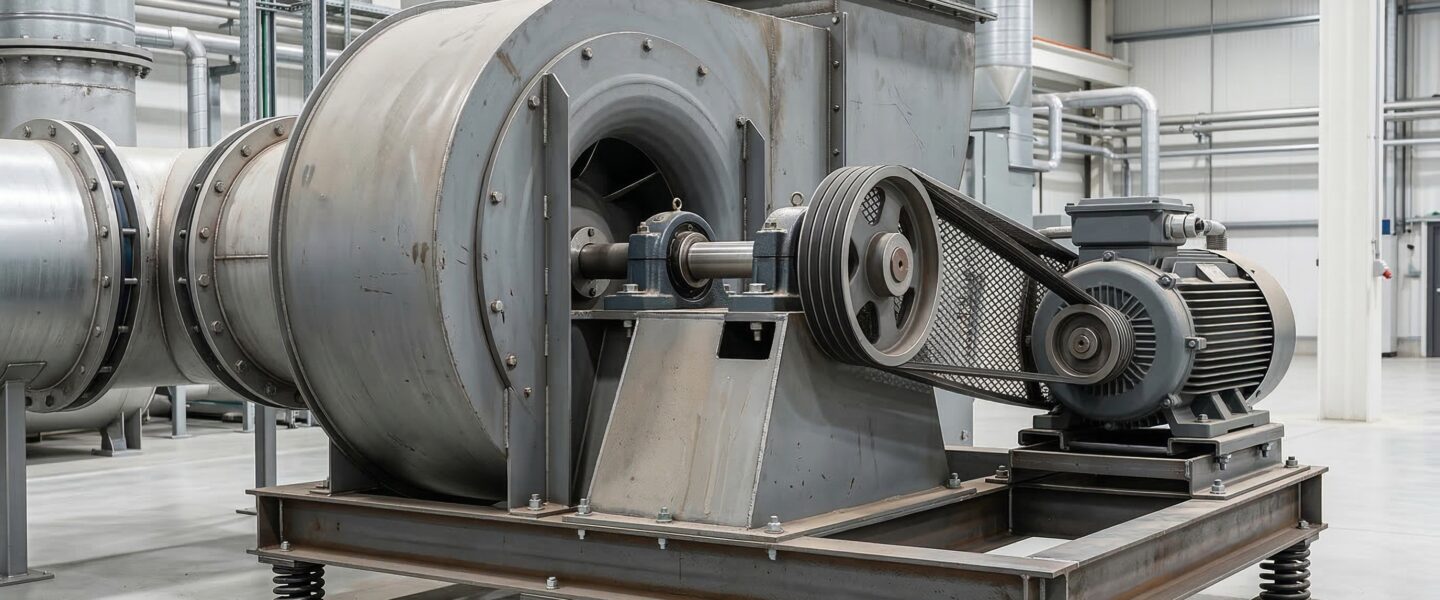
Centrifugal Fan Reliability & Maintenance — industrial maintenance and reliability services

Why Do Centrifugal Fans Deserve Reliability Attention?

Many maintenance organizations treat centrifugal fans as simple, low-priority equipment. This perception is dangerously misleading. Centrifugal fans often operate continuously, accumulating 8,000 or more running hours annually, which subjects bearings, shafts, impellers, and housings to sustained mechanical loading. The operating environment frequently introduces additional stressors that accelerate degradation — high temperatures in furnace exhaust applications, corrosive gases in chemical process ventilation, and abrasive dust in material handling and cement production.

The consequences of an unplanned centrifugal fan failure vary by application, but they are rarely insignificant. A primary air fan failure in a combustion process can force an immediate shutdown. A baghouse fan failure can trigger environmental compliance violations within minutes. An HVAC supply fan failure in a manufacturing facility can halt production lines that depend on temperature or humidity control. In each of these scenarios, the cost of a single unplanned failure typically exceeds the annual cost of a comprehensive centrifugal fan maintenance and monitoring program by a factor of five to ten.

Facilities that implement condition-based centrifugal fan maintenance typically reduce unplanned fan failures by 70-85% within the first two years of program operation.


What Are the Common Reliability Challenges in Centrifugal Fans?

Understanding the specific challenges that degrade centrifugal fan reliability is the foundation of any effective maintenance strategy. While failure modes are covered in detail elsewhere on this page, the broader reliability challenges that create conditions for those failures are worth examining.

Imbalance and Buildup Accumulation

Centrifugal fans operating in dirty environments are particularly susceptible to material buildup on the impeller. Even small amounts of particulate accumulation can create significant imbalance forces because the material does not deposit uniformly. A buildup of just 50 grams on one blade of a large industrial fan impeller can produce vibration levels that exceed acceptable operating limits. In applications involving hygroscopic materials, moisture changes can cause buildup to shift or release unpredictably, creating intermittent vibration spikes that complicate diagnosis if monitoring is not frequent enough to capture the pattern.

The challenge is compounded in fans with backward-curved or airfoil impellers, where buildup accumulates on the concave side of the blades and is difficult to remove without disassembly. Facilities that operate fans in dusty environments without a structured cleaning protocol often find themselves trapped in a cycle of escalating imbalance, accelerated bearing wear, and premature failure.

Bearing System Degradation

Centrifugal fan bearings operate under conditions that demand careful attention to lubrication, alignment, and thermal management. Pillow block bearings on belt-driven fans are subject to radial loads from belt tension in addition to the aerodynamic and gravitational loads from the impeller. When belt tension is excessive or unevenly distributed across multiple belts, bearing loads increase substantially, and bearing life decreases according to the cube of the load increase. A 20% increase in bearing load reduces calculated bearing life by approximately 42%.

Temperature is another persistent challenge. Fans handling hot gases transfer heat through the shaft to the bearings, and without adequate thermal management — shaft cooling discs, extended bearing pedestals, or forced cooling — bearing temperatures can rise into ranges where conventional lubricants break down. Bearing temperatures above 180°F (82°C) require high-temperature greases and more frequent relubrication intervals to prevent premature failure.

Structural and Foundation Issues

Centrifugal fans generate significant dynamic forces, and the structural integrity of the foundation and mounting system is critical to reliable operation. Soft foot conditions, deteriorated grouting, cracked baseplates, and loosened anchor bolts all reduce the effective stiffness of the fan support structure. When structural stiffness decreases, vibration amplitudes increase — not because the fan has developed a mechanical fault, but because the support system can no longer adequately restrain the normal dynamic forces. This distinction matters because the corrective action for a structural deficiency is fundamentally different from the corrective action for a rotor fault.


How Does Condition Monitoring Apply to Centrifugal Fans?

Condition monitoring transforms centrifugal fan maintenance from a calendar-driven activity to a condition-driven strategy that responds to actual equipment health. The monitoring technologies most applicable to centrifugal fans include vibration analysis, thermographic inspection, motor current analysis, and ultrasonic testing, each providing visibility into different aspects of fan condition.

Vibration Analysis for Fan Monitoring

Vibration analysis is the primary monitoring technology for centrifugal fans. Route-based vibration data collection on a monthly interval provides adequate detection margin for the dominant failure modes — imbalance, misalignment, bearing degradation, looseness, and structural resonance. Spectral analysis allows analysts to distinguish between these conditions based on frequency content, amplitude relationships, and phase behavior. For critical fans where unplanned failure carries severe consequences, online continuous monitoring systems provide real-time data and automated alerting that eliminates the gap between collection intervals.

Fans operating at variable speeds require special attention in the vibration monitoring program. Variable-speed operation shifts the running speed frequency and all speed-dependent harmonic content, which means that fixed-threshold alarms based on specific frequency bands will produce false alarms or missed detections. Order-based analysis, which normalizes spectral data to multiples of running speed rather than fixed frequencies, solves this problem and should be the standard approach for any variable-speed fan monitoring.

Vibration trending with a four-stage severity classification system gives maintenance planners the lead time to schedule fan repairs during planned outages rather than reacting to catastrophic failures.

Thermographic and Ultrasonic Inspection

Infrared thermography provides visibility into bearing temperatures, motor winding conditions, electrical connection integrity, and belt drive system health. Thermal patterns on fan housings can also reveal internal buildup accumulation by identifying areas where material deposits insulate the housing and alter heat transfer patterns. Ultrasonic inspection complements vibration analysis by detecting high-frequency stress waves from early-stage bearing defects and lubrication breakdown — often providing earlier detection of lubrication-related issues than vibration analysis alone.


Maintenance Strategies That Work for Centrifugal Fans

The most effective centrifugal fan maintenance programs combine condition-based monitoring with targeted preventive tasks that address the known degradation mechanisms specific to each fan’s operating context. This is not a one-size-fits-all proposition. A clean-air HVAC fan operating at constant speed in a temperature-controlled environment has fundamentally different maintenance requirements than a primary air fan handling abrasive particulate at elevated temperatures.

Preventive Maintenance Essentials

Certain preventive tasks remain essential regardless of the monitoring program in place. Lubrication management — applying the correct grease type and quantity at the correct interval — is the single most impactful preventive action for fan bearings. Over-lubrication causes approximately 36% of bearing failures in electric motor and fan applications, which means that lubrication management is as much about precision and discipline as it is about frequency. Belt inspection and tensioning, cleaning schedules for fans in dirty service, and periodic alignment verification during outages round out the core preventive program.

Condition-Based Repair Scheduling

When condition monitoring identifies a developing fault, the value is realized only if the maintenance organization can respond effectively. This means translating monitoring findings into prioritized, planned work orders with clear descriptions of the identified condition, recommended corrective actions, required parts, and estimated labor hours. Fans identified at early severity stages can be scheduled for the next planned outage. Fans at advanced severity stages require expedited scheduling with operational adjustments to extend remaining life until the repair window opens.

Post-Maintenance Verification

Every fan repair should conclude with a post-maintenance vibration check to verify that the repair achieved acceptable mechanical condition. This step catches installation errors — misalignment introduced during reassembly, soft foot from uneven shimming, imbalance from an improperly installed impeller — before they have time to cause secondary damage. Facilities that consistently perform post-maintenance verification reduce repeat repairs by 25-40% compared to those that return equipment to service without verification.


What Results Can You Expect?

Facilities that partner with Forge Reliability for centrifugal fan maintenance and monitoring programs consistently achieve measurable improvements. Unplanned fan failures decrease significantly, often by 70% or more within 18-24 months. Bearing life extends as lubrication practices improve and alignment deficiencies are corrected. Energy consumption decreases as fans operate in better mechanical condition with reduced friction, lower vibration, and optimized belt tension. Maintenance labor shifts from emergency repairs to planned, scheduled activities that are safer, more efficient, and less disruptive to production.

The return on investment is compelling. For most industrial facilities, the monitoring and maintenance program cost is recovered within the first avoided unplanned failure — and the benefits compound as the program matures, the equipment condition baseline stabilizes, and the maintenance team gains confidence in condition-based decision-making. Forge Reliability provides the monitoring technology, diagnostic expertise, and program structure to make this transition practical and sustainable.

Failure Modes

Common Centrifugal Fan Reliability & Maintenance Failure Modes

Engineers often arrive searching for specific failures. Here are the most common issues we diagnose and resolve.

Impeller Erosion and Buildup

Material erosion from abrasive particulate in the gas stream removes impeller blade material, while sticky deposits build up unevenly, creating mass imbalance that generates vibration and reduces aerodynamic performance.

Key symptom: Increasing synchronous vibration amplitude with visible buildup on impeller

Get Help With This →

Bearing Failure

Bearing degradation from contamination ingress, inadequate lubrication, or misalignment-induced loading creates elevated temperatures, noise, and vibration that progress to seizure if unaddressed.

Key symptom: Elevated bearing housing temperature with audible rumbling or grinding

Get Help With This →

Shaft Fatigue Cracking

Cyclic bending and torsional stresses at shaft diameter transitions, keyways, and coupling fits initiate fatigue cracks that propagate under continued operation, risking sudden shaft fracture during service.

Key symptom: Visible crack indication at shaft shoulder during NDE inspection

Get Help With This →

Housing and Inlet Cone Wear

Erosive gas streams wear housing liners, inlet cones, and cutoff plates, creating clearance increases and air leakage paths that reduce fan efficiency and alter system performance.

Key symptom: Declining static pressure capability with increasing power consumption

Get Help With This →

Diagnostic Methods

Diagnostic Techniques We Use

Vibration Analysis and Balancing

Regular vibration measurement and in-place balancing corrects imbalance from erosion and buildup between shutdowns, maintaining vibration within acceptable limits and extending intervals between impeller cleaning or replacement.

Bearing Condition Monitoring

Bearing housing vibration enveloping (high-frequency demodulation) combined with temperature monitoring and grease analysis detects early-stage bearing degradation from defects, contamination, and lubrication problems.

Structural Integrity Inspection

Scheduled nondestructive examination of shaft critical sections, impeller welds, and housing structural joints using dye penetrant, magnetic particle, or ultrasonic methods detects fatigue cracks before they reach critical size.

Aerodynamic Performance Testing

Pitot traverse and fan curve testing compared against original manufacturer performance data quantifies efficiency losses from erosion, buildup, clearance increases, and damper system degradation.

Services

Services for Centrifugal Fan Reliability & Maintenance

Service

Asset Management for Centrifugal Fans

Asset Management programs for Centrifugal Fans, targeting common failure modes and degradation mechanisms.

Learn More →
Service

CMMS Implementation for Centrifugal Fans

CMMS implementation for centrifugal fans with impeller wall thickness wear tracking, bearing condition trend records, and damper mechanism service data.

Learn More →
Service

Condition Monitoring for Centrifugal Fans

Condition Monitoring programs for Centrifugal Fans, targeting common failure modes and degradation mechanisms.

Learn More →
Service

Dynamic Balancing for Centrifugal Fans

We perform single-plane field balancing on centrifugal fans to ISO 1940 G6.3 or better, correcting imbalance from buildup, erosion, and blade damage.

Learn More →
Service

Equipment Condition Assessment for Centrifugal Fans

Condition assessment for centrifugal fans including impeller wear mapping, bearing condition evaluation, and housing structural integrity review findings.

Learn More →
Service

Equipment Maintenance Programs for Industrial Fans

Forge Reliability delivers structured maintenance programs for industrial fans, targeting blade erosion, bearing failures, imbalance through proven...

Learn More →
Service

FMEA for Centrifugal Fans

Our centrifugal fan FMEA evaluates impeller, bearing, drive, and structural failure modes with RPN scores reflecting your specific gas conditions.

Learn More →
Service

Maintenance Outsourcing for Industrial Fans

Forge Reliability delivers outsourced maintenance for industrial fans, targeting blade erosion, bearing failures, imbalance through proven reliability methods.

Learn More →
Service

Maintenance Planning for Centrifugal Fans

Maintenance planning for centrifugal fans covering impeller erosion inspection job plans, bearing housing service tasks, and vibration-based scheduling.

Learn More →
Service

Motor Current Analysis for Centrifugal Fans

We detect centrifugal fan imbalance, blade damage, and bearing wear through MCSA, identifying fan-specific fault signatures in motor current spectra.

Learn More →
Service

Oil Analysis for Centrifugal Fans

We analyze centrifugal fan bearing lubricants for contamination, wear metals, and grease breakdown to optimize relubrication and prevent failures.

Learn More →
Service

Plant Optimization for Industrial Fans

Forge Reliability delivers plant-level optimization for industrial fans, targeting blade erosion, bearing failures, imbalance through proven reliability...

Learn More →
Service

Precision Shaft Alignment for Centrifugal Fans

We align centrifugal fan drives with thermal growth compensation for hot gas service fans and belt alignment for V-belt and synchronous belt drives.

Learn More →
Service

Predictive Maintenance for Centrifugal Fans

We monitor centrifugal fan health using vibration analysis, bearing temperature trending, and performance mapping to detect imbalance and wear early.

Learn More →
Service

Preventive Maintenance for Centrifugal Fans

We optimize centrifugal fan PM by setting cleaning, bearing service, and impeller inspection intervals based on actual operating conditions and wear data.

Learn More →
Service

RCM for Centrifugal Fans

RCM analysis for centrifugal fans evaluating impeller erosion, bearing degradation, and structural fatigue failure modes per SAE JA1011 decision logic.

Learn More →
Service

Reliability Consulting for Centrifugal Fans

We provide reliability consulting for centrifugal fan fleets with fan wheel fatigue analysis, bearing life optimization, and bad actor identification.

Learn More →
Service

Root Cause Analysis for Centrifugal Fans

We investigate centrifugal fan failures by examining impeller damage, bearing evidence, and structural fatigue to identify the true originating cause.

Learn More →
Service

Thermographic Inspection for Centrifugal Fans

We use infrared imaging to detect fan bearing overheating, motor thermal distress, and ductwork insulation breakdowns on centrifugal fan installations.

Learn More →
Service

Ultrasonic Testing for Centrifugal Fans

Our ultrasonic testing programs detect fan bearing lubrication faults, housing air leaks, and damper seal degradation through acoustic emission methods.

Learn More →
Service

Vibration Analysis for Centrifugal Fans

We diagnose blade imbalance, bearing wear, and structural resonance in centrifugal fans through vibration measurements per AMCA and ISO 14694 standards.

Learn More →

Industries

Industries That Rely on Centrifugal Fan Reliability & Maintenance

Industry

Centrifugal Fan Reliability for Automotive Paint and HVAC Systems

We deliver centrifugal fan reliability for automotive plants, covering paint booth supply and exhaust fans, oven recirculation, and building ventilation.

Learn More →
Industry

Centrifugal Fans Reliability for Cement & Aggregates

We deliver centrifugal fan reliability programs for kiln ID, cooler exhaust, and raw mill fans operating under extreme dust loads in cement production.

Learn More →
Industry

Centrifugal Fans Reliability for Industrial Refrigeration

We deliver centrifugal fan monitoring for ammonia engine room ventilation, evaporator air handling, and condenser airflow systems in refrigeration plants.

Learn More →
Industry

Centrifugal Fans Reliability for Logistics & Distribution

We optimize centrifugal fan reliability for warehouse HVAC, dock ventilation, and refrigerated storage air handling at logistics distribution centers.

Learn More →
Industry

Centrifugal Fan Reliability for Metals & Steel Plant Systems

We deliver centrifugal fan reliability for metals and steel plants, covering EAF fume extraction, baghouse ID fans, and furnace combustion air supply.

Learn More →
Industry

Centrifugal Fan Reliability for Mining Ventilation Systems

We deliver centrifugal fan reliability for mining ventilation, covering main surface fans, underground booster fans, and MSHA-required monitoring systems.

Learn More →
Industry

Centrifugal Fan Reliability for Pharmaceutical HVAC Systems

We deliver centrifugal fan reliability for pharmaceutical HVAC systems, covering bearing wear, wheel imbalance, and cleanroom pressurization stability.

Learn More →
Industry

Centrifugal Fans Reliability for Plastics & Rubber

We optimize centrifugal fan reliability for fume extraction, process cooling, and HVAC ventilation systems across plastics and rubber manufacturing plants.

Learn More →
Industry

Centrifugal Fan Reliability for Pulp & Paper Mill HVAC and Process

We deliver centrifugal fan reliability for pulp and paper mills, covering ID fans, FD fans, dryer hood exhaust, and TRS emission control systems.

Learn More →
Industry

Centrifugal Fans Reliability for Water & Wastewater

We optimize centrifugal fan reliability on odor control scrubbers, HVAC ventilation, and process air systems throughout water treatment facilities.

Learn More →
Industry

Chemical Processing Centrifugal Fans Reliability

Forge Reliability reduces bearing failures and corrosion on centrifugal fans in chemical plant process exhaust, scrubber, and HVAC ventilation systems.

Learn More →
Industry

Food & Beverage Centrifugal Fans Reliability

Forge Reliability improves centrifugal fan reliability on food plant dryers, ovens, exhaust hoods, and HVAC systems handling sanitary air requirements.

Learn More →
Industry

Manufacturing Centrifugal Fans Reliability

Forge Reliability reduces bearing failures and imbalance on centrifugal fans in manufacturing HVAC, dust collection, and process exhaust applications.

Learn More →
Industry

Oil & Gas Centrifugal Fans Reliability

Forge Reliability reduces fan bearing failures and corrosion on centrifugal fans in refinery process units, flare systems, and gas processing ventilation.

Learn More →
Industry

Power Generation Centrifugal Fans Reliability

Forge Reliability reduces bearing failures and erosion on centrifugal fans providing forced draft, induced draft, and primary air at generating stations.

Learn More →

Technical Reference

Technical Overview

Fan vibration limits per AMCA 204 should not exceed 0.15 in/s velocity for direct-drive and 0.20 in/s for belt-driven units in normal service. Imbalance from material buildup on the impeller is the leading cause of elevated vibration — a buildup as small as 50 grams on a 48-inch wheel can push vibration above alarm levels. Belt-driven fans should have belt tension checked monthly; a 1/64-inch deflection per inch of span is the target. Bearing temperature trending should alarm at 180 degrees F for standard grease-lubricated pillow blocks.

Common Questions

FAQ

The most common cause of gradually increasing fan vibration is mass imbalance from uneven erosion or deposit buildup on the impeller. Other contributors include bearing wear, foundation deterioration, coupling wear, and inlet damper imbalance. Regular in-place trim balancing can manage imbalance between overhauls, but the root cause (erosion or fouling) should be addressed to avoid frequent rebalancing requirements.

Limited Availability
We onboard a limited number of new facilities each quarter. Secure your assessment slot before our current availability closes. Reserve Your Spot →

Get Started

Request a Free Reliability Assessment

Tell us about your equipment and facility. Our reliability team will review your situation and recommend a tailored reliability program — no obligation.

Free initial assessment
Response within 1 business day
No obligation or commitment

No obligation. Typical response within 24 hours.

Balance Your Fans in the Field Without Removing the Impeller

Reach out to our engineers to evaluate your fan reliability and implement a monitoring program that prevents unexpected failures.

Claim Your Free Assessment →