
Centrifugal fans are among the most common rotating assets in industrial facilities, and their reliability directly impacts process throughput, energy costs, and environmental compliance. Despite their apparent simplicity, centrifugal fan maintenance demands a disciplined approach because these machines operate under a wide range of conditions — from clean-air HVAC service to heavy-duty material handling with abrasive particulate loads. When a centrifugal fan fails unexpectedly, the consequences extend well beyond the fan itself: lost production, environmental permit violations from failed emissions control, overheated processes, and secondary damage to motors, ductwork, and downstream equipment. Forge Reliability helps industrial facilities move from reactive fan repairs to condition-based strategies that catch developing faults weeks or months before they become failures.
Why Do Centrifugal Fans Deserve Reliability Attention?
Many maintenance organizations treat centrifugal fans as simple, low-priority equipment. This perception is dangerously misleading. Centrifugal fans often operate continuously, accumulating 8,000 or more running hours annually, which subjects bearings, shafts, impellers, and housings to sustained mechanical loading. The operating environment frequently introduces additional stressors that accelerate degradation — high temperatures in furnace exhaust applications, corrosive gases in chemical process ventilation, and abrasive dust in material handling and cement production.
The consequences of an unplanned centrifugal fan failure vary by application, but they are rarely insignificant. A primary air fan failure in a combustion process can force an immediate shutdown. A baghouse fan failure can trigger environmental compliance violations within minutes. An HVAC supply fan failure in a manufacturing facility can halt production lines that depend on temperature or humidity control. In each of these scenarios, the cost of a single unplanned failure typically exceeds the annual cost of a comprehensive centrifugal fan maintenance and monitoring program by a factor of five to ten.
Facilities that implement condition-based centrifugal fan maintenance typically reduce unplanned fan failures by 70-85% within the first two years of program operation.
What Are the Common Reliability Challenges in Centrifugal Fans?
Understanding the specific challenges that degrade centrifugal fan reliability is the foundation of any effective maintenance strategy. While failure modes are covered in detail elsewhere on this page, the broader reliability challenges that create conditions for those failures are worth examining.
Imbalance and Buildup Accumulation
Centrifugal fans operating in dirty environments are particularly susceptible to material buildup on the impeller. Even small amounts of particulate accumulation can create significant imbalance forces because the material does not deposit uniformly. A buildup of just 50 grams on one blade of a large industrial fan impeller can produce vibration levels that exceed acceptable operating limits. In applications involving hygroscopic materials, moisture changes can cause buildup to shift or release unpredictably, creating intermittent vibration spikes that complicate diagnosis if monitoring is not frequent enough to capture the pattern.
The challenge is compounded in fans with backward-curved or airfoil impellers, where buildup accumulates on the concave side of the blades and is difficult to remove without disassembly. Facilities that operate fans in dusty environments without a structured cleaning protocol often find themselves trapped in a cycle of escalating imbalance, accelerated bearing wear, and premature failure.
Bearing System Degradation
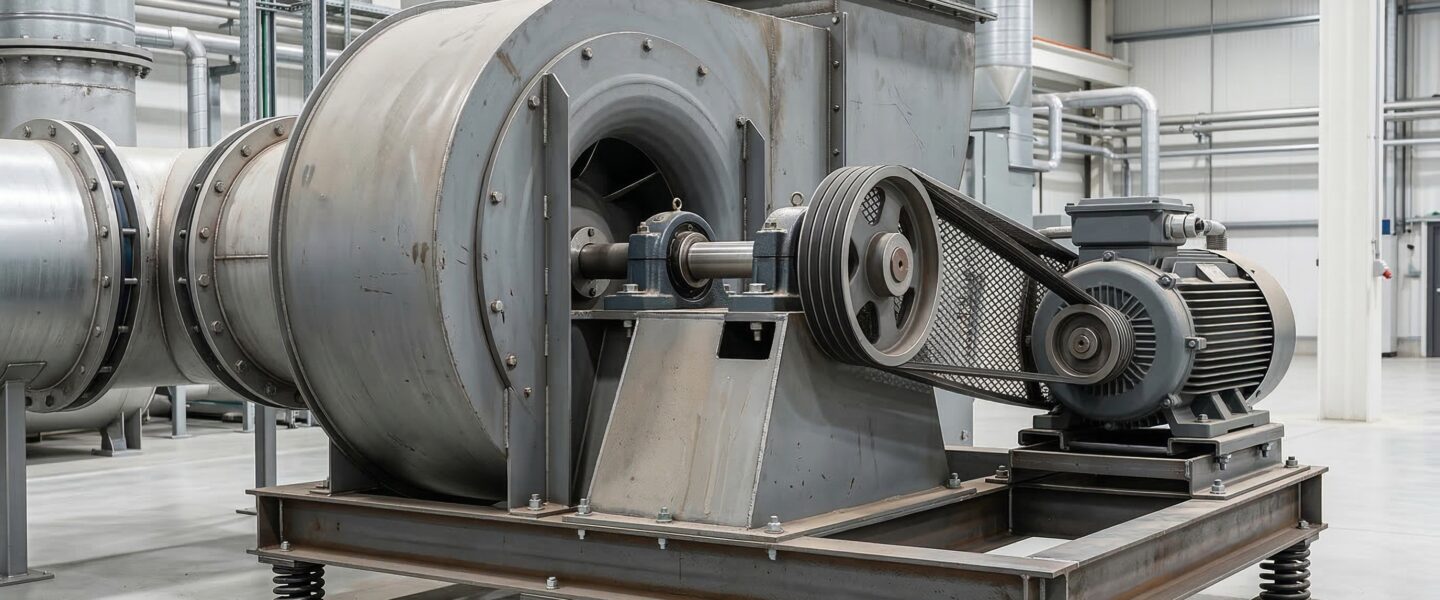
Centrifugal fan bearings operate under conditions that demand careful attention to lubrication, alignment, and thermal management. Pillow block bearings on belt-driven fans are subject to radial loads from belt tension in addition to the aerodynamic and gravitational loads from the impeller. When belt tension is excessive or unevenly distributed across multiple belts, bearing loads increase substantially, and bearing life decreases according to the cube of the load increase. A 20% increase in bearing load reduces calculated bearing life by approximately 42%.
Temperature is another persistent challenge. Fans handling hot gases transfer heat through the shaft to the bearings, and without adequate thermal management — shaft cooling discs, extended bearing pedestals, or forced cooling — bearing temperatures can rise into ranges where conventional lubricants break down. Bearing temperatures above 180°F (82°C) require high-temperature greases and more frequent relubrication intervals to prevent premature failure.
Structural and Foundation Issues
Centrifugal fans generate significant dynamic forces, and the structural integrity of the foundation and mounting system is critical to reliable operation. Soft foot conditions, deteriorated grouting, cracked baseplates, and loosened anchor bolts all reduce the effective stiffness of the fan support structure. When structural stiffness decreases, vibration amplitudes increase — not because the fan has developed a mechanical fault, but because the support system can no longer adequately restrain the normal dynamic forces. This distinction matters because the corrective action for a structural deficiency is fundamentally different from the corrective action for a rotor fault.
How Does Condition Monitoring Apply to Centrifugal Fans?
Condition monitoring transforms centrifugal fan maintenance from a calendar-driven activity to a condition-driven strategy that responds to actual equipment health. The monitoring technologies most applicable to centrifugal fans include vibration analysis, thermographic inspection, motor current analysis, and ultrasonic testing, each providing visibility into different aspects of fan condition.
Vibration Analysis for Fan Monitoring
Vibration analysis is the primary monitoring technology for centrifugal fans. Route-based vibration data collection on a monthly interval provides adequate detection margin for the dominant failure modes — imbalance, misalignment, bearing degradation, looseness, and structural resonance. Spectral analysis allows analysts to distinguish between these conditions based on frequency content, amplitude relationships, and phase behavior. For critical fans where unplanned failure carries severe consequences, online continuous monitoring systems provide real-time data and automated alerting that eliminates the gap between collection intervals.
Fans operating at variable speeds require special attention in the vibration monitoring program. Variable-speed operation shifts the running speed frequency and all speed-dependent harmonic content, which means that fixed-threshold alarms based on specific frequency bands will produce false alarms or missed detections. Order-based analysis, which normalizes spectral data to multiples of running speed rather than fixed frequencies, solves this problem and should be the standard approach for any variable-speed fan monitoring.
Vibration trending with a four-stage severity classification system gives maintenance planners the lead time to schedule fan repairs during planned outages rather than reacting to catastrophic failures.
Thermographic and Ultrasonic Inspection
Infrared thermography provides visibility into bearing temperatures, motor winding conditions, electrical connection integrity, and belt drive system health. Thermal patterns on fan housings can also reveal internal buildup accumulation by identifying areas where material deposits insulate the housing and alter heat transfer patterns. Ultrasonic inspection complements vibration analysis by detecting high-frequency stress waves from early-stage bearing defects and lubrication breakdown — often providing earlier detection of lubrication-related issues than vibration analysis alone.
Maintenance Strategies That Work for Centrifugal Fans
The most effective centrifugal fan maintenance programs combine condition-based monitoring with targeted preventive tasks that address the known degradation mechanisms specific to each fan’s operating context. This is not a one-size-fits-all proposition. A clean-air HVAC fan operating at constant speed in a temperature-controlled environment has fundamentally different maintenance requirements than a primary air fan handling abrasive particulate at elevated temperatures.
Preventive Maintenance Essentials
Certain preventive tasks remain essential regardless of the monitoring program in place. Lubrication management — applying the correct grease type and quantity at the correct interval — is the single most impactful preventive action for fan bearings. Over-lubrication causes approximately 36% of bearing failures in electric motor and fan applications, which means that lubrication management is as much about precision and discipline as it is about frequency. Belt inspection and tensioning, cleaning schedules for fans in dirty service, and periodic alignment verification during outages round out the core preventive program.
Condition-Based Repair Scheduling
When condition monitoring identifies a developing fault, the value is realized only if the maintenance organization can respond effectively. This means translating monitoring findings into prioritized, planned work orders with clear descriptions of the identified condition, recommended corrective actions, required parts, and estimated labor hours. Fans identified at early severity stages can be scheduled for the next planned outage. Fans at advanced severity stages require expedited scheduling with operational adjustments to extend remaining life until the repair window opens.
Post-Maintenance Verification
Every fan repair should conclude with a post-maintenance vibration check to verify that the repair achieved acceptable mechanical condition. This step catches installation errors — misalignment introduced during reassembly, soft foot from uneven shimming, imbalance from an improperly installed impeller — before they have time to cause secondary damage. Facilities that consistently perform post-maintenance verification reduce repeat repairs by 25-40% compared to those that return equipment to service without verification.
What Results Can You Expect?
Facilities that partner with Forge Reliability for centrifugal fan maintenance and monitoring programs consistently achieve measurable improvements. Unplanned fan failures decrease significantly, often by 70% or more within 18-24 months. Bearing life extends as lubrication practices improve and alignment deficiencies are corrected. Energy consumption decreases as fans operate in better mechanical condition with reduced friction, lower vibration, and optimized belt tension. Maintenance labor shifts from emergency repairs to planned, scheduled activities that are safer, more efficient, and less disruptive to production.
The return on investment is compelling. For most industrial facilities, the monitoring and maintenance program cost is recovered within the first avoided unplanned failure — and the benefits compound as the program matures, the equipment condition baseline stabilizes, and the maintenance team gains confidence in condition-based decision-making. Forge Reliability provides the monitoring technology, diagnostic expertise, and program structure to make this transition practical and sustainable.