Home Equipment Thermal Equipment Cooling Towers

Cooling Towers

Reliability programs for cooling tower gearboxes, fans, fill media, and water distribution systems.

Cooling towers are essential components of industrial heat rejection systems, supporting everything from chiller condensers and process heat exchangers to power generation and heavy manufacturing operations. Despite their critical role, cooling towers are frequently among the most neglected assets in a facility — subjected to harsh environmental exposure, aggressive water chemistry, and continuous thermal cycling with minimal monitoring or maintenance attention. When cooling tower performance degrades, the impact propagates through every system that depends on it: chiller efficiency drops, process temperatures rise, and production capacity suffers. Forge Reliability helps industrial facilities implement cooling tower maintenance programs that protect system performance, extend structural life, and prevent the costly cascading failures that tower neglect produces.
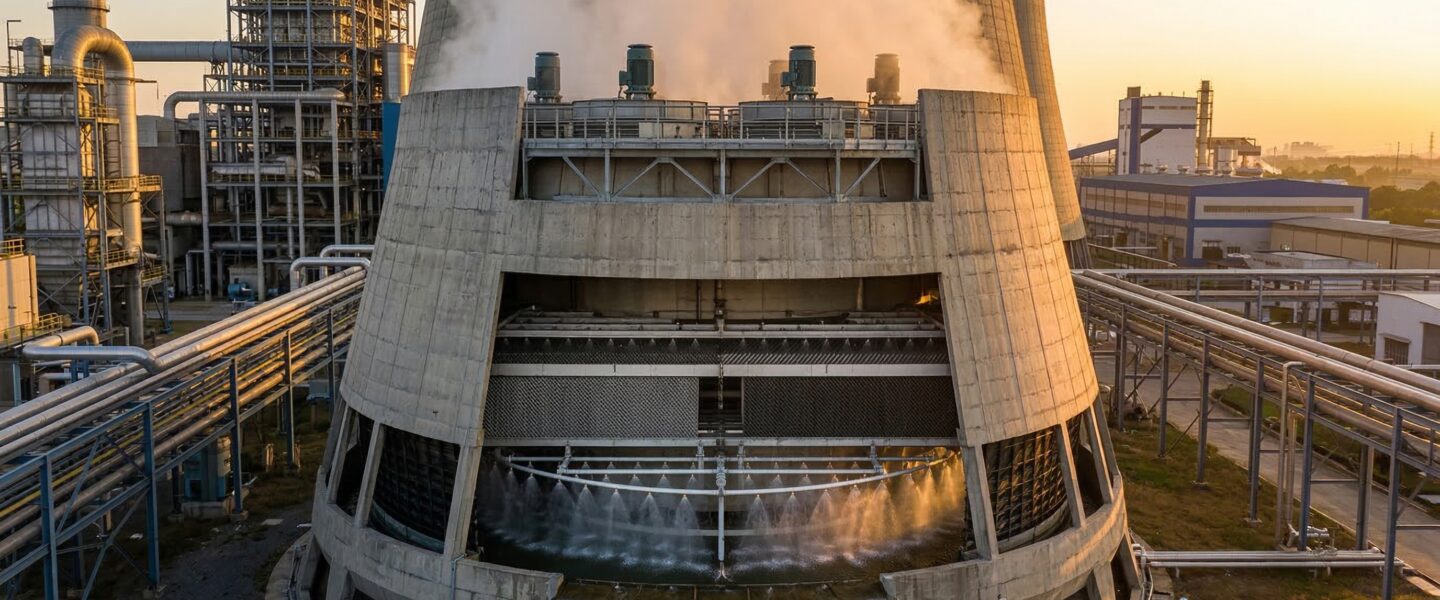
Cooling Tower | Forge Reliability

The Hidden Cost of Cooling Tower Neglect

Cooling towers operate in a uniquely demanding environment. They are exposed to outdoor weather conditions year-round, handle water that concentrates dissolved minerals and biological contaminants through the evaporation process, and experience continuous thermal cycling that stresses structural and mechanical components. This combination of stressors produces degradation that is both relentless and insidious — it progresses gradually enough that operators adapt to declining performance without recognizing the magnitude of the efficiency loss.

The financial impact of cooling tower degradation is often underestimated because it manifests indirectly. A cooling tower that delivers condenser water 5°F warmer than design does not appear broken — but it forces the connected chiller to operate at higher head pressure, increasing compressor energy consumption by approximately 15-20%. Across a cooling season, this single deficiency can add tens of thousands of dollars in excess energy costs to a facility’s operating budget. When multiplied across the thermal, structural, and mechanical degradation modes that accumulate in a neglected tower, the total cost of poor cooling tower maintenance can rival the cost of major equipment failures.

Restoring a neglected cooling tower to design performance typically recovers 10-25% of connected chiller energy consumption — often the single largest energy savings opportunity in a facility’s cooling plant.


What Are the Common Reliability Challenges in Cooling Towers?

Cooling tower reliability encompasses thermal performance, structural integrity, mechanical component condition, and water treatment effectiveness. Each of these domains presents distinct challenges that must be addressed through appropriate monitoring and maintenance strategies.

Fill Media Degradation and Fouling

The fill media is the primary heat transfer surface in a cooling tower, and its condition directly determines thermal performance. Film-type fill media provides high thermal efficiency but is susceptible to fouling from biological growth, scale deposition, and airborne debris. Once fouling restricts airflow through the fill, the tower’s ability to cool water degrades — and the fouling tends to accelerate because reduced airflow allows biological growth and debris accumulation to progress faster. In severe cases, fill fouling adds so much weight that fill support structures fail, dropping fill packs onto the cold water basin and creating a cascading structural failure. Biological fouling is the leading cause of fill media failure in cooling towers that use film-type fill, and controlling it requires consistent water treatment combined with periodic physical inspection.

Splash-type fill is more resistant to fouling but has lower thermal efficiency per unit volume. Many facilities with chronic fouling problems have converted from film to splash fill as a reliability improvement, accepting a modest reduction in thermal performance in exchange for significantly improved maintainability and reduced fouling risk.

Structural Deterioration

Cooling tower structures operate in one of the most corrosive environments in any industrial facility. The combination of warm, saturated air, concentrated mineral content in the recirculating water, and continuous wet-dry cycling at the air inlet faces creates conditions that aggressively attack both wood and metal structural components. Fiberglass reinforced plastic (FRP) structures resist corrosion but can degrade from UV exposure, chemical attack, and mechanical damage over time.

Wood structures require periodic inspection for decay, particularly at connection points and areas of intermittent wetting. Galvanized steel structures lose their protective coating over time, and once the zinc layer is consumed, the underlying steel corrodes rapidly. Structural inspections should occur at minimum annually, with more frequent checks in aggressive environments or on older towers. Structural failures in cooling towers can be catastrophic — a collapsed fan deck, failed distribution system, or structural member failure can take an entire cell out of service for weeks or months.

Mechanical Component Wear

Cooling tower fans, gearboxes, motors, and drive shafts operate in a hot, humid, and often corrosive atmosphere that accelerates wear and degradation. Fan gearbox failures are among the most common and costly mechanical failures in cooling towers. The gearbox operates under continuous load in a high-moisture environment, and lubrication degradation from moisture contamination and thermal cycling is a persistent challenge. Drive shaft imbalance from blade erosion, pitch errors, or ice damage generates cyclic loading that shortens both gearbox and motor bearing life.


How Does Condition Monitoring Apply to Cooling Towers?

Cooling tower condition monitoring addresses both the thermal performance of the tower and the mechanical condition of its rotating components. This dual focus is necessary because thermal performance degradation and mechanical failures are driven by different mechanisms and require different monitoring technologies.

Vibration Analysis for Tower Mechanical Components

Vibration analysis is the primary monitoring technology for cooling tower fan assemblies, gearboxes, and motors. Route-based vibration data collection at monthly intervals tracks bearing condition in the motor, gearbox, and fan shaft bearings. Spectral analysis identifies specific fault conditions: gear mesh frequency analysis detects tooth wear, pitting, and misalignment in the gearbox; running speed and blade pass frequency analysis detects fan imbalance and blade damage; and bearing defect frequency analysis provides early warning of rolling element bearing degradation.

Cooling tower vibration monitoring presents some unique challenges. Access to measurement points on the gearbox and fan bearing assembly often requires climbing to the fan deck, which may be restricted during operation due to safety concerns. For towers where manual access is impractical or hazardous, permanently installed vibration sensors with wireless data transmission provide continuous monitoring without requiring personnel to access the fan deck during operation.

Oil Analysis for Gearbox Health

Gearbox oil analysis is critically important for cooling tower reliability because the gearbox operates in conditions that aggressively degrade lubricant quality. Moisture contamination from the tower environment, thermal cycling between ambient and operating temperatures, and gear wear particle generation all affect oil condition. Quarterly oil sampling with analysis for moisture content, viscosity, particle count, wear metals, and acid number provides a comprehensive view of both lubricant and gearbox health. Trending iron and copper wear metal concentrations reveals gear and bearing wear progression that may not yet be detectable through vibration analysis.

Cooling tower gearbox failures typically cost 3-5 times more than the annual monitoring and maintenance program for the entire tower cell — making condition-based gearbox management one of the highest-return reliability investments available.

Thermal Performance Monitoring

Thermal performance monitoring tracks the tower’s ability to cool water to its design conditions. Key parameters include approach temperature (the difference between the cold water temperature leaving the tower and the ambient wet-bulb temperature), range (the temperature difference between hot water entering and cold water leaving), and effectiveness (the ratio of actual cooling range to the theoretical maximum). Trending these parameters against consistent load and ambient conditions reveals fill fouling, distribution problems, and airflow restrictions that degrade performance. A thermal performance test conducted against design specifications provides a definitive assessment of tower capability and identifies the specific deficiencies that need corrective action.


Maintenance Strategies That Work for Cooling Towers

Effective cooling tower maintenance combines condition monitoring of mechanical components with systematic inspection and maintenance of the tower’s thermal and structural elements. The seasonal nature of many cooling tower operations creates natural windows for maintenance activities that require cells to be out of service.

Seasonal Inspection and Cleaning Programs

Each cooling season should begin with a thorough inspection and cleaning of every tower cell. This includes fill media inspection for fouling and damage, distribution nozzle cleaning and verification, drift eliminator inspection, basin cleaning and debris removal, structural member inspection, and fan blade condition assessment. End-of-season inspections document the condition after a full cooling season and identify work items for off-season maintenance. Facilities that perform consistent seasonal inspections maintain a detailed condition history that supports informed decisions about fill replacement timing, structural repairs, and capital planning.

Water Treatment as a Reliability Strategy

Water treatment is not merely a chemical management task — it is a fundamental reliability strategy for cooling towers and every system connected to them. Effective water treatment programs control scale formation to protect heat transfer surfaces, manage biological growth to prevent fill fouling and Legionella risk, inhibit corrosion to extend structural and piping life, and control suspended solids to prevent basin accumulation and distribution system blockage. Facilities that invest in quality water treatment programs typically achieve 30-50% longer fill media life compared to facilities with minimal or inconsistent treatment.

Gearbox and Drive System Maintenance

Gearbox oil changes should be performed based on oil analysis results rather than fixed calendar intervals. When analysis indicates acceptable oil condition, the change interval can be safely extended — reducing waste and cost without increasing risk. When analysis reveals moisture contamination, particle accumulation, or viscosity changes, the oil should be changed promptly regardless of elapsed time. Fan blade inspection, pitch verification, and balance assessment during the off-season prevent vibration-related damage to the gearbox and motor during the operating season.


What Results Can You Expect?

Facilities that implement comprehensive cooling tower maintenance programs with Forge Reliability consistently achieve improvements that impact both the tower and every system that depends on it. Tower thermal performance returns to or near design conditions, reducing connected chiller energy consumption by 10-25%. Gearbox and fan mechanical failures decrease as condition monitoring identifies developing faults in time for planned repairs. Structural life extends as corrosion is controlled and damage is repaired before it progresses to the point of requiring major structural reconstruction.

The return on investment is compelling because the benefits compound across connected systems. Every degree of improvement in condenser water temperature translates to measurable energy savings at the chiller. Every avoided gearbox failure prevents weeks of lost cooling capacity during peak demand. And every year of extended structural life defers the significant capital cost of tower replacement. Forge Reliability provides the monitoring, inspection, and maintenance program expertise to capture these returns and sustain them across the full service life of your cooling tower assets.

Failure Modes

Common Cooling Tower Reliability & Maintenance Failure Modes

Engineers often arrive searching for specific failures. Here are the most common issues we diagnose and resolve.

Fan Blade Fatigue Cracking

FRP and aluminum cooling tower fan blades develop fatigue cracks from cyclic aerodynamic loading, thermal stress, UV degradation, and erosion from entrained water droplets, with blade separation causing catastrophic damage to the fan stack, gearbox, and tower structure.

Key symptom: Increasing fan vibration with visual cracks at blade root connections or leading edge erosion visible during inspection

Get Help With This →

Gearbox Gear and Bearing Failure

Cooling tower gearbox spiral bevel gears and bearings degrade from torque loading, thermal cycling between ambient and operating temperatures, moisture contamination of lubricant, and misalignment with the fan shaft or motor coupling.

Key symptom: Increasing gearbox vibration and noise with oil analysis showing elevated wear metals and moisture content

Get Help With This →

Fill Media Fouling and Degradation

PVC, PP, and wood fill media surfaces foul with mineral scale, biological growth, silt deposits, and airborne debris, reducing air-water contact surface area and increasing air-side pressure drop, while UV exposure and chemical attack degrade fill structural integrity.

Key symptom: Declining cooling tower approach temperature and capacity with visible fouling or structural deterioration of fill media during internal inspection

Get Help With This →

Basin and Structural Corrosion

Concrete basins deteriorate from carbonation, reinforcing steel corrosion, and chemical attack, while steel structures corrode from the combination of warm, humid air, water spray, and water treatment chemicals, creating leaks and structural safety concerns.

Key symptom: Water leaks from basin walls or joints with visible concrete spalling, reinforcing steel exposure, or steel section loss at structural connections

Get Help With This →

Water Distribution System Failure

Hot water distribution nozzles, troughs, and spray headers plug with debris and scale deposits or crack from UV exposure and thermal stress, creating uneven water distribution over the fill that reduces effective heat transfer surface and tower capacity.

Key symptom: Uneven water distribution visible during tower operation with dry fill sections and declining thermal performance despite adequate water flow

Get Help With This →

Diagnostic Methods

Diagnostic Techniques We Use

Fan and Gearbox Vibration Analysis

Accelerometers on cooling tower gearbox housings and motor bearings detect fan imbalance from blade damage or ice loading, gearbox gear and bearing defects, and structural looseness, providing advance warning of fan system mechanical failures.

Gearbox Oil Analysis

Regular sampling of cooling tower gearbox lubricant for wear metals, moisture content, viscosity, and particle count tracks gear and bearing condition and detects moisture ingress from the cooling tower environment that accelerates lubricant degradation and component wear.

Thermal Performance Testing

Measurement of hot water temperature, cold water temperature, wet bulb temperature, and water flow rate per CTI ATC-105 methodology quantifies actual tower thermal capability as a percentage of design, detecting performance losses from fill fouling, fan degradation, or air recirculation.

Water Chemistry Monitoring

Regular testing of cooling water for conductivity, pH, calcium hardness, alkalinity, scale and corrosion inhibitor residuals, microbiological counts, and Legionella per ASHRAE 188 ensures water treatment programs are maintaining tower performance and public health protection.

Structural Condition Assessment

Periodic inspection of concrete basins, steel and FRP structures, fill supports, fan deck, and handrail systems per CTI guidelines identifies corrosion, deterioration, and structural deficiencies before they create safety hazards or allow component failures.

Services

Services for Cooling Tower Reliability & Maintenance

Service

Asset Management for Cooling Towers

Asset Management programs for Cooling Towers, targeting common failure modes and degradation mechanisms.

Learn More →
Service

CMMS Implementation for Cooling Towers

CMMS Implementation programs for Cooling Towers, targeting common failure modes and degradation mechanisms.

Learn More →
Service

Condition Monitoring for Cooling Towers

Our team establishes continuous condition monitoring programs for cooling towers, targeting fill media degradation, drift eliminator damage, and related...

Learn More →
Service

Dynamic Balancing for Cooling Towers

Dynamic Balancing programs for Cooling Towers, targeting common failure modes and degradation mechanisms.

Learn More →
Service

Equipment Condition Assessment for Cooling Towers

Our team provides comprehensive condition assessments for cooling towers, targeting fill media degradation, drift eliminator damage, and related degradation...

Learn More →
Service

Equipment Maintenance for Cooling Towers

Equipment Maintenance programs for Cooling Towers, targeting common failure modes and degradation mechanisms.

Learn More →
Service

FMEA for Cooling Towers

FMEA programs for Cooling Towers, targeting common failure modes and degradation mechanisms.

Learn More →
Service

Maintenance Outsourcing for Cooling Towers

Maintenance Outsourcing programs for Cooling Towers, targeting common failure modes and degradation mechanisms.

Learn More →
Service

Maintenance Planning for Cooling Towers

Maintenance Planning programs for Cooling Towers, targeting common failure modes and degradation mechanisms.

Learn More →
Service

Motor Current Analysis for Cooling Towers

Motor Current Analysis programs for Cooling Towers, targeting common failure modes and degradation mechanisms.

Learn More →
Service

Oil & Lubrication Analysis for Cooling Towers

Oil & Lubrication Analysis programs for Cooling Towers, targeting common failure modes and degradation mechanisms.

Learn More →
Service

Plant Optimization for Cooling Towers

Plant Optimization programs for Cooling Towers, targeting common failure modes and degradation mechanisms.

Learn More →
Service

Precision Shaft Alignment for Cooling Towers

Precision Shaft Alignment programs for Cooling Towers, targeting common failure modes and degradation mechanisms.

Learn More →
Service

Predictive Maintenance for Cooling Towers

Our team applies predictive maintenance technologies to cooling towers, targeting fill media degradation, drift eliminator damage, and related degradation...

Learn More →
Service

Preventive Maintenance for Cooling Towers

Preventive Maintenance programs for Cooling Towers, targeting common failure modes and degradation mechanisms.

Learn More →
Service

RCM for Cooling Towers

RCM programs for Cooling Towers, targeting common failure modes and degradation mechanisms.

Learn More →
Service

Reliability Consulting for Cooling Towers

Our team applies reliability consulting methodology to cooling towers, targeting fill media degradation, drift eliminator damage, and related degradation...

Learn More →
Service

Root Cause Analysis for Cooling Towers

Our team investigates failures in cooling towers, targeting fill media degradation, drift eliminator damage, and related degradation mechanisms before they...

Learn More →
Service

Thermographic Inspection for Cooling Towers

Thermographic Inspection programs for Cooling Towers, targeting common failure modes and degradation mechanisms.

Learn More →
Service

Ultrasonic Testing for Cooling Towers

Ultrasonic Testing programs for Cooling Towers, targeting common failure modes and degradation mechanisms.

Learn More →
Service

Vibration Analysis for Cooling Towers

Vibration Analysis programs for Cooling Towers, targeting common failure modes and degradation mechanisms.

Learn More →

Industries

Industries That Rely on Cooling Tower Reliability & Maintenance

Industry

Cooling Towers Reliability for Automotive

Cooling Towers reliability and predictive maintenance programs designed for automotive operating environments and compliance requirements.

Learn More →
Industry

Cooling Towers Reliability for Cement & Aggregates

Cooling Towers reliability and predictive maintenance programs designed for cement & aggregates operating environments and compliance requirements.

Learn More →
Industry

Cooling Towers Reliability for Chemical Processing

Cooling Towers reliability and predictive maintenance programs designed for chemical processing operating environments and compliance requirements.

Learn More →
Industry

Cooling Towers Reliability for Food & Beverage

Cooling Towers reliability and predictive maintenance programs designed for food & beverage operating environments and compliance requirements.

Learn More →
Industry

Cooling Towers Reliability for Industrial Refrigeration

Cooling Towers reliability and predictive maintenance programs designed for industrial refrigeration operating environments and compliance requirements.

Learn More →
Industry

Cooling Towers Reliability for Logistics & Distribution

Cooling Towers reliability and predictive maintenance programs designed for logistics & distribution operating environments and compliance requirements.

Learn More →
Industry

Cooling Towers Reliability for Manufacturing

Cooling Towers reliability and predictive maintenance programs designed for manufacturing operating environments and compliance requirements.

Learn More →
Industry

Cooling Towers Reliability for Metals & Steel

Cooling Towers reliability and predictive maintenance programs designed for metals & steel operating environments and compliance requirements.

Learn More →
Industry

Cooling Towers Reliability for Mining

Cooling Towers reliability and predictive maintenance programs designed for mining operating environments and compliance requirements.

Learn More →
Industry

Cooling Towers Reliability for Oil & Gas

Cooling Towers reliability and predictive maintenance programs designed for oil & gas operating environments and compliance requirements.

Learn More →
Industry

Cooling Towers Reliability for Pharmaceutical

Cooling Towers reliability and predictive maintenance programs designed for pharmaceutical operating environments and compliance requirements.

Learn More →
Industry

Cooling Towers Reliability for Plastics & Rubber

Cooling Towers reliability and predictive maintenance programs designed for plastics & rubber operating environments and compliance requirements.

Learn More →
Industry

Cooling Towers Reliability for Power Generation

Cooling Towers reliability and predictive maintenance programs designed for power generation operating environments and compliance requirements.

Learn More →
Industry

Cooling Towers Reliability for Pulp & Paper

Cooling Towers reliability and predictive maintenance programs designed for pulp & paper operating environments and compliance requirements.

Learn More →
Industry

Cooling Towers Reliability for Water & Wastewater

Cooling Towers reliability and predictive maintenance programs designed for water & wastewater operating environments and compliance requirements.

Learn More →

Technical Reference

Technical Overview

Cooling towers manage heat rejection for process and HVAC systems. Key failure modes include fill media degradation, fan motor and gearbox failures, basin corrosion, and water treatment issues. Vibration monitoring, thermography, and water chemistry analysis form an effective cooling tower reliability program.

Common Questions

FAQ

Approach temperature is the difference between the cold water temperature leaving the cooling tower basin and the ambient wet bulb temperature. It is the primary measure of cooling tower thermal performance — a tower designed for a 7 degree F approach that is measuring 12 degrees F approach has lost significant cooling capacity. Approach temperature increases over time from fill fouling, fan degradation, air recirculation, and water distribution problems. Trending approach temperature at consistent operating conditions (water flow rate and heat load) provides the most practical indicator of when maintenance or fill replacement is needed to restore cooling capacity.

Limited Availability
We onboard a limited number of new facilities each quarter. Secure your assessment slot before our current availability closes. Reserve Your Spot →

Get Started

Request a Free Reliability Assessment

Tell us about your equipment and facility. Our reliability team will review your situation and recommend a tailored reliability program — no obligation.

Free initial assessment
Response within 1 business day
No obligation or commitment

No obligation. Typical response within 24 hours.

Having Problems With Your Cooling Towers?

Claim Your Free Assessment →