
Gas turbines represent some of the highest-value rotating assets in any industrial operation, with individual units valued from several hundred thousand dollars to tens of millions depending on size and application. Whether driving generators in power plants, compressors in oil and gas pipelines, or mechanical loads in petrochemical facilities, gas turbines operate at extreme temperatures, high rotational speeds, and tight engineering tolerances that leave little margin for undetected degradation. Effective gas turbine maintenance is not simply about preventing failures — it is about managing the controlled degradation of hot section components, optimizing maintenance intervals to capture maximum component life, and ensuring that every maintenance intervention returns the machine to a condition that supports reliable, efficient operation until the next planned event.
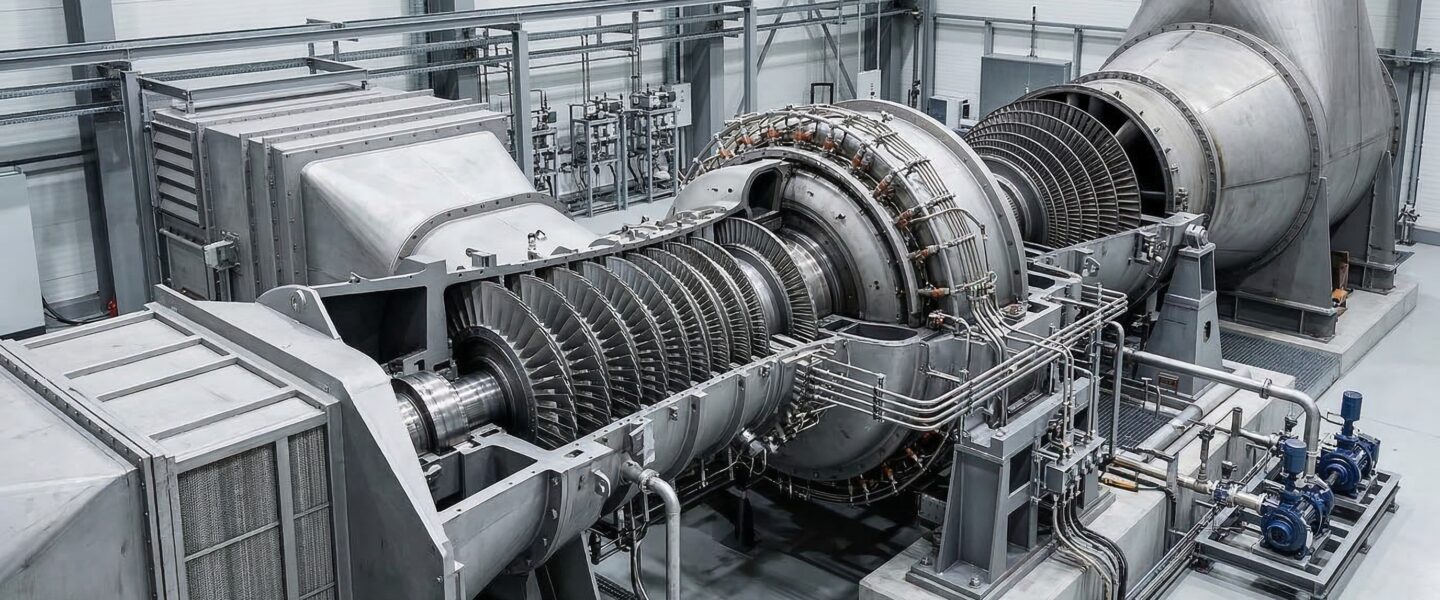
The Reliability Landscape of Gas Turbines
Gas turbines operate on the Brayton thermodynamic cycle, compressing ambient air, mixing it with fuel, combusting the mixture, and expanding the hot gas through turbine stages that extract mechanical work. The combination of firing temperatures exceeding 2,000 degrees Fahrenheit in modern machines, compressor discharge pressures above 250 PSI, and rotor speeds ranging from 3,600 RPM for large frame units to over 25,000 RPM for aeroderivative machines creates an operating environment where component degradation is not a question of if, but how fast.
The hot gas path — combustion liners, transition pieces, first-stage turbine nozzles, and first-stage turbine buckets — experiences the most severe conditions and drives the maintenance planning cycle. These components operate at temperatures that approach the metallurgical limits of the nickel-based superalloys and thermal barrier coatings from which they are constructed. Creep deformation, thermal fatigue cracking, oxidation, hot corrosion, and coating degradation all progress as functions of operating hours, starts (thermal cycles), and fuel quality. Original equipment manufacturers define maintenance intervals in terms of factored fired hours and factored starts, with adjustment factors for fuel type, load profile, trip events, and environmental conditions. Understanding and correctly applying these factors is fundamental to gas turbine maintenance planning.
A single unplanned gas turbine trip can consume 10-20 equivalent factored starts worth of hot section component life, making trip reduction one of the most impactful reliability investments a facility can make.
Compressor Section Challenges
While the hot section receives the most attention in gas turbine maintenance planning, the compressor section has its own significant reliability challenges. Compressor blade fouling from airborne contaminants — salt, hydrocarbons, agricultural dust, industrial particulate — reduces compressor efficiency and mass flow, which directly reduces power output and increases heat rate. A fouled compressor operating at 3-5% below design efficiency can cost a facility hundreds of thousands of dollars annually in reduced output and increased fuel consumption. Compressor blade erosion, foreign object damage, and in severe cases, compressor blade liberation events add mechanical integrity concerns to the performance degradation challenge.
Condition Monitoring for Gas Turbines
Gas turbine condition monitoring combines performance analysis, mechanical monitoring, and fluid analysis into an integrated health management approach. The stakes are high — both the cost of unplanned failures and the cost of premature maintenance interventions on these expensive machines justify sophisticated monitoring programs.
Performance Monitoring and Thermodynamic Analysis
Gas turbine performance monitoring uses the machine’s own operating data — compressor inlet and discharge pressures and temperatures, exhaust temperature, fuel flow, power output, and ambient conditions — to calculate key performance parameters including compressor efficiency, turbine efficiency, heat rate, and power output corrected to reference conditions. Trending these corrected parameters over time reveals degradation patterns that identify specific maintenance needs. Declining compressor efficiency with stable turbine section performance indicates compressor fouling or blade damage. Increasing exhaust temperature spread — the variation among individual exhaust thermocouples — indicates combustion system or first-stage nozzle deterioration. Performance monitoring provides continuous health assessment without any physical contact with the machine, making it the foundation of any gas turbine maintenance program.
Vibration Monitoring
Gas turbines are equipped with factory-installed vibration monitoring systems — typically proximity probes on the rotor bearings measuring shaft-relative vibration per API 670 standards. Continuous monitoring of shaft vibration amplitude, phase, and frequency content detects rotor imbalance from blade damage or deposits, bearing wear, misalignment, and rotor thermal distortion. Startup and shutdown transient analysis using Bode and polar plots reveals changes in rotor dynamics that indicate developing problems not visible at steady-state operating speed. Casing-mounted accelerometers supplement proximity probe data by detecting bearing housing vibration and structural response that shaft-relative measurements may not capture.
Exhaust Gas Analysis
Exhaust gas analysis provides a direct window into combustion quality and hot section component condition. Individual exhaust thermocouple monitoring reveals temperature spreads that indicate uneven combustion, failed or degraded combustion liners, or nozzle passage blockage. In some advanced monitoring programs, exhaust gas spectral analysis can detect trace metals in the exhaust stream that indicate hot section component material loss — an early indicator of coating failure or base metal distress. Trending exhaust temperature patterns against fuel flow and load provides a sensitive indicator of combustion system health.
Facilities that implement comprehensive gas turbine condition monitoring — combining performance analysis, vibration trending, and exhaust gas monitoring — typically extend hot section inspection intervals by 10-15% while maintaining or improving reliability, recovering significant value from deferred maintenance costs.
Maintenance Strategy: Navigating the Inspection Cycle
Gas turbine maintenance is structured around a hierarchy of planned inspection intervals — combustion inspection (CI), hot gas path inspection (HGPI), and major overhaul — each with increasing scope and cost. The specific intervals depend on the machine model, operating profile, and OEM recommendations, but a typical heavy-frame gas turbine might follow a pattern of combustion inspections at 8,000 factored fired hours, hot gas path inspections at 24,000 hours, and major overhauls at 48,000 hours. Aeroderivative machines follow different patterns based on their modular design philosophy.
Combustion Inspection Planning
The combustion inspection is the most frequent planned maintenance event and focuses on the combustion liners, transition pieces, fuel nozzles, and crossfire tubes. These components operate in the hottest region of the gas path and are designed as replaceable wear items. Effective gas turbine maintenance planning for combustion inspections includes trending combustion dynamics data (pressure pulsations in the combustion chambers) to detect incipient liner cracking, monitoring exhaust temperature spread trends to identify deteriorating combustion hardware, and using borescope inspections between planned events to visually assess component condition. The goal is to arrive at each combustion inspection with a clear understanding of expected component conditions, allowing parts and repair services to be staged in advance to minimize outage duration.
Hot Gas Path and Major Overhaul Management
Hot gas path inspections address the first-stage turbine nozzles and buckets in addition to combustion components, while major overhauls extend the scope to include the full turbine section, compressor, rotor, and bearings. These are high-cost events — a major overhaul on a large frame gas turbine can cost several million dollars in parts, labor, and lost production. Condition-based extension of these intervals using monitoring data, borescope findings, and trending analysis can defer millions in maintenance costs when the data supports it. Conversely, ignoring warning signs and running components beyond their safe operational limit risks catastrophic failures that dwarf the cost of a planned overhaul.
Fuel and Inlet Air Quality Management
Gas turbine component life is heavily influenced by fuel quality and inlet air quality — two factors that are often under the facility’s direct control. Natural gas fuel quality variations including hydrogen sulfide content, moisture, and heavy hydrocarbon liquids affect combustion dynamics, hot section corrosion rates, and emissions compliance. Liquid fuel operations introduce additional concerns including trace metal contamination (vanadium, sodium, potassium, lead) that causes accelerated hot corrosion of turbine components at rates many times greater than clean fuel operation.
Inlet air filtration system maintenance directly impacts compressor section reliability and performance. Filter efficiency, pressure drop, and bypass seal integrity determine how much ambient contamination reaches the compressor. A filter system operating with degraded seals or damaged filter elements allows particulate ingestion that erodes compressor blades and fouls surfaces, reducing both efficiency and component life. Inlet air filtration system maintenance should be integrated into the gas turbine maintenance program rather than treated as a separate, lower-priority activity.
Compressor water wash programs — both online and offline — recover compressor performance lost to fouling. Online water wash performed during operation slows the rate of fouling-related performance loss. Offline (crank) water wash performed during shutdowns provides more thorough cleaning. The economics of compressor washing are compelling — a properly executed wash program on a 40 MW gas turbine can recover $200,000-500,000 annually in fuel savings and additional power output compared to allowing the compressor to foul between planned maintenance events.
What Results Can You Expect?
Implementing a comprehensive gas turbine maintenance program built on condition monitoring, planned inspection management, and operational best practices delivers significant financial and reliability improvements. Based on our experience with industrial and power generation gas turbines, the following outcomes are representative.
- Unplanned outage frequency reduced by 50-65% through comprehensive condition monitoring that detects developing problems with sufficient lead time for planned intervention
- Maintenance cost per fired hour reduced by 15-25% through condition-based inspection interval optimization that captures full component life without exceeding safe operational limits
- Hot section component life extended by 10-20% through trip reduction programs, fuel quality management, and operational practices that minimize thermal cycling and peak temperature excursions
- Compressor performance maintained within 1-2% of new-and-clean baseline through optimized wash programs and inlet filtration system maintenance
- Heat rate improvement of 1-3% from maintained compressor efficiency, optimized combustion tuning, and corrected mechanical conditions that affect thermodynamic performance
- Outage duration reduced by 20-30% through pre-outage condition assessment that enables accurate scope definition, advance parts staging, and elimination of scope surprises during the event
Gas turbines are unique among industrial assets in that the cost of both undermaintenance and overmaintenance is exceptionally high. Running hot section components to failure risks catastrophic damage to downstream components that multiplies repair costs by an order of magnitude. Replacing components too early discards millions of dollars in remaining useful life. The discipline of gas turbine maintenance is finding the precise balance — using monitoring data, inspection findings, and engineering analysis to extract maximum value from every component while maintaining the safety and reliability margins that these high-energy machines demand.