
Heat exchanger maintenance on plate-type units is a specialized discipline that balances thermal performance, mechanical integrity, and process hygiene — often simultaneously. Plate heat exchangers are favored across industries for their compact footprint, high thermal efficiency, and the ability to be disassembled for inspection and cleaning, but these advantages come with maintenance requirements that differ fundamentally from shell-and-tube designs. At Forge Reliability, we help facilities manage plate heat exchanger reliability through structured inspection programs, condition monitoring, and maintenance strategies that prevent the two most costly failure modes: thermal performance degradation and gasket-related leakage.
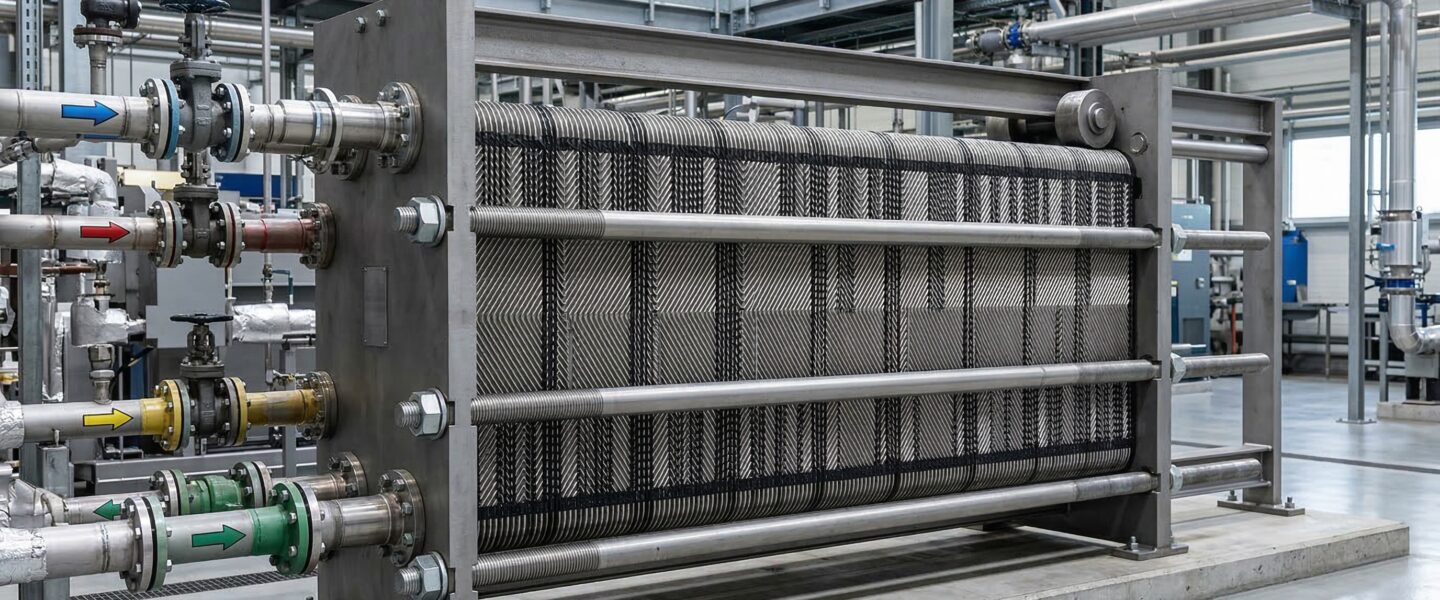
The operating principle of a plate heat exchanger — thin corrugated plates separated by gaskets, creating alternating channels for hot and cold fluids — makes these units exceptionally efficient at transferring heat. The corrugated plate pattern induces turbulent flow at relatively low velocities, which increases heat transfer coefficients far above what smooth-tube designs achieve. However, this same design creates narrow flow channels that are sensitive to fouling, gasket surfaces that are vulnerable to chemical attack and thermal cycling, and plate materials that can suffer corrosion, erosion, and fatigue cracking under conditions that would not challenge a heavier-walled shell-and-tube exchanger. Successful heat exchanger maintenance requires understanding these vulnerabilities and managing them proactively.
The Real Cost of Plate Heat Exchanger Neglect
Plate heat exchanger problems rarely announce themselves with dramatic failures. Instead, they erode process performance gradually. Fouling accumulates layer by layer, reducing thermal efficiency and requiring the system to compensate — higher flow rates, elevated temperatures, or longer process times — to achieve the same heat transfer result. Gaskets age and lose elasticity, developing micro-leaks that may go undetected until a cross-contamination event or environmental release occurs. Plates thin from corrosion in localized areas, eventually developing pinhole leaks that allow the two process streams to mix.
The financial impact of these gradual degradation modes is substantial but often hidden in operating costs rather than appearing as a discrete maintenance event. A fouled plate heat exchanger in a process cooling application may force the facility to run additional cooling capacity — a compressor, cooling tower, or chilled water system — to compensate for the lost thermal performance. The energy cost of running that additional capacity can exceed $10,000 to $50,000 annually depending on the application, but it accrues as a utility expense rather than a maintenance cost, making it invisible to maintenance budgets.
Industry experience shows that plate heat exchangers operating with even a 1-2 mm fouling layer can lose 20-30% of their design heat transfer capacity — a loss that compounds energy costs continuously until the exchanger is cleaned or replaced.
Gasket Degradation and Leakage Risk
Gaskets are the consumable component of a plate heat exchanger, and their condition directly determines the unit’s integrity. Gasket materials — typically nitrile (NBR), EPDM, or fluoroelastomer (FKM/Viton) compounds depending on the process chemistry and temperature — degrade through a combination of chemical exposure, thermal aging, compression set, and mechanical stress during plate pack tightening cycles. As gaskets lose elasticity, they can no longer maintain the seal pressure needed to prevent leakage between the process streams or to the atmosphere.
The consequences of gasket failure range from nuisance drips to catastrophic process cross-contamination. In food and beverage or pharmaceutical applications, any cross-contamination between the product and utility streams can result in product recalls, regulatory citations, and significant financial liability. In chemical processing, mixing incompatible streams through a failed gasket can create hazardous reactions. For these reasons, gasket management — selecting the right material for the application, tracking gasket age and compression history, and establishing condition-based replacement criteria — is a central element of any heat exchanger maintenance program.
Plate Corrosion and Fatigue
Plate materials are selected based on process chemistry — stainless steel grades 304 and 316 for general service, titanium for seawater and chloride-rich streams, nickel alloys for aggressive chemical applications. Even with proper material selection, localized corrosion can develop at crevices, under deposits, or in areas where the passive oxide layer has been damaged by abrasive particles or high-velocity impingement. Pitting corrosion is particularly insidious because it penetrates the thin plate wall from one side, potentially creating a leak path between process streams before the external surface shows any visible degradation.
Thermal fatigue is another concern on exchangers that experience frequent temperature cycling. The thin plates expand and contract with each thermal cycle, and over thousands of cycles, fatigue cracks can initiate at stress concentration points — typically at the edges of the corrugation pattern or at the gasket groove transitions. Plates in services with temperature differentials exceeding 100 degrees Fahrenheit between startup and operating conditions are at elevated risk and warrant more frequent inspection.
Condition Monitoring and Inspection for Plate Heat Exchangers
Unlike rotating equipment where vibration analysis provides a continuous window into mechanical health, plate heat exchangers require a combination of performance monitoring, periodic inspection, and non-destructive examination to assess condition comprehensively.
Thermal Performance Monitoring
The most accessible and valuable monitoring parameter for plate heat exchangers is thermal performance — the actual heat transfer rate compared to the design or clean-condition baseline. Monitoring inlet and outlet temperatures on both the hot and cold sides, along with flow rates, allows calculation of the actual heat duty and the overall heat transfer coefficient (U-value). Trending the U-value over time reveals fouling accumulation as a progressive decline from the clean baseline. When the U-value has dropped to 70-80% of the clean condition, cleaning should be scheduled to restore performance before the fouling progresses to a point where it compromises process requirements or becomes difficult to remove.
This approach transforms cleaning from a time-based activity — “clean the exchanger every six months” — to a condition-based decision driven by actual performance data. Some exchangers in clean services may run for a year or more before needing attention, while others in fouling-prone applications may need cleaning quarterly. Performance monitoring ensures each unit is cleaned when it needs it, not when the calendar says so.
Pressure Drop Monitoring
Pressure drop across the plate pack is a complementary indicator of fouling and flow restriction. As deposits accumulate in the narrow plate channels, the flow resistance increases and the pressure drop rises. Trending differential pressure at constant flow rate provides an early and sensitive indicator of fouling that often shows changes before thermal performance monitoring detects a significant decline. A sudden spike in pressure drop at constant flow may indicate that debris has entered the exchanger and is blocking channels — a condition that can cause flow maldistribution and localized overheating if not addressed.
Combining thermal performance trending with pressure drop monitoring catches over 90% of fouling events early enough to schedule cleaning during planned downtime rather than forcing emergency shutdowns when process temperatures exceed limits.
Visual and Non-Destructive Plate Inspection
When the plate pack is opened for cleaning, the opportunity for direct plate and gasket inspection should never be wasted. Each plate should be visually examined for corrosion pitting, erosion patterns, cracking, and deformation. Gaskets should be inspected for hardening, cracking, permanent compression set, and chemical attack. Plates with suspected thinning can be assessed using ultrasonic thickness measurement to quantify remaining wall thickness and determine whether the plate is fit for continued service.
Dye penetrant inspection on plates suspected of fatigue cracking provides a reliable method for detecting surface-breaking cracks that visual inspection may miss. This is particularly important on plates that have been in service for multiple years in thermally cycling applications, where fatigue cracks may be present but not yet through-wall.
Maintenance Strategies for Long-Term Plate Heat Exchanger Reliability
At Forge Reliability, we build heat exchanger maintenance programs that integrate performance monitoring, scheduled inspection, and component lifecycle management into a cohesive strategy. The goal is to maximize thermal efficiency, prevent leakage events, and extend the useful life of the plate pack and gasket set.
Cleaning Protocols and Fouling Prevention
Cleaning effectiveness depends on matching the cleaning method and chemistry to the type of fouling. Biological fouling in cooling water applications responds to alkaline cleaners and biocides. Mineral scale from hard water requires acid-based cleaning solutions. Particulate fouling may be removable with high-pressure water washing alone. Using the wrong cleaning approach wastes time and chemicals while leaving residual fouling that accelerates recontamination. We develop cleaning procedures specific to each exchanger’s fouling profile, including chemical concentrations, contact times, temperature requirements, and rinse protocols that protect plate and gasket materials while maximizing cleaning effectiveness.
Gasket Lifecycle Management
Rather than replacing gaskets only when they leak, a lifecycle management approach tracks gasket age, compression history (number of tightening cycles), and exposure conditions to predict when replacement is warranted. Gaskets that have been compressed and released multiple times during plate pack openings lose resilience progressively. Industry guidance suggests that most elastomeric gaskets should be evaluated for replacement after five to seven compression cycles or when they have reached the material manufacturer’s recommended age limit for the operating conditions, whichever comes first.
Results from a Proactive Program
Facilities that implement structured heat exchanger maintenance programs realize measurable benefits across energy efficiency, process reliability, and maintenance cost. Energy savings from maintaining clean heat transfer surfaces typically range from 10-25% of the exchanger’s contribution to process energy consumption. Unplanned shutdowns from gasket leaks and cross-contamination events decline as gasket condition is managed proactively. Plate replacement costs decrease as corrosion and fouling are managed before they cause irreversible plate damage. The combined effect is a heat exchanger fleet that delivers consistent process performance at lower total cost of ownership — an outcome that pays dividends on every operating hour.