
A predictive maintenance schedule shouldn't turn a remaining-useful-life estimate into an automatic work-order date. A forecast can identify risk, but it can't book an outage, confirm the failure mode, locate a spare, or put the right technicians on the job. The schedule has to connect what equipment is doing to what the plant can safely execute.
That distinction matters on a process-water pump, where changing load and noisy vibration readings can make a precise failure date misleading. The useful output is a rolling risk window: a period in which the team can verify the condition, prepare the repair, and intervene before the risk becomes unacceptable.
Table of Contents
- Why a Predictive Maintenance Schedule Is a Risk Window
- Ranking Assets and Mapping Failure Modes
- Choosing Route Checks or Continuous Monitoring
- Setting Alarm Thresholds and Work Windows
- Prioritizing Jobs When Capacity Runs Short
- Piloting the Schedule and Tracking Results
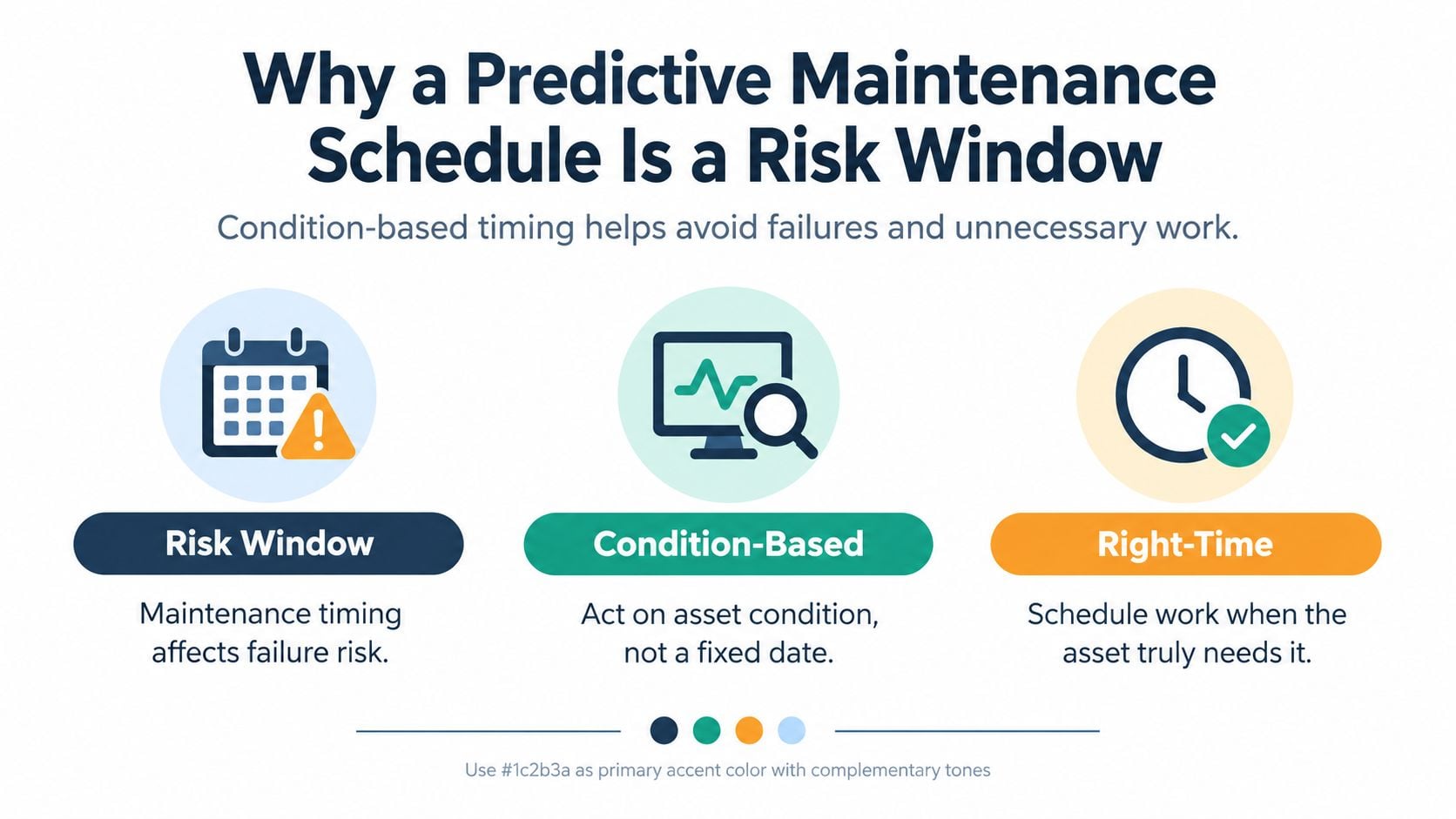
Why a Predictive Maintenance Schedule Is a Risk Window
The popular advice that predictive maintenance replaces maintenance judgment with a precise date gets the decision backward. A remaining-useful-life estimate can inform a plan, but it can't make one. Sensor noise, operating-regime changes, and production constraints all affect when a repair can happen. A useful schedule identifies the period in which action is safe and necessary, then assigns people and resources to make that action possible.
The scale of reactive maintenance shows what's at stake. In a national study of U.S. manufacturing machinery based on 2016 data, NIST found that establishments allocated 17.3% of maintenance activity to predictive work, 31.8% to preventive work, and 45.7% to reactive work. NIST also estimated $222.0 billion in annual maintenance-related costs and losses, including $57.3 billion in direct machinery-maintenance expenditures, $16.3 billion in additional fault and failure costs, and $0.9 billion in inventory used to buffer maintenance problems (NIST's manufacturing machinery maintenance study). Nearly half of maintenance activity occurring after failure is a warning: a schedule that only predicts a date without creating an executable plan leaves the plant exposed to disruption and secondary damage.
The window is the decision
Consider a process-water pump with a rising vibration trend. The operating load changes, the sensor reading has some noise, and a production outage isn't available on the day a model flags increased risk. A single date conceals those conditions. A risk window makes them part of the decision by specifying the earliest safe intervention, the latest acceptable intervention, and what evidence or operating change would require escalation.
The schedule should connect five actions:
- Detect: Identify a meaningful change in vibration, oil debris, motor current, or temperature.
- Diagnose: Confirm which failure mechanism best explains the change.
- Plan: Secure labor, access, spares, and a production opportunity.
- Repair: Complete the intervention within the agreed window.
- Verify: Record what the inspection found and whether the repair addressed the suspected mechanism.
Practical rule: A forecast isn't a maintenance plan until the work can be staffed, supplied, and fitted into a safe operating window.
That's why a predictive maintenance schedule is best understood as a condition-based, right-time intervention strategy, not a fixed calendar slot. A prediction can still be accurate and lead to a poor outcome if the plan ignores uncertainty, outage opportunities, or execution capacity. The schedule must change as new evidence arrives.
Ranking Assets and Mapping Failure Modes
Not every asset deserves continuous monitoring or a predictive work plan. The starting point is consequence: what happens to safety, production, quality, or the environment if the asset fails? Reliability engineers and maintenance managers should rank assets by failure consequence, frequency, detectability, and required lead time for parts, access, and repair.
A conveyor drive motor may deserve attention if its failure stops a production line and its bearing or electrical condition can be detected early. A failure that arrives with little warning, by contrast, may be better managed with preventive tasks or a controlled run-to-failure policy. Predictive monitoring only helps when a measurable precursor appears early enough for the plant to act.
Map condition data to a credible mechanism
FMEA, or failure modes and effects analysis, is a structured way to name how equipment can fail and what that failure would affect. RCM, or reliability-centered maintenance, uses failure consequences and available condition information to decide which maintenance approach fits each failure mode. Together, they help teams avoid treating every anomaly as a repair instruction.
For a conveyor drive motor, the mapping could look like this:
- Vibration: A change may indicate mechanical imbalance or bearing deterioration.
- Temperature: A rise may point to lubrication or cooling trouble.
- Motor current: A trend change may reflect an abnormal load or electrical problem.
- Process load: Production data can help distinguish a machine fault from a change in what the conveyor is carrying.
The schedule line should state the measured variable, why and how often it's collected, what alarm logic applies, how the finding will be confirmed, and what intervention follows. “Inspect motor monthly” doesn't identify the failure mechanism or make a condition-based decision. A more useful instruction names the signal and specifies what the team does when that signal changes.
A structured FMEA for manufacturing can help teams document failure modes, effects, and detection opportunities before assigning monitoring work. The output should be a short critical-asset list, not a blanket mandate to instrument every machine. Intrusive maintenance should wait for a credible failure mechanism; failures that are hard to detect early or develop suddenly should remain on a suitable preventive or run-to-failure strategy.
Choosing Route Checks or Continuous Monitoring
Once an asset and failure mode justify condition monitoring, the planner has to choose how the signal will be collected. Route-based checks work when the fault develops slowly enough for scheduled readings and the equipment is accessible. Continuous monitoring is more suitable when the warning time is short, the asset is difficult to access, or missing a reading could leave too little time to act.
A centrifugal pump illustrates the difference. After alignment and commissioning, the team should establish a vibration baseline and collect later readings under comparable load and speed. A material change in the trend or a new feature associated with a bearing or rotating component deserves investigation. One isolated reading, without context, isn't a reliable reason to replace a bearing.
The U.S. Department of Energy notes that vibration trending can detect impending bearing failure and identify imbalance associated with impeller erosion or coupling problems. Its pump guidance also recommends combining vibration or oil analysis with bearing-noise and operating-temperature checks, and following the pump manufacturer's instructions when lubricating or replacing bearings (Department of Energy guidance on pumping systems).
Match collection style to the signal
For a process-water pump, rising broadband vibration accompanied by higher bearing temperature should prompt checks of lubrication, coupling alignment, soft foot, and the hydraulic operating point before a bearing replacement is authorized. Soft foot is a condition in which a machine's mounting feet don't sit evenly on the base, which can distort the frame when the hold-down bolts are tightened.
| Failure signal | Typical asset | Better format | Why |
|---|---|---|---|
| Gradual bearing vibration trend | Accessible pump or motor | Route-based checks | Readings can be compared under similar operating conditions. |
| Rapidly changing vibration on a critical machine | Hard-to-access rotating equipment | Continuous monitoring | Frequent data helps reveal changes between inspection routes. |
| Oil debris or viscosity change | Gearbox or lubricated bearing system | Route-based oil analysis, with escalation as needed | Sample trends can guide confirmation and repair planning. |
| Electrical hot spot | Motor connection or electrical assembly | Thermography route, with follow-up inspection | A periodic thermal check can identify abnormal heating. |
| Motor-current sidebands | Motor or driven equipment | Continuous or targeted current monitoring | Changes can help flag rotor or load-related abnormalities. |
Forge Reliability's available methods include vibration, oil analysis, thermography, ultrasound, and motor current signature analysis, delivered through routes or continuous monitoring for equipment such as pumps, compressors, motors, gearboxes, and turbines. For another example of condition-based monitoring applied to rotating equipment, predictive elevator maintenance for building owners provides context on how monitoring can support earlier maintenance planning outside a manufacturing plant. Planners comparing vibration measurement approaches can also review vibration analysis tools and techniques.
The choice isn't route versus sensors in the abstract. It's whether the collection method can detect the specific failure mode with enough warning for the plant to confirm, plan, and complete the work.
Setting Alarm Thresholds and Work Windows
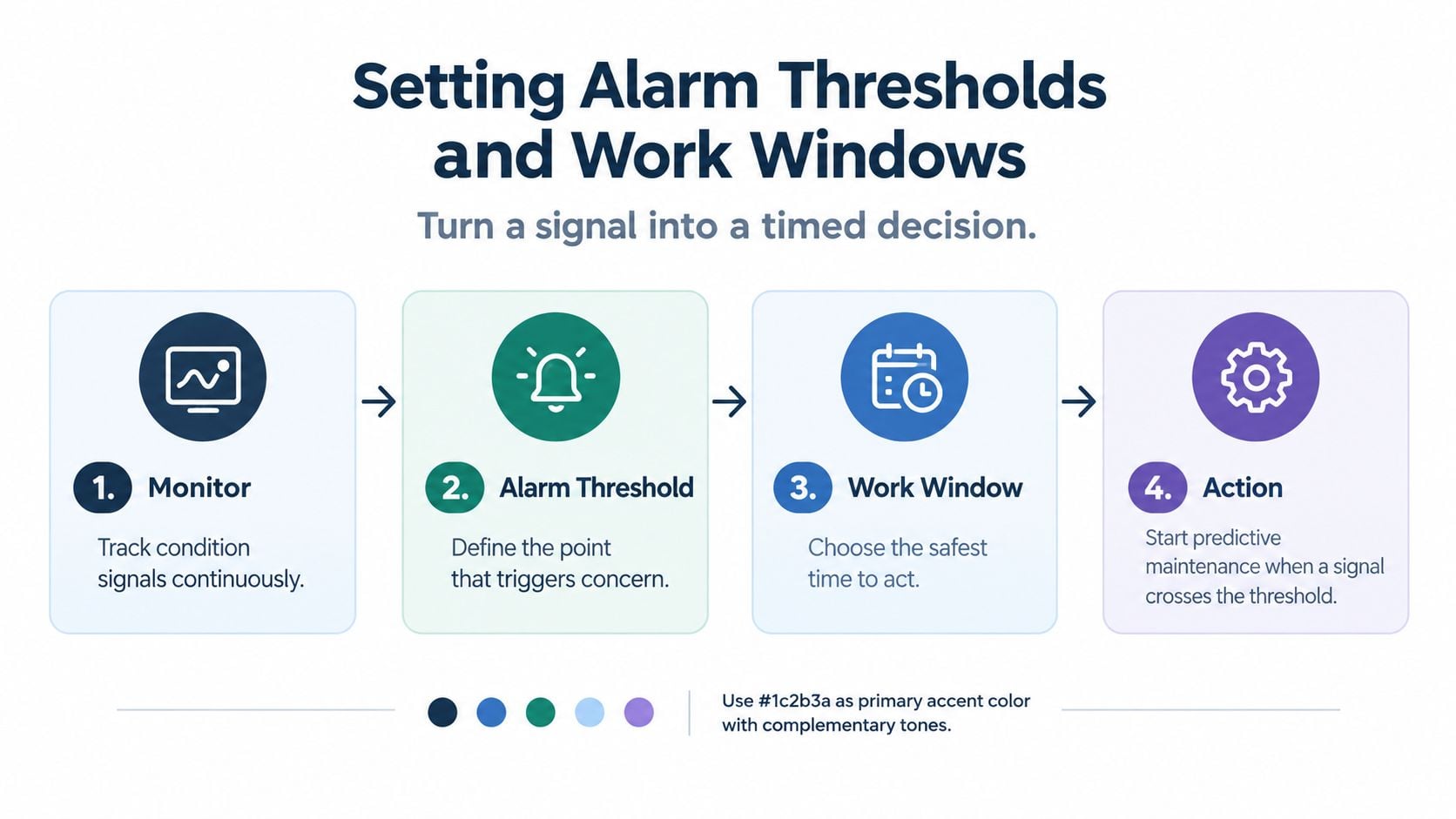
Predictive maintenance begins when observed equipment data triggers action at a predetermined reliability limit. Prognostics extends that work by detecting precursors, tracking degradation, and estimating remaining useful life. Neither concept makes an alert an automatic repair order. The plant needs separate thresholds for concern, confirmation, and intervention.
For a pump, an analytical alert might trigger a route reading and a review of process conditions. A confirmation threshold could require a stable rise in bearing-envelope energy, meaning vibration energy associated with rolling-element bearing defects, alongside temperature or lubrication evidence. A work-order trigger should come only when the predicted risk outweighs the cost-adjusted case for waiting and a safe production window is available.
Define the response before the alarm
A usable schedule gives the planner four things to manage: an earliest-safe date, a latest-acceptable date, a confidence level in the diagnosis or forecast, and an escalation trigger. The window should be revised when vibration, oil debris, temperature, load, or process data changes. The point isn't to force a date from uncertain data. It's to make the limits and next decisions explicit.
The underlying analysis needs asset-specific baselines. The healthy range for vibration or temperature should account for operating state, speed, load, and temperature. Features used to detect degradation should be tied to actual inspection, maintenance, and failure timestamps; otherwise, a model may learn from data that was recorded after an intervention or failure rather than before it. Performance should be tested with time-ordered, asset-separated data, so information from the same asset or later time periods doesn't leak into training and make results look better than they are.
For planners setting vibration alarms, ISO vibration standards and their practical use can provide context for evaluating measurements. Still, a standard or model output doesn't replace an asset-specific confirmation process. Public benchmark datasets can be a poor stand-in for plant equipment, and thresholds copied across unlike assets can flag harmless differences or miss real degradation.
Balance detection against inspection burden
A model's precision is the share of its alarms that prove to be meaningful; recall is its ability to catch real failures. Raising recall can catch more developing problems, but it can also flood the shop with unnecessary inspections. Chasing precision can reduce false alarms while allowing a critical failure to go undetected.
Each alarm should therefore have a defined confirmation step and decision owner. The work window must include failure probability, consequence, labor, spares, production limits, and expected outage length. After the inspection, the planner should record the actual condition and update the thresholds or diagnosis. Without that feedback, the schedule can't learn whether its alarms are useful.
Prioritizing Jobs When Capacity Runs Short
A high-risk alert still competes for technicians, parts, access, and production time. When several assets deteriorate at once, the plant needs a dispatch rule that puts the most consequential, actionable job first rather than automatically treating the newest alarm as the top priority.
For each job within the planning horizon, the planner should compare:
- Criticality and consequence: What happens if the asset fails before the next opportunity to act?
- Probability of failure: How credible is the failure risk within the available window?
- Job duration and resource fit: Are the required skills, labor, tools, and access available?
- Parts readiness: Are the necessary spares on hand, or does lead time force earlier action?
- Production opportunity: What is the next real window that can accommodate the work?
A compressor bearing with a confirmed degradation mechanism and a narrow safe window may outrank a stable gearbox oil-debris trend. A motor-current anomaly with no confirmed fault mechanism may stay on watch while the team checks load and electrical conditions. The planner should compare evidence and consequence, not just alarm severity.
Replan when conditions change
Consider a plant where a compressor bearing alert, a gearbox debris trend, and a motor-current anomaly arrive in the same week. If the compressor supports a critical process and the bearing risk is rising, the team should confirm that mechanism, secure the spare and specialist labor, and schedule the repair at the next safe production opportunity. The gearbox can remain under closer monitoring if its trend is stable and the plant has time to plan its repair. The motor anomaly should receive diagnostic confirmation before it displaces a higher-confidence repair.
That priority can change if a new breakdown appears, a spare arrives late, or the production window moves. A rolling schedule means the planner revisits job order as risk, resources, and operating conditions change, instead of freezing the list at the start of the planning cycle. Guidance on resource allocation and maintenance optimization can support that kind of capacity-focused planning.
A CMMS handoff should give the planner and technicians the information needed to execute: whether the sensor is healthy, the likely failure mechanism, the available operating window, parts status, required skills, and the response level. That response could mean a controlled shutdown, repair during the next production window, or continued monitoring.
Don't bundle work just because two jobs are nearby. Combining repairs can reduce mobilization, but it can also extend the outage, expand scope, or delay the repair with the greater failure risk.
A defensible weekly priority is the job with the strongest combination of credible risk, consequence, and readiness to execute. Lower-priority work stays visible, with a specific review condition, rather than disappearing into a deferred backlog.
Piloting the Schedule and Tracking Results
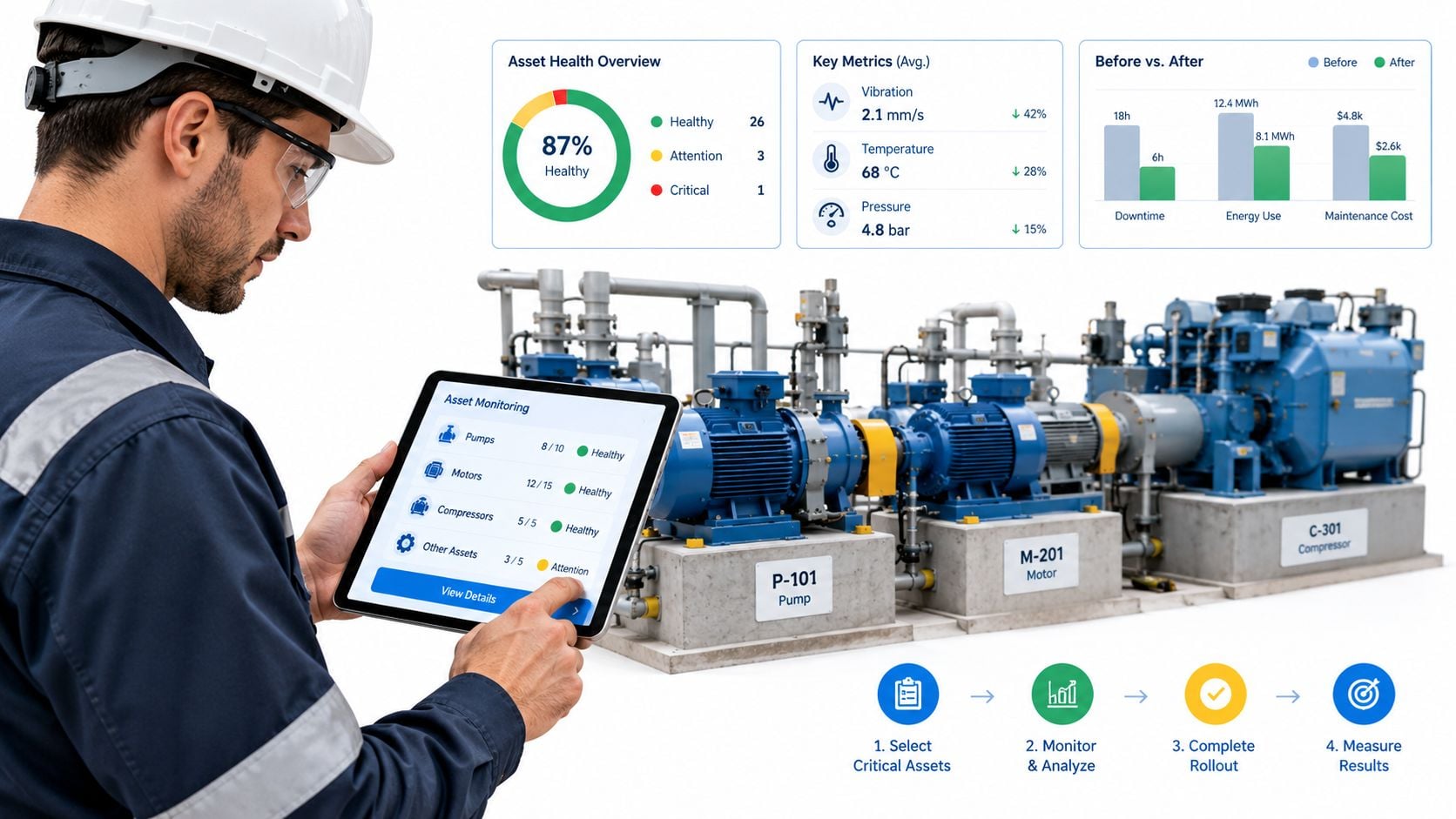
A predictive schedule should earn wider deployment through a controlled pilot, not through a vendor dashboard or a model-accuracy figure alone. Select 20–30 critical assets, collect a healthy baseline across several operating cycles, and run predictions in shadow mode before allowing them to drive work orders. Shadow mode means the team observes and evaluates predictions without letting the system automatically dispatch maintenance.
Compare predicted events with confirmed failure modes and the actual lead time available to plan work. If an alert predicts bearing degradation but inspection finds a lubrication issue, that outcome still matters: the model's usefulness depends on whether the signal supports a decision, not whether its label sounds precise.
Measure whether the work gets done
The pilot should track precision, recall, lead-time coverage, avoided downtime, schedule compliance, false-alarm burden, and cost per true alarm. Those measures reveal whether the program catches relevant failure modes early enough and whether the organization can respond without creating an unmanageable inspection queue.
NIST reported differences between U.S. manufacturing establishments using different maintenance strategies. Sites relying more heavily on predictive and preventive maintenance had 52.7% less unplanned downtime and 78.5% fewer defects than the comparison group relying more heavily on reactive practices. Among organizations already using primarily preventive and predictive approaches, greater reliance on predictive maintenance was associated with 18.5% less unplanned downtime and 87.3% fewer defects than greater reliance on preventive maintenance. A related NIST summary associated predictive maintenance with 15% less downtime, an 87% lower defect rate, and 66% fewer inventory increases caused by maintenance issues (NIST's study of maintenance costs and advanced techniques). These are associations, not guaranteed results for a particular plant.
Teams should verify local benefits with matched assets and before-and-after records of downtime, maintenance cost, false alarms, and schedule compliance. A CMMS asset-management process can help connect validated alerts to work orders, labor planning, parts, and completed inspection findings. The pilot succeeds when the plant can explain which failure modes it detects, how much warning the schedule provides, and whether crews can complete the work inside the required windows.
Forge Reliability helps industrial teams build equipment-specific predictive maintenance schedules using condition monitoring, failure-mode analysis, alarm thresholds, and practical work-planning workflows. Request a free reliability assessment from Forge Reliability to review critical assets, diagnostic coverage, and whether the plant can staff, supply, and schedule the jobs its alerts identify.