
Industrial blowers are essential to process operations across a broad range of industries, providing the forced air and gas movement that supports combustion, pneumatic conveying, aeration, ventilation, cooling, and drying applications. Whether the application calls for a centrifugal blower handling clean air in an HVAC system or a positive displacement blower pushing material through a pneumatic conveying line, the reliability of the blower directly determines the reliability of the process it serves. Industrial blower maintenance is a discipline that demands attention to both the mechanical condition of the rotating assembly and the aerodynamic performance of the machine, because degradation in either domain can reduce throughput, increase energy consumption, and ultimately lead to unplanned failures that shut down production.
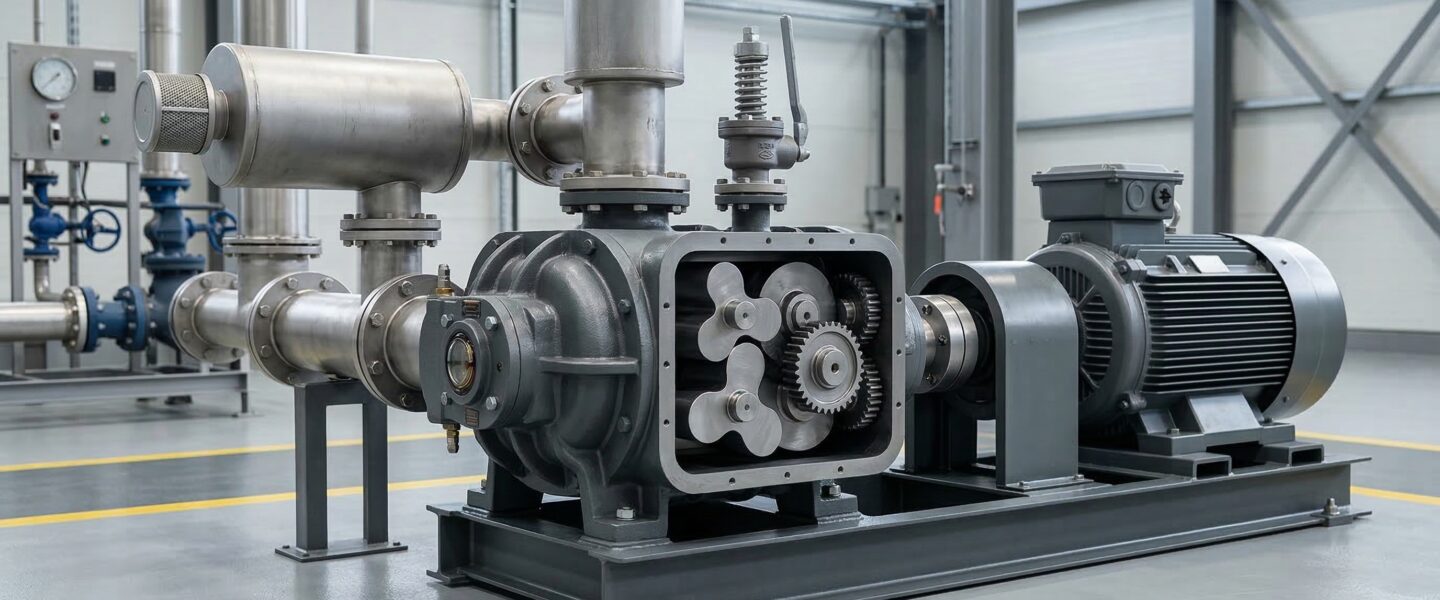
Blowers often operate in the background of a facility’s maintenance awareness — they are not as prominent as large compressors or turbines, and they typically lack the redundancy that allows one unit to be taken offline while another carries the load. This makes unplanned blower failures disproportionately disruptive. A failed combustion air blower shuts down a furnace. A failed aeration blower compromises a biological treatment process. A failed conveying blower stops a packaging line. The maintenance strategy for industrial blowers must reflect this criticality, even when the equipment itself does not carry a large capital cost.
What Are the Common Reliability Challenges in Industrial Blower Operations?
Industrial blowers face a combination of mechanical, aerodynamic, and environmental challenges that vary significantly with the type of blower and the application. Understanding these challenges is the foundation for building an effective maintenance program.
Bearing Wear and Failure
Bearings are the most failure-prone components in industrial blowers, subjected to a combination of radial loads from impeller weight and belt tension, axial loads from aerodynamic thrust, and dynamic loads from residual imbalance and misalignment. Centrifugal blowers with overhung impellers place particularly high loads on the drive-end bearing, and any increase in imbalance from material buildup or erosion on the impeller amplifies those loads. Positive displacement blowers — including rotary lobe (Roots-type) and rotary screw designs — have tight internal clearances that make them sensitive to bearing wear; as bearings allow shaft position to shift, internal clearances close and the risk of rotor-to-rotor or rotor-to-housing contact increases. Bearing failures account for approximately 40-45% of all forced outages on industrial blowers across most industry surveys.
Impeller and Rotor Degradation
Centrifugal blower impellers are subject to erosion from particulate-laden air streams, corrosion from chemical exposure, and material buildup that changes the mass distribution and aerodynamic profile. Even modest material buildup on impeller blades creates mass imbalance that increases bearing loads and vibration, and uneven buildup changes the aerodynamic balance between blades, reducing efficiency. Positive displacement blower rotors wear at their tips and lobes, increasing internal slip (recirculation of gas from discharge back to suction) which reduces volumetric efficiency and increases discharge temperature. A rotary lobe blower with worn lobes can lose 10-20% of its volumetric efficiency before operators notice a process impact, particularly in applications where the blower has been oversized relative to the actual demand.
Centrifugal blowers handling particulate-laden or corrosive gas streams can lose up to 15% of their aerodynamic efficiency from impeller erosion and buildup before the degradation is evident from process measurements alone — condition monitoring catches this performance drift far earlier.
Belt Drive Issues
Many industrial blowers, particularly centrifugal designs, use belt drives that introduce their own set of reliability challenges. Belt tension that is too high overloads bearings and accelerates belt wear. Tension that is too low allows slippage, reduces blower speed, and generates heat that degrades belts. Sheave misalignment causes uneven belt wear, increases vibration transmitted to the blower and motor bearings, and shortens belt life. Sheave wear — grooves worn in the sheave surfaces — allows belts to ride low in the groove, changing the effective drive ratio and causing premature belt failure. Belt drive maintenance is straightforward but must be performed consistently, and belt tension should be verified with a tension gauge rather than estimated by feel.
Inlet and Discharge System Problems
Blower performance and reliability are strongly influenced by the inlet and discharge piping and ductwork connected to the machine. Inlet restrictions from clogged filters, collapsed ductwork, or partially closed dampers increase the pressure differential across the blower, increase power consumption, and can cause operating instabilities including surge in centrifugal machines. Discharge restrictions have similar effects. Piping-induced loads from thermal expansion, misalignment, or inadequate support transmit forces to the blower casing and bearings that they were not designed to carry.
How Does Condition Monitoring Apply to Industrial Blowers?
Condition monitoring for industrial blowers combines vibration analysis for mechanical condition assessment with performance monitoring for aerodynamic health. Together, these techniques cover the full range of degradation mechanisms and provide the data needed for condition-based maintenance decisions.
Vibration Analysis
Vibration monitoring is the cornerstone of blower condition assessment. For centrifugal blowers, spectral analysis at the blower bearings detects imbalance (from impeller buildup, erosion, or loss of material), bearing defects, misalignment between the blower and its driver, structural looseness, and belt-related frequencies including belt rate, sheave misalignment, and belt resonance. For positive displacement blowers, vibration analysis detects bearing defects, gear mesh problems (in gear-driven designs), and changes in lobe passing frequency amplitudes and harmonics that indicate rotor wear or contact. Monthly route-based vibration data collection is appropriate for most blower installations, with continuous online monitoring justified for critical blowers where the process consequence of failure is severe and the P-F interval may be short.
Thermographic Inspection
Infrared thermography provides valuable screening data for blower installations. Thermal imaging of bearings identifies abnormal operating temperatures from lubrication problems, preload issues, or developing defects. Thermal imaging of belt drives reveals misalignment, tension problems, and worn sheaves through characteristic heat patterns. Thermal imaging of the blower casing and discharge piping can identify abnormal temperature distributions that indicate internal recirculation in positive displacement blowers or efficiency degradation in centrifugal machines. Motor terminal connections, contactors, and power cabling are also surveyed to catch electrical connection problems before they cause a trip or fire.
Performance Monitoring
Tracking blower performance parameters — flow rate, pressure rise, power consumption, and discharge temperature — over time reveals aerodynamic degradation that vibration analysis alone may not detect. An increase in power consumption at the same operating point indicates increased internal losses. A decrease in flow at the same pressure indicates impeller or rotor degradation. Rising discharge temperatures in positive displacement blowers indicate increased internal slip. Performance monitoring is most valuable when the blower’s original performance curve is available as a baseline, but even without a manufacturer’s curve, trending operating parameters against process demand provides actionable insight.
Facilities that combine vibration analysis with thermographic inspection and basic performance trending on their blower populations report unplanned blower failures reduced by 55-65% and maintenance labor redirected from emergency repairs to planned, scheduled service.
Maintenance Strategies That Work for Industrial Blowers
An effective industrial blower maintenance strategy addresses the mechanical, aerodynamic, and drive-system components as an integrated system rather than treating each in isolation.
Bearing Lubrication and Monitoring
Bearing lubrication for blowers follows the same principles as for any rotating equipment: correct lubricant type, correct quantity, correct interval, and proper application technique. Grease-lubricated bearings should be serviced at intervals calculated from bearing speed, size, and operating temperature, using ultrasonic monitoring during regreasing to confirm that the lubricant is reaching the bearing and that the correct quantity has been applied. Oil-lubricated bearings — common on larger blowers — require regular oil sampling and analysis to monitor viscosity, contamination, and wear metal trends. Oil level, temperature, and condition should be checked as part of every operator round.
Impeller and Rotor Maintenance
Centrifugal blower impellers should be inspected for buildup, erosion, and corrosion at intervals determined by the operating environment. In clean-air applications, annual inspection during a planned outage may be sufficient. In dirty or corrosive service, quarterly or even monthly inspection and cleaning may be necessary. Impeller buildup should be removed using methods that do not damage blade surfaces or coatings. After cleaning, a field balance check should be performed, as material removal changes the mass distribution. Positive displacement blower rotors should be inspected for tip and lobe wear, scoring, and coating degradation. Internal clearances should be measured and compared to manufacturer specifications.
Belt Drive Maintenance
Belt drive maintenance includes regular tension checks using a calibrated tension gauge, alignment verification using a straightedge or laser alignment tool, sheave groove inspection for wear, and belt condition assessment for cracking, glazing, and cord damage. Belts should be replaced as matched sets — never replacing individual belts in a multi-belt drive — and sheaves should be replaced when groove wear exceeds manufacturer limits. Upgrading from conventional V-belts to synchronous (cogged or timing) belt drives eliminates slip losses and can improve blower energy efficiency by 2-5% in addition to extending belt service life.
Inlet Filtration and System Maintenance
Inlet filter condition directly affects blower performance, energy consumption, and internal component life. Filter differential pressure should be monitored continuously or checked on every operator round, with filter replacement triggered by a predefined pressure drop threshold rather than a calendar schedule. Inlet ductwork should be inspected periodically for damage, leaks, and obstructions. Discharge piping supports and expansion joints should be inspected to ensure that piping loads are not being transmitted to the blower casing.
What Results Can You Expect?
Facilities that implement a structured industrial blower maintenance program built on condition monitoring, disciplined lubrication, regular impeller and drive maintenance, and system-level awareness consistently achieve measurable improvements in blower reliability and operating cost. Bearing life extends as lubrication practices improve and operating loads are managed through proper alignment and belt tensioning. Impeller and rotor performance is maintained closer to design specifications through regular cleaning and inspection. Energy consumption decreases as belt drives, filters, and aerodynamic surfaces are kept in good condition.
The typical trajectory shows a 40-60% reduction in unplanned blower outages within the first 12-18 months of a mature program, with ongoing improvements as condition data accumulates and maintenance intervals are refined based on actual equipment degradation rates rather than generic time-based schedules. For facilities with large blower populations — wastewater treatment plants, cement plants, pneumatic conveying systems, and combustion air systems — the aggregate impact on maintenance spending and production reliability is substantial.
Forge Reliability works with facilities to develop blower maintenance programs that are tailored to the specific equipment types, operating environments, and criticality profiles in your plant. From establishing baseline condition data on your blower population to building the monitoring routes, analysis protocols, and maintenance procedures that sustain long-term reliability, we provide the expertise and structure that transform blower maintenance from reactive firefighting to planned, predictable, and cost-effective asset management.