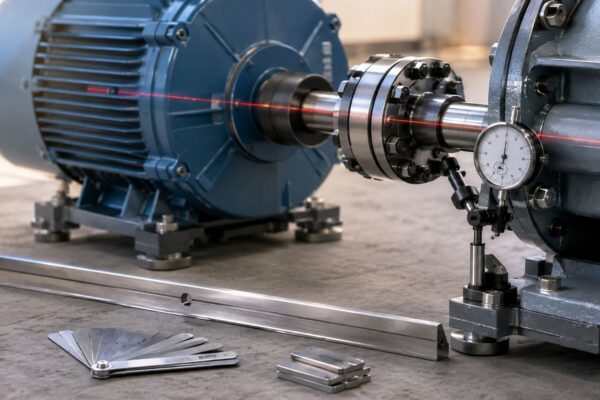
Most advice on time based maintenance starts in the wrong place. It treats calendar-based service as the default answer, then asks teams to justify why they should do anything different. That flips reliability logic on its head, because fixed-interval work only makes sense for failure modes that follow time, usage, or wear patterns.
In industrial plants, time based maintenance is still common because it is simple to schedule and easy to explain. Preventive maintenance remains the most widely used strategy, with 71% of maintenance professionals saying they use it, yet benchmark data also show that many facilities still spend less than half their time on scheduled maintenance and fewer than 35% spend a majority of time on preventive tasks. PM compliance averages 60 to 75%, while top-tier organizations target 90%+, and planned maintenance percentage averages 55 to 65% versus an 85%+ world-class target, which is why the key question is not whether fixed-interval work exists, but whether it belongs on the asset at all. Maintenance benchmark data
For rotating assets, filters, belts, seals, lubrication points, and safety-critical inspections, calendar-based service can be the cleanest way to prevent expensive misses. For bearings, motors, and other assets that show measurable degradation, it can also become a routine source of over-maintenance if the interval is chosen by habit instead of failure behavior. The disciplined approach is to start with the failure mode, not the schedule.
Table of Contents
- What Time Based Maintenance Actually Is
- Comparing Time Based Maintenance with Condition-Based and Predictive Strategies
- How to Decide Which Assets Belong on Time Based Maintenance
- Calculating and Optimizing Maintenance Intervals
- Implementation Checklist for Time Based Maintenance Programs
- Industry Examples and Common Pitfalls
- Measuring TBM Effectiveness and Continuous Improvement
- Get a Free Reliability Assessment for Your TBM Program
What Time Based Maintenance Actually Is
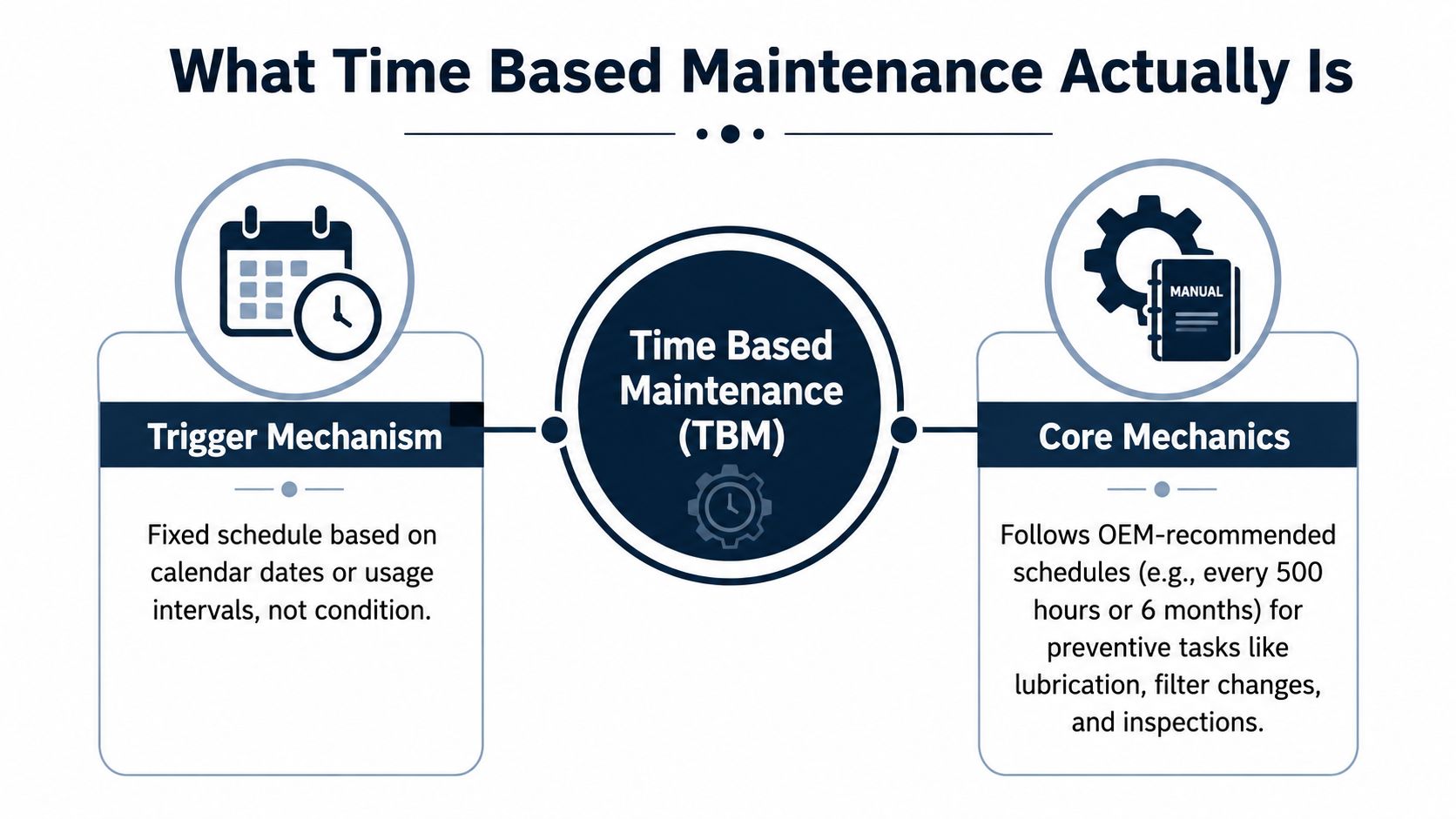
Time based maintenance is maintenance performed on a fixed schedule, where the trigger is the passage of time or the accumulation of operating hours, not the measured condition of the asset. That distinction matters. A monthly inspection, a quarterly oil change, or a 500-hour lubrication task is TBM only if the work is initiated by the schedule, not by vibration, oil debris, thermography, or any other condition signal. Time-based maintenance definition and scheduling basics
The strongest TBM programs do not begin with a calendar. They begin with the asset inventory, OEM guidance, historical failure data, and risk-based intervals. In practice, that means a plant may decide to inspect one gearbox every quarter, clean one filter bank every 500 operating hours, and verify one electrical panel every season, because those intervals reflect real wear and compliance needs rather than a blanket rule.
Where TBM fits in the maintenance hierarchy
TBM sits between reactive maintenance and more data-rich strategies like condition-based maintenance and predictive maintenance. It is proactive, but it is not diagnostic. It does not wait for failure, yet it also does not watch asset health in real time.
That is why TBM is often the first structured preventive program in plants that are still building reliability discipline. It gives maintenance teams a repeatable way to plan labor, stage parts, and create task accountability. But it should never be mistaken for a universal answer, because the strategy only works when the failure mode has a meaningful age or usage pattern.
Practical rule: if a task stays on the schedule because “we've always done it,” it probably needs a failure-mode review, not a longer checklist.
For a broader view of maintenance categories, a useful internal reference is the overview of industrial maintenance types. That kind of framework helps teams separate calendar-based work from condition-based tasks, run-to-failure choices, and true emergency response.
A clean TBM program usually includes lubrication on continuously loaded bearings, filter changes on systems with predictable contamination buildup, and safety inspections on equipment where regulatory compliance demands fixed intervals. What it should not include is every asset that happens to have a PM slot available. That mistake turns a reliability tool into an administrative habit.
Comparing Time Based Maintenance with Condition-Based and Predictive Strategies
TBM, condition-based maintenance, and predictive maintenance solve different failure problems. TBM assumes the risk rises with time or usage. Condition-based maintenance, or CBM, waits for measurable degradation. Predictive maintenance extends that logic by using trends and analytics to estimate when an asset is moving toward failure.
A simple example makes the split obvious. A conveyor belt that stretches at a known rate can fit TBM well, especially when the plant has a known replacement interval and the cost of a missed service is high. A bearing on the same line is often a better candidate for vibration analysis or oil analysis, because the bearing may show detectable degradation long before a calendar-based interval expires.
For teams building an IT reliability mindset into physical operations, Nutmeg Technologies on IT care is a reminder that proactive work only pays when the trigger matches the risk. The principle is the same in industrial plants, fixed schedules are useful only when the failure pattern supports them.
| Maintenance Strategy Comparison by Failure Mode | Best For | Detection Method | Typical Assets | Cost Structure |
|---|---|---|---|---|
| Time Based Maintenance | Wear that follows time or usage | Calendar dates, operating hours, cycle counts | Filters, belts, lubricated components, compliance inspections | Predictable labor and parts, but can create over-maintenance |
| Condition-Based Maintenance | Assets with visible degradation signals | Vibration, oil analysis, temperature, visual indicators | Bearings, motors, gearboxes, pumps | Sensor and monitoring investment, lower unnecessary work |
| Predictive Maintenance | Assets with rich data histories and complex degradation | Trend analysis, analytics, multi-sensor inputs | Critical rotating assets, complex production equipment | Higher analytics overhead, strongest planning leverage |
The trade-off that matters
TBM keeps the labor plan simple. Craft, planning, and procurement can all work from the same schedule. That simplicity is valuable in a plant with limited monitoring infrastructure, because it reduces uncertainty and helps maintenance teams coordinate access, parts, and staffing.
CBM and predictive maintenance ask for more up front. They need instrumentation, data capture, and someone who knows how to interpret the signals. The return is better targeting. Work happens when the asset shows a problem, not merely when the calendar says it should.
A good internal comparison point is condition-based maintenance versus predictive maintenance, because many plants do not need to choose one strategy for everything. They need a layered model. A cooling system may stay on TBM, while a critical motor train moves to monitoring, and a spare pump may remain run-to-failure because the risk does not justify intervention.
TBM is the right answer when the failure mode is boring and repeatable. The moment the asset starts telling a different story through vibration, oil condition, or temperature drift, the schedule should stop pretending it is enough.
That is also why many plants end up with hybrid programs. They use fixed intervals for compliance-driven and wear-driven tasks, then use CBM or predictive methods for assets where the condition signal arrives early enough to matter. The mistake is not using TBM. The mistake is using it where it no longer fits.
How to Decide Which Assets Belong on Time Based Maintenance
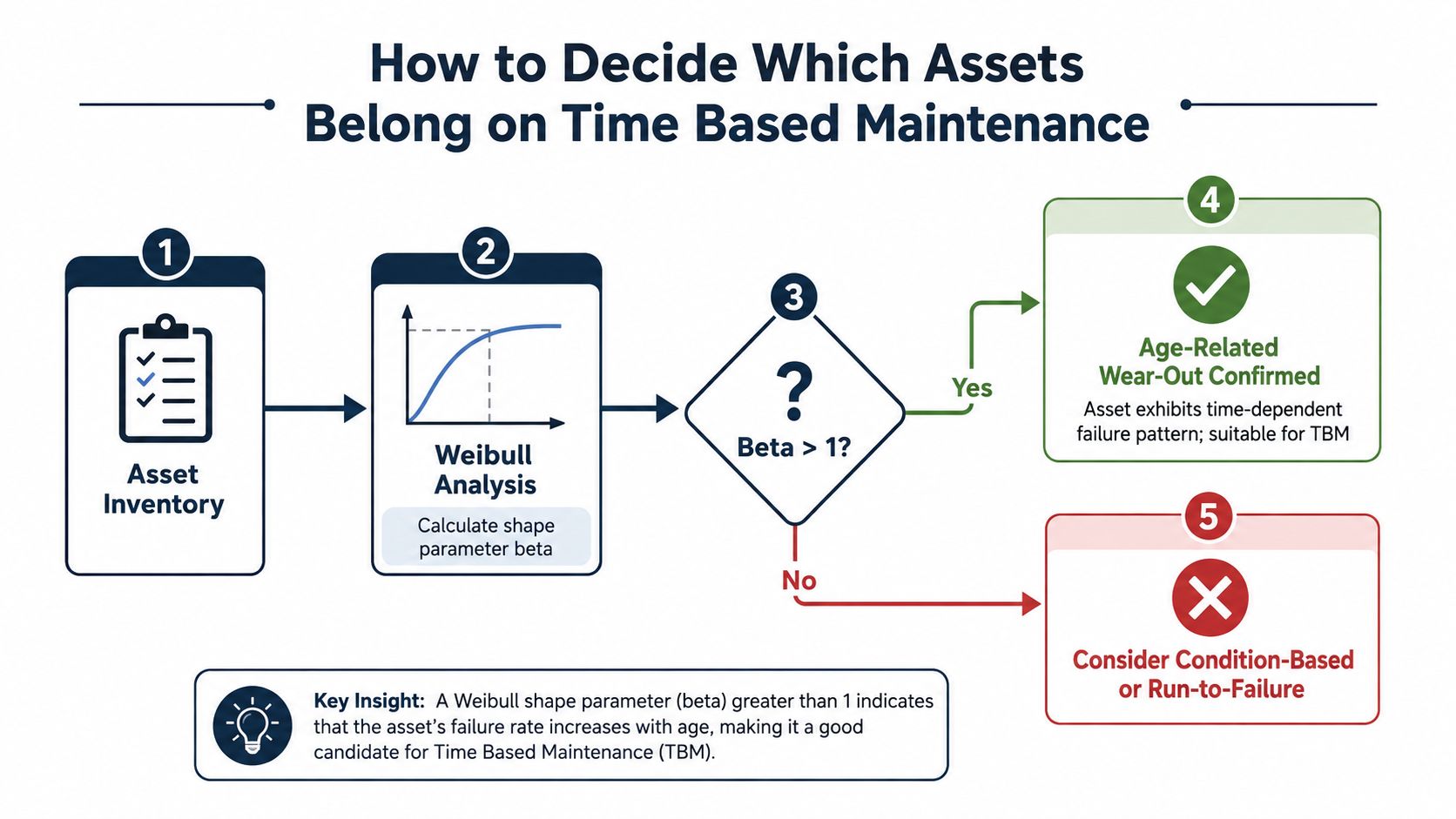
The decision should start with failure distribution, not equipment class. A pump is not automatically a TBM asset just because it is a pump. A seal, a filter, or a fan motor may each behave differently, and the maintenance plan should follow the failure mode instead of the nameplate.
One reliability source notes that TBM is only effective for equipment with clear age-related wear-out, while most failure modes are not age-related, and one cited industry estimate suggests roughly 90% of machine failures are random and not time-based. That makes calendar-based PM a poor default for large portions of an asset base. Reliability guidance on when time-based maintenance fits
Use Weibull shape to test the hypothesis
Weibull analysis is the easiest statistical check for whether an asset looks like a TBM candidate. The shape parameter, beta, tells the story.
- Beta greater than 1, wear-out is increasing with age, which supports fixed-interval maintenance.
- Beta around 1, failures are random, which weakens the case for calendar-based replacement.
- Beta less than 1, early-life failures dominate, which points toward installation quality, infant mortality, or process issues rather than age-based wear.
That framework is more useful than arguing about PM frequency in a meeting. If the failure history shows a flat or random pattern, shortening the interval usually just creates more labor and more maintenance-induced defects. If the failure curve rises with age, the interval can be tuned to catch the wear-out zone before the asset fails in service.
The same logic is central to reliability-centered maintenance, because RCM asks what can fail, how it fails, and whether the chosen task prevents or detects that failure mode. TBM belongs only where the answer supports it.
Rank criticality before assigning the schedule
Criticality ranking decides how much risk the plant can tolerate. A low-impact utility fan and a production-critical compressor should not receive the same maintenance logic, even if they share similar components. If the failure consequence is small, run-to-failure may be cheaper than calendar-based intervention.
A practical review starts with three questions:
- Does the failure mode age predictably? If not, TBM is probably the wrong strategy.
- Does the failure consequence justify interruption? If not, the work may be wasted effort.
- Do failures cluster before the PM interval? If yes, the interval is too long or the strategy is wrong.
Decision point: if repeated PMs keep finding healthy assets and failures still happen between intervals, the problem is not just the interval. The strategy itself may be wrong.
A maintenance planner looking at a compressor seal, for example, may find that the seal wears out in a predictable pattern and belongs on TBM. The same plant's motor bearings may show random failures tied to contamination and alignment issues, which is a stronger case for condition monitoring and root cause work than for a tighter calendar. That is the filter. TBM should survive the data review, not the other way around.
Calculating and Optimizing Maintenance Intervals
Intervals should begin with the OEM baseline, but they should never end there. Manufacturer recommendations are the first draft, not the final answer. The interval depends on duty cycle, environmental severity, load variation, and the consequences of failure.
A quarter-turn valve in clean service and a similar valve in abrasive slurry service will not age at the same rate. A blower that runs continuously also behaves differently from one that starts and stops several times per shift. The schedule has to reflect the actual operating context, or the program will drift into compliance theater.
For teams using MTBF as a planning input, a useful internal reference is how to calculate mean time between failure. MTBF alone does not solve the interval question, but it helps frame whether current work history supports the schedule or contradicts it.
A practical interval-setting sequence
- Start with the OEM recommendation. Use it as the baseline for lubrication, inspection, cleaning, and replacement tasks.
- Adjust for operating severity. Harsh heat, contamination, dust, or corrosion justify shorter intervals than mild service.
- Separate calendar from usage. If the asset is heavily cycled or lightly used, runtime or cycle triggers often fit better than pure date-based service.
- Stage parts and labor around the window. The interval is only useful if the parts are on hand and the crew is available.
- Review failures after each cycle. If the asset keeps failing between PMs, the interval is too long or the task is the wrong one.
A hybrid trigger often works better than a pure calendar rule. For example, an air compressor might receive a quarterly inspection plus a runtime-based filter change at a defined hour count. That keeps lightly used equipment from being over-serviced while still protecting heavily loaded equipment from hidden wear.
The biggest mistake is treating interval optimization as a one-time project. Plants change. Dust loading changes. Production ramps change. Product mix changes. When duty cycle shifts, the PM interval has to move with it.
A second mistake is letting TBM become a paperwork ritual. If technicians repeatedly complete the same task and almost never find degradation, the task may not belong on the schedule. If they keep discovering wear earlier than planned, the interval is too loose. In either case, the data should push the maintenance plan, not the other way around.
Implementation Checklist for Time Based Maintenance Programs
A TBM program fails fastest when the CMMS is configured loosely and the work package is vague. The schedule may exist on paper, but if the system does not generate the right work at the right time, technicians end up improvising in the field. That is where compliance slips and reliability gains disappear.
On a packaged food line, for example, a quarterly inspection on a sanitation air system can work well if the CMMS creates the job automatically, the checklist spells out acceptance criteria, and the parts bin already contains the consumables. The same task becomes unreliable if the planner relies on memory, the task text is generic, and the crew discovers the needed gasket only after opening the unit.
Build the program in four layers
- CMMS setup. Configure each asset with its TBM schedule, trigger logic, and completion fields so the system can record what was done and when.
- Work package design. Write the task steps, lockout requirements, tools, parts, and pass-fail criteria in plain language.
- Spare parts staging. Match inventory to the schedule so routine PMs do not stall while someone hunts for consumables.
- Staffing and access. Assign qualified technicians, train them on the task, and coordinate with operations for shutdown windows.
The CMMS should capture more than completion status. It needs the date, the runtime or cycle count if applicable, the defects found, and whether the task revealed wear. That information is what turns a calendar from a compliance tool into a reliability dataset.
Work packages should also be specific enough to prevent variation. A lubrication task on a gearbox needs the correct grease, quantity, and inspection point. A panel inspection needs safety checks, torque criteria if applicable, and a way to record abnormal heat, contamination, or loose connections.
Forge Reliability also provides CMMS asset management support, which matters because schedule logic is only as good as the data and governance underneath it. If asset records are messy, TBM turns into a guessing game fast.
A technician should be able to open the work order and know exactly what success looks like before the first tool comes out of the box.
The staffing plan matters as much as the schedule. If the plant assigns too many PMs to the same shift or forgets to align access with operations, even a good TBM program will slip. Execution discipline, not the calendar itself, is what separates a reliable schedule from a missed one.
Industry Examples and Common Pitfalls
A steel mill with high-temperature conveyors gives a clean TBM example. The plant may keep belt tension checks, lubrication points, and electrical-panel inspections on fixed intervals because the failure modes are predictable and the consequence of a missed service is serious. In that environment, the schedule protects throughput and safety.
A water-treatment site can show the opposite problem. A small auxiliary pump may have been placed on quarterly replacement tasks even though its failures are random and its downtime consequence is minor. Each PM consumes labor, parts, and access time, yet the task rarely finds anything actionable. That is over-maintenance, not prevention.
The warning signs are easy to spot once the team starts looking for them.
- Repeated clean inspections mean the asset is being touched too often, or the wrong indicator is being checked.
- Failures between scheduled intervals mean the failure mode is not being intercepted by the PM.
- Uniform schedules across critical and noncritical assets mean the plant is ignoring consequence and risk.
- Intervals that never change mean the program is not learning from its own history.
A thermal-processing line offers another trap. If a fan motor keeps failing between quarterly PMs, the response should not automatically be a shorter calendar. The right question is whether vibration, alignment, lubrication, or contamination is driving the failure. If the data points away from age, TBM is just delaying the next outage.
The common pattern is complacency. Teams build a schedule, then stop asking whether it still matches reality. That is how TBM turns into a compliance exercise instead of a reliability tool. The better plants treat every PM as a test of the strategy itself.
Measuring TBM Effectiveness and Continuous Improvement
TBM should be judged by what it prevents and what it wastes. If the schedule is clean but the asset still fails, the program is not working. If the schedule is clean and the asset never shows wear, the plant may be spending money to preserve a habit.
The main KPIs are straightforward. PM compliance tells whether the work is being completed on time. Planned maintenance percentage shows whether the organization is spending more time on scheduled work or emergency response. Schedule adherence reveals whether maintenance is executing the plan that planning created. Those measures matter because a schedule that looks good on paper can still be operationally weak.
For a broader process context, a guide for upgrading aging platforms is useful as an analogy, because old systems often fail when organizations stop governing change. Maintenance programs behave the same way. If the logic does not get reviewed, the asset base outgrows it.
What to watch in the data
- Failures between PM intervals point to a weak trigger or the wrong maintenance strategy.
- PM effectiveness ratio should show whether the work is finding defects before failure, not just consuming labor.
- Maintenance cost per operating hour helps expose hidden waste from over-maintenance.
- Ratio of preventive to reactive work orders shows whether TBM is helping stabilize operations or adding more planned activity.
Quarterly review is usually enough to catch drift without overreacting to noise. During the review, teams should compare failure history against the current interval, refresh any Weibull analysis, and move assets toward condition-based monitoring when the degradation signal is clear. That shift is not a failure of TBM, it is a sign that the maintenance strategy matured.
Plants that do this well usually treat the PM calendar as a living document. The schedule is adjusted when the operating context changes, the maintenance task proves ineffective, or a new condition signal becomes available. That discipline is what keeps TBM from becoming a static list of obligations.
Get a Free Reliability Assessment for Your TBM Program
A weak TBM program costs twice. It wastes labor and parts on assets that do not need calendar-based attention, and it leaves critical equipment exposed when the interval misses the failure pattern. The only safe way to know which side of that line a plant is on is to review the data, not the habit.
Forge Reliability offers a free reliability assessment that reviews current PM schedules, failure history, criticality rankings, and the asset logic behind each TBM decision. The assessment can also test which assets still belong on fixed intervals and which should move to condition monitoring or another strategy. That includes support for predictive maintenance, condition monitoring, and reliability consulting across rotating and static equipment.
The value is straightforward. Plants get a clearer maintenance strategy, fewer unnecessary interventions, and a better shot at reducing downtime on the assets that matter. Forge Reliability's published outcomes include 30%+ reductions in unplanned downtime and 3 to 5x ROI, which is why a review of TBM logic is worth doing before the next budget cycle closes.
If the plant is carrying too many calendar-based PMs, or if critical equipment is still failing between scheduled tasks, the schedule is telling on itself. A reliability assessment can show where the calendar still fits, where it should be tightened, and where it should disappear entirely.
Visit Forge Reliability to request a free reliability assessment and have the current TBM program reviewed against failure history, criticality, and real operating conditions. A focused review can show which assets belong on fixed intervals, which ones need condition monitoring, and where maintenance effort is being wasted today.