A diesel engine rarely fails without warning. A standby generator at a food processing plant may start a little slower, carry load a little less cleanly, or burn more fuel than it did last quarter. A haul truck may still finish the shift, but the operator reports that it feels softer on acceleration when hot. Those are reliability signals, not annoyances.
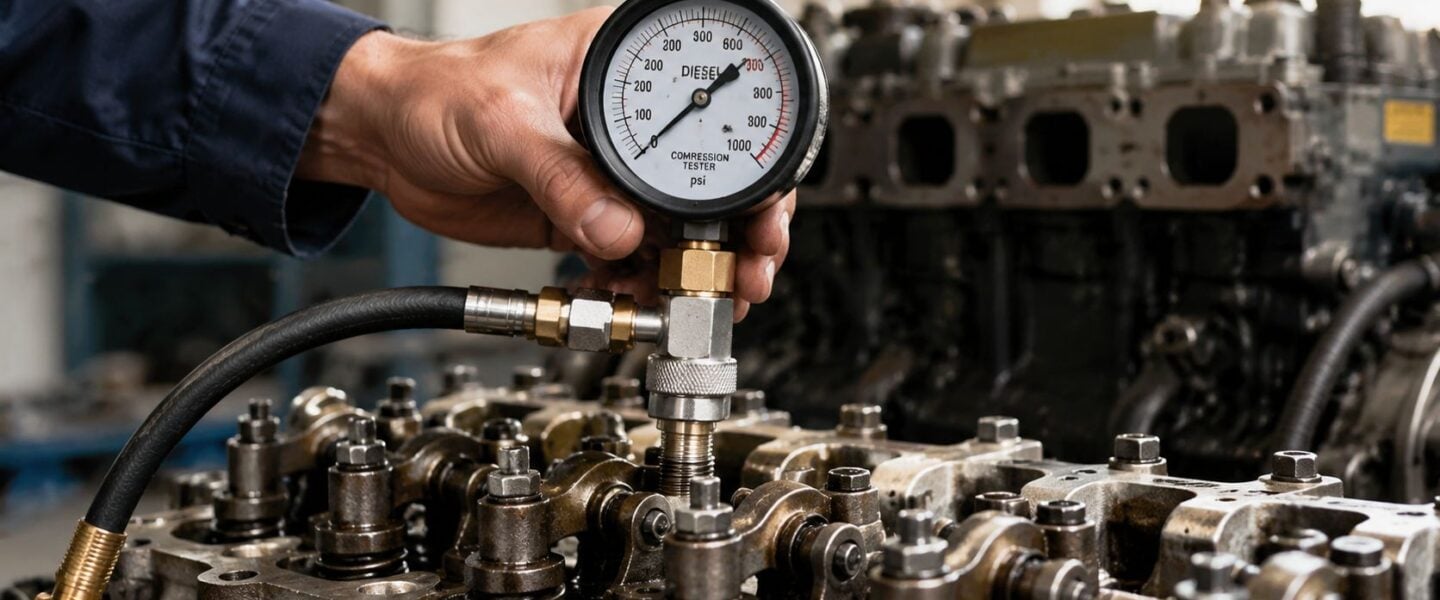
For industrial teams, a diesel compression test kit isn't a garage accessory. It's a quantitative way to check the sealing condition inside the cylinders, where piston rings, valves, and the head gasket determine whether the engine can convert cranking effort and combustion energy into dependable work. Used correctly, compression data helps maintenance teams separate internal mechanical wear from fuel, air, and controls issues before a forced outage turns into a production problem.
Table of Contents
- Beyond the Dipstick Using Compression Data for Diagnostics
- Preparing for an Accurate Compression Test
- Executing the Cylinder Compression Test Protocol
- Interpreting Compression Test Results for Fault Isolation
- Common Pitfalls That Compromise Test Accuracy
- Integrating Compression Data into Your Reliability Strategy
Beyond the Dipstick Using Compression Data for Diagnostics
A diesel generator in a plant utility building can pass routine inspections and still be moving toward a mechanical problem. Oil analysis may stay clean. Vibration may not show much if the defect is still confined to sealing surfaces inside the combustion chamber. Operators only notice that the unit doesn't reach rated response as crisply as it used to.
That is where compression testing earns its place in a condition monitoring program. It turns a vague symptom into a cylinder-by-cylinder mechanical assessment. Instead of debating whether the engine “sounds tired,” the maintenance team gets hard readings that show whether one cylinder is weak, whether two neighboring cylinders are drifting together, or whether the entire engine is losing sealing efficiency.
Industrial engines aren't a copy of automotive practice
Many published guides miss what reliability teams deal with in plants, quarries, ports, and marine service. Industrial engines in agricultural and marine duty often operate at 350–600+ PSI, and many guides focus only on automotive glow plug adapters while overlooking metric injector-port thread variations used on industrial compressors and other equipment, which pushes teams toward rough qualitative checks instead of data suitable for predictive maintenance (industrial diesel application limits and adapter gaps).
A maintenance manager evaluating a diesel compression test kit for a mine-site service truck or a compressor drive engine should care less about consumer convenience and more about fit, range, and repeatability. If the adapter set doesn't match the installed fleet, the gauge quality won't matter. If the readings can't be compared over time, the test won't support planning decisions.
Practical rule: Compression testing belongs beside oil analysis, thermography, and vibration, not beneath them. It answers a different question. Whether the cylinders are still sealing.
What the data changes
Compression data is especially valuable when the team is already seeing indirect symptoms. Rising fuel use, smoke changes, slower load acceptance, crankcase blow-by, and uneven exhaust temperatures often point toward internal wear, but they don't isolate it. Compression readings narrow the field.
On heavy mobile assets, the same logic applies to fleet reliability. Teams looking for broader maintenance advice for haulage fleets often focus first on driveline, cooling, or electrical faults. That's sensible, but internal engine sealing still needs its own quantitative check when performance trends drift.
When those readings are folded into structured troubleshooting, they also support deeper logic trees for failure elimination. A planner building a diagnostic path can connect low compression evidence with other failure branches using fault tree analysis examples for industrial troubleshooting. That keeps teardown decisions tied to evidence rather than instinct.
Preparing for an Accurate Compression Test
Bad preparation produces believable but useless numbers. On a backup generator, that usually means the team loses a maintenance window chasing a false low reading caused by poor setup instead of actual cylinder wear.
The pre-test routine has to be treated like any other precision diagnostic. The engine condition, power supply, adapter fit, and safety steps all affect the result before the first cylinder is even cranked.
Start with stable test conditions
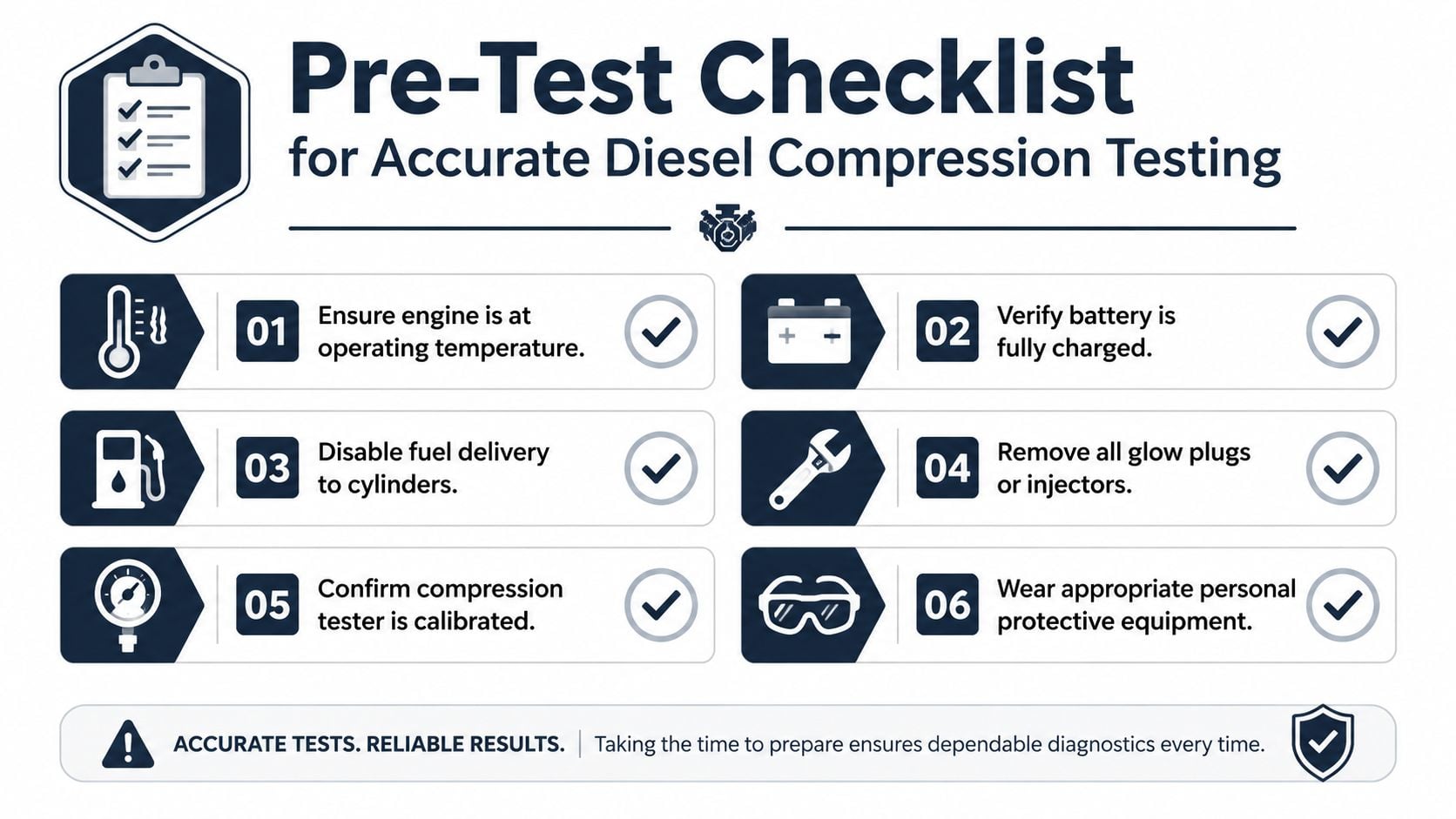
A diesel compression test requires bringing the engine to normal operating temperature first because cold parts produce artificially low readings. The battery also needs to stay above 12.4 volts so cranking speed remains consistent, and poor adapter sealing is a known cause of falsely low measurements (accurate diesel compression test preparation requirements).
That matters on industrial assets because component clearances change with heat. A cold engine can make a serviceable cylinder look weak, especially on equipment that sits for long periods between runs. Reliability teams should schedule the test when they can warm the machine safely, stabilize the operating condition, and move directly into the procedure.
A simple pre-job structure helps technicians avoid avoidable error:
- Confirm the work scope: Identify whether the engine uses glow plug access, injector access, or another approved connection point.
- Verify the power source: Check battery condition before teardown starts so the team doesn't learn mid-test that cranking speed is drifting.
- Plan safe isolation: Lock out what needs to be locked out, especially on packaged generator sets with automatic start functions.
- Match adapters before removal: Lay out threads, seals, and hose fittings in advance. Guessing at fit after components are out creates delay and damaged threads.
Preparation decisions that affect data integrity
Adapter sealing deserves more attention than it usually gets. A minor leak at the glow plug or injector port can mimic a bad cylinder. On engines with expensive cylinder heads, the primary skill isn't just getting the adapter in. It's getting a seal without damaging threads or introducing doubt into the reading.
The team also needs a clear removal plan. Pulling all glow plugs or injectors used for access reduces cranking load and makes cylinder-to-cylinder comparison cleaner. It also speeds the test on multi-cylinder industrial engines, which matters when the machine is needed back in service.
A compression reading only has value if another technician can repeat the setup later and trust that the conditions were the same.
Maintenance managers who are formalizing this work should fold the checklist into the broader operation and maintenance program framework. That turns compression testing from a one-off skill held by one senior technician into a controlled plant practice.
Executing the Cylinder Compression Test Protocol
Once the engine is prepared, the job shifts from setup to discipline. A diesel compression test kit can produce useful data on a generator, a compressor driver, or a haul truck engine only if the team follows the same sequence every time.
A common field example is a high-hour engine in off-highway service. The machine still starts and runs, but the planner wants evidence before authorizing injector work or a top-end inspection. In that situation, the test procedure needs to be standardized enough that today's readings can be compared with the next outage or the next machine in the fleet.
Use a repeatable sequence
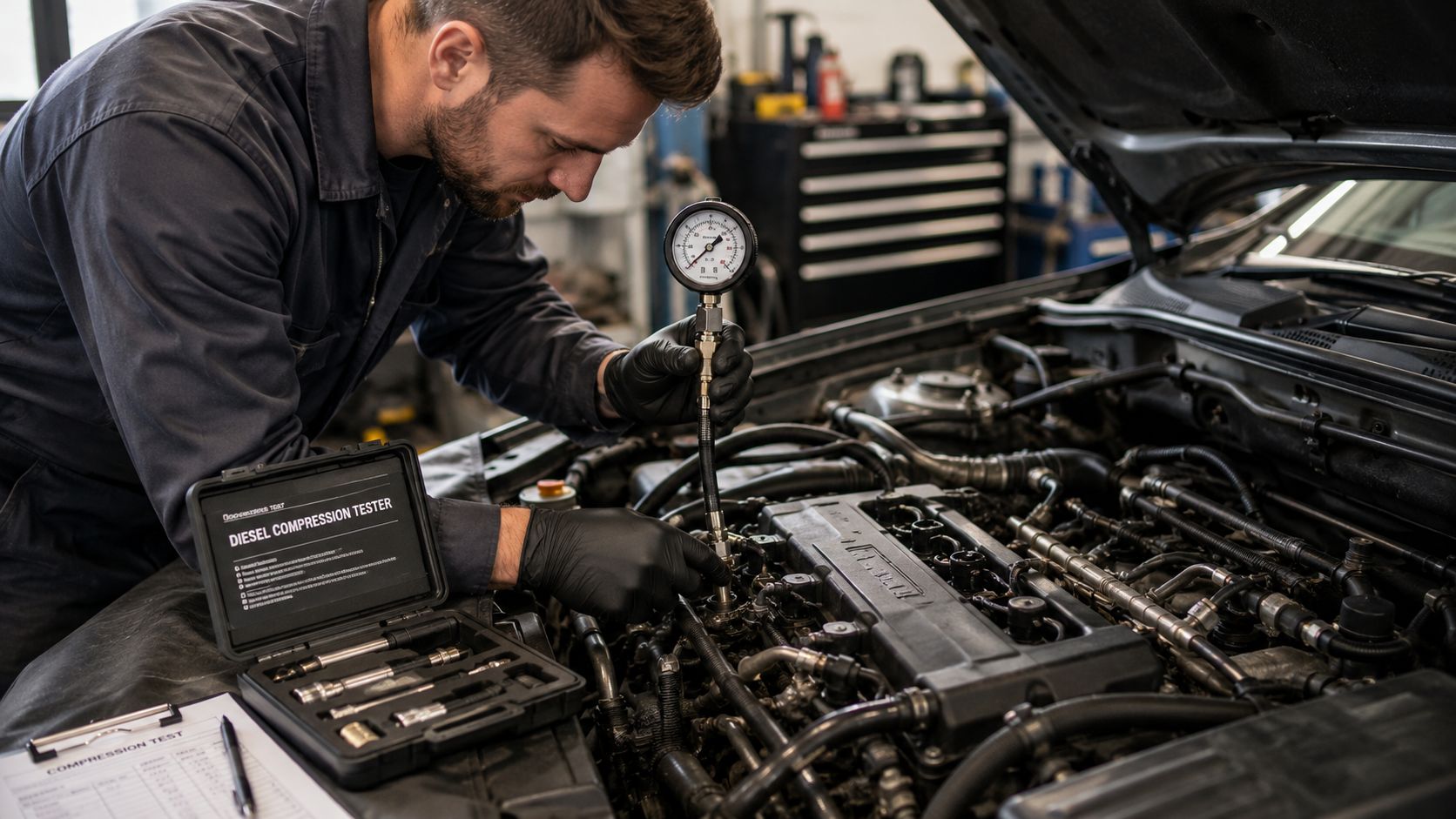
Standard protocol requires cranking the engine for exactly eight revolutions with the fuel pedal fully depressed to capture the maximum pressure reading while preventing starter overheating. That specific method creates a consistent basis for comparing one cylinder with another and one test event with the next (standard eight-revolution diesel compression procedure).
For a heavy-duty engine, the sequence should look like this:
- Disable fuel delivery fully. The engine must not inject fuel during cranking. This protects the test result and the machine.
- Install the adapter on the first cylinder. Thread engagement should be clean and deliberate.
- Connect the gauge and hose. Verify that the release valve and hose fittings are secure before cranking.
- Crank for the fixed revolution count. The operator should keep the pedal fully depressed for the full count.
- Record the maximum reading immediately. Don't rely on memory across several cylinders.
- Release pressure and move to the next cylinder. Follow the same order each time so the log is easy to review.
Logging matters as much as cranking
A reliability technician shouldn't write “front cylinder low” on a paper towel and call it done. The log needs cylinder number, reading, engine condition, technician, date, and any abnormal observations such as leakage at the adapter or weak cranking. That record is what turns a field test into maintenance evidence.
A Cat C15 in a haul truck is a good example of why this matters. If one shift performs a compression test during a short outage and another team repeats it months later after a complaint of low power, the second result only means something if both tests used the same protocol. Consistent cranking count, same access point, same general engine condition, and complete notes make the readings trendable.
The useful compression test isn't the loudest one in the shop. It's the one another crew can reproduce under the same conditions.
Where the procedure fits in condition monitoring
Compression testing is not a replacement for routine monitoring routes. It is a targeted mechanical diagnostic that complements them. Oil analysis can indicate wear debris. Thermography can show exhaust imbalance. Vibration can identify structure-borne problems around the engine and driven equipment. Compression confirms whether the cylinders are still mechanically sealing.
Plants that want this work to support planning, not just troubleshooting, should place it inside a formal condition monitoring workflow. That gives the test a trigger, a documented method, and a defined path for follow-up action.
Interpreting Compression Test Results for Fault Isolation
A standby generator fails its monthly load test, yet vibration, oil analysis, and exhaust temperature checks show only weak signals. Compression testing often breaks that tie. It shows whether the problem sits in one cylinder, in one bank, or across the whole engine.
For reliability work, the reading itself is only the start. The value comes from the pattern across cylinders, the spread from baseline, and how that pattern lines up with known failure modes. On most industrial diesel engines, cylinders should stay tightly grouped. A noticeable spread between cylinders matters more than chasing one absolute number taken out of context, especially when cranking speed, altitude, engine family, and test method vary from site to site.
Read the pattern before choosing the repair scope
Start with distribution.
One low cylinder usually points to a localized sealing problem. Common causes are exhaust valve leakage, intake valve damage, ring wear, liner scoring, or a defect at the head gasket around that cylinder. Two adjacent cylinders reading low shifts suspicion toward a gasket breach between cylinders or a localized head problem. Uniformly low readings across all cylinders usually indicate a broader condition issue such as general wear, incorrect valve timing, or test conditions that reduced every result in the same direction.
That distinction changes the work order. A single-cylinder defect may justify a planned top-end inspection during the next outage window. Evenly depressed readings across the engine call for a bigger decision about remaining life, overhaul timing, and whether the asset can still carry its required duty.
| Observation | Probable Cause | Recommended Next Step |
|---|---|---|
| One cylinder reads low while others stay closely grouped | Localized valve leakage, ring wear, liner damage, or a sealing defect in that cylinder | Repeat the dry test on that cylinder. Confirm the reading, then inspect related symptoms such as blow-by, exhaust temperature, and starting quality |
| Two adjacent cylinders read low | Head gasket breach between neighboring cylinders or a localized head fault | Check for coolant loss, combustion leakage, and pressure transfer between cylinders. Plan targeted teardown |
| All cylinders read low but relatively even | General wear, timing-related issue, or test conditions affecting the whole engine | Compare against prior results, verify test conditions, and review overhaul history before opening the engine |
| Wet test raises compression on the weak cylinder | Ring wear, liner wear, or poor ring sealing | Inspect piston, ring, and liner condition at the next planned outage |
| Wet test does not change the weak cylinder | Valve leakage or head gasket fault | Focus follow-up inspection on the valve train, seat condition, and head sealing surfaces |
Use the wet test carefully
A wet test can help separate ring sealing problems from top-end leakage, but it is a follow-up check, not a stand-alone verdict. If adding a small amount of oil to a low cylinder produces a meaningful increase, ring or liner wear becomes more likely because the oil temporarily improves sealing at the bore. If the reading stays flat, valve leakage or a head sealing problem moves higher on the list.
On industrial assets, I would not approve intrusive work from a wet test alone. Pair it with crankcase pressure, oil consumption trend, exhaust temperature spread, borescope findings, and the asset's recent loading history. That combination is what turns a useful field test into a maintenance decision with acceptable risk.
Translate readings into maintenance action
Compression results need clear thresholds for response. If one cylinder falls materially below its historical baseline while the rest remain stable, increase monitoring frequency and inspect at the next opportunity. If the cylinder also shows high blow-by, hard starting, or a cold exhaust port, the risk is no longer theoretical. Schedule corrective work before the defect grows into piston, liner, or head damage.
A fleet example makes the trade-off clear. On a diesel-driven compressor, one weak cylinder may still allow operation for a limited period if load can be controlled and the machine is not in critical service. On a prime or emergency generator, the same finding can justify earlier intervention because a single missed start carries a much higher business consequence.
Compression testing narrows the fault tree. It does not replace failure analysis. When low-compression findings repeat on the same cylinders, or return soon after repair, the next step is a formal root cause analysis process. That is how reliability teams separate isolated wear from lubrication problems, cooling issues, loading practices, or repair quality problems.
A normal average can hide a bad cylinder. Maintenance planning should follow the pattern, the trend, and the consequence of failure.
Common Pitfalls That Compromise Test Accuracy
A standby generator fails its monthly start test. The team pulls compression readings, finds one cylinder low, and starts planning a teardown. Two hours later, a repeat test with the correct adapter and a fully charged starting system brings that cylinder back into line. The engine was not the problem. The test setup was.
That kind of error costs real money on industrial assets. A false low reading can pull a generator, compressor engine, or haul truck out of service without cause. A false normal reading is worse. It leaves a worn cylinder, leaking valve, or head gasket defect in operation until the failure shows up under load.
What experienced technicians don't skip
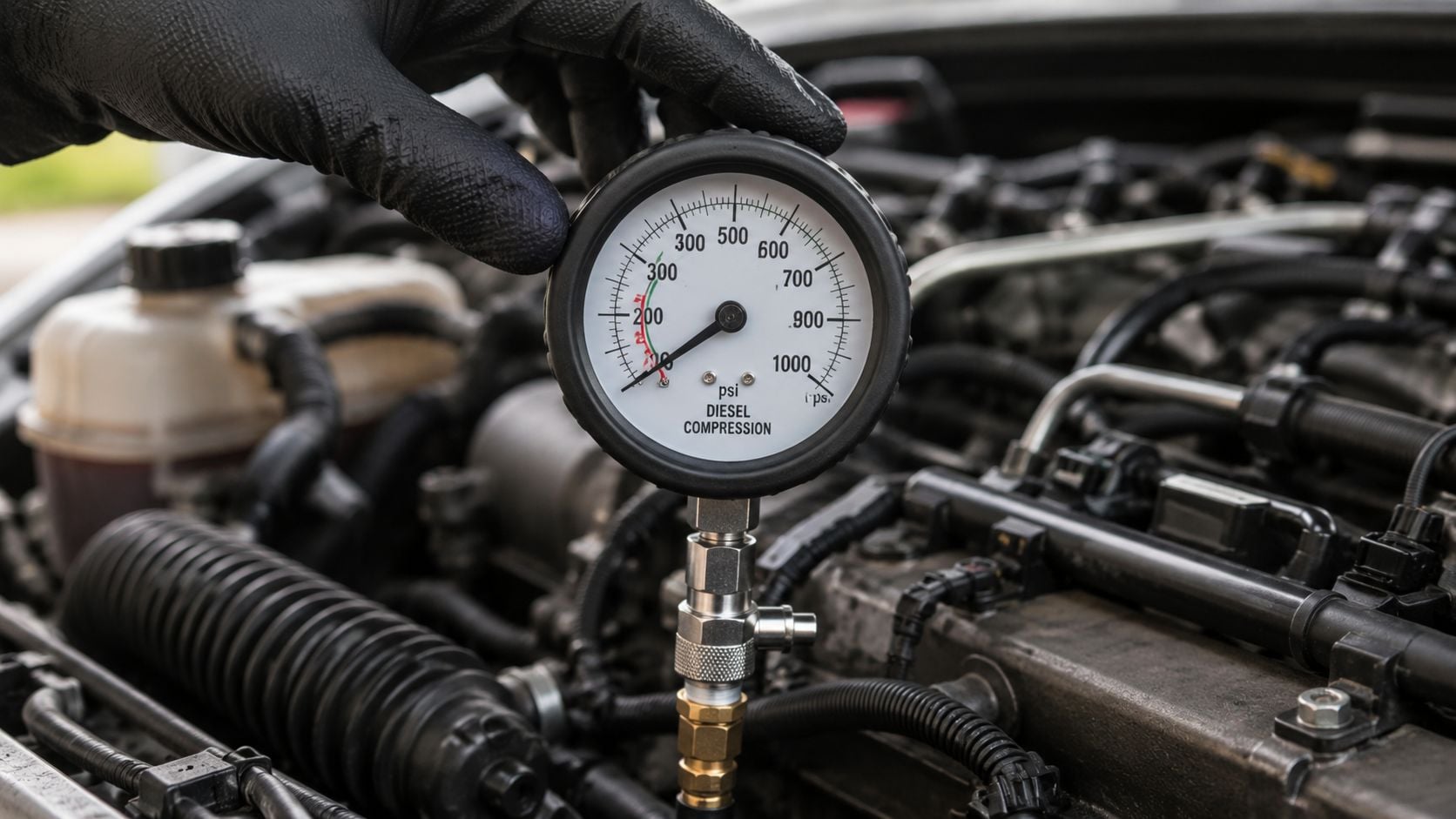
The biggest accuracy problems are procedural. Fuel must be fully disabled before cranking. If injection continues, cylinder wall washing can lower readings and change the condition you are trying to measure. Gauge condition matters too. If the instrument is out of calibration or the hose check valve is sticking, every cylinder reading is suspect.
The mechanical setup causes the next tier of errors:
- Poor adapter fit: wrong thread, damaged seal, or shallow seating can create an artificial leak path
- Uneven cranking speed: weak batteries, poor cable connections, or starter issues distort cylinder-to-cylinder comparison
- Hot versus cold inconsistency: comparing results taken at different engine temperatures weakens trend value
- Incomplete test repetition: a questionable reading that is not rerun under the same conditions should not drive a work order
- Bad documentation: an incorrect cylinder number in the CMMS can send the repair crew to the wrong hole
These are not paperwork issues. They change maintenance decisions.
A reliability team should treat compression testing like any other condition assessment. Control the test conditions, verify the instrument, and record enough context to make the reading usable months later. That includes engine temperature, cranking speed if available, adapter used, battery condition, and whether the result was confirmed on repeat test.
Why one reading is not enough
One low number does not isolate a failure mode. It only establishes that the cylinder needs confirmation.
Repeat the dry test first. If the result stays low, review the setup before concluding that the engine has an internal defect. On industrial engines, I also want that low cylinder checked against the operating symptoms already on record, such as hard starting, cold exhaust temperature, rising blow-by, or load instability. Compression data has more value when it agrees with other evidence.
The trade-off is straightforward. Repeating a test adds a few minutes. Tearing down a healthy engine adds days, parts cost, and avoidable outage risk.
Field reminder: A compression number is only as good as the test conditions behind it. If those conditions are not controlled, the reading should not be used for maintenance planning.
Integrating Compression Data into Your Reliability Strategy
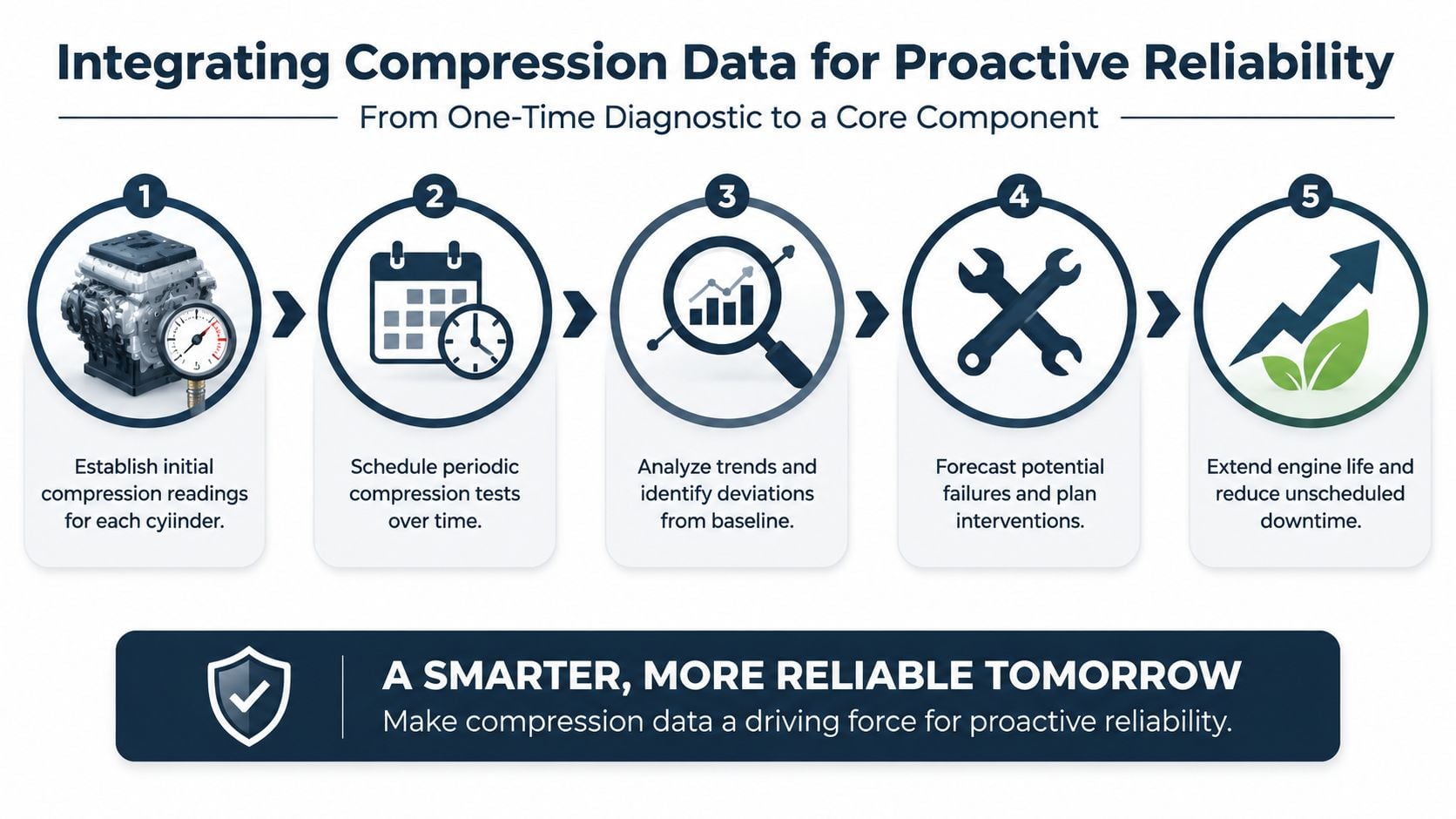
A single compression test is a snapshot. A series of tests, performed under controlled conditions and attached to the asset record, becomes a forecast.
That shift matters most on critical diesel assets such as standby generators, fire pump drivers, compressor engines, and heavy mobile equipment. These machines don't just need repair capability. They need a defensible strategy for when to inspect, when to continue operating, and when to plan intervention before production or safety is exposed.
Build a trend, not a filing cabinet
A diesel engine fault is confirmed when any cylinder's reading differs from the manufacturer's specification by more than 44 psi, and tracking that threshold helps reliability programs catch seal degradation and related wear before it drives efficiency loss and higher fuel consumption (44 psi fault confirmation threshold for diesel compression data).
That threshold becomes much more powerful when it is used as a rule inside the maintenance system. Instead of filing the report and moving on, the team can define an alarm condition tied to deviation from specification, recurring decline on one cylinder, or a pattern of deterioration across the engine.
Turn readings into maintenance decisions
A practical program usually follows a sequence like this:
- Baseline the engine: Capture cylinder readings after overhaul, commissioning, or a known healthy inspection.
- Schedule repeat checks: Test during planned outages, seasonal readiness work, or after symptoms such as fuel drift or hard starting.
- Set decision criteria: Use the manufacturer's specification and the fault threshold to determine when engineering review is required.
- Trigger follow-up work: Assign borescope inspection, leak-path inspection, or top-end planning when the data crosses the alarm point.
- Review the strategy: Compare compression trends with outage history, overhaul timing, and asset criticality.
On a facility generator, this prevents the common mistake of treating every performance complaint as a fuel-system issue. On a quarry loader or a marine auxiliary engine, it helps the planner justify intervention before the machine loses availability in service.
Teams moving from time-based maintenance to a more mature approach should connect compression testing with the larger predictive vs preventive maintenance strategy. That is how a diesel compression test kit stops being a reactive troubleshooting tool and starts supporting reliability planning.
If a plant wants to turn compression readings, vibration trends, oil analysis, and failure history into a workable maintenance strategy, Forge Reliability offers a free reliability assessment. It's a practical way to identify gaps in condition monitoring, strengthen asset decisions, and reduce unplanned downtime on critical industrial equipment.