
A pump can run clean for months, then fail on a Saturday night while the crew is thin, the shift supervisor is on the phone, and the only failure history lives in three spreadsheets and a couple of veteran memories. In that moment, the question is not whether the plant has software, it's whether the plant has a way to connect the asset, the work, the parts, the schedule, and the people who have to make a replacement call before production loses another hour.
That's the enterprise asset management meaning. It's not a software label, it's an operating model for deciding what to maintain, when to maintain it, who owns the work, and whether repair still makes sense compared with replacement. For plants that live with pumps, compressors, turbines, and other critical rotating equipment, that distinction matters because the wrong model turns asset decisions into hallway conversations instead of data-backed choices.
Table of Contents
- Why the Term Enterprise Asset Management Confuses Plant Teams
- The Four Building Blocks Behind the EAM Definition
- How EAM Differs from CMMS and Predictive Maintenance
- Core EAM Modules Every Reliability Leader Should Know
- Integrating Condition Monitoring and Reliability Engineering
- KPIs That Prove an EAM Program Is Working
- Implementing EAM and the Pitfalls That Derail It
- Applying EAM to Pumps, Compressors, and Turbines
Why the Term Enterprise Asset Management Confuses Plant Teams
A maintenance planner can have a solid work order system and still feel like the plant is missing something. A centrifugal pump in the cooling-water loop goes down, the corrective history is split between CMMS records, an Excel sheet from the day crew, and a mechanic's handwritten notes, and the replacement decision gets made in a hallway with no clear view of failure frequency, spares, or lifecycle cost.
That is where the term enterprise asset management gets slippery. Many teams hear “asset management” and think “better tracking,” but the broader meaning is about how the plant governs physical assets from acquisition through disposal, with work, inventory, procurement, and finance tied together in one decision framework. IBM frames EAM as the mix of software, systems, and services used to maintain and control operational assets, while Purdue describes it as managing assets across the lifecycle, and SAP focuses on keeping physical assets available, reliable, and safe over time, which is why the term reaches beyond a maintenance screen into operating discipline. IBM's EAM overview and SAP's explanation of EAM both reflect that lifecycle view.
What plant teams usually want to know
Most plant-floor leaders are not asking for a definition quiz. They want to know whether EAM helps them answer three practical questions fast, which assets matter most, what work should happen next, and whether repair is still the right choice.
Practical rule: if a record only tells maintenance what was fixed, it's a work log. If it helps leadership decide what to do next with the asset, it's closer to EAM.
That's why the meaning gets clearer when it's tied to a steam turbine with repeated seal issues or a compressor with recurring temperature alarms. The operating model has to link the failure history, the parts picture, and the labor plan before the next outage window closes. That is the language reliability leaders need when they explain EAM to operations and finance without sliding into software jargon.
The Four Building Blocks Behind the EAM Definition
The cleanest way to understand EAM is to separate the model into four parts, people, processes, data, and software. A delivery business running a car fleet makes the idea easy to picture, drivers and dispatchers are the people, route rules are the process, vehicle records are the data, and the fleet system is the software that keeps them aligned.
In a chemical plant, the same logic applies to a gearbox on a conveyor or a booster pump in a utility area. The planner owns the schedule, the reliability engineer owns the failure logic, the technician owns execution, and the supervisor owns priorities. If the asset hierarchy says the gearbox belongs to one line while the floor sees it as part of another skid, the data structure is already wrong before the wrench comes out.
People and process come before screens
EAM fails when the software is bought before the roles are defined. A weekly scheduler needs to know who approves a shutdown, which craft owns a pump PM, and what happens when an alert lands during a production run.
The software only amplifies the operating model already in place. If the roles are vague, the system just makes the confusion faster.
The process side matters just as much. Work management, planning, scheduling, and closeout are not administrative extras. They are the steps that keep a bearing change, seal inspection, or vibration follow-up from becoming a one-off event with no learning captured.
Data is the asset memory
Data gives EAM its long memory. That includes the asset register, parent-child hierarchy, history, and naming rules, so a technician can trace a motor, coupling, and pump as one chain instead of three disconnected records. The internal structure has to match the physical structure on the floor, or the system will keep suggesting the wrong parts, the wrong jobs, or the wrong criticality. A useful reference point for lifecycle thinking is this asset lifecycle management guide, because EAM only works when the record follows the asset through every stage.
Software sits on top of those four building blocks. It doesn't create discipline by itself, it only makes disciplined work easier to repeat.
How EAM Differs from CMMS and Predictive Maintenance
A lot of plants own a CMMS and still feel under-governed. That's because CMMS, predictive maintenance, and EAM solve different problems, even though they touch the same asset. A work order system can keep technicians busy, a condition program can spot trouble early, and EAM can decide how the whole lifecycle should be managed.
Here's the simplest rule of thumb. If the question is how do we execute the work, that sits in CMMS. If the question is when will it fail, that belongs to predictive maintenance. If the question is should we keep repairing it or replace it, that is EAM territory.
| Layer | Primary Question | Scope | Typical Outputs |
|---|---|---|---|
| EAM | Should we repair, replace, or re-plan the asset strategy? | Full lifecycle, inventory, procurement, finance, governance | Asset hierarchy, lifecycle cost view, capital decision support |
| CMMS | How do we plan and record maintenance work? | Work orders, PMs, labor, parts, closeout | Job plans, completed work, failure codes, history |
| Predictive Maintenance | When is failure likely or starting to develop? | Condition monitoring and early warning signals | Alerts, trend data, anomaly flags |
A compressor train makes the boundaries obvious. Predictive maintenance may flag rising vibration on the drive-end bearing. CMMS turns that into a work order, assigns the crew, and records the repair. EAM asks whether repeated bearing work means the machine should move into a replacement or overhaul path, especially if downtime is more expensive than the next repair cycle. A detailed overview of the maintenance side is available in this CMMS asset management guide, which helps show where execution ends and lifecycle governance begins.
A practical test for the next meeting
Decision test: if the meeting is about scheduling a job, the CMMS is in focus. If the meeting is about asset health, the PdM program is in focus. If the meeting is about asset strategy and capital risk, EAM is in focus.
That distinction keeps teams from expecting one system to solve every problem. A plant can have strong condition monitoring and still miss the bigger capital question if lifecycle cost, replacement timing, and spares strategy are not part of the same operating model.
Core EAM Modules Every Reliability Leader Should Know
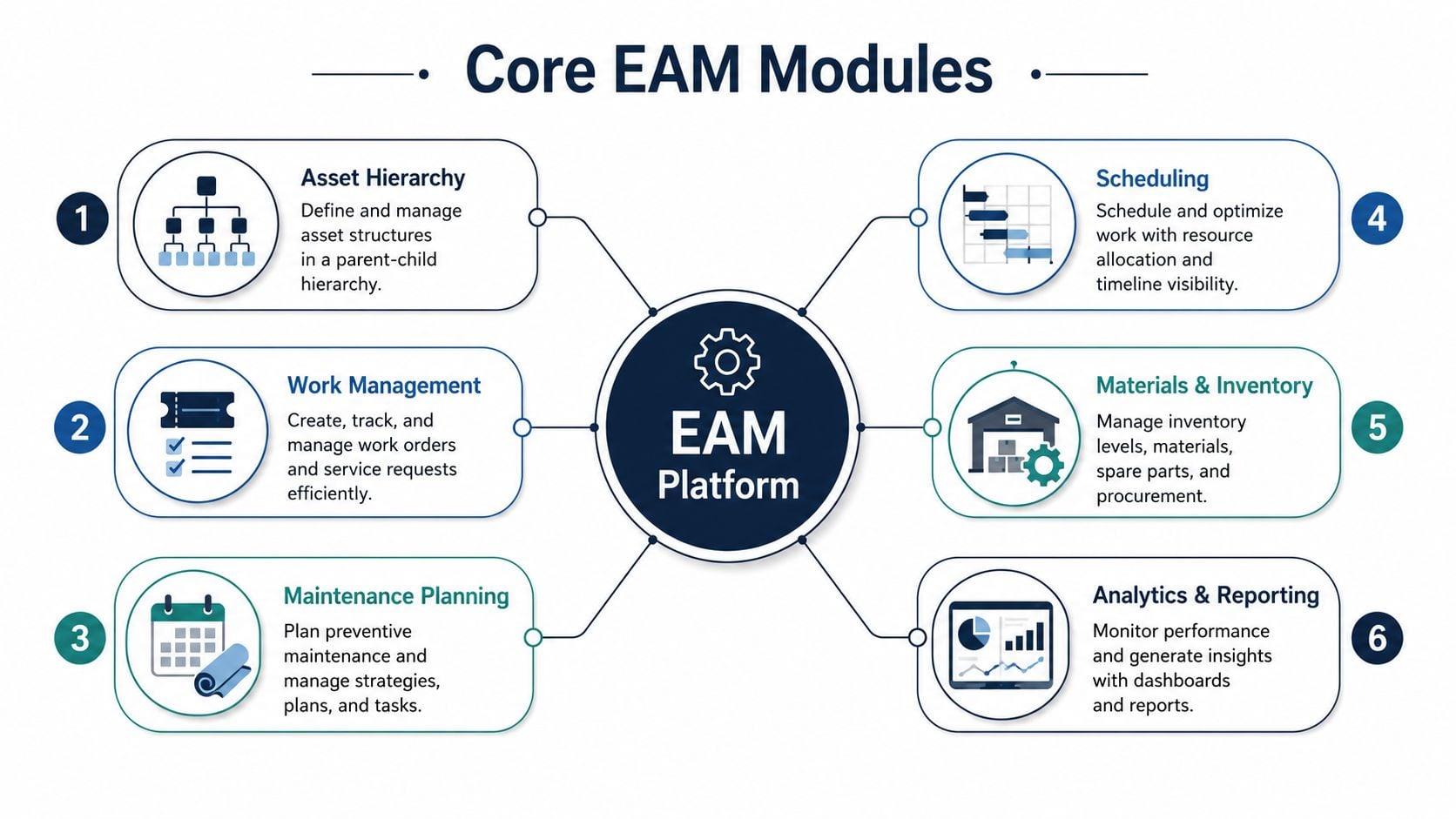
A compressor, a pump, or a turbine does not fail in a spreadsheet, it fails in the field. EAM matters because it gives maintenance, asset, and workforce planning one shared data backbone, so the next decision is based on the same asset record instead of three different versions of the truth. A good program usually brings together six core pieces, and each one answers a question a reliability leader has to resolve before a failure turns into lost production or a bigger repair.
Asset hierarchy and work management
The asset hierarchy is the plant's family tree. A pump should sit under its skid, train, system, and area, so the planner can open one record and trace the pump, motor, seal, coupling, and bearings back to the same line of sight. That prevents a team from treating each symptom as a separate problem when the issue sits one level higher in the equipment structure.
Work management is the execution layer that turns that structure into action. It captures the job plan, safety steps, labor, parts used, and closeout notes, so the record shows what was done and what still needs attention. A clear work order path supports work order management by keeping planning, scheduling, and closeout consistent instead of ad hoc.
Spare parts, lifecycle cost, and capital planning
Spare parts management keeps the right seals, bearings, cartridges, and similar items ready when a failure hits. If the inventory record is inaccurate, the plant pays for stockouts or overbuying, and both outcomes slow response time and strain reliability.
Lifecycle cost gives EAM its capital perspective. It compares acquisition, operation, maintenance, and disposal cost over time, so a manager can weigh repeated compressor repairs against overhaul or replacement. Capital planning turns that cost picture into a timing decision, where outage windows, budget cycles, and replacement timing all need to line up.
A good EAM program makes replacement decisions less emotional. If a machine keeps draining money and the risk keeps rising, the record should show that plainly.
Data governance and platform selection
Data governance keeps the records usable. That means standards, ownership, naming rules, audit trails, and approval paths for changes to asset master data. Without that layer, even a well-set-up system drifts into duplicate tags, inconsistent failure codes, and reporting that nobody trusts.
For teams comparing configuration options and implementation scope, compare Nuvolo EAM options can help frame how different EAM setups handle asset records, work flows, and reporting. The point is not the software label, it is whether the setup supports disciplined decisions on the equipment that matters.
The practical check is simple. If a solution does not help with hierarchy, work execution, spares, lifecycle cost, capex timing, and governance, it is not covering the full EAM job.
Integrating Condition Monitoring and Reliability Engineering
A bearing starts to change before it fails. Vibration rises, oil carries more debris, heat shows up on a thermal scan, or a motor draws current in a pattern that does not fit the normal load. Condition monitoring turns those early signs into usable information, and EAM turns that information into the next decision on the asset record.
That decision should not stay as an alert on a screen. A rising vibration trend on a fan motor should open a work order, carry the history into the job plan, and give the planner enough context to choose between a bearing change, an alignment check, or a deeper inspection. The same loop applies to a gearbox with contaminated oil, a compressor with hot spots, or a turbine that starts to show abnormal operating behavior.
A condition monitoring system gives reliability teams the measurements. EAM gives those measurements a place to land, so the record for the pump, compressor, or turbine reflects what the asset is doing right now, not just what it looked like during the last inspection.
The reliability vocabulary that belongs inside EAM
FMEA means failure modes and effects analysis, the structured review of how a component can fail and what that failure does to the process. RCM is reliability-centered maintenance, the method used to decide the most sensible maintenance strategy for each failure mode. RCFA means root cause failure analysis, the disciplined search for why the failure happened, not just what part broke.
Apollo, 5-Why, and fault tree analysis are investigation tools. Apollo and 5-Why push teams to keep asking why until the cause becomes visible, while fault tree analysis shows how several faults can combine into a larger event. Those findings should not sit in a report folder. They should flow back into the criticality ranking, PM interval, and work instructions so the next job reflects what the team learned.
How the data should move
A modern EAM setup should let reliability engineering do three things. First, use condition alerts to create work. Second, use FMEA and RCM outputs to decide which assets deserve the most attention. Third, use Weibull or similar life analysis to adjust replacement intervals and lifecycle cost assumptions. A plant that keeps those loops closed is far more likely to stop repeating the same failure on the same pump or compressor.
Forge Reliability can serve as a reference point for combining condition monitoring, reliability consulting, and asset management support, including vibration, oil analysis, thermography, ultrasound, MCSA, FMEA, RCM, criticality ranking, lifecycle cost analysis, spare parts optimization, and CMMS data governance.
KPIs That Prove an EAM Program Is Working
An EAM program should change the scoreboard, not just the software stack. If the team can't point to the numbers that moved, the initiative is just better administration with a new interface.
OEE stands for overall equipment effectiveness, the combined view of availability, performance, and quality. MTTR is mean time to repair, the time it takes to restore a failed asset. MTBF is mean time between failures, the reliability signal that shows how long the machine runs before the next breakdown.
What the metrics tell a plant leader
OEE belongs on the dashboard because it shows whether maintenance is protecting throughput or eating it. MTTR matters because a hard-to-access pump or poorly kitted compressor job can stay down longer than it should. MTBF matters because repeated failure on the same turbine seal or gearbox bearing is a sign the maintenance strategy needs to change, not just the wrenching.
Downtime cost is the financial side of the same story. It should be tied to the line, unit, or area where the asset sits, because a problem on a critical process pump is not the same as a problem on a utility fan. ROI then asks whether the EAM effort, including software, data cleanup, process changes, and integration work, returned enough value to justify the spend.
| KPI | What it shows | Typical decision it drives |
|---|---|---|
| OEE | Throughput health | Which bad actors are suppressing production |
| MTTR | Repair speed | Whether kitting, access, and planning need work |
| MTBF | Asset reliability | Whether the PM strategy needs to change |
| Downtime cost | Financial exposure | Which asset deserves priority attention |
| ROI | Program value | Whether the operating model is paying back |
For a deeper reliability metrics reference, this MTBF, MTTR, and OEE guide is a useful companion when the plant is building a dashboard that finance will trust.
A program without these numbers can still move work orders. It can't prove it's managing asset risk as an operating model.
Implementing EAM and the Pitfalls That Derail It
EAM succeeds when the rollout is treated like a plant change, not an IT install. The first move is a criticality-ranked asset register, because the plant can't govern everything at once. The second is standardizing CMMS fields, ownership, and naming so one pump tag means one thing everywhere.
The third step is narrow pilot scope. A single area, one pump train, or one compressor line is enough to prove whether the process works before the team expands. The fourth step is condition monitoring integration, which keeps alerts from dying in inboxes. The fifth step is governance, usually monthly KPI reviews and a clear data steward who owns record quality.
Five failure points that show up fast
- Treating EAM as an IT project. The symptom is a live system with no behavior change, because the plant never agreed on ownership or process.
- Underinvesting in data cleanup. Duplicate records, broken hierarchies, and bad failure codes turn reporting into guesswork.
- Skipping criticality analysis. The team ends up giving equal attention to a boiler feed pump and a low-risk spare, which burns time.
- Over-customizing the software. Every exception becomes a special rule, and the system stops supporting standard work.
- Leaving data quality without an owner. Nobody fixes the record, so the same errors reappear in planning, procurement, and closeout.
A plant with a steady governance cadence sees the difference quickly. Technicians stop hunting for parts that were already on hand, planners get cleaner shutdown packages, and supervisors can see which alerts need attention before the next shift starts. A plant without governance usually sees the opposite, more duplicate records, more wasted inventory, and more ignored notifications.
Applying EAM to Pumps, Compressors, and Turbines
A centrifugal pump shows the EAM logic plainly. Seal and bearing PM intervals should line up with vibration and oil analysis trends, not just calendar time, and lifecycle cost should answer whether a repeated seal replacement still makes sense compared with replacement. That decision moves MTTR when the job is kitted well and MTBF when the strategy addresses the failure mode.
A rotary screw compressor needs a different lens. Oil changes, element replacement, and load-control decisions should tie back to lost-air cost, because a compressor that runs inefficiently can hurt production even when it is not fully failed. EAM helps the team connect inspection intervals, spares, and operating hours to the cost of compressed air.
A steam turbine raises the stakes again. RCM-derived inspection intervals, spare rotor strategy, and outage planning all have to feed capital decisions, especially when the machine sits on the path to major production. The right EAM structure keeps those choices visible to maintenance, operations, and leadership instead of hiding them in separate documents.
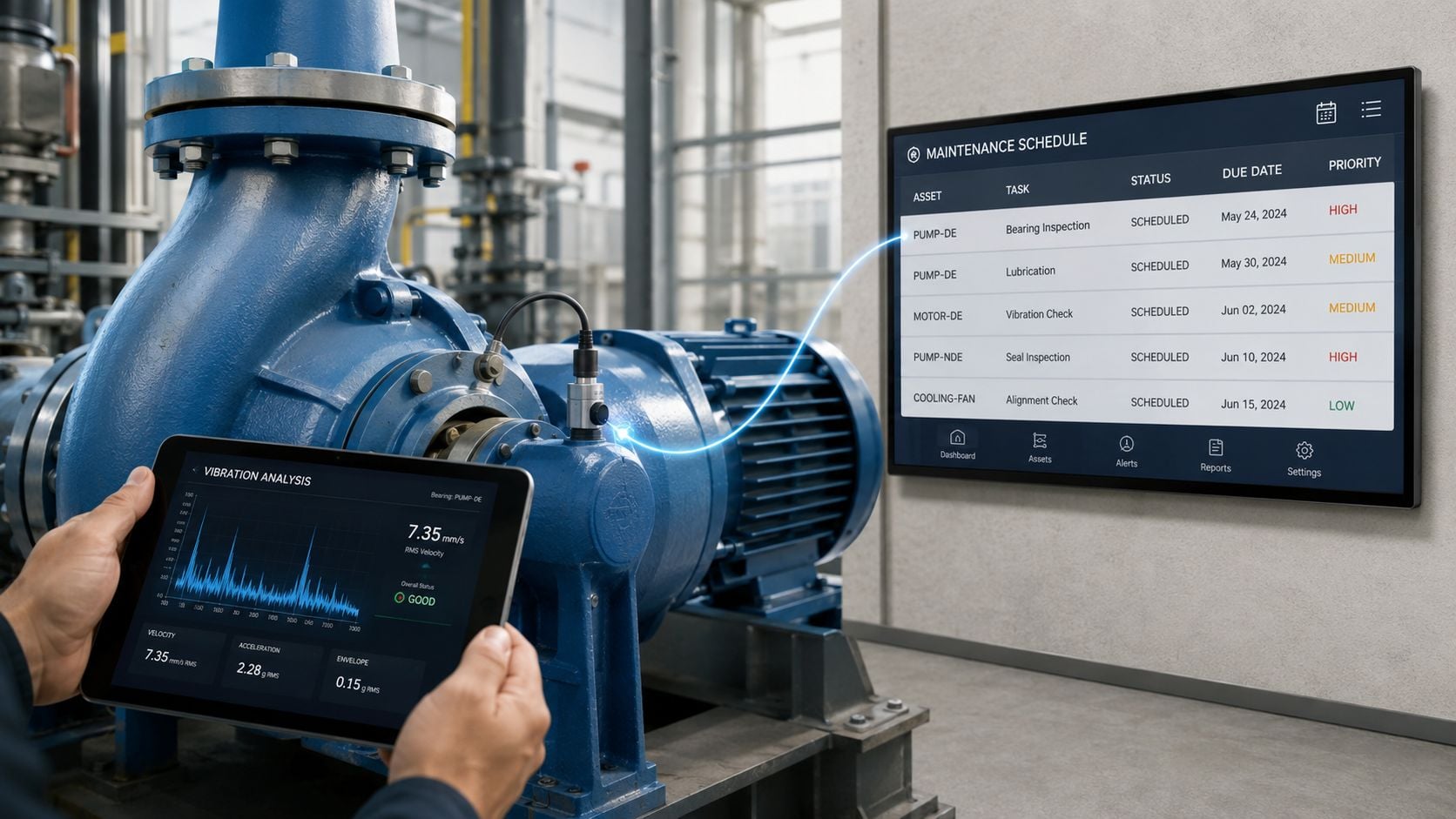
The common thread is simple. EAM links the asset record, the work order, the parts decision, and the capital plan to one reliability outcome, fewer surprises on critical equipment. That is the practical meaning of the term on a plant floor.
Forge Reliability helps plants connect asset management with condition monitoring, reliability engineering, and lifecycle planning so critical equipment decisions are based on data instead of guesswork. For teams trying to turn EAM into uptime on pumps, compressors, and turbines, a free reliability assessment from Forge Reliability is a practical next step.