
Siemens' obsolescence audit assessed 843 assets across 17 manufacturers and found 699 already obsolete, including discontinued and end-of-life products. Of those obsolete assets, 249 required immediate replacement and 450 were assigned to long-term replacement. That is roughly 83% of the evaluated installed base classified as obsolete, with about 36% of obsolete assets requiring urgent action. Siemens' audit example exposes the operational issue clearly: equipment can remain functional while its support chain, repair path, and replacement options disappear.
For reliability engineers and plant leaders, equipment obsolescence management is therefore not a catalog-cleanup exercise. It's a way to identify assets that can fail without a viable recovery path, quantify the consequence, and schedule intervention before a PLC, drive, instrument, or control card becomes a production constraint.
Table of Contents
- Why Obsolescence Is a Reliability Problem Not a Purchasing Problem
- Building Your Installed Base Inventory and Verifying the BOM
- Scoring Criticality and Obsolescence Risk Together
- Choosing Between Lifetime Buys Retrofits and Full Upgrades
- Spare Parts Optimization and CMMS Data Governance
- Governance Structures and Continuous Improvement KPIs
Why Obsolescence Is a Reliability Problem Not a Purchasing Problem
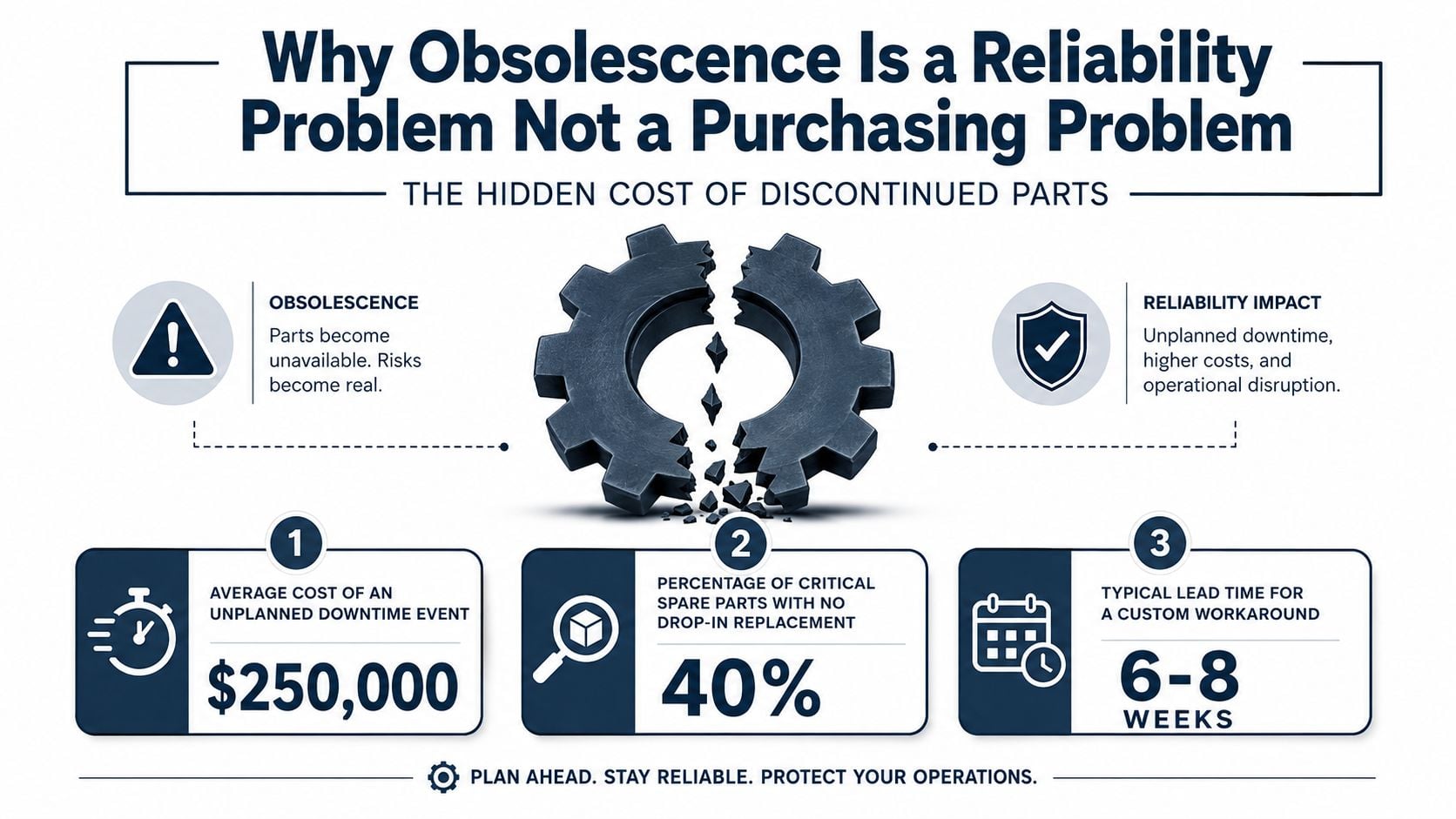
A discontinued component may keep running for years. That apparent stability often delays action until a critical failure occurs. When the processor card in a compressor control cabinet fails, the maintenance team may discover that the original part is unavailable, the approved substitute needs engineering review, and the existing program cannot be transferred without testing. Procurement can locate a part, but procurement alone can't restore a validated control function.
The International Atomic Energy Agency's guidance on ageing and obsolescence management treats obsolescence as a measurable lifecycle risk. Useful measures include the number of systems reviewed, the number of obsolete equipment items identified, the percentage of issues resolved before affecting operations, average replacement lead time, and the number of temporary workarounds required to keep assets operating. Those measures belong beside vibration alarms, oil-analysis findings, thermography results, and bearing replacement forecasts because each describes exposure to future loss of function.
The failure mode is loss of recoverability
Traditional condition monitoring asks whether an asset is degrading. Obsolescence management asks whether the plant can recover when that asset fails. A legacy variable frequency drive may show normal current balance and acceptable temperature while its keypad, power module, or control board has no supported replacement. The failure mode isn't visible degradation. It's loss of maintainability under failure conditions.
That distinction changes the maintenance plan:
- Failure consequence: Determine whether the asset affects safety, environmental control, throughput, quality, or utility availability.
- Recovery path: Confirm whether a repairable module, approved alternative, or tested redesign exists.
- Replacement lead time: Record the time required to source, engineer, validate, install, and commission the alternative.
- Workaround exposure: Track bypasses, temporary wiring, manual operation, or borrowed components that keep production running.
- Knowledge dependency: Identify systems understood by only one technician or engineer, especially when documentation is incomplete.
A food plant may continue producing with an aging packaging-line PLC until a digital input module fails. The line then stops not because the machine is physically worn out, but because the replacement module has different diagnostics, wiring requirements, or firmware behavior. Treating that event as a purchasing failure hides the reliability decision that should have occurred earlier.
Leadership needs a risk narrative
Plant leadership responds more effectively to a ranked operational exposure than to a spreadsheet of discontinued part numbers. The message should connect each item to a production function, failure consequence, recovery time, and mitigation cost. A lifecycle register that shows “obsolete” without showing what happens after failure won't compete successfully for outage time or capital.
Maintenance teams can also use what an enterprise asset management program covers to position obsolescence data within broader asset governance. The same asset hierarchy should connect equipment criticality, failure history, spare parts, lifecycle status, and planned replacement timing.
Obsolescence can also affect the technology footprint beyond the plant floor. Teams evaluating how to cut IT costs with lifecycle management should apply the same principle to operational technology, where unsupported equipment may carry a direct uptime and safety consequence. The reliable decision is not “buy the part when it fails.” It is “remove the unsupported recovery path before failure makes the decision for the plant.”
Building Your Installed Base Inventory and Verifying the BOM
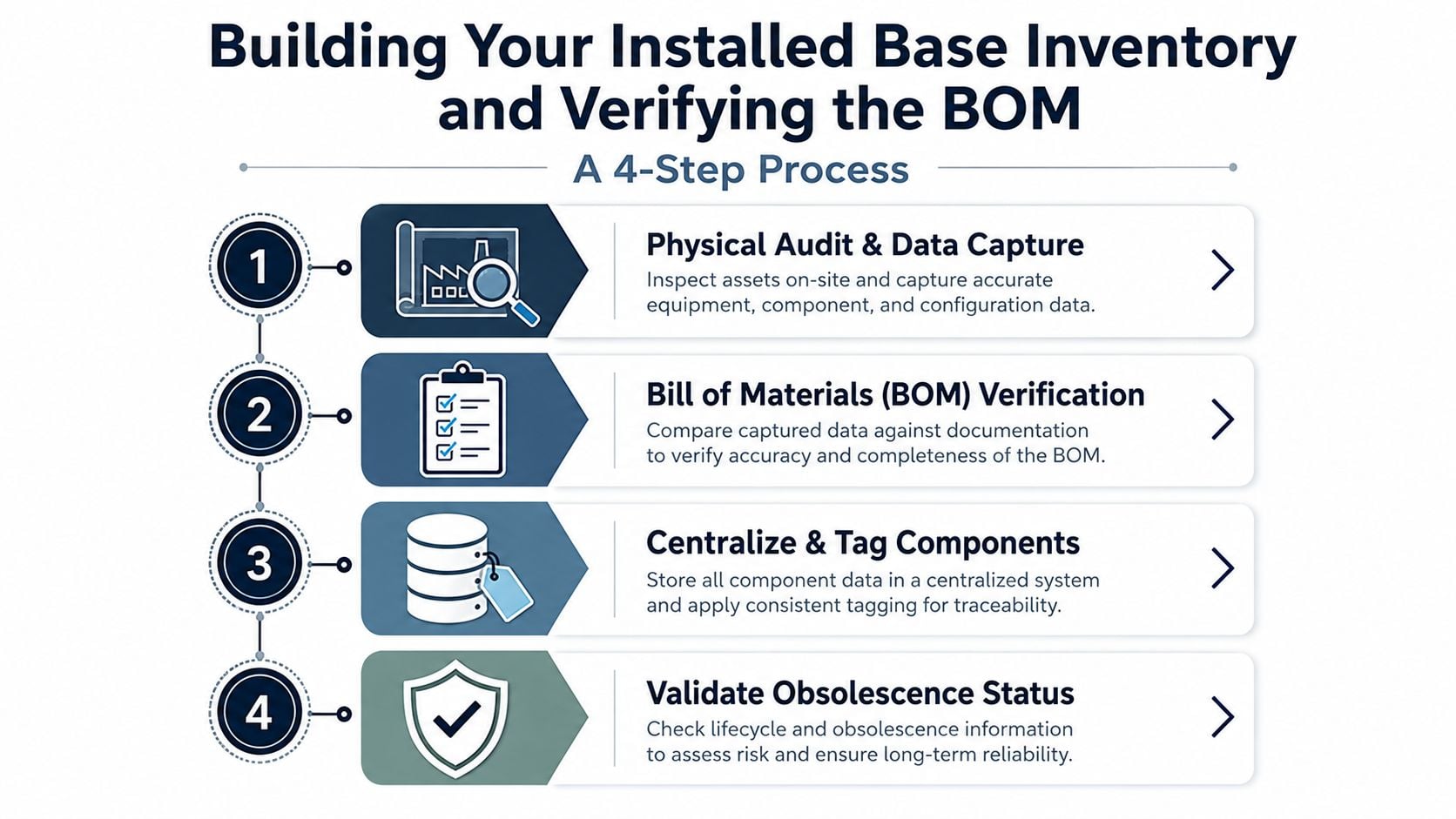
A risk score is only as accurate as the installed-base record behind it. The inventory must describe what is physically installed, how the component functions, which equipment depends on it, and whether the bill of materials reflects the current configuration. A clean CMMS record can still be wrong if technicians installed an undocumented revision during an earlier breakdown.
The first pass should combine document review with a physical audit. Export equipment and spare-part records from the CMMS, then walk down each critical line with electrical drawings, panel schedules, control narratives, and maintenance history. Capture manufacturer, exact part number, revision, firmware where relevant, location, parent asset, function, quantity installed, quantity held as a spare, and approved alternatives.
Start with the physical configuration
A chemical processing facility may have a control cabinet documented with a processor, communication module, and I/O rack from the original project. A later modification may have added a remote I/O island, an isolator, or a specialty analog module without updating the drawing or BOM. That undocumented component can become the single point of failure even though the main controller appears fully documented.
During the walkdown, technicians should photograph nameplates and cabinet layouts under the site's documentation and safety rules. They should reconcile every visible module against the BOM, record missing or substituted items, and flag assemblies that cannot be identified from the available documents. A component with an uncertain identity should not receive a low risk rating solely because its status is unknown.
Secure records matter because lifecycle decisions depend on traceable evidence. A practical reference for organizing controlled technical records is this myhalo guide to secure documentation, particularly for sites managing drawings, configuration files, manuals, and revision history across multiple teams.
Structure the data for later scoring
The inventory should support both asset-level and component-level analysis. A compressor may be one maintainable asset, but its obsolescence exposure can sit in the PLC processor, remote I/O adapter, VFD control board, pressure transmitter, or safety relay.
Useful CMMS fields include:
| Field | Why it matters |
|---|---|
| Parent asset and location | Shows where failure will occur and which process depends on the part |
| Exact part number and revision | Prevents generic descriptions from hiding incompatible variants |
| Function and failure consequence | Connects the component to production, safety, quality, or environmental performance |
| Lifecycle status | Separates active, at-risk, discontinued, and end-of-support items |
| Vendor support information | Records whether repair, technical help, firmware, or replacement remains available |
| Installed quantity and spare quantity | Exposes single points of failure and inventory concentration |
| Approved alternative | Identifies whether a replacement has been technically reviewed |
| Last-time-buy status | Shows whether procurement must make a finite supply decision |
| Documentation reference | Links the record to drawings, manuals, test results, and change control |
The CMMS asset management framework should preserve the relationship between the component, parent equipment, BOM, work orders, and mitigation plan. Lifecycle status should never live only in an engineer's spreadsheet. Once the physical audit and document reconciliation are complete, the verified inventory becomes the source for criticality scoring, spare-parts decisions, and capital planning.
Scoring Criticality and Obsolescence Risk Together
A discontinued sensor on a redundant cooling loop doesn't deserve the same response as a discontinued processor controlling the plant's main compressor. The scoring model must combine consequence of failure with probability that the recovery path will fail.
A practical model uses two independent scores:
- Criticality score, 1 to 5: Measures the operational consequence if the component fails. A score of 1 indicates limited effect and a score of 5 indicates a safety, environmental, or major production consequence.
- Obsolescence probability, 1 to 5: Measures the likelihood that sourcing or recovery will be difficult. A score of 1 indicates active support and available alternatives. A score of 5 indicates discontinued status, no validated substitute, limited spares, or an extended engineering requirement.
- Combined risk score: Multiply the two scores. The result ranks exposure without pretending every obsolete item needs immediate replacement.
The score should be supported by evidence, not intuition. Review vendor lifecycle notices, repair history, spare consumption, supplier availability, firmware compatibility, and the time required for testing and revalidation. A part with one spare in the storeroom may still score high if that spare is the last usable unit and no approved replacement exists.
A working matrix for plant equipment
The following matrix illustrates how the method can be applied to common equipment. The values are an example scoring convention for prioritization, not measured performance data.
| Equipment Type | Criticality Score (1-5) | Obsolescence Probability (1-5) | Combined Risk Score | Recommended Action |
|---|---|---|---|---|
| Main compressor PLC processor | 5 | 5 | 25 | Start a controlled retrofit or upgrade plan, validate the recovery path, and protect the outage window |
| Production-line VFD | 4 | 4 | 16 | Confirm power-module and control-board availability, qualify an alternative, and schedule targeted replacement |
| Chemical-feed pump motor | 4 | 3 | 12 | Verify motor compatibility, hold a justified spare, and monitor failure history |
| Cooling-loop gearbox | 3 | 3 | 9 | Review repairability and replacement lead time, then include it in the planned lifecycle program |
| Non-critical utility sensor | 2 | 4 | 8 | Document an alternate and replace during routine maintenance unless the process consequence changes |
The matrix creates a ranked action list, but it shouldn't replace engineering judgment. A low-frequency failure in a safety-related instrument may warrant escalation even when the production consequence appears limited. Conversely, a high-cost asset with installed redundancy may receive a lower immediate priority if the redundant path is tested and dependable.
Make the ranking auditable
Each score should include a reason code. Examples include “unsupported processor,” “sole source,” “no approved substitute,” “last spare consumed,” “long validation requirement,” or “manual bypass available.” This makes the register defensible during capital reviews and gives the next engineer enough context to update the assessment.
A risk priority number approach can help align obsolescence scoring with existing FMEA and reliability workflows. The critical control is consistency. If one site rates criticality by production value and another rates it by safety consequence, corporate comparisons become unreliable.
Practical rule: A high score should trigger a decision date, an accountable owner, and a documented recovery path. It shouldn't merely create another red cell in a spreadsheet.
Choosing Between Lifetime Buys Retrofits and Full Upgrades
Once the ranked register identifies exposure, the intervention choice depends on remaining useful life, failure consequence, compatibility, validation burden, and the vendor roadmap. Three options appear repeatedly, and each solves a different problem.
Lifetime buys preserve continuity but create inventory obligations
A lifetime buy can make sense when the surrounding system remains stable, the asset has meaningful remaining useful life, and the replacement requires extensive revalidation. Buying additional PLC cards or VFD control modules may protect a short-term outage plan, especially when the plant can store and test the units properly.
The trade-off is finite supply. A lifetime buy doesn't remove obsolescence. It converts an external availability problem into an internal inventory and preservation problem. Electrical and electronic parts may require controlled storage, periodic inspection, traceability, and a clear allocation rule so one emergency doesn't consume the entire reserve.
This option is weak when the asset has multiple unsupported components, the software environment is undocumented, or the plant has no credible estimate of future demand. Holding one part without understanding its configuration, firmware, or compatibility can create false confidence.
Retrofits target the exposure without replacing everything
A retrofit replaces selected components while preserving useful infrastructure. Examples include replacing a legacy drive with a current compatible drive, moving remote I/O to a supported architecture, or changing a control card while retaining the motor, gearbox, enclosure, and field wiring.
Retrofits can reduce project scope, but they introduce interface risk. Engineers must check signal types, scaling, communication behavior, cabinet heat, short-circuit ratings, motor characteristics, safety functions, and control logic. A drive replacement may require changes to acceleration parameters, braking hardware, motor protection, or harmonic mitigation.
A pharmaceutical facility may prefer a targeted retrofit for a packaging skid because a full upgrade would trigger process revalidation across the line. That decision is sound only if the replacement preserves required control performance and the validation plan addresses every changed interface.
Full upgrades remove the legacy dependency
A full upgrade replaces the unsupported control platform or system architecture and establishes a new support baseline. It offers the clearest long-term recovery path, but the project must account for engineering, programming, testing, operator training, commissioning, documentation, and planned downtime.
An oil and gas facility may choose a full upgrade for a compressor train when the control system has several unsupported modules, scarce expertise, and a high consequence of failure. The upgrade can be scheduled around a major turnaround, with factory acceptance testing, simulation, loop checks, trip testing, and a controlled return to service.
The decision can be organized as follows:
| Decision condition | Lifetime buy | Retrofit | Full upgrade |
|---|---|---|---|
| Remaining useful life | Strong | Strong to moderate | Limited or uncertain |
| Unsupported components | Isolated | Selected subsystems | Broad or deeply integrated |
| Validation burden | Low after qualification | Moderate to high | High, but comprehensive |
| Downtime window | Minimal | Planned | Significant |
| Long-term support need | Temporary | Extended | Strategic |
| Documentation quality | Good | Good to moderate | Must be rebuilt or standardized |
Use remaining useful life analysis to avoid spending heavily on a control retrofit for equipment that is already approaching mechanical replacement. The right intervention is the one that reduces operational exposure across the asset's actual future service period, not just the one with the lowest purchase price.
Spare Parts Optimization and CMMS Data Governance
Obsolescence programs often fail after the initial cleanup because the CMMS returns to stale descriptions, missing BOM links, and unassigned lifecycle fields. The inventory then appears complete while new supplier discontinuations, substitutions, and undocumented repairs accumulate outside the governance process.
The spare-parts record should distinguish dead stock from critical reserve stock. A part with no recent consumption may be dead stock, or it may be a low-demand item that protects a high-consequence asset. Consumption alone cannot decide the issue. The record needs the parent-asset relationship, failure consequence, replenishment difficulty, approved alternative, and last-time-buy status.
A practical screening process uses the following triggers identified in spare-parts obsolescence guidance:
- Zero consumption: Flag parts with zero consumption for the site's defined review periods, then check whether the item supports a critical asset before disposal.
- No active BOM linkage: Investigate parts that aren't linked to an operating asset, because missing linkage may indicate either dead stock or poor master data.
- No last-time-buy flag: Review discontinued parts without a documented procurement decision.
- High-value exposure: In one maintenance framework, high-value A-items typically represent 10 to 20% of SKUs but 70 to 80% of inventory value, so those items deserve focused governance rather than equal treatment across the catalog. Spare-parts obsolescence guidance
Configure fields that drive action
At minimum, the CMMS should hold lifecycle status, vendor support end date when available, last review date, alternate part reference, qualification status, last-time-buy flag, stock quantity, preservation requirements, and mitigation owner. The lifecycle field should use controlled values such as active, at risk, discontinued, end of support, and unknown. Free-text notes can't support reliable filtering or escalation.
The system should also distinguish “alternative identified” from “alternative approved.” A mechanically similar motor may have different thermal characteristics. A replacement VFD may require new parameter sets. An electronic module may fit the rack but use different diagnostics or firmware. Approval needs evidence from engineering, testing, or a documented manufacturer compatibility statement.
Set review frequency by consequence
High-criticality spares should receive a more frequent review than general inventory. The review should verify stock condition, actual location, shelf-life requirements, current BOM linkage, and whether the proposed replacement remains obtainable and technically valid. Broader inventory health can be reviewed on a quarterly cycle, while lifecycle changes should be entered as soon as the site receives a supplier notice or identifies a field substitution.
Multi-site organizations need a common data standard with local ownership. Each plant should maintain its physical truth, while a central reliability or asset-management function controls field definitions, escalation rules, and reporting. The CMMS implementation guide for maintenance teams provides a useful reference for aligning workflows, ownership, and data quality.
Governance Structures and Continuous Improvement KPIs
A sustainable program gives obsolescence a home between maintenance, engineering, procurement, operations, and finance. The obsolescence register should have one accountable owner, but no single department can maintain it accurately in isolation. Maintenance knows failure history and spare consumption. Engineering understands compatibility and validation. Procurement sees supplier notices and lead-time changes. Operations defines the consequence of lost function.
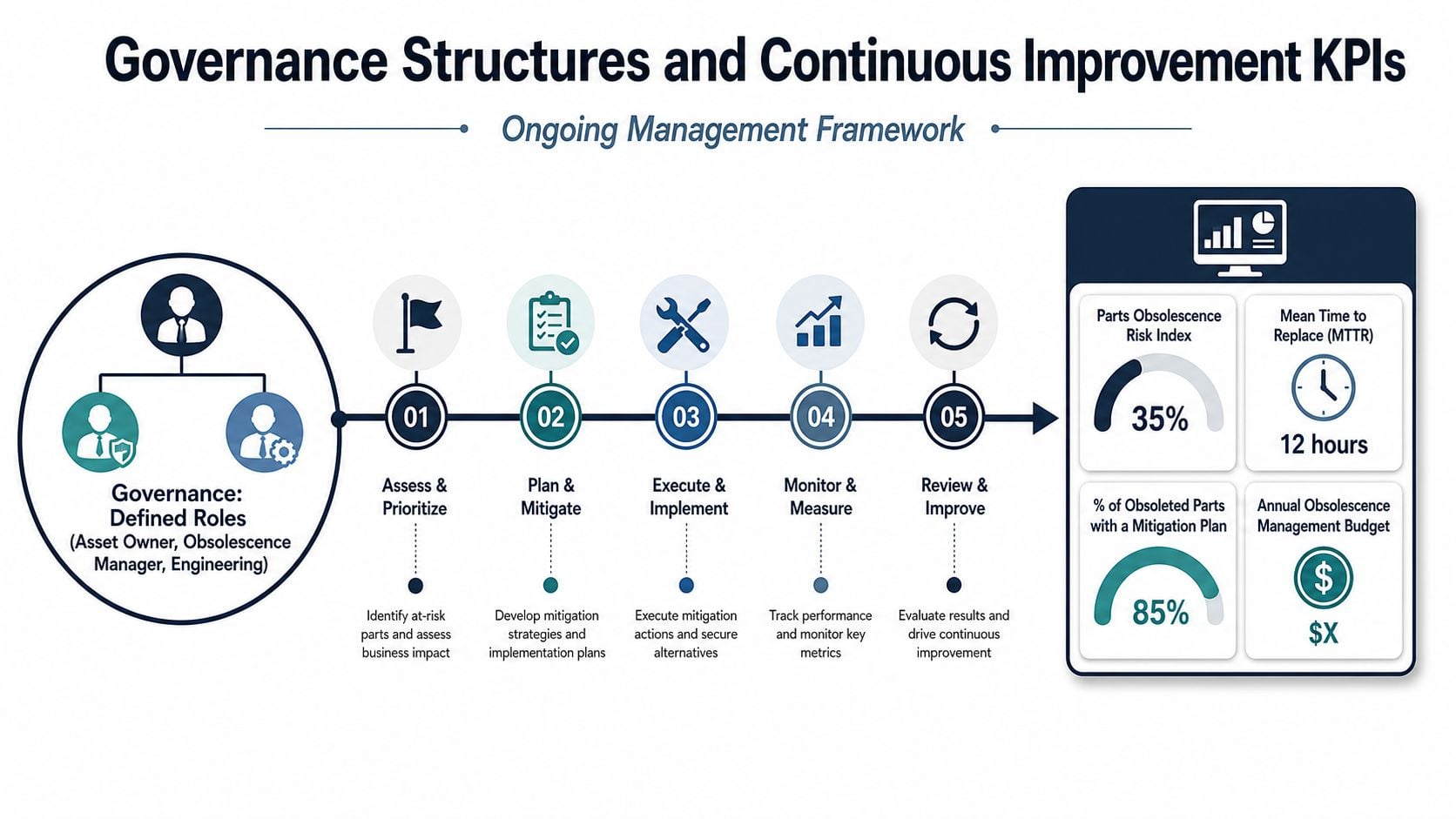
Industry guidance describes a five-stage flow: identify, prioritise, implement solutions, monitor, improve and share, then develop organisational interfaces that support the process. The structured obsolescence strategy guidance is consistent with how a plant should run the register. Identification without prioritization creates noise. Implementation without monitoring fails to prove whether risk declined.
Assign ownership at each decision point
The asset owner confirms process consequence. The obsolescence manager maintains the register, coordinates reviews, and escalates overdue actions. Engineering approves technical alternatives and change control. Maintenance validates maintainability, spares, and work instructions. Procurement manages supplier communication and sourcing decisions. Operations approves outage windows and temporary operating limits.
The register should show the accountable person, decision date, mitigation status, required outage, validation requirements, and residual risk. A monthly review can focus on high-risk items and overdue decisions, while a broader governance review examines new lifecycle alerts, inventory changes, completed interventions, and lessons from failures or workarounds.
Measure prevention, not activity
Useful KPIs include:
- Percentage of obsolescence issues resolved before affecting operations, which measures proactive control rather than the number of parts purchased.
- Average replacement lead time, measured across sourcing, engineering, validation, and installation where the site can capture those stages.
- Temporary workarounds in service, because every workaround indicates unresolved configuration, safety, training, or maintainability exposure.
- Total assets reviewed and obsolete assets identified, which shows the coverage and scale of the program.
- Reactive replacements caused by obsolescence and unplanned downtime caused by part failure, tracked before and after major interventions.
A heavy-industry automation study reported about a 70% reduction in reactive obsolescence replacements and a 24% reduction in unplanned downtime caused by part failure during normal operation after a major upgrade. The reported reliability study supports a practical measurement principle: evaluate whether the intervention reduces reactive events and downtime, not only whether the project replaced equipment.
A governance team can also compare its information controls with retail data governance frameworks, while adapting the concepts to industrial asset ownership, change control, and safety requirements. The register becomes valuable when each review changes a decision, closes an exposure, or prevents an emergency workaround.
Obsolescence management earns continued funding when leadership can see fewer reactive replacements, shorter recovery paths, clearer capital timing, and fewer temporary fixes.
Forge Reliability provides a free reliability assessment that can map installed-base exposure, criticality, spare-parts risk, CMMS data quality, and replacement priorities across industrial assets. Visit Forge Reliability to request an assessment and turn unsupported equipment into a ranked, actionable reliability plan.