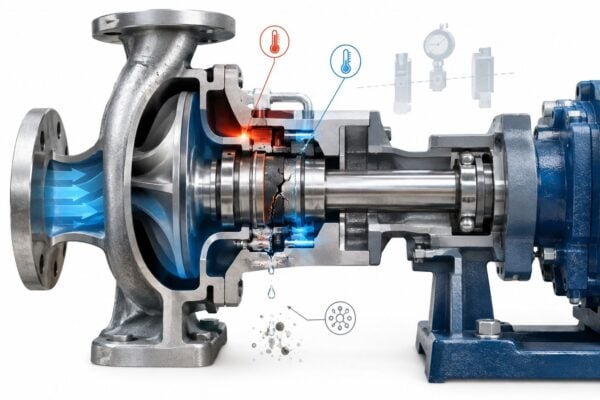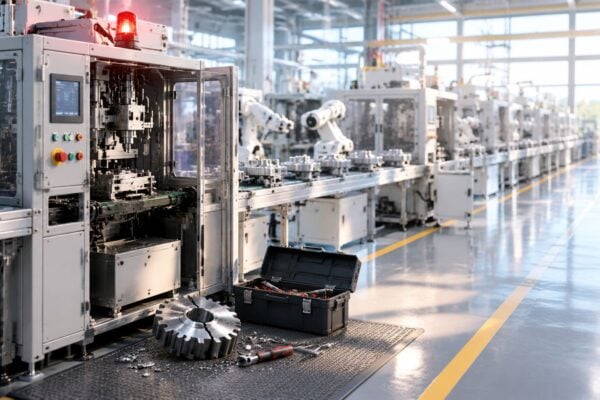
Inventory holding cost for industrial spares typically runs 20% to 30% of average inventory value per year, so a plant carrying $500,000 in MRO stock absorbs roughly $100,000 to $150,000 annually before a single breakdown happens. That number gets attention fast when the storeroom is full of pump parts, motors, seal kits, and repairables that were bought to protect uptime but never reviewed as a system.
Most plants don't feel this cost in one obvious place. They feel it as crowded shelves, obsolete motor frames, duplicate bearing numbers, seal elastomers aging out in bins, and capital that can't be used for condition monitoring or a root-cause investigation on the very equipment driving the spare demand. For reliability engineers, maintenance managers, and plant operations leaders, inventory holding cost isn't just a finance metric. It's a direct signal of how well the plant understands failure modes, lead times, and equipment criticality.
Table of Contents
- The Storeroom Nobody Wants to Audit
- What Inventory Holding Cost Really Means
- Calculating Carrying Cost for Spare Parts
- Holding Cost Versus Stockout Risk
- Classifying MRO Stock and the KPIs That Expose It
- The Hidden Cost of Safety Stock
- Tactics That Move the Number
- Turning Spare-Parts Strategy Into Uptime
The Storeroom Nobody Wants to Audit
The maintenance planner usually sees it first. A storeroom that looked “well stocked” from the doorway starts to look different once the shelves are checked against the CMMS. One rack holds coupling hubs for equipment no longer in service. Another has three motors with different frame histories because each was bought during a separate emergency. In the back, there are boxed seal kits with labels fading off and no clear link to a current pump model.

Plants usually don't avoid these audits because they're difficult technically. They avoid them because the findings are uncomfortable. The room exposes years of reactive decisions, weak part-number discipline, and equipment standardization that never happened. A solid CMMS asset management approach makes those patterns visible fast, especially when spare records are tied cleanly to asset hierarchy and BOMs.
What the shelves usually reveal
A process plant storeroom with pump and motor spares often shows the same failure points:
- Duplicate part records: The same deep-groove bearing exists under three descriptions, with different units of measure and different reorder settings.
- Obsolete asset support: Motor frames remain in stock long after the driven equipment has been modified or retired.
- Shelf-life exposure: Mechanical seals, elastomers, lubricants, and adhesive repair materials sit well past their useful life window.
- Emergency buying scars: Expedited purchases become permanent stock even when the original failure mode was corrected.
Unused inventory often hides unresolved reliability problems. Plants buy around repeat failures long before they eliminate them.
The problem isn't clutter. It's that the storeroom starts acting like a substitute for engineering. Instead of ranking assets, studying failure modes, and deciding what needs protection, the plant keeps adding parts. Every unused spare ties up money that could have funded vibration routes on a problematic process pump, ultrasound for motor bearings, or a failure analysis on repeated seal leakage.
Why this is a reliability problem first
Finance will eventually ask about write-offs, but operations pays first. The wrong inventory creates false confidence. Teams think they're protected because shelves are full, yet the part they need may still be missing, misidentified, or unusable. That disconnect is why spare-parts rationalization belongs with reliability and maintenance leadership, not just purchasing.
What Inventory Holding Cost Really Means
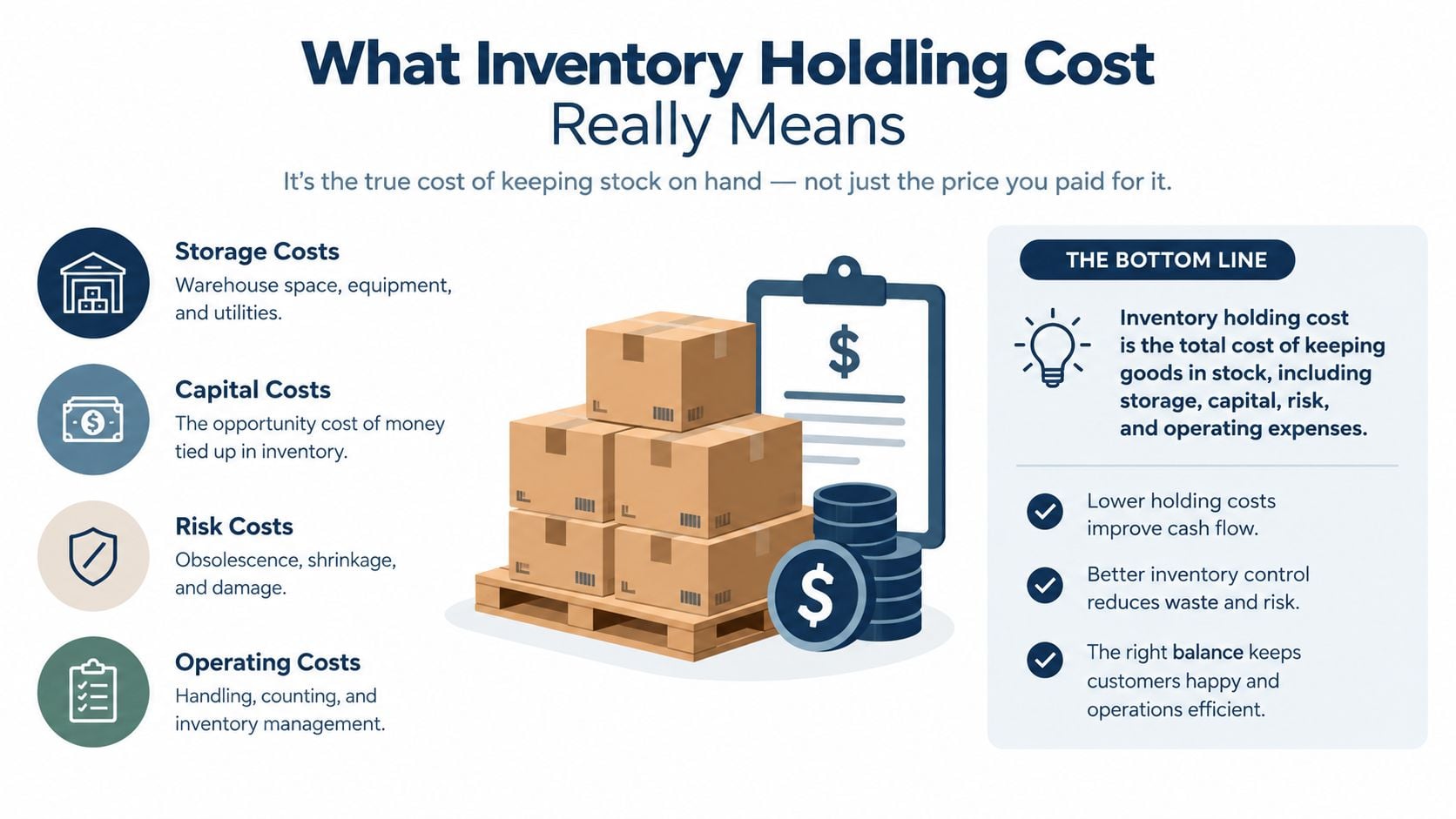
Inventory holding cost is the annual price of keeping a spare on the shelf, whether anyone touches it or not. In a plant, that cost sits on top of the purchase price from the day receiving books the part into stock. A spare motor, pump rotor, or seal kit may look harmless as a line item. Over a year, each one carries a reliability decision with a cash penalty attached.
For MRO stock, the mistake is treating carrying cost as a finance percentage and stopping there. The question is whether the plant bought the right protection for the failure consequence. If a critical cooling-water pump gets one properly chosen spare assembly, that can be justified. If five low-criticality motors each have a full spare because no one reviewed failure modes, the storeroom is absorbing reliability uncertainty at a high annual cost.
The cost buckets are simple. The decisions behind them are not.
Most carrying-cost models group the annual burden into four parts:
- Capital cost: cash tied up in stock instead of being used on reliability work, operations support, or other maintenance priorities
- Storage cost: racking, preservation, climate control, handling, and warehouse space
- Service cost: insurance, systems support, cycle counts, purchasing effort, and administration
- Risk cost: damage, shelf-life expiry, corrosion, loss, obsolescence, and write-offs
Those buckets are useful, but they do not all behave the same way on a plant floor. Capital and risk usually move the number the most for slow-moving spares. A boxed mechanical seal for a common pump might survive the year with modest exposure. A spare VFD for retired equipment or a motor frame that no longer matches the installed base starts picking up obsolescence risk the moment the asset strategy changes.
A reliability-focused maintenance budgeting process helps because it separates necessary protection from inherited stock. That distinction matters more than getting perfect agreement on one carrying-cost percentage.
Where the textbook view misses field reality
A single benchmark rate is fine for screening. It is weak for decision-making.
In practice, carrying cost rises or falls based on three reliability choices. Criticality ranking decides which assets deserve protection. Condition monitoring changes how much safety stock the plant needs to carry. Repair-versus-replace logic determines whether the shelf should hold a complete spare motor, a bearing and seal kit, or nothing at all.
I have seen this play out with process pumps. A site keeps a full spare rotor because the pump is called "critical," but vibration data already gives weeks of warning on bearing degradation and seal condition is visible in leak history. In that case, the annual holding cost on the rotor is often a penalty for not trusting the monitoring program. The same review on a firewater pump or an unmonitored caustic transfer pump can lead to the opposite decision. Stock the assembly, accept the carrying cost, and protect uptime.
Safety stock causes the same problem. Every extra unit added "just in case" creates an annual charge on that part's value. On paper, one more spare motor looks like protection. In the field, it may be a recurring cost caused by weak criticality logic, long lead time assumptions nobody has revisited, or a repair loop that should have been standardized years ago.
That is what inventory holding cost really means in maintenance. It is the yearly cost of uncertainty the plant chose to store.
Calculating Carrying Cost for Spare Parts
The easiest way to make inventory holding cost real is to calculate it on one pump package instead of one storeroom total. Consider an ANSI process pump with these stocked spares: bearings, a mechanical seal, an impeller, and a complete spare rotor. None of those parts look expensive sitting alone on a shelf. Together they create a meaningful annual carrying burden.
A quick planning assumption of 25% works well for this exercise. That sits inside the commonly used benchmark range already discussed and keeps the calculation simple enough for a planner to run during a review meeting.
Carrying Cost for a Centrifugal Pump Spares Package
| Spare Part | Unit Cost | Avg Qty | Avg Inventory Value | Carrying Cost @ 25% |
|---|---|---|---|---|
| Bearings | $1,800 | 1 | $1,800 | $450 |
| Mechanical seal | $450 | 1 | $450 | $113 |
| Impeller | $1,200 | 1 | $1,200 | $300 |
| Spare rotor | $3,800 | 1 | $3,800 | $950 |
| Total | $7,250 | $1,813 |
That means a single four-line spare package with an average inventory value of $7,250 consumes about $1,813 per year just to exist in stores. No labor has touched it. No outage has used it. The carrying cost starts the day it is received.
Why scale changes the conversation
Now extend the same logic across a fleet. A 40-pump spares package built on the same structure reaches roughly $145,000 in inventory value and produces an annual carrying cost near $36,250 at the same planning rate. That kind of number gets leadership attention because it reframes “just keeping prudent stock” as a real operating cost.
The part that catches many teams is quantity creep. One spare each often has a clear justification. Two or three each usually comes from habit, old lead-time fears, or the memory of a painful outage that was never revisited after supplier conditions changed.
For planners working on reduction targets, an inventory days guide from Nexist can be useful. It helps connect how long stock sits with the financial effect of carrying it, which is often more informative than unit price alone.
What works and what doesn't
Some spare categories deserve depth. Others don't.
- Worth carrying deeper: Long-lead pump rotors for a bottleneck unit, uncommon sleeve bearings tied to a critical machine, or repairables with uncertain turnaround.
- Usually overstored: Generic rolling-element bearings, standard motor protection devices, and duplicate seal kits across near-identical pumps.
- Frequently misjudged: Cheap items with low unit cost but high count. They rarely trigger concern individually, yet they build a large dormant value pool.
A structured maintenance cost reduction program usually starts here, not with blanket cuts. The plant needs to know which parts create true uptime protection and which ones make the shelves feel safer.
Holding Cost Versus Stockout Risk
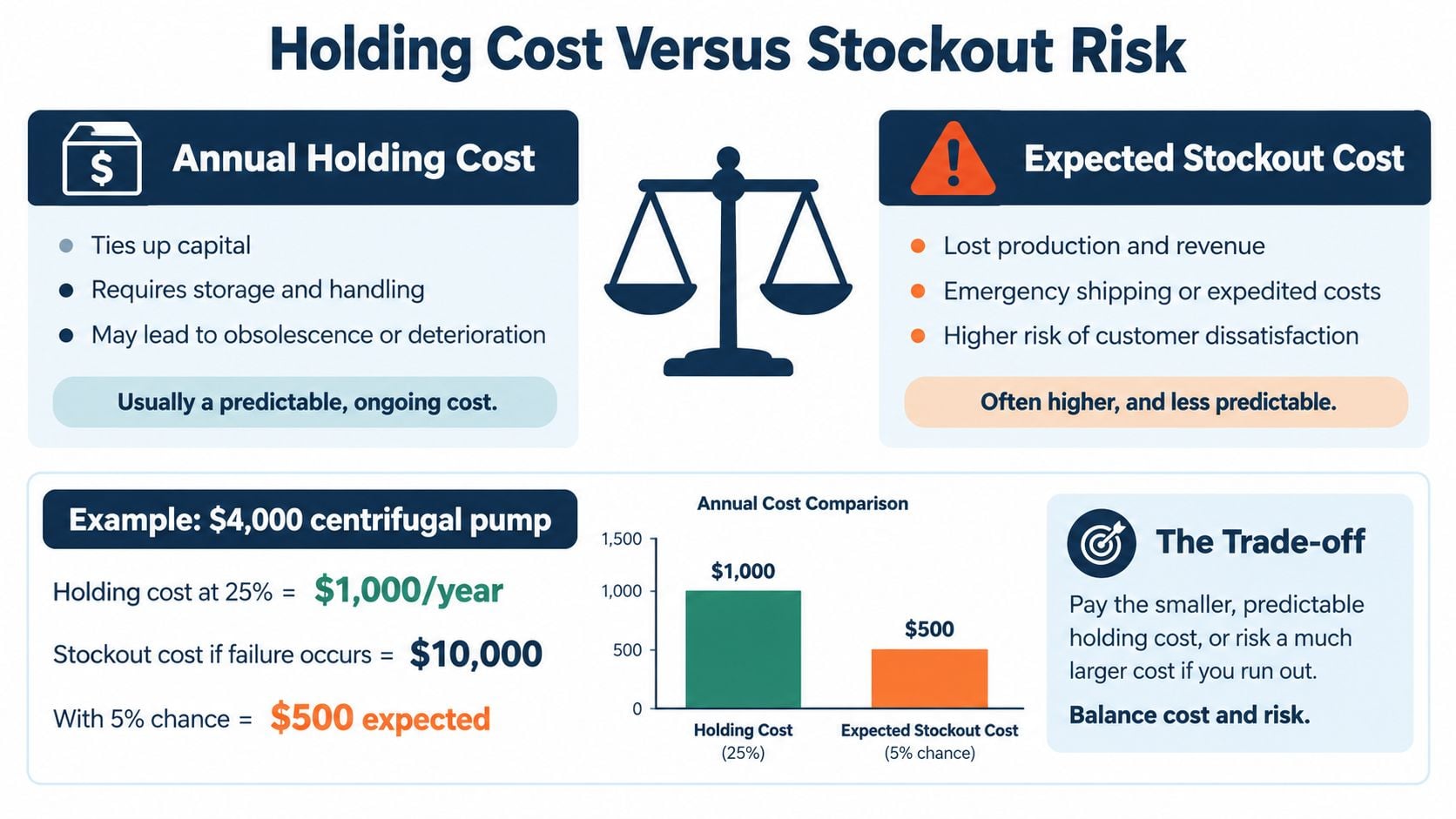
Every spare-parts decision is a trade between annual holding cost and expected stockout cost. Plants get into trouble when they treat either side as absolute. “Never stock out” produces bloated stores. “Cut inventory hard” produces emergency buys, extended downtime, and repair windows that blow past the shutdown plan.
Take a simple case. A critical centrifugal pump impeller costs $4,000. At a 25% carrying cost rate, that spare costs $1,000 per year to hold. If failure without a spare would stop a line for 48 hours and the lost throughput impact is $80,000, the break-even annual failure probability is about 1.3%. Above that, carrying the impeller is financially justified.
The variables that change the answer
That break-even point shifts fast when lead time and asset role change.
- Critical pump with long lead time: A process pump feeding a reactor train or boiler system usually justifies more protection, especially when replacement lead time is measured in weeks.
- Non-critical motor with short lead time: A redundant HVAC fan motor doesn't deserve the same stocking rule, even if the unit cost is similar.
- Repairable assembly: If the plant can swap and rebuild quickly, one ready spare may beat multiple complete replacements.
The practical mistake is using one service philosophy for every asset. Reliability teams need a triage model.
A simple field quadrant
A working screen for MRO decisions is a criticality by holding-cost matrix:
| Quadrant | Typical Action |
|---|---|
| High criticality, low holding cost | Stock locally and review condition triggers |
| High criticality, high holding cost | Stock selectively, consider repairable strategy or supplier agreement |
| Low criticality, low holding cost | Use simple reorder control |
| Low criticality, high holding cost | Challenge the need to stock at all |
A spare isn't justified because failure is possible. It's justified when the expected operational loss of not having it is greater than the annual cost of carrying it.
resource allocation optimization helps maintenance leaders defend decisions. The conversation stops being “buy less” or “buy more” and becomes “buy where risk-adjusted uptime requires it.”
Classifying MRO Stock and the KPIs That Expose It
Pure ABC classification by annual spend is too blunt for plant spares. A $500 bearing for a critical process pump shouldn't be managed the same way as a $500 bearing for a non-critical ventilation fan. The better method is a combined ABC plus criticality matrix that overlays consumption value with asset consequence.
A practical setup starts with usage history from the CMMS and then adds criticality from the asset hierarchy. The result is much more useful than value alone because it separates expensive but unimportant stock from moderately priced parts that protect uptime.
A workable classification method
The sequence is straightforward:
- Pull usage history: Export recent MRO issue history from the CMMS.
- Rank by annual consumption value: Identify which parts consume the most spend over time.
- Apply criticality tags: Link each spare to the asset it supports and the business consequence of failure.
- Assign stocking rules: Use the combined class to determine min/max, reorder method, and review cadence.
A strong enterprise asset management structure makes this sustainable because it keeps spares connected to asset records, BOM discipline, and criticality rankings rather than isolated stock codes.
ABC + Criticality Classification Matrix
| Class | Criticality | Stocking Policy | Review Frequency | Target Service Level | Target Turns |
|---|---|---|---|---|---|
| A-Critical | High | Min/max plus supplier coordination and protected stocking | Frequent | High | Low to moderate |
| A-Important | Medium | Min/max with tighter usage review | Regular | Moderately high | Moderate |
| B-Critical | High | Reorder point with lead-time validation | Regular | High | Moderate |
| B-General | Low | Standard reorder point | Periodic | Moderate | Moderate to higher |
| C-Critical | High | Stock only when failure consequence justifies it | Regular | Selective | Low |
| C-General | Low | Challenge stocking need, standardize or buy on demand | Periodic | Lower | Higher |
Which KPIs expose weak stores
Three indicators usually reveal where a storeroom is out of control:
- Inventory turns: Low turns often flag dormant value, duplicate stock, or unsupported legacy equipment.
- Service level: If the plant misses high-priority picks for critical spares, the issue isn't inventory value. It's stocking logic.
- Stockout rate per pick activity: This exposes whether reductions are cutting real protection or just excess.
- Carrying cost as a share of inventory value: This shows whether the storeroom is becoming more expensive to own over time.
The useful move isn't forcing every class to behave the same way. It is deciding which classes deserve high availability and which ones deserve scrutiny.
The Hidden Cost of Safety Stock
A plant can hit its service-level target and still waste money badly. I saw it in a spare-parts review where three stored pump assemblies had not moved in four years, but each one kept getting counted, preserved, and protected as if failure was due next week. On paper, that stock looked prudent. On the floor, it was a reliability decision that had never been revisited.
Safety stock costs more than its purchase price because the penalty keeps running while the part waits. Preservation labor, controlled storage, cycle counts, obsolescence exposure, and tied-up capital all sit on top of the item value. The longer a spare stays untouched, the less useful a single carrying-cost percentage becomes.
That matters most with MRO spares because the slowest-moving items are often the most expensive and the most emotionally protected.
Why the buffer gets expensive
Base stock supports expected consumption. Safety stock protects against uncertainty in failure timing, lead time, and repair turnaround. Those are different jobs, and they should not be carried with the same logic.
In practice, the protective layer often gets a higher real holding cost for three reasons:
- It sits longer: More calendar time means more inspections, recounts, corrosion checks, packaging degradation, and more chances for the part to become obsolete before use.
- It gets better storage: Critical spares often take the cleanest, driest, easiest-access locations, especially for motors, VFDs, instrument cards, and precision pump internals.
- It survives old assumptions: A spare marked critical during startup or after one painful outage often stays at that quantity even after redundancy, condition monitoring, or supplier performance improves.
A 250 kW motor held for a single-service pump train is a good example. If the plant has online motor testing, known repair vendors, and a verified rewind option, carrying two complete spare motors as permanent safety stock may be hard to justify. The second unit is not buying the same risk reduction as the first. It is mostly buying comfort, and comfort is expensive.
Where textbook safety stock misses the plant
Textbook formulas treat uncertainty as a demand and lead-time problem. Plants live with failure modes, repairability, and asset consequence.
A spare cartridge seal for a process pump, a motor bearing set, and a complete pump casing do not deserve the same protection method just because they belong to the same asset class. One can be rebuilt quickly. One can be predicted through vibration and temperature trends. One may never fail without a preceding condition warning. If those differences are ignored, safety stock turns into a blanket applied to every bad memory in the plant.
The carrying-cost number moves when reliability practices improve. Better condition monitoring reduces uncertainty. Better criticality ranking cuts protection for assets with standby capacity. Better repair-versus-replace logic lowers the need to hold multiple new units when one rotating spare and a repair loop will do the job.
A practical test for every safety-stock item
Review the protective quantity separately from the cycle stock and ask four questions:
- What failure consequence is this buffer covering? Production loss, safety exposure, environmental risk, or just schedule inconvenience.
- Has the uncertainty changed? Lead time, vendor performance, repair turnaround, and actual failure history drift over time.
- Can the asset condition be seen early enough to act? If vibration, oil analysis, thermography, or inspection gives warning, the required buffer may be smaller.
- Is a repair loop cheaper than another new spare? This is often true for pump cartridges, gearboxes, large motors, and seal assemblies.
Safety stock should be earned item by item. If a spare cannot pass that review, the plant is carrying a reliability story from the past, not protection matched to current risk.
Tactics That Move the Number
A plant does not lower carrying cost by trimming line items at random. It lowers carrying cost by reducing uncertainty around failure, lead time, and repair. That is a reliability job first, and a storeroom job second.
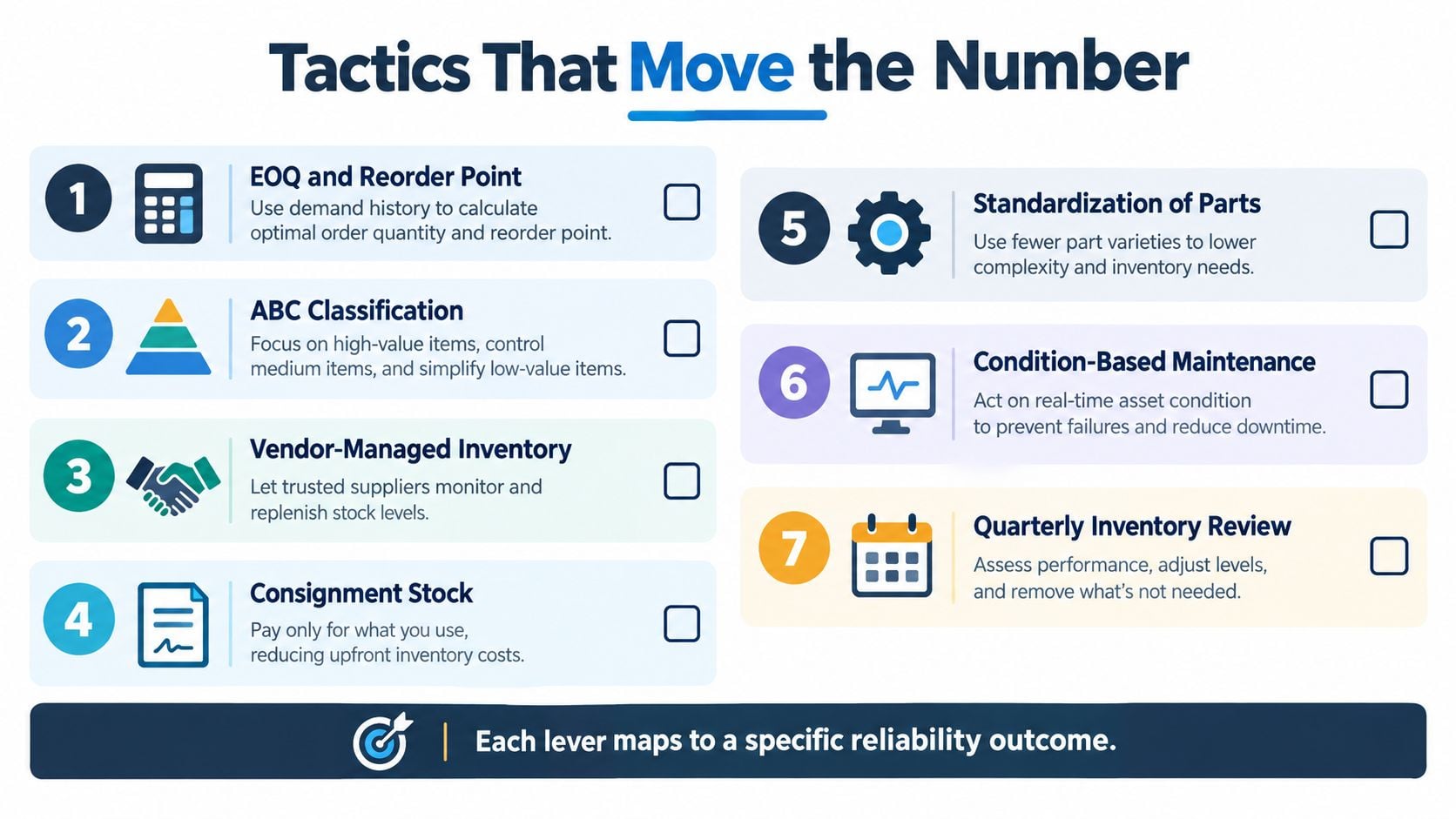
On a recent spare-parts review, the biggest savings did not come from broad inventory cuts. They came from item-level decisions. A pump cartridge with condition warning did not need the same protective stock as a motor rotor with a long rewind cycle and no local backup. A common bearing family could be standardized across several assets. A repairable assembly could be put into a rotation instead of buying another new unit. Those choices changed the carrying-cost number without shifting risk blindly onto operations.
Seven levers that actually help
- EOQ and reorder point discipline: Use real consumption history and current lead time. This works well for stable consumables and frequently used MRO items. It usually fails on rare event spares where one failure can distort years of demand history.
- Vendor-managed inventory: Keep this for standard, repeat-use parts where replenishment is predictable and service levels are clear. It reduces local stock only if the supplier response is dependable.
- Consignment stock: This can make sense for expensive, slow-moving parts such as large motor components or specialized pump internals. Availability stays local while the plant avoids tying up cash before the part is used.
- Repair versus replace logic: Many assemblies should be evaluated as repair loops, not one-time purchases. That is often true for gearboxes, pump cartridges, seal assemblies, and some motor subcomponents.
- Condition-based triggers: Vibration, oil analysis, thermography, ultrasound, and motor current checks can cut the penalty of safety stock because planners get warning time before functional failure.
- Part standardization: Fewer motor frame sizes, bearing series, seal kits, and coupling elements mean fewer duplicate SKUs and less stranded inventory.
- CMMS data hygiene: Bad item masters drive bad stocking decisions. Duplicate part numbers, weak supersession control, and wrong units of measure create reorder mistakes that look small but add up fast.
Match the tactic to the failure pattern
The right tactic depends on what the spare is protecting.
A critical motor on a single-train process unit may justify consignment, condition monitoring, and a defined repair path. A general-service pump seal kit usually benefits more from standardization and disciplined reorder settings. Low-criticality hardware often should not be stocked at all if local supply is reliable.
Textbook inventory logic often misses plant reality. Two parts can have the same unit cost and completely different carrying-cost logic because outage consequence is different. The plant is not paying to store metal on a shelf. It is paying for protection against a specific failure scenario.
What usually fails
The common mistakes are straightforward:
- Blanket reductions: They improve the inventory report for a quarter, then show up later as expediting, rentals, and lost production.
- Static min/max settings: They stay frozen while duty cycle, installed population, repair turnaround, and supplier performance change.
- No owner for obsolescence: Legacy motor frames, old seal variants, and retired pump models stay active in the system for years.
- PdM without spare alignment: Early warning has little value if the repair kit, bearing set, or rotor is not available when the work order is ready.
- Criticality rankings that never get revised: Once the process changes or standby capacity is added, the old stocking logic can become pure carrying cost.
Plants that move the number sustainably treat inventory policy as part of reliability strategy. They rank consequence, tighten failure detection, standardize where they can, and build repair loops where replacement stock is the expensive answer. That is how carrying cost comes down without buying more downtime.
Turning Spare-Parts Strategy Into Uptime
A feed pump trips at 2:10 a.m. Operations wants restart time, maintenance wants the right bearing and seal set, and procurement wants to know why a part that costs a few hundred dollars is not on the shelf. That argument usually gets framed as an inventory problem. On the plant floor, it is a reliability decision with a price tag.
A spare-parts strategy earns its keep when it cuts delay at the job site. The storeroom stops being a dumping ground and starts functioning as outage insurance for specific failure modes. That means the expensive items are there for assets that can actually hurt production, while the low-value clutter, obsolete motor frames, duplicate bearing variants, and dead pump kits get cleared out.
The payoff shows up in execution, not in a prettier inventory report.
What should improve on the plant floor
- Shorter repair delay: Craftspeople spend less time hunting, checking wrong descriptions, or waiting on a buyer to source a standard bearing that should have been staged already.
- Better shutdown performance: Work packs line up with the actual bill of materials, so a motor overhaul or pump rebuild does not stall halfway through for a missing seal sleeve or coupling element.
- Lower expedite spend: Air freight, after-hours purchases, and rental equipment drop when the plant stocks around consequence and lead time instead of reacting after each failure.
- Stronger use of maintenance dollars: Cash tied up in dead stock can move into vibration routes, oil analysis, alignment correction, and design fixes that reduce future demand for spares.
In practice, the biggest gain often comes from separating "must-have for uptime" from "nice to have because we got burned once." I saw that clearly during a spare-parts rationalization on a process plant with a large motor and pump population. One repairable pump cartridge assembly sat on the shelf for years because the old min/max said it was critical. After we reviewed installed spares, actual failure history, repair turnaround, and the presence of a duty-standby train, the part moved from stocked replacement to planned repair coverage. Carrying cost dropped immediately. Uptime risk did not go up.
That is the shift that matters. The plant is not trying to minimize part count. It is trying to buy the right amount of protection.
What leaders should watch next
A short metric set is enough if it drives action:
- Turns by spare class
- Service level for high-criticality parts
- Stockout events tied to production consequence
- Obsolete inventory status
- Repair-versus-replace share for major assemblies
- Inventory holding cost trend
Safety stock deserves extra attention here. A critical spare held "just in case" can carry for years with no demand, especially on low-frequency failures such as large motors, specialized pump shafts, or legacy control cards. If condition monitoring improves warning time, or if a repair loop gets reliable, that same safety stock level may no longer make sense. The carrying-cost number moves when detection improves, repair cycle time comes down, or asset criticality changes.
The plants that get results stop arguing whether spare parts belong to finance or maintenance. Reliability sets the reason to hold the part. Asset management sets how much risk the site is willing to pay to avoid.
Forge Reliability helps plants connect spare-parts decisions to failure modes, criticality, condition monitoring, and CMMS discipline so inventory holding cost comes down without exposing the operation to preventable downtime. Teams that want a practical outside review can visit Forge Reliability for a free reliability assessment focused on MRO stock, asset risk, and the highest-value moves for uptime.