Stop Recurring Failures: The Power of the One-Point Lesson
A critical pump fails again because a new technician took a vibration reading from the wrong location and missed the early warning signs. That situation is common in manufacturing, food processing, chemical plants, water systems, and every other operation that depends on consistent execution of small technical tasks. The problem usually isn't a lack of effort. The problem is variation. One technician samples oil from the live zone, another pulls from the drain. One thermographer adjusts emissivity, another doesn't. One analyst captures motor current under stable load, another records during a transient and trusts the result anyway.
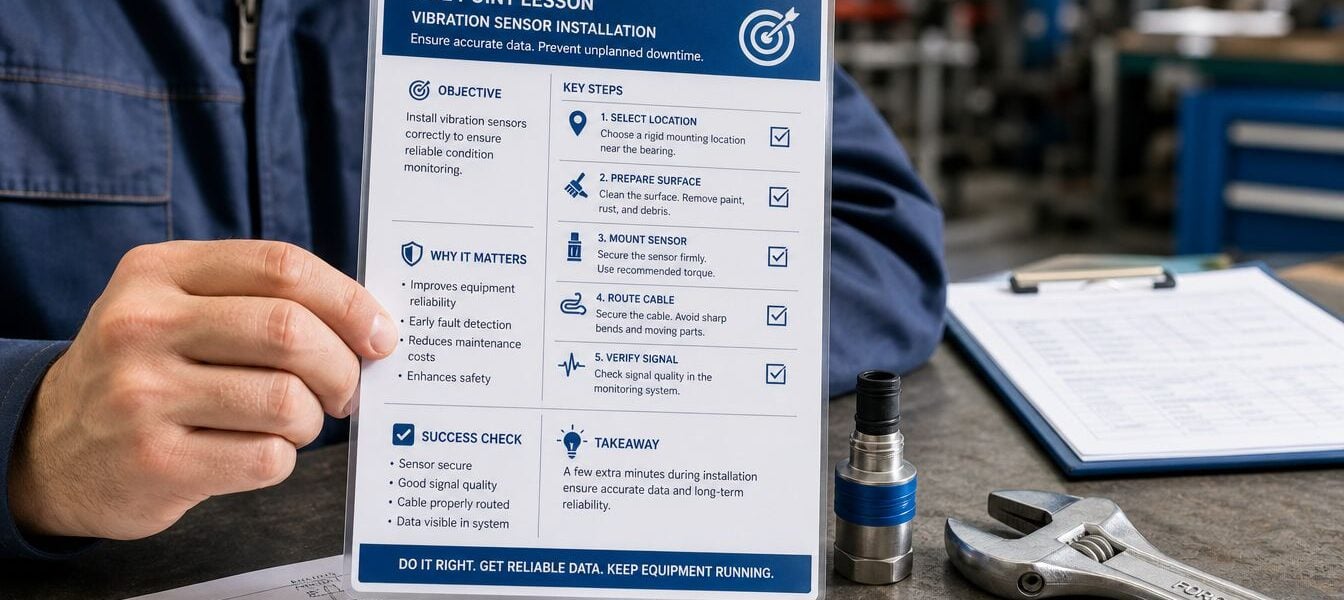
A one point lesson fixes that gap when it's built correctly. It is a single-page, highly visual instruction sheet used at the Gemba, meaning the actual place where the work happens, and the format is supposed to follow an 80% visual and 20% text structure with rapid teaching cycles that typically fit within 3 to 10 minutes. The strongest lessons also include control fields such as date, revision number, and author or approver names so the document stays traceable and usable as a controlled document in a real plant environment.
For reliability engineers, maintenance managers, and plant operations leaders, the value isn't academic. A good one point lesson example turns expert judgment into repeatable field behavior. The eight examples below focus on condition monitoring tasks that directly affect pumps, motors, gearboxes, electrical panels, and other high-consequence assets.
Table of Contents
- 1. OPL Example 1 Establishing a Vibration Signature Baseline
- 2. OPL Example 2 Correct Oil Sampling for Trend Analysis
- 3. OPL Example 3 Thermographic Inspection of Electrical Panels
- 4. OPL Example 4 Using MCSA to Detect Rotor Bar Faults
- 5. OPL Example 5 Ultrasonic Checks for Bearing Lubrication
- 6. OPL Example 6 Integrating Condition Data into the CMMS
- 7. OPL Example 7 Verifying Technician Competency
- 8. OPL Example 8 Selecting the Right Condition Monitoring Tool
- One-Point Lesson Examples, 8-Point Comparison
- From Lesson to Action Build Your Reliability Program
1. OPL Example 1 Establishing a Vibration Signature Baseline
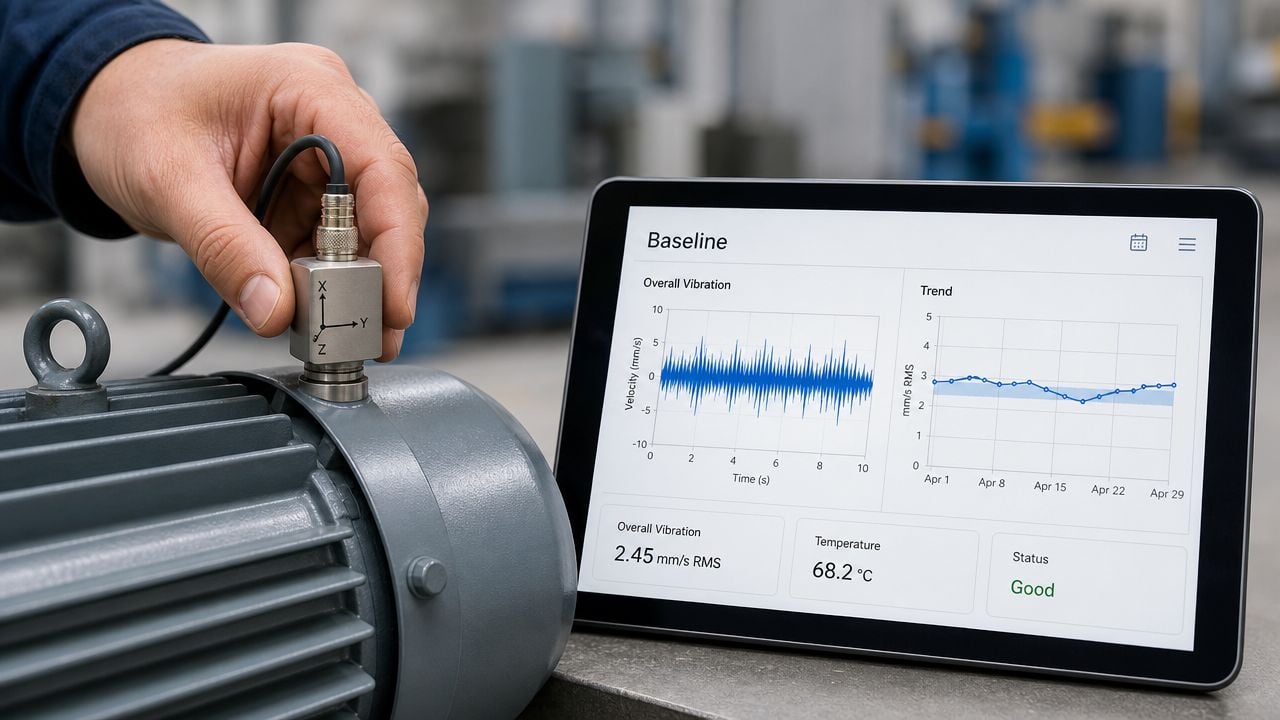
On a centrifugal pump or electric motor, no predictive program works without a trustworthy baseline. Baseline means the reference vibration data captured when the machine is known to be operating normally. Without it, trend alarms drift into opinion, and technicians start arguing over whether a reading is acceptable instead of deciding what action to take.
A strong one point lesson example for baseline collection should show the exact sensor locations on the drive-end and non-drive-end bearings, the measurement direction, and the analyzer settings to use every time. This is especially important on pumps in water and wastewater service, where vertical measurements often expose looseness or structural issues that horizontal readings don't show as clearly.
What belongs on the page
The lesson should visually identify when to collect the baseline. It needs to be under normal operating state, not during warm-up, startup, unstable process demand, or a temporary bypass condition. If the asset is a process pump in a food and beverage plant, the lesson should also tell the technician to record load, product state, bearing age, coupling condition, and any unusual process constraints in the CMMS.
A practical baseline OPL also needs a decision rule for re-baselining. If a rotor is repaired, bearings are changed, the base is regrouted, or the coupling is replaced, the old signature may no longer be valid. The lesson should tell the team to establish a new reference after the machine returns to stable service.
Practical rule: A baseline is only useful when the next technician can repeat the same point, direction, setup, and operating condition.
One manufacturing maintenance program showed how disciplined OPL deployment changes execution. In an operator-based care rollout, the plant developed 30 to 40 targeted OPLs, generated more than 100 work notifications, raised weekly PM completion from about 25% to 100% within three months, and improved uptime from about 50% to over 75%. That wasn't caused by theory. It came from converting critical tasks into visible, repeatable actions.
For route discipline, the best field layouts mirror the same measurement-point logic used in a vibration monitoring route setup guide. On pumps, motors, and compressors, consistency beats sophistication every time.
2. OPL Example 2 Correct Oil Sampling for Trend Analysis
Oil analysis only works if the sample represents the machine. That's where most plants lose the value. A contaminated bottle, the wrong port, or a cold sample taken before the oil is circulating can send the lab a story that the machine never told.
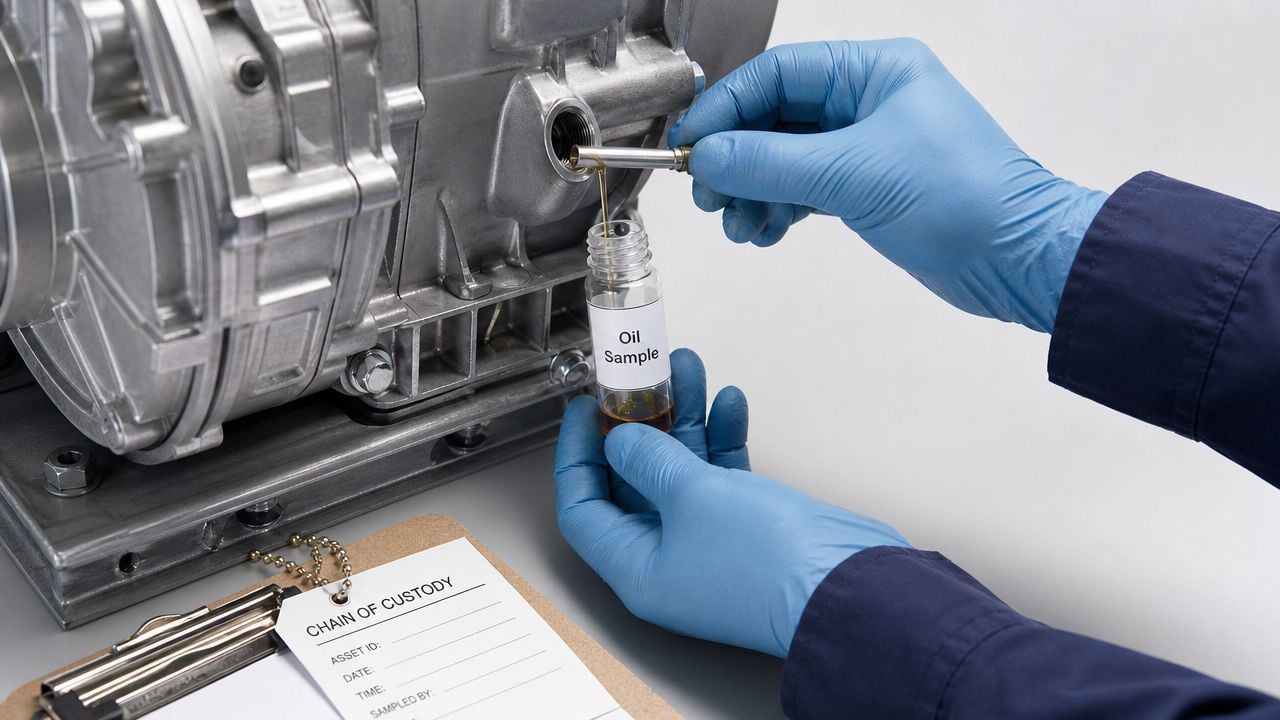
A one point lesson example for oil sampling should be built around the machine's live zone. On a gearbox in a pharmaceutical packaging line, that means identifying the dedicated sample port and the flush volume before collection. On a hydraulic power unit in automotive stamping, it means showing the exact sample location away from stagnant areas and return-line turbulence.
What a strong oil sampling OPL shows
The best version is visual first. It marks the sample port, correct bottle handling, normal machine temperature state, and labeling sequence. It also shows what not to do, because poor habits are usually faster to copy than good ones.
An effective lesson should include these field decisions:
- Sample at stable temperature: Take the sample after the machine reaches a stable operating state, not during startup or shutdown.
- Use the same method every time: Bottle type, port, purge practice, and sample volume should remain fixed for trending.
- Protect chain of custody: Label immediately and store the sample so dirt, water, and handling errors don't distort the lab result.
- Link results back to the asset: The sample means little if the report never reaches the CMMS and planner.
The strongest OPL formats stay close to the established structure used in manufacturing. Guidance on OPL design consistently points back to a one-page lesson with about 80% imagery and 20% text, categorized by type such as basic, safety, problem, or improvement, with metadata like area, line, topic, and revision date. That matters for oil sampling because small procedural drift destroys trend value long before the team notices.
Wrong sample point, wrong answer. The lab can only analyze what the bottle contains.
A good companion reference for planners and lubrication leads is this industrial oil analysis guide. It helps align the OPL with alarm logic, contamination control, and work-order response.
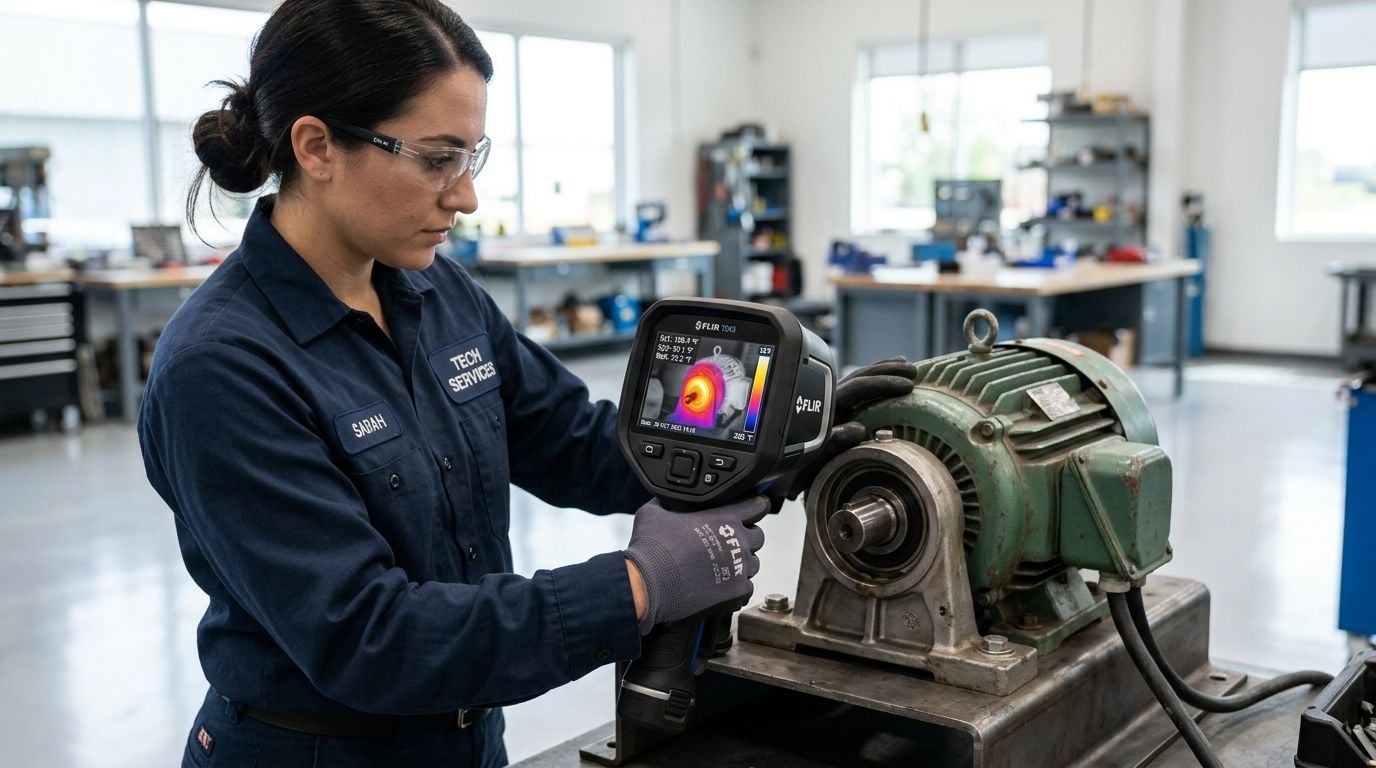
3. OPL Example 3 Thermographic Inspection of Electrical Panels
Thermography is one of the easiest techniques to misuse because the camera makes every image look authoritative. It isn't. A hot spot only means something when the technician understands load, emissivity, reflection, and comparison points.
For electrical panels, motor control centers, and switchgear, the one point lesson needs to lock technicians into a safe, repeatable imaging method. In a plastics plant with multiple 480V motor feeders, that usually means a paired image set: one thermal image and one visible-light photo of the same component, taken under stable load with panel identification visible.
What the lesson needs to lock down
The visual lesson should show exactly where to stand, what components to compare, and which metadata to capture. Left-right symmetry checks are especially useful on bearing housings, parallel conductors, and cooling circuits because they force the technician to compare similar components under similar duty.
A strong thermography OPL should also remind the team to calibrate the camera and verify emissivity correction factors against known references. Otherwise, the plant ends up with images that look precise but aren't operationally reliable.
Three practices prevent most wasted thermography routes:
- Image under stable conditions: Capture the asset after it has run long enough to reflect normal thermal behavior.
- Compare, don't guess: Evaluate one phase against the others, one bearing housing against its mate, or one exchanger zone against baseline images.
- Correlate across technologies: Thermal data gains value when vibration or oil analysis confirms the likely failure mode.
For electrical and mechanical field programs, this infrared thermography inspection reference is the right companion document to the OPL. It supports the lesson with broader route planning and diagnostic follow-up.
A plant shouldn't treat thermography as a standalone verdict. On a motor starter bucket, a hot lug may point to a loose connection, phase imbalance, overload, or reflection error. The OPL should force the technician to document load and route the finding to the next diagnostic step rather than close the task after one image.
4. OPL Example 4 Using MCSA to Detect Rotor Bar Faults
Motor Current Signature Analysis, or MCSA, is one of the most useful tools for seeing motor defects that vibration alone may not separate cleanly. It evaluates electrical current waveforms from a motor and looks for frequency components associated with mechanical or electrical faults. On three-phase induction motors driving pumps, fans, and screw conveyors, that makes it valuable for rotor bar defects, supply issues, and load-related modulation.
An OPL for MCSA should be blunt and visual. Clamp location, simultaneous three-phase capture, safe setup, motor loading state, and spectral markers all need to be on one page. If a technician has to infer any of that from a paragraph, the lesson is already too text-heavy for real plant use.
Where MCSA OPLs usually fail
The most common mistake is recording data under unstable load and then trusting the sidebands. The second is trying to do fault detection from a single phase when the motor and supply condition require a full three-phase view. In a chemical processing unit with VFD-driven pumps, the OPL should also warn technicians to document carrier frequency and switching behavior because harmonics can obscure the signature.
The visual portion should identify the classic sideband pattern around line frequency and show a simple "acceptable versus investigate" comparison screenshot. It should also define slip in plain language. Slip is the small difference between synchronous speed and actual rotor speed, and that difference affects where fault-related components appear.
Use MCSA when the question is electrical condition under load, not just mechanical vibration at the bearing.
A workable shop-floor lesson includes these essential elements:
- Capture all three phases together: That preserves fault relationships a single channel can miss.
- Record under stable rated duty: Startup and varying load can distort interpretation.
- Note VFD details: Carrier and switching settings matter on variable-speed applications.
- Verify with another method: Rotor bar suspicion should trigger follow-up through vibration, thermography, or inspection planning.
Teams building or refreshing this lesson should align it with a motor current signature analysis fault detection resource. The OPL handles the task execution. The broader guide supports diagnosis and escalation.
5. OPL Example 5 Ultrasonic Checks for Bearing Lubrication
Ultrasound earns its keep on assets where vibration has limited sensitivity, especially slow-speed bearings, chain drives, and lightly loaded rolling elements. It detects high-frequency acoustic activity generated by friction, impacting, and lubrication state. In practical terms, it helps the technician hear a lubrication problem before temperature or vibration rises enough to make the issue obvious.
On a conveyor system in grain handling or a slow paper machine roll bearing, the one point lesson should center on repeatability. Ultrasound is highly sensitive to contact pressure, sensor angle, and measurement location. That means the OPL must show exactly how the sensor touches the point, where the reading is taken, and what normal sounds or patterns look like.
The shop-floor version that works
The best OPL uses side-by-side images of the correct point and an incorrect point. It should also show the technician when to stop adding grease. Too many plants use ultrasound to find under-lubricated bearings, then fail the same asset by over-greasing it.
That lesson should include a visual sequence for listen, compare, grease slowly if allowed by the procedure, and confirm whether the ultrasonic response improved or worsened. If the asset is sealed or has contamination risk, the OPL must direct the technician to escalate rather than lubricate on instinct.
A practical ultrasonic lesson should standardize:
- Sensor contact and orientation: Small changes can shift the reading enough to ruin trending.
- Baseline behavior: Used equipment still needs a defined reference after repair or stable operation.
- Frequency band or envelope method: The analyzer setup has to match the equipment speed and fault type.
- Escalation path: Rising ultrasonic activity without lubrication benefit should trigger inspection or another technology.
One challenge with OPLs is that many organizations stop at paper creation and never solve revision control in digital maintenance systems. Commentary from industry practitioners notes a gap around digital lifecycle management for OPLs, especially when teams need version control and event-driven updates tied to predictive maintenance workflows. Ultrasound routes expose that weakness quickly because field technique drifts unless the latest lesson is easy to access.
For field execution, an ultrasonic bearing monitoring and acoustic lubrication guide helps convert the OPL into route settings and lubrication decisions that technicians can apply consistently.
6. OPL Example 6 Integrating Condition Data into the CMMS
A condition monitoring program starts losing value the moment data stays in a handheld device, an email attachment, or a technician's notebook. The OPL for CMMS integration should make that failure impossible. It has to show where the reading goes, which asset fields are mandatory, what alert status gets assigned, and who receives the follow-up task.
In a beverage plant with critical filler pumps, compressors, and motors, this lesson should map the path from field collection to planning decision. Vibration routes, thermal images, and oil reports all need a common asset hierarchy. If the pump tag in the analyzer doesn't match the CMMS tag, trending breaks and the planner can't trust the history.
The workflow that should be visible
The best one-page layout is a visual workflow. It starts with the reading, moves through validation, then assigns a status such as informational, investigate, or urgent, and finally generates a work order or review task. A screenshot from the actual CMMS helps because generic diagrams don't prevent data-entry errors.
One plant integrated vibration baselines, thermography images, and oil lab results into its CMMS so correlated findings could be bundled into a single planned outage instead of creating scattered repair events. That is where reliability programs start acting like systems instead of disconnected specialties.
A useful OPL should direct technicians to enter:
- Asset and point ID: The exact machine and location of the reading.
- Operating context: Load, ambient conditions, and process state if those affect interpretation.
- Attached evidence: Spectra, images, or lab reports linked to the record.
- Response priority: The alert level that determines planner action and work-order timing.
This lesson also needs one hard rule. If the data isn't entered completely, the task isn't done. Plants often accept partial uploads and then wonder why condition-based work never reaches execution. In reliability work, data governance isn't an office function. It's a failure-prevention function.
7. OPL Example 7 Verifying Technician Competency
A one point lesson can teach a task, but it can also verify that the task is learned. That distinction matters. Many recurring failures continue after training because no supervisor has watched the technician perform the work under normal field conditions.
For a vibration route on a refinery charge pump or a thermal inspection on a motor control center, the competency OPL should be an observable checklist. The supervisor needs to see the technician select the correct point, use the right setup, capture clean data, identify an obvious anomaly, and enter the result into the CMMS without coaching.
What supervisors should verify directly
The strongest competency lessons don't ask whether the technician "understands" the tool. They ask whether the technician can perform the task correctly, safely, and repeatably. That means the checklist should focus on visible actions and objective outputs.
A practical verification OPL should assess:
- Preparation: Correct PPE, instrument check, and asset identification.
- Technique: Proper sensor placement, image framing, sample handling, or clamp placement.
- Interpretation: Ability to recognize normal versus abnormal patterns at a basic level.
- Documentation: Correct upload, alert selection, and note quality in the CMMS.
Competency isn't attendance. It's repeatable field performance without intervention.
Quarterly practical labs are useful because they expose drift in methods that classroom refreshers miss. Plants should also cross-train more than one technician on each critical technology so vacations, turnover, and shift changes don't break the program. The OPL should include sign-off blocks, revision status, and a place to note when retraining is required after a procedure or tool change.
For new managers, this is one of the highest-value one point lesson example types because it closes the gap between training delivered and training retained.
8. OPL Example 8 Selecting the Right Condition Monitoring Tool
Not every failure mode needs the same instrument. Sending a vibration analyst to solve an obvious lubrication problem on a slow-speed bearing can waste time. Using only thermography to judge a developing rolling element defect can miss the problem entirely. The OPL here should work as a fast decision chart at the point of need.
In a refinery, chemical plant, or heavy manufacturing site, this lesson is especially useful for mixed teams where operators, mechanics, electricians, and reliability staff all report findings. It helps them choose the first diagnostic tool and the confirming tool based on the suspected failure mode.
A decision chart operators can actually use
The most practical version is a visual matrix with failure modes on one side and primary and secondary tools on the other. Common rows include imbalance, misalignment, looseness, lubrication failure, bearing defect, rotor electrical fault, insulation heating, and contamination. The language should stay plain enough for shop-floor use while still being technically correct.
A realistic equipment example is a facility that uses handheld ultrasound for broad screening and reserves higher-end vibration analysis or permanent sensors for its most critical pumps. That is the right trade-off in many plants. Broad coverage catches obvious risk early, while deeper instrumentation stays focused on assets where continuous trending matters most.
The OPL should also show where the tool choice can go wrong:
- Use vibration first for mechanical rotor issues: Imbalance, misalignment, looseness, and many bearing defects show there earliest.
- Use MCSA for electrical motor questions: Rotor bar issues, current imbalance, and supply-related problems need current data.
- Use thermography for heat-related anomalies: Electrical resistance heating and some mechanical friction problems are easier to localize thermally.
- Use ultrasound where friction and lubrication dominate: Especially on slow-speed bearings or compressed-air leak surveys.
A good selection lesson doesn't pretend one tool solves everything. It teaches the team to stack methods intelligently, based on failure mode, asset criticality, and what decision the plant needs to make.
One-Point Lesson Examples, 8-Point Comparison
| Example | Implementation complexity | Resource requirements | Expected outcomes | Ideal use cases | Key advantages |
|---|---|---|---|---|---|
| OPL 1: Vibration Signature Baseline | Medium–High: standardized routes, FFT skill, re-baselining after changes | Tri-axial analyzers or sensor networks; trained technicians; time per asset | Early detection of bearing, imbalance, misalignment; reliable trending | Rotating equipment (pumps, motors, compressors) at fixed loads | Equipment-specific baselines reduce false alarms and support spare planning |
| OPL 2: Correct Oil Sampling | Low–Medium: disciplined procedure and chain-of-custody | Sampling kits; accredited lab services; consistent sampling schedule | Detect contamination, additive depletion, water ingress; condition-based oil changes | Gearboxes, hydraulics, lubricated bearings | Low cost per sample; extends component life; root-cause evidence for suppliers |
| OPL 3: Thermographic Inspection | Low–Medium: camera handling, emissivity correction, baseline images | Infrared camera (calibrated); trained thermographer; imaging protocols | Non-contact hotspot detection; identify loose connections and overloaded circuits | Electrical panels, motor feeders, heat exchangers | Safe, fast inspections; good for energized equipment and trendable hotspots |
| OPL 4: MCSA for Rotor Bar Faults | Medium: three-phase acquisition, slip calculations, FFT sideband analysis | Clamp-on CTs or line transducers; portable analyzers; trained interpreters | Early detection of rotor bar cracks, phase imbalance, THD issues | Three-phase induction motors, including VFD-driven applications | Non-invasive, effective on VFD motors; prevents secondary mechanical damage |
| OPL 5: Ultrasonic Checks for Lubrication | Low–Medium: consistent coupling and envelope settings | Ultrasonic detectors or sensors; signal processing capability | Early detection of lubrication starvation and impulsive bearing events | Slow-speed bearings, conveyors, gearboxes, cooling tower bearings | Highly sensitive to lubrication issues; low-cost measurement points |
| OPL 6: Integrating Condition Data into CMMS | High: system integration, data standards, alert workflows | CMMS with APIs; configuration effort; multi-sensor data feeds | Automated trending, condition-based work orders, consolidated root-cause data | Facilities using multi-modal monitoring across disciplines | Centralizes data, automates response, improves planning and justification |
| OPL 7: Verifying Technician Competency | Low–Medium: checklists, regular practical refreshers, audits | Training programs/certifications; scheduled hands-on time; recordkeeping | Fewer misdiagnoses; consistent data quality; sustained diagnostic skill | Any site performing condition monitoring and inspections | Preserves institutional knowledge and increases equipment-monitoring ROI |
| OPL 8: Selecting the Right Condition Monitoring Tool | Medium: specification, calibration planning, cost–benefit balancing | Procurement specs; calibration schedules; mix of portable and permanent devices | Optimized sensor selection; reduced false positives and retrofit rework | Equipment portfolio planning; matching tools to failure modes | Right-sizing instruments improves sensitivity and lowers long-term cost |
From Lesson to Action Build Your Reliability Program
These examples show the technical core of an effective OPL library, but the document alone won't fix recurring failures. Results come from building the lessons into the way the plant works every day. That means the right lesson has to be available at the Gemba, tied to the asset, current in revision, and used during real tasks instead of sitting in a binder or a shared drive nobody opens on shift.
The structure matters more than many teams expect. OPLs work best when each lesson stays limited to one clear point, uses visuals more heavily than text, and shows the exact task sequence the technician must follow. The established format in manufacturing emphasizes about 80% visual content and 20% text, which is why effective lessons are absorbed quickly on the floor instead of getting ignored like mini-procedures. If the lesson starts reading like a full SOP, it has already lost the speed advantage that makes OPLs useful.
Management discipline matters just as much as format. Every lesson should include traceable metadata such as date, revision number, and author or approver names. That protects the plant from an old version staying posted after a change in sensor location, sampling point, analyzer settings, or equipment configuration. In predictive maintenance programs, stale guidance is often worse than no guidance because it creates confident error.
Plants should also judge OPLs by what they change operationally. Reliable measures include fewer task-execution mistakes, better adherence to measurement-point standards, faster competency verification, and longer mean time between failures for the specific failure modes the lesson was built to address. On a pump train, that might mean fewer missed vibration trends from poor sensor placement. On a gearbox, it might mean cleaner oil samples and fewer false alarms. On an MCC, it might mean fewer poorly documented thermal findings that require repeat inspections.
One more point deserves attention. Many organizations are good at creating one point lessons and weak at managing them over time. The digital side matters. If the lesson isn't easy to retrieve in the CMMS or linked to the route, technicians eventually rely on memory, and memory is where variation starts.
Forge Reliability helps industrial teams close that gap. Its engineers support predictive maintenance, condition monitoring, CMMS data governance, failure analysis, and reliability program design built around real plant execution. For reliability engineers, maintenance managers, and plant operations leaders trying to stop recurring failures on pumps, motors, compressors, gearboxes, and electrical systems, the next step is to identify the few tasks where inconsistent technique is creating the most risk and convert those tasks into controlled, visual standards.
Forge Reliability helps manufacturers, processors, and industrial facilities turn condition monitoring data into practical action. If a plant needs help building OPLs for vibration, oil analysis, thermography, ultrasound, MCSA, or CMMS workflows, request a free reliability assessment from Forge Reliability.