A steam turbine rarely fails on a convenient day. It trips during a production run, during a peak steam demand period, or halfway through a turnaround window that was already too tight. In a chemical plant, that can mean lost process stability, flaring risk, compressor interruptions, and a maintenance team forced into outage decisions with incomplete information.
That's the fundamental difference in steam turbine maintenance. Average programs follow the manual, complete the checklist, and hope the interval was right. World-class programs build a decision system around failure modes, operating context, and condition evidence. They don't wait for a bearing to wipe, a seal to open up, or a wet-steam problem to chew through blades before acting.
Steam turbines are long-life assets. With proper care, they can last 20 to 30 years, and major overhauls are often scheduled around 8,000 to 25,000 operating hours rather than calendar time, which is exactly why plants need condition monitoring between planned outages (steam turbine maintenance intervals and asset life). The plants that manage them well treat maintenance as lifecycle risk control, not as a periodic mechanical event.
Table of Contents
- Beyond the Manual A Modern Steam Turbine Reliability Program
- Foundational Care Routine Inspections and Lubrication
- Implementing Advanced Condition Monitoring Diagnostics
- Diagnosing Common Failure Modes and Root Causes
- Choosing Your Monitoring Strategy Route-Based vs Continuous
- From Data to Decisions Overhauls and RCM Integration
- Build a Proactive Steam Turbine Maintenance Strategy
Beyond the Manual A Modern Steam Turbine Reliability Program
A typical failure story starts with something small. Operators notice a subtle change in sound during load changes. A monthly vibration route shows movement, but not enough to force action. An oil sample comes back “watch closely.” Then the unit trips, and the discussion shifts from reliability to emergency work scope.
That pattern shows why a modern steam turbine maintenance program can't stop at OEM intervals. Manuals matter, but they don't know the plant's steam quality, startup frequency, load swings, maintenance backlog, or production risk. A turbine in a paper mill backing a critical process header doesn't live the same life as an extraction unit in a refinery or a condensing turbine in power generation.
What world-class looks like
A serious program starts with Reliability-Centered Maintenance (RCM). In plain terms, RCM asks which functions matter most, how the turbine can fail to perform them, what evidence appears before failure, and which maintenance task reduces risk. That shifts the team away from “because it's due” and toward “because this failure mode is progressing.”
Failure Modes and Effects Analysis (FMEA) supports that work. It breaks the turbine into practical failure paths such as bearing distress, seal leakage, rotor imbalance, valve problems, steam-path damage, and auxiliary-system degradation. Then it ties each one to consequences. Lost efficiency. Reduced load capability. Forced outage. Secondary damage.
A steam turbine maintenance program becomes credible when every inspection, alarm, and outage task is connected to a known failure mode.
A chemical processing site offers a common example. The turbine itself may be mechanically healthy, but repeated short starts, marginal gland sealing, and unstable steam conditions create a risk profile that a generic maintenance plan won't capture. The site needs operating discipline, trend review, and defined decision rules.
The program has to be built, not inherited
Plants often inherit a collection of PMs, route points, and outage tasks without a reliability architecture behind them. That's why many teams benefit from a structured reliability roadmap before they invest in more technology. A practical reference is this 12-month reliability program roadmap, which helps translate scattered maintenance activity into a planned system.
The key point is simple. Better steam turbine maintenance doesn't begin with a bigger teardown. It begins with sharper questions, cleaner data, and a maintenance strategy that treats the machine like the capital asset it is.
Foundational Care Routine Inspections and Lubrication
Most steam turbine failures don't announce themselves during the overhaul. They start in ordinary operating hours, where routine care either catches the drift or misses it. A strong baseline program depends on disciplined inspections, startup and shutdown checks, and lubrication control that operators and mechanics can execute without guesswork.
A pulp and paper mill is a good example. Its steam turbines often operate in a process environment with moisture, heat, variable load, and pressure to keep production moving. In that setting, basic care isn't basic at all. It's the barrier between stable operation and bearing damage, steam leakage, or a costly forced outage.
What operators should check every shift
Shift inspections should be written for the machine, not copied from a generic rotating-equipment form. The route needs to focus on what changes first when turbine condition starts to degrade.
- Listen for changes in mechanical sound: A new whine, rub, or roughness during load transitions often matters more than a static reading that still appears acceptable.
- Watch the lube system closely: Pressure, temperature, filter differential indications, and reservoir condition tell the team whether bearings are receiving clean, stable oil.
- Check for leakage paths: Steam leaks, oil leaks, and gland sealing issues often start small and are easiest to correct before they affect reliability.
- Verify auxiliary readiness: Turning gear operation, drains, control valves, and condensate handling have a direct effect on startup quality and thermal stability.
Pre-start checks matter just as much. Oil pressure has to be established before rotation. Drains have to be managed so condensate doesn't enter the machine. Protective devices have to be available and trustworthy. Plants get into trouble when startup becomes routine and people stop treating it like a high-risk operating state.
Lubrication is a failure-mode control point
Steam turbine bearings are unforgiving when oil quality drifts. Water contamination, varnish potential, particulate contamination, and unstable oil temperature all move the machine toward wiped bearings, journal distress, and control issues.
That's why a good lubrication program includes more than top-offs and filter changes. It needs consistent sampling locations, clean bottles, trend review, and action limits defined by the site's reliability team. The point isn't just to “take samples.” The point is to decide what the sample means for machine risk.
Practical rule: If oil analysis isn't tied to an action plan, it's only recordkeeping.
A disciplined lubrication routine usually includes:
- Stable sampling practice so trends are comparable over time.
- Contamination control during fill, transfer, and reservoir access.
- Temperature control to protect oil film strength and oxidation resistance.
- Filter and seal attention because the oil system often reveals developing problems elsewhere.
Plants that want a stronger framework for this area can use a focused resource on oil analysis for steam turbines.
What works and what usually fails
The most effective foundational programs are simple, repetitive, and specific. The weakest ones rely on vague PM language such as “inspect turbine” or “check oil condition.”
A food processing plant, for example, may have one turbine driving a critical compressor train and another serving a utility function. Both may receive the same PM frequency, even though the business consequence of failure is completely different. That's a planning mistake, not a staffing problem.
Routine care works when tasks are written around failure prevention. It fails when inspections are broad, rushed, and disconnected from the machine's actual risk profile.
Implementing Advanced Condition Monitoring Diagnostics
Once the basics are under control, the next step in steam turbine maintenance is diagnostic depth. Teams need tools that don't just confirm a problem after it becomes obvious, but reveal the failure pattern while there's still time to plan the work.
The business case is straightforward. The steam turbine service market was valued at USD 19.5 billion in 2024, the repair segment was valued at over USD 8 billion in 2024, and advanced inspection methods such as phased-array ultrasonic testing (PAUT) are being used to detect sub-surface flaws and crack indications in rotors and blade attachment areas before failure occurs. Plants don't invest in diagnostics because they're fashionable. They invest because failure is expensive and often avoidable.
Four methods that belong in the core program
A useful diagnostic stack for most turbines includes four techniques, each aimed at different failure evidence.
| Method | What it helps detect | Typical use in practice |
|---|---|---|
| Vibration analysis | Imbalance, misalignment, looseness, rubs, bearing distress | Trend changes across speed, load, and steady-state operation |
| Oil analysis | Wear debris, contamination, lubricant degradation | Confirms bearing and lubrication-system health |
| Thermography | Hot spots, insulation loss, steam leaks, auxiliary electrical issues | Finds thermal asymmetry and support-system problems |
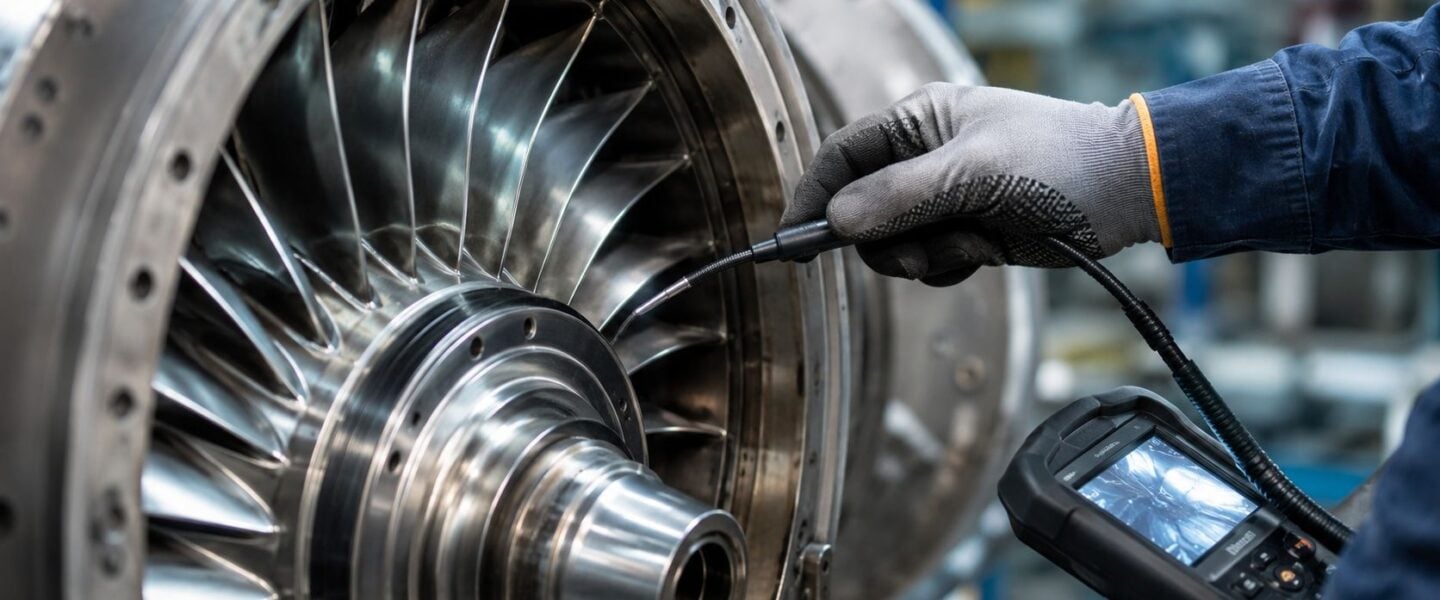
| Borescope inspection | Blade distress, deposits, rub evidence, internal wear | Supports outage scoping without full teardown |
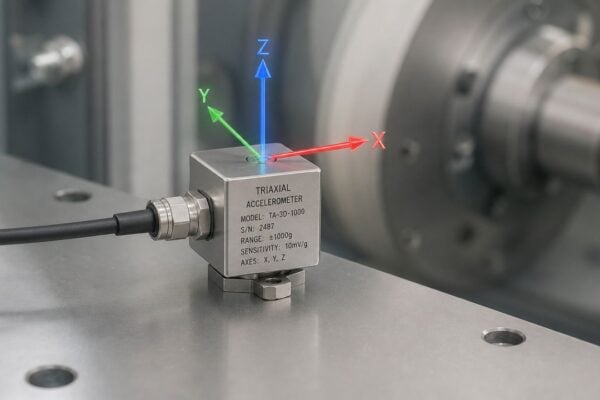
Vibration analysis usually gives the earliest broad warning. A rise at running speed often points toward balance or mechanical condition issues. Broader spectral changes, sideband activity, or higher-frequency content can suggest bearing or contact-related problems. The key isn't one snapshot. It's the trend across time and operating states.
Oil analysis then helps confirm whether the machine is vibrating differently or shedding material. If the turbine shows increasing vibration and the oil begins showing signs of abnormal wear or contamination, the team is no longer dealing with a theoretical issue.
Diagnostics work best in combination
A power generation site might spot a gradual vibration increase on the high-pressure casing, with no immediate protection trip and no obvious process upset. A borescope inspection during the next opportunity may reveal steam-path contact evidence or deposit-related clearancing change. Thermography may then show heat loss around upstream insulation that hints at steam-condition problems contributing to the issue.
That's how a planned outage gets justified. Not by one noisy reading, but by multiple clues that agree.
A single condition-monitoring technology almost never tells the full story. Reliable decisions come from convergence.
Plants that are formalizing that approach often start with a framework for condition monitoring on steam turbines, then tailor the method mix to turbine criticality and operating mode.
What not to do
Three mistakes show up repeatedly in underperforming programs:
- Collecting data without context: Route data that ignores load, steam conditions, and recent work history can mislead the team.
- Treating alarms as diagnosis: An alarm says something changed. It doesn't explain why.
- Skipping verification after maintenance: Alignment, valve work, balancing, and bearing replacement should trigger follow-up condition checks.
Advanced diagnostics aren't complicated because the tools are mysterious. They're complicated because the machine is part of a process system, and the evidence has to be interpreted that way.
Diagnosing Common Failure Modes and Root Causes
A steam turbine doesn't care whether the maintenance team labels a problem “mechanical” or “process-related.” The machine only responds to stress, contamination, temperature, loading, and steam condition. That's why the most important troubleshooting skill is connecting the symptom at the turbine to the root cause upstream or downstream.
A food and beverage plant illustrates the point well. Repeated blade distress may appear to be a turbine repair problem, but the actual driver may be condensate carryover, poor trap performance, or uninsulated sections of steam piping that allow steam quality to degrade before it reaches the casing.
Failure modes that show up most often
The visible failures are familiar:
- Blade erosion and cracking: Often linked to wet steam, deposits, foreign material, or repeated stress cycling.
- Bearing wear or wiping: Usually tied to oil contamination, oil starvation, overload, misalignment, or instability.
- Seal leakage: Can indicate wear, thermal distortion, shaft movement, or steam-path condition changes.
- Rotor bowing or imbalance: Frequently connected to uneven heating, deposits, contact, or mechanical correction that didn't address the underlying cause.
Most plants are good at recognizing the symptom. Fewer are good at proving the driver.
Steam quality is often the missed cause
Turbine reliability depends on high steam quality, and insulation on steam lines matters not just for efficiency but also for condensation control. Technical guidance notes that condensation and wet-steam exposure can drive erosion, corrosion, fatigue, and stress-corrosion cracking in blades (steam quality and wet-steam damage in steam turbine maintenance).
That changes how root cause analysis should be run. If a plant keeps repairing blades, seals, or internals without checking steam conditions, it may be repairing damage while preserving the cause.
Wet steam can make a healthy turbine look like a bad turbine.
The practical questions are upstream questions. Are drains working? Are traps maintained? Are steam lines insulated where they need to be? Is load cycling creating conditions that increase condensate risk? Is the unit seeing carryover from the source system?
A root-cause workflow that produces useful answers
A recurring-failure review should move in this order:
- Confirm the damage mechanism through inspection findings, operating history, and condition trends.
- Map the process contributors such as startup practice, steam condition, valve behavior, and load profile.
- Check maintenance-induced factors including alignment changes, oil handling errors, and incomplete post-work verification.
- Validate corrective actions with follow-up monitoring instead of assuming the repair solved the problem.
A site that wants a structured path can use a dedicated resource on root cause analysis for steam turbines.
A reliable diagnosis doesn't stop at “blade damage found” or “bearing failed.” It answers the operational question that matters. Why did this unit produce that damage in this plant, under these conditions, at this time?
Choosing Your Monitoring Strategy Route-Based vs Continuous
Monitoring strategy is one of the most important design choices in steam turbine maintenance because it determines how quickly the plant can detect change, how much diagnostic context is available, and how early the team can intervene. The wrong choice usually comes from applying one standard to every turbine.
An oil and gas refinery may have a steam turbine driving a critical process compressor where any forced outage immediately affects production. In the same site, another small turbine may serve a less critical duty with stable operation and more forgiving outage windows. Those two machines shouldn't be monitored the same way.
When route-based monitoring makes sense
Route-based monitoring means technicians collect vibration, temperature, ultrasound, or other condition data at planned intervals. It works well when failure progression is relatively slow, machine accessibility is manageable, and the asset isn't so critical that a missed event would create unacceptable risk.
It's usually the right fit when:
- The turbine is lower in criticality: A short interruption won't create a major safety or production event.
- Operating mode is stable: The machine runs consistently enough that periodic comparisons remain meaningful.
- The detectable failure interval is wide enough: The team is likely to catch the problem before it becomes urgent.
Route-based programs are also easier to start. They require less installed hardware and can be scaled across a fleet. For many auxiliary turbines, that's a practical first step.
When continuous monitoring earns its cost
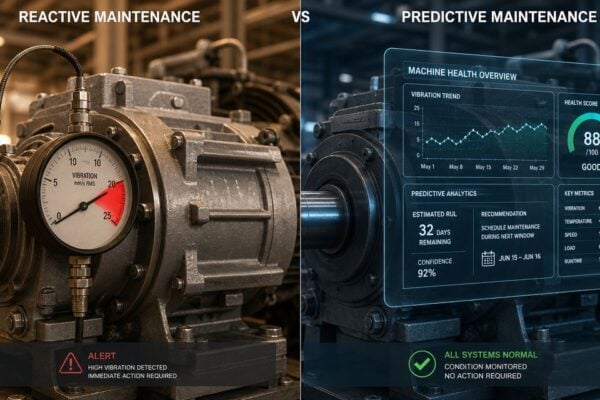
Continuous monitoring is justified when the plant needs alarm capability, tighter trend resolution, and evidence during transient conditions that route work would never capture. That matters for highly loaded, high-consequence, or operationally sensitive turbines.
Siemens Energy states that with daily monitoring, a turbine opening at 50,000 equivalent operating hours can be avoided and no full overhaul may be needed within 100,000 EOH, which it describes as up to 12 years (condition-based overhaul deferral through daily monitoring). That's a strong signal that continuous or near-continuous visibility can change outage strategy, not just fault detection.
The more expensive the consequence of uncertainty, the more valuable continuous monitoring becomes.
A practical comparison
| Decision factor | Route-based | Continuous |
|---|---|---|
| Data frequency | Periodic snapshots | Ongoing trend visibility |
| Alarm response | Usually delayed until next route or review | Immediate or near-immediate alerting |
| Best fit | Stable, lower-criticality turbines | Critical turbines with fast or costly failure modes |
| Installation demand | Lower upfront complexity | Higher setup and integration effort |
Plants often need both. A layered model can put continuous systems on the most critical units and route-based collection on supporting assets. That's usually a better use of budget than over-instrumenting everything or under-monitoring the machines that drive business risk.
Teams that are defining route quality and interval logic can use a vibration monitoring route setup guide to tighten collection consistency before deciding where permanent instrumentation belongs.
From Data to Decisions Overhauls and RCM Integration
The hardest decision in steam turbine maintenance isn't whether to inspect. It's whether the evidence justifies a full overhaul, a partial repair, a life-extension scope, or continued operation with heightened monitoring. Many plants still answer that question with operating hours plus instinct. That approach leaves too much money and too much risk on the table.
Technical guidance has pointed out a major gap here. The right choice after a distress finding depends on measured degradation rate, unit criticality, and outage opportunity cost, not on a generic interval, and many articles still don't answer the practical question of what evidence is enough to justify an outage (repair-versus-overhaul decision gap in steam turbine maintenance).
Start with a disciplined overhaul workflow
When a unit does go down, the work scope should follow a structured sequence. A practical overhaul checklist includes reviewing operating history and OEM documentation, inspecting seals, nozzles, diaphragms, and control valves, checking auxiliary systems such as steam piping and condensers, then performing vibration and performance testing before reassembly and precision alignment (practical steam turbine overhaul checklist).
That sequence matters because it ties inspection to failure mechanisms instead of treating the outage as a general teardown. Leakage, fouling, valve wear, rotor unbalance, and auxiliary-system issues each require different decisions.
The decision framework most plants need
A world-class program doesn't ask only “what was found?” It asks four more useful questions.
Is the damage active or stable?
Borescope comparisons, vibration trend shape, and oil-condition history help determine whether the problem is progressing or is present.What happens if the plant waits?
The answer depends on unit criticality. A standby turbine with operating margin allows a different response than a machine tied to a process bottleneck.Can scope be isolated?
Some findings justify targeted repair rather than full overhaul. Others indicate system-wide deterioration that makes piecemeal work false economy.Is there a credible life-extension path?
If the machine remains structurally sound and monitoring is strong, a life-extension strategy may be appropriate. If risk is accelerating, deferral becomes expensive gambling.
Good maintenance leaders don't approve outages because a component looks bad. They approve outages because the evidence shows risk is moving faster than the plant can safely tolerate.
Bring the data into RCM and FMEA
An overhaul decision shouldn't end in the outage report. It should feed back into the maintenance strategy. If a turbine repeatedly shows seal wear after certain operating modes, the FMEA should be updated. If oil contamination trends correlate with maintenance activities, lubrication controls need revision. If steam-quality issues are damaging internals, the maintenance program must extend into the steam system.
That's where administrative discipline matters more than often recognized. Plants often have vibration reports, oil reports, work orders, borescope notes, valve-test records, and operator logs scattered across different files and formats. Pulling those into a usable reliability history takes work. For teams trying to standardize how inspection findings move into decision-making, this guide to smarter document processing is useful context because it addresses how operations teams can extract structured data from messy technical records.
What a mature decision process looks like
A mature turbine program usually includes:
- Defined evidence thresholds: Not universal numbers, but site-specific criteria for when trend movement triggers engineering review, scope development, or outage planning.
- Criticality-based response plans: The same distress indication doesn't demand the same action on every unit.
- Post-outage learning loops: Findings update maintenance tasks, monitoring frequency, spare strategy, and failure analysis.
- Cross-functional review: Reliability, operations, maintenance, and planning all need to weigh the same evidence.
In this part of the program, one option some plants use is a structured reliability support model from Forge Reliability, which combines condition monitoring and reliability consulting around FMEA, RCM, and outage planning. The value of that approach isn't branding. It's that overhaul decisions improve when data collection, failure analysis, and maintenance strategy are managed in one system instead of in separate silos.
The difference between average and world-class steam turbine maintenance shows up here. Average programs collect condition data. Strong programs convert that data into repeatable decisions about risk, cost, and asset life.
Build a Proactive Steam Turbine Maintenance Strategy
The strongest steam turbine programs don't rely on one tactic. They combine sharp operator care, disciplined lubrication, condition monitoring, root-cause thinking, and evidence-based overhaul decisions into one reliability system.
That's the shift that matters. A checklist by itself won't prevent a wet-steam blade problem. A vibration route by itself won't fix an oil-handling weakness. An overhaul by itself won't solve a recurring operating practice that keeps pushing the unit back toward distress. Plants get durable results when those pieces are connected.
The practical model
A reliability-focused plant usually builds steam turbine maintenance around three layers:
- Daily control of known risks: Startup discipline, shutdown discipline, leakage checks, oil-system care, and operator observations.
- Condition-based visibility: Vibration, oil analysis, thermography, borescopes, and the right mix of route-based or continuous monitoring.
- Decision governance: RCM logic, FMEA updates, outage criteria, and clear accountability for repair-versus-run decisions.
A chemical plant, refinery, or paper mill may execute those layers differently, but the structure is the same. The machine has to be monitored as both rotating equipment and part of the larger steam system.
What separates mature programs
Plants that struggle with steam turbines usually have one of three gaps. They collect data but don't act on it consistently. They repair symptoms without solving upstream causes. Or they run overhauls as events instead of using them as learning points for the reliability program.
The plants that improve fastest tend to start with an honest assessment of current state. Which failure modes are already known but poorly controlled? Which critical turbines lack adequate monitoring? Which outage decisions are still being made with incomplete evidence? Those answers show where the next reliability gain is most likely to come from.
A proactive strategy doesn't require perfection on day one. It requires a clear baseline, a repeatable method, and the discipline to make maintenance decisions from evidence instead of habit.
If a plant is ready to tighten its steam turbine maintenance strategy, reduce avoidable trips, and make overhaul decisions with more confidence, a free reliability assessment from Forge Reliability is a practical next step. It gives maintenance and operations leaders a clear view of failure risks, monitoring gaps, and the highest-value actions to improve turbine reliability.