
A high-pressure header is lined up for shutdown, the crew expects a clean isolation, and the valve still passes enough product to turn the job into a delay, a permit problem, and a lot of second-guessing. That's the situation with a trunnion ball valve, it often looks like simple quarter-turn hardware until seat leakage, torque drift, or trunnion wear shows up under load. In hydrocarbon, pipeline, and process service, that matters because the design was created to control larger sizes and higher pressures than a floating-ball valve, with the fixed-ball architecture reducing pressure-induced movement and improving seal stability at differential pressure trunnion-mounted ball valve technical overview.
Table of Contents
- Why Trunnion Ball Valves Fail When They Shouldn't
- How a Trunnion Ball Valve Is Built and Why It Matters
- The Failure Modes Reliability Teams Actually See
- Diagnostic Techniques That Catch Problems Early
- A Field Example from a Refinery Hydrocracker Service
- Specifying Trunnion Valves for Severe Service
- Installation, Commissioning, and a Maintenance Strategy That Works
- Build a Reliability Baseline for Your Critical Valves
Why Trunnion Ball Valves Fail When They Shouldn't
A shutdown crew sees a valve that should be isolated, but the line stays alive enough to block hot work and stall the schedule. That's the sort of event that gets blamed on “bad luck,” yet the failure is usually traceable to wear, contamination, misloading, or an actuation problem that built up over time. A trunnion ball valve is not commodity hardware in that service, it is a controlled-load isolation device, and the loading conditions matter as much as the nameplate.
The design exists because the ball is mechanically anchored at the top and bottom, so line pressure is absorbed by the trunnion instead of forcing the ball and seats to carry the full load. That is why the category is used above 3.9 in (10 cm) and 580 psi (40 bar), where a floating-ball design becomes less practical and operating torque starts to matter technical threshold and service range. The broader rise of the ball valve in the 1950s set the stage for this later design evolution, and the category became a major industrial valve class in large markets as demand shifted toward larger-bore, high-pressure shutoff service ball valve history and market growth.
Practical rule: if a trunnion valve starts leaking, don't assume the seat alone is guilty. Check for a load problem, because the load path is what makes this valve different.
Reliability teams get better results when they treat the valve as an asset with a predictable degradation path. That means watching the early signs, rising torque, incomplete quarter-turn travel, small external leaks, actuator strain, and changes in acoustic behavior, instead of waiting for a hard failure. A useful starting point for bearing-related diagnosis is this bearing failure guide, because trunnion wear often looks like a bearing problem long before anyone calls it a valve problem.
How a Trunnion Ball Valve Is Built and Why It Matters
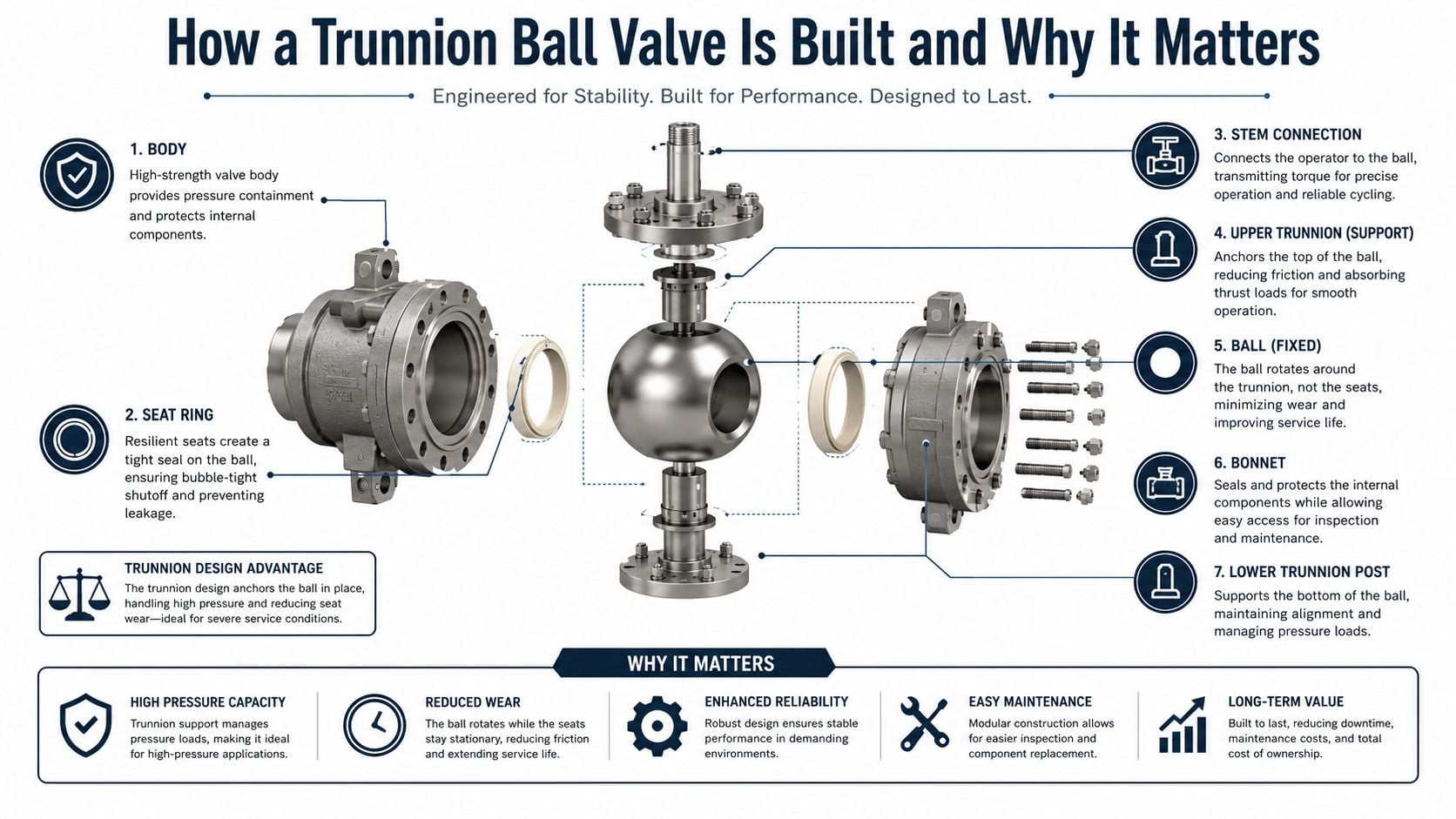
A trunnion is the mechanical support that anchors the ball at the top and bottom, so the ball stays fixed while the stem turns it 90 degrees from open to closed. The seat is the sealing ring that contacts the ball, the stem is the shaft that transmits torque, the body holds the pressure boundary, and the seat pocket is the cavity that retains the seat assembly and its loading components. In this design, the seats are typically spring-loaded or otherwise energized toward the ball, which keeps sealing contact available even when differential pressure is low spring-loaded seat description.
That fixed-ball construction changes the physics. Line pressure is not trying to shove the ball downstream the way it does in a floating design, so the seats do not have to absorb the full load. The practical result is lower operating torque and steadier sealing behavior under pressure, which is why these valves are common in large-diameter pipeline and process service mechanical support and torque reduction, fixed ball and lower torque in refinery service.
A floating-ball valve can work well in smaller or less demanding service, but it depends more on line pressure to push the ball into the downstream seat. Trunnion construction changes that dependence. It gives maintenance teams a more stable load path, more predictable operating torque, and better shutoff control when the line gets bigger or hotter, or both.
Reliability takeaway: the trunnion is not just a support feature, it is the reason the valve can stay predictable when pressure, size, and seat loading all rise at once.
A quick comparison helps maintenance planners use the right vocabulary. A floating design uses process pressure to create sealing force, while a trunnion design uses mechanical support and spring-loaded seats to make seal behavior less dependent on pressure. That difference is why a trunnion unit belongs in severe service and not in a generic valve bucket. For a related reference on relief hardware behavior, see the internal discussion of the steam relief valve, because the same reliability mindset applies, stable load paths matter.
The Failure Modes Reliability Teams Actually See
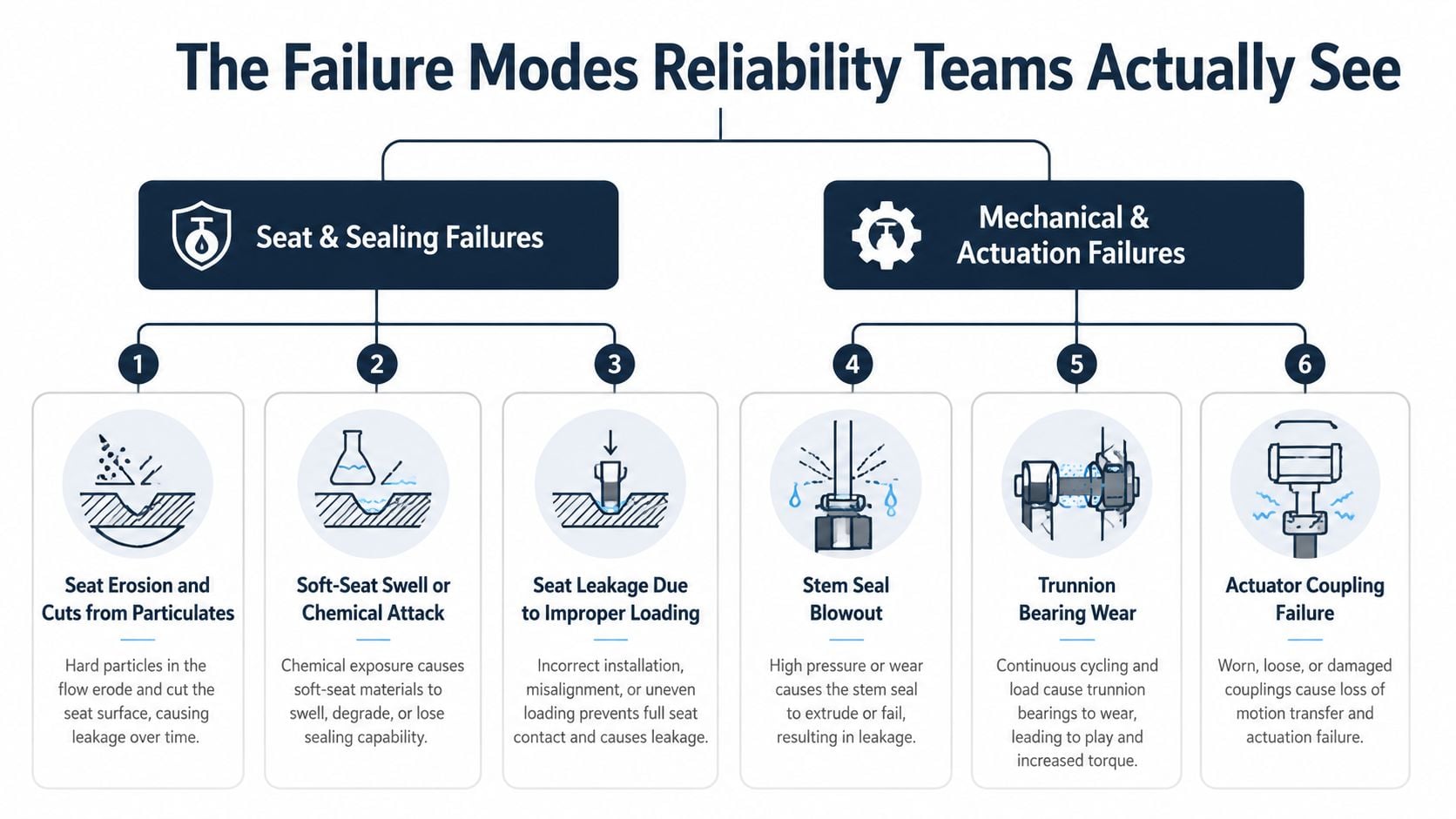
Seat and sealing failures
Seat erosion is common when the line carries solids, scale, or debris. The root cause is mechanical cutting of the seat face, and the field clue is usually a valve that still closes but needs more torque or leaves a faint leak path under pressure. Soft-seat swell or chemical attack shows up in incompatible service, especially where the process fluid changes the seat material over time, and the symptom is inconsistent shutoff after the valve has sat in service for a while.
Seat leakage can also come from improper loading, not just damage. If the spring-loaded seat no longer follows the ball cleanly, the valve may pass product even though the actuator reaches the correct travel stop. That's why a closed position on the indicator is not the same thing as a verified seal.
Mechanical and actuation failures
Trunnion bearing wear allows the ball to shift off-axis. That sounds subtle, but it changes loading on the seat rings, raises friction, and can create a torque spike that the actuator has to fight every time the valve moves. Stem seal blowout is a different problem, often linked to thermal cycling and repeated pressure swings, and it usually appears first as a visible external leak around the stem area.
Fugitive emissions through the packing tend to start small. Operators may notice a faint smell, a wet stain, or a slow change in leak rate before the problem becomes obvious. Actuator torque drift is another important signal, and it often reflects rising seat friction, debris, or bearing degradation rather than a motor issue. If current draw, air demand, or travel time starts changing together, the valve is telling the team that the load path is no longer stable.
The failure pattern matters more than the isolated symptom. One leak can be packing. Two leaks and rising torque can be a mechanical alignment issue.
Diagnostic Techniques That Catch Problems Early
The best PdM program for a trunnion ball valve doesn't rely on one tool. It layers measurements so a maintenance team can separate seal leakage from mechanical wear and then decide whether the problem belongs to the seat, the trunnion, the actuator, or all three. For a practical reference on acoustic screening methods, the internal resource on ultrasound testing equipment is a useful companion, because ultrasound is one of the fastest ways to spot early leakage and friction.
Match the tool to the failure mode
Vibration analysis on the actuator and gearbox is useful for looseness, bearing wear, and coupling problems. If the spectrum changes as the torque trend rises, the issue is usually mechanical rather than hydraulic. Airborne or structure-borne ultrasound is better for early internal leakage through the seat or packing, because it picks up turbulent flow before the leak becomes visible.
Thermography helps when friction is building. A hotter actuator, stem area, or bonnet can indicate packing drag or a seat hot spot after repeated stroking. Oil analysis on gearbox lubricant catches wear debris, which is a strong clue that the torque path is degrading. Torque trending during partial-stroke tests is one of the most valuable tools, because it reveals a rising load before the valve fails to operate fully.
Field rule: if ultrasound shows leakage and torque is rising at the same time, treat the valve as an active degradation event, not a nuisance reading.
| Diagnostic Technique | Failure Mode Detected | Trend Cue to Watch |
|---|---|---|
| Vibration analysis | Trunnion bearing wear, coupling looseness | New mechanical looseness or a rising overall vibration pattern |
| Ultrasound | Seat leakage, packing leakage | A distinct increase in acoustic energy during a closed or partially closed check |
| Thermography | Packing friction, seat hot spots | Localized temperature rise around the stem, bonnet, or actuator housing |
| Oil analysis | Gearbox wear, contamination | Metallic debris or dirty lubricant that wasn't present before |
| Torque trending | Seat degradation, actuator underperformance | Higher opening or closing load during the same valve stroke |
| Partial-stroke testing | Incomplete travel, binding, hidden friction | Slower response or a changing torque signature across repeat tests |
The best route program combines these tools instead of running them as separate silos. One technician can compare the torque baseline, listen with ultrasound, and look at vibration and temperature in the same visit, then decide whether the valve needs closer inspection or a planned outage. That route-based discipline is what catches problems before a shutdown crew has to discover them the hard way.
A Field Example from a Refinery Hydrocracker Service
A refinery hydrocracker team kept seeing the same reactor isolation valve pass product during shutdowns, even after three outage cycles. The seat was blamed first, which is a common assumption, but the condition data told a different story. Torque trend history showed the actuator working harder over time, ultrasound during partial-stroke testing showed internal leakage, and vibration spectra on the actuator pointed to a mechanical looseness pattern rather than a simple sealing defect.
The reliability lead tied those signals together and pushed for a planned overhaul instead of another seat-only repair. The teardown confirmed trunnion bearing wear, and the worn support had allowed the ball to shift enough to disturb seat contact under pressure. The team replaced the seat components, restored the bearing condition, and reset the monitoring interval so the valve would be watched as a load-bearing assembly rather than a static isolation device.
That kind of fix has wider business implications than a spare-part swap. In oilfield finance conversations, asset availability and cash flow often get discussed together, and a useful background read on that angle is recourse and non recourse factoring for oilfield, because valve-related downtime can affect the same production economics that drive working-capital decisions.
The most useful lesson from the case wasn't the repair itself, it was the diagnostic sequence. No single measurement proved the failure by itself. The torque trend, ultrasound result, and vibration data became convincing only when they were read together against the valve's duty cycle and pressure history. Since then, that site has used the same pattern to catch similar issues before a shutdown window was lost.
Specifying Trunnion Valves for Severe Service
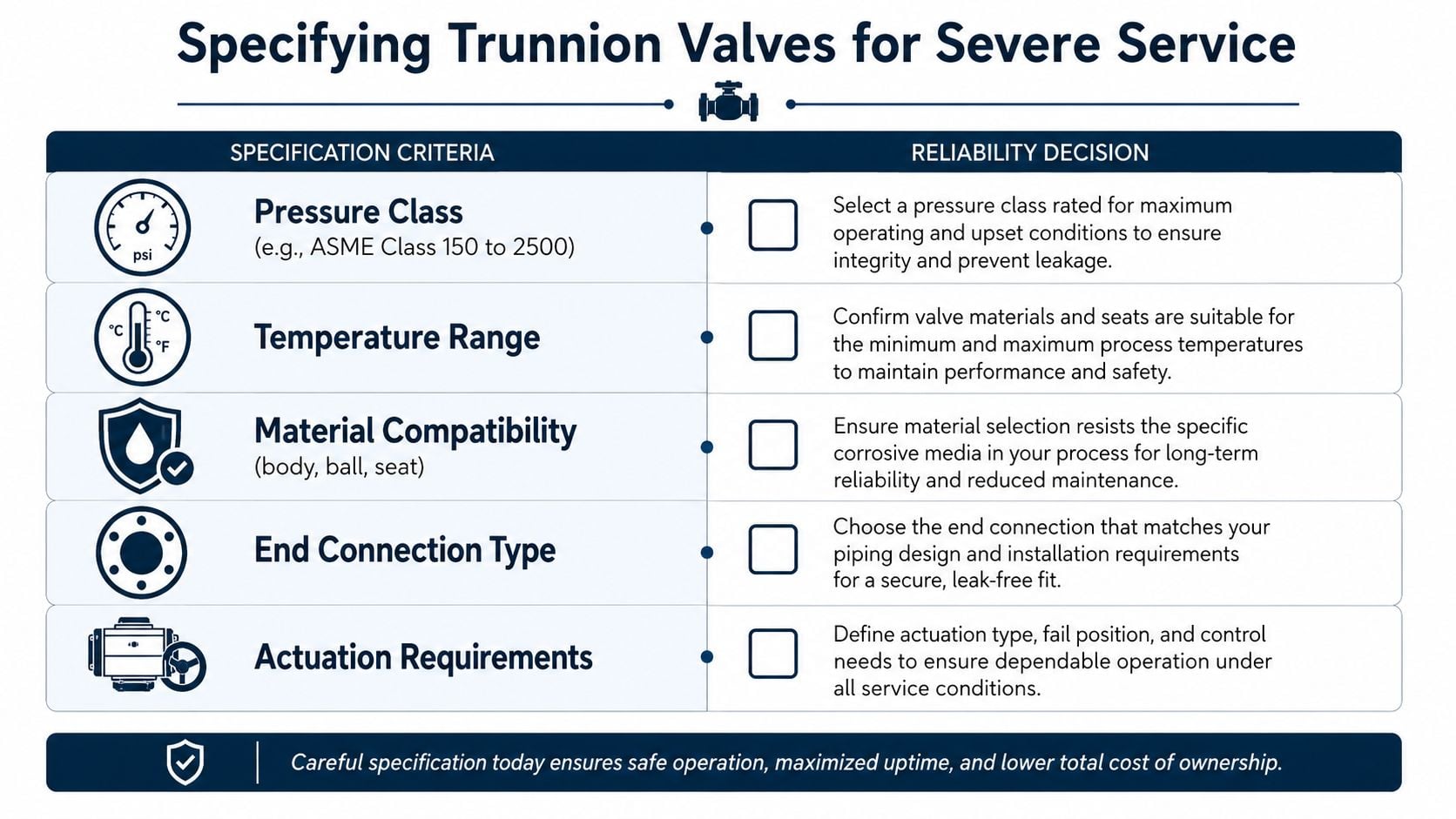
A specification should start with the service, not the catalog. A trunnion ball valve belongs in the discussion when the line is large, the pressure is high, or the isolation duty is severe enough that seat stress and operating torque have to stay under control. In practice, that usually means the valve is being asked to hold up as a reliability asset, not just as a shutoff device. The design is commonly applied above 3.9 in (10 cm) and 580 psi (40 bar), which is why it shows up so often in pipeline and hydrocarbon service service threshold and use range.
What matters most on the datasheet
Pressure class and size should match the duty, not the cheapest line item on the quote. For large-bore service, a trunnion design is usually the practical choice because the ball is mechanically supported and the seats are not carrying the full load path. Spring-loaded seats deserve attention when low-differential-pressure sealing still has to be dependable, because the seat has to maintain contact even when line pressure is not helping.
Fire-safe construction matters where hydrocarbon release could escalate, and anti-static features matter where ignition risk has to be controlled. Double block and bleed arrangements are useful when operators need positive isolation and a way to verify cavity bleed-off. Materials matter too. Sour service, chloride exposure, and high-temperature duties can all change what a seat, ball, stem, or body can tolerate over time.
A good specification review also asks a simpler question, what happens after the first degradation event. If the answer is “remove and replace the whole valve,” the design may not match the maintenance philosophy. If the answer is “repair the load path and verify sealing,” the valve is closer to what a reliability team wants.
| Decision Point | Reliability Question |
|---|---|
| Pressure class | Can the valve hold the line without forcing the seats to carry the load? |
| Size | Is the bore large enough that floating-ball torque would become unstable? |
| Fluid service | Will the media attack seat, packing, or metallurgy over time? |
| Fire-safe need | Would a fire exposure create unacceptable release risk? |
| DBB requirement | Does the isolation task need cavity verification and positive separation? |
The specification should also match the failure you are trying to prevent. For a hydrocarbon header, seat loading control and actuation margin usually matter more than a polished finish or a broad durability claim. For a chemical line, compatibility and packing performance can matter more than the nominal pressure class. If the valve cannot be monitored, tested, and maintained as part of the site's condition-monitoring program, the spec is too optimistic for severe service. A useful reference point for maintenance planning is reliability-centered maintenance, because the installation and upkeep questions are usually the same failure question seen from two angles.
Vendor literature often gives every feature the same weight. Field failures do not. In service, the first signs of trouble are usually torque drift, packing leakage, seat wear, or a change in actuator margin. A sound spec makes those degradation paths visible early, and it leaves the maintenance team enough access to confirm them before the next upset turns into an unplanned shutdown.
Installation, Commissioning, and a Maintenance Strategy That Works
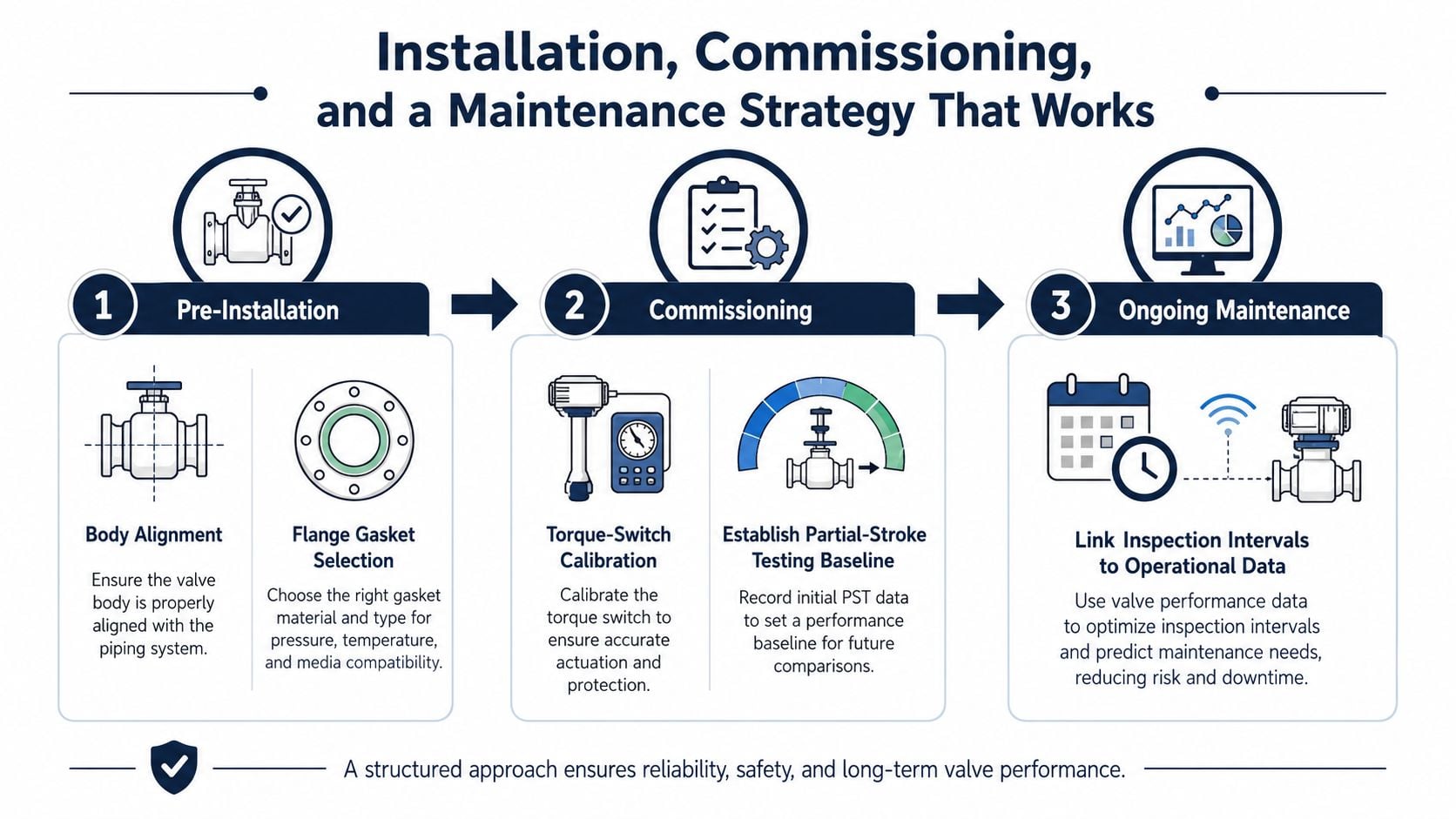
The first failures often start at installation, not after years of service. Body alignment, flange gasket selection, and actuator setup all influence whether the valve starts life with even loading or with a hidden side load that shows up later as torque drift. A basic maintenance-centered check on reliability-centered maintenance is useful here, because the installation job and the maintenance job are really the same problem, preserve function and prevent avoidable wear.
Commission it like a critical asset
During commissioning, baseline the valve in the same condition it will run in. Record vibration, ultrasound, and torque data before the first hard process upset, because the first 90 days often reveal the most about fit-up and early wear behavior. A poor torque-switch calibration can mask binding, and a weak partial-stroke baseline can make later comparisons meaningless.
Oil and gas facilities should pay special attention to actuator margin and leakage verification on high-pressure hydrocarbon lines. Chemical plants need to focus harder on compatibility, since seat and packing performance can change with media exposure. Power generation sites often care most about repeatability, because thermal cycling and duty changes can wear the load path faster than expected.
Baselines are only useful if they are repeatable. A torque reading taken under one process condition and compared to a different one is not a trend, it's noise.
Turn inspection into a trigger, not a ritual
A maintenance strategy works when it uses symptoms to drive the next action. Rising torque plus leakage points to seat or bearing inspection. External leak plus temperature rise points to packing or stem seal work. Vibration increase plus torque drift points to mechanical loading, especially around the trunnion and actuator interface.
Use cumulative seat cycles, not calendar time alone, to decide when a full overhaul is justified. A valve that cycles often in a tough service can age quickly even if the calendar looks harmless. A valve that sits mostly static can still need inspection if its process conditions are harsh or if early-life data already showed irregular loading. That's the practical difference between a PM program that prevents downtime and one that only documents it.
Build a Reliability Baseline for Your Critical Valves
A structured valve program starts with criticality ranking, baseline vibration and ultrasound data, and a route to the assets that can hurt production first. For critical trunnion ball valve service, that usually means a faster path to fewer unplanned shutdowns and better use of monitoring time, especially where valve events can stop a whole header or unit. A straightforward way to quantify the case is to review mean time between failure against the valve's real duty, then decide where PdM belongs first.
A no-cost reliability assessment should identify the highest-risk valve assets, establish condition baselines, and give operations a prioritized roadmap instead of a generic checklist. That's the right next move when valve reliability is becoming a shutdown issue instead of a maintenance line item.
Forge Reliability helps teams build that baseline with condition monitoring, root cause failure analysis, and practical reliability planning for critical valves and the systems they protect. If trunnion valve leakage, torque drift, or repeat shutdowns are creating risk in your plant, visit Forge Reliability to schedule a free reliability assessment and get a prioritized plan for the assets that matter most.