A bearing rarely fails in isolation. A pump comes back twice in one quarter, the alignment checks out, the grease looks clean enough, and the replacement bearing still comes out rough. In a lot of plants, that's the moment the underlying problem appears, the bearing family itself doesn't match the actual mix of speed, load direction, shock, and misalignment the machine lives with every day.
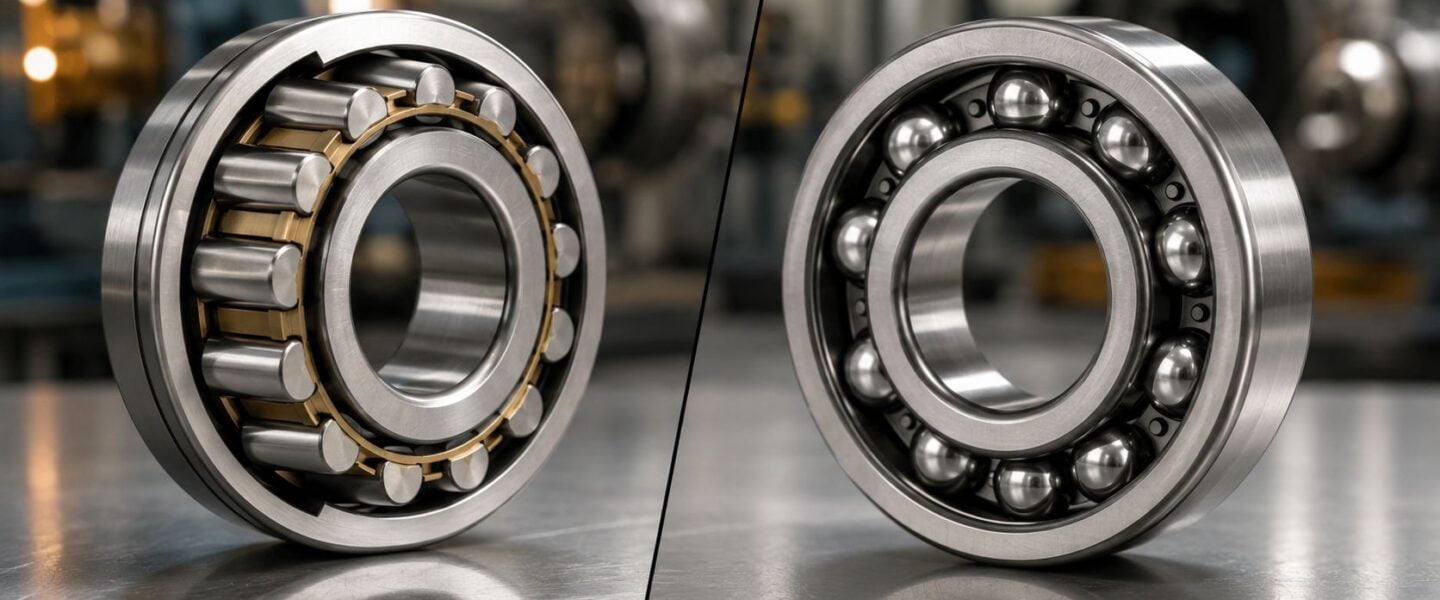
That's why roller vs ball bearing selection matters far beyond procurement. The choice changes how the shaft behaves, how heat builds, what vibration analysts expect to see, and what maintenance teams should treat as normal versus suspicious. The core distinction is simple, ball bearings use point contact and roller bearings use line contact, but the reliability consequences spread through the entire asset strategy, from installation to condition monitoring to failure analysis. For the engineering basis behind that distinction, the University of Utah bearing lecture material is a solid reference for the underlying geometry and load-speed trade-offs, and it's the right place to anchor the discussion of why one family is chosen over the other in the first place (University of Utah bearing lecture material).
| Criterion | Ball Bearings | Roller Bearings |
|---|---|---|
| Contact geometry | Point contact | Line contact |
| Typical strength | Lower friction, higher speed capability | Higher load capacity, greater stiffness |
| Axial load handling | Modest axial loads in many designs | Only tapered rollers are built for axial loads |
| Reliability lens | Better when heat and speed dominate | Better when radial load, shock, or rigidity dominate |
Table of Contents
- Why Bearing Choice Determines Equipment Reliability
- Contact Geometry and Performance Fundamentals
- Comparing Roller and Ball Bearings Across Critical Criteria
- Equipment-Specific Bearing Selection Guidance
- Failure Modes and Predictive Maintenance Signatures
- Decision Framework and Retrofit Considerations
- Optimize Your Bearing Strategy with Expert Support
Why Bearing Choice Determines Equipment Reliability
A centrifugal pump that keeps coming apart every few months can send a maintenance team down the wrong path, chasing alignment, grease, and seal issues long after the core problem has been set in motion. When the duty involves heavy radial load with occasional shock from process upsets, a ball bearing that looked acceptable on paper may be the wrong fit for the service. The machine is not unlucky. It is telling maintenance that the bearing family and the operating envelope do not match.
The selection decision sits upstream of most failure modes
Bearing choice sets the limits on what the asset can tolerate before it starts to complain. A ball bearing usually brings lower friction and higher speed capability, while a roller bearing usually brings higher stiffness and load capacity. That difference matters in the field. It changes how a motor behaves during startup, how a pump reacts to coupling strain, and how a gearbox handles process shock.
It also changes the maintenance signature. A bearing chosen too light for the duty tends to show up as rising vibration, heat, and surface distress long before a hard failure. Oil analysis can also shift sooner than expected, with wear debris patterns that point to overload, misload, or early spalling rather than a simple lubrication lapse. Reliability teams that watch only grease condition or seal condition miss the larger clue, the bearing family may be wrong for the load path.
Practical rule: If the machine shows overload marks, edge damage, or early spalling, the bearing family deserves the same attention as the lubrication program.
The choice upstream shapes the whole failure story. It changes the expected vibration baseline, the temperature trend that still looks normal, and the point at which oil analysis should start raising concern. Teams that treat all bearings as interchangeable often read the symptoms incorrectly and replace parts without correcting the cause.
Why this matters on the plant floor
A high-speed electric motor and a heavily loaded conveyor do not ask the bearing to do the same job. The ball bearing is usually the cleaner fit for speed and lower drag. The roller bearing is usually the better answer when the shaft must carry more radial force or hold geometry under load. In a gearbox, that decision can separate steady service from recurring cage wear, surface distress, and a pattern of repeat repairs.
A practical selection process starts with duty, not stock on the shelf. The right bearing family should match the load, speed, and expected fault signatures the reliability team will monitor. For a common sizing example, see this bearing size guide for a 6202 bearing. If the duty changes, the reliability plan should change with it.
Contact Geometry and Performance Fundamentals
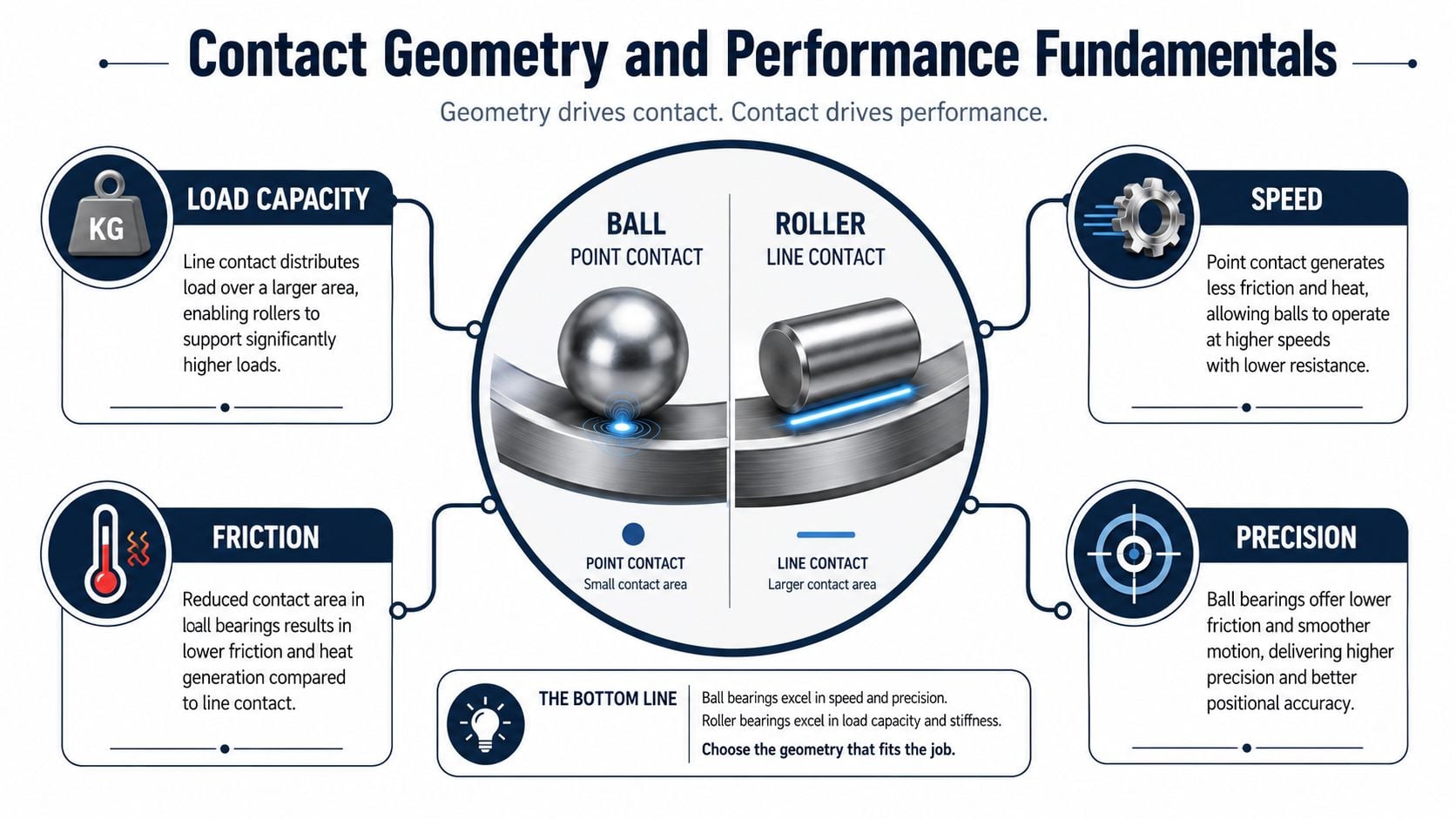
Bearing geometry drives the operating trade-off. A ball touches the raceway at a small point, so the contact stress is concentrated but friction stays low. A roller touches along a line, so the load spreads out and the bearing can usually carry more force and run with more stiffness in service. That difference shows up on the plant floor fast. The same shaft can run cleanly with one family in a motor and start showing distress if the wrong family is used in a conveyor or mill.
What the main bearing terms mean
Dynamic load rating is the catalog value used to compare how much load a bearing can carry under motion. Static load rating describes what the bearing can tolerate while sitting still or under very slow movement. Limiting speed is the practical ceiling where heat, lubrication, and internal geometry stop the bearing from being a good idea in continuous service. Those terms matter because bearing selection is never just about fit, it is about what the bearing can survive without running hot, losing clearance, or making the vibration data hard to trust.
Deep groove ball bearings are the workhorses of the ball family. They show up in high-speed electric motors and general-purpose equipment because they balance friction, compactness, and broad usefulness. Angular contact ball bearings are used when the machine needs to manage combined loads more deliberately. On the roller side, cylindrical roller bearings fit applications that need high radial capacity and relatively low friction for a roller design, spherical roller bearings handle misalignment and heavy load in rougher service, tapered roller bearings handle combined radial and axial loads, and needle rollers fit tight spaces where the load is still serious.
Field note: If the housing is small but the shaft is punished by load, needle rollers often tempt designers. In many plant retrofits, that choice shows up later as heat and lubrication trouble.
How the geometry shows up in real behavior
As noted in the engineering fundamentals, roller bearings are stiffer and have higher load capacity than comparably sized ball bearings, while ball bearings have lower friction and can often run faster. The same material also notes that most ball bearings handle only modest axial load, while only tapered rollers handle axial load in a direct, practical way. That is why a gear reducer can tolerate a different bearing family than a high-speed fan motor.
For installation checks, the basic geometry also changes what “good” looks like. A ball bearing often gives a cleaner, quieter vibration profile when the load is within its comfort zone. A roller bearing can sound and measure harsher under healthy load because the contact pattern and stiffness are different. Reliability teams need the right benchmark, not a generic “low vibration” target. For sizing context, a bearing size reference helps teams tie the geometry back to actual envelope constraints, such as a 6202 family fit check.
Comparing Roller and Ball Bearings Across Critical Criteria
The quickest way to separate the families is to compare them where failures show up. Load capacity is only one variable. Misalignment, contamination, speed, and heat matter just as much because they shape how the bearing wears, how it sounds, and how long it stays in service.
| Criterion | Ball Bearings | Roller Bearings |
|---|---|---|
| Radial load capacity | Better for lighter to moderate radial duty | Better for heavy radial duty |
| Axial load handling | Modest axial capacity in many designs | Only tapered rollers are built for axial load |
| Speed capability | Usually higher speed capability | Usually lower top speed because of greater contact area and friction |
| Misalignment tolerance | Generally lower tolerance | Better in designs such as spherical rollers |
| Contamination sensitivity | Sensitive, especially when load is concentrated | Also sensitive, but heavy-duty designs can tolerate rougher service better |
| Friction and heat | Lower friction, usually less heat at speed | More friction, more heat risk in high-speed service |
Where each family fits best
Ball bearings usually make sense in electric motors, small pumps, and fans where high speed and low friction matter more than brute load capacity. That's why deep groove ball bearings are common in motor end bells and general-purpose rotating equipment. Roller bearings show up in gearboxes, vibrating screens, and heavy conveyors, where stiffness and radial capacity are more important than top speed. Spherical roller bearings are especially useful in equipment that sees shaft deflection or housing movement, such as vibrating screens, because the machine doesn't stay perfectly aligned while it works.
Misalignment tolerance changes the maintenance strategy. If the bearing family has little tolerance, then shaft alignment, base flatness, thermal growth, and soft foot become more important to the life of the asset. If the family can tolerate more misalignment, the team may still need good installation practice, but the machine won't punish tiny geometry errors as quickly.
Why the trade-offs matter to maintenance planning
Contamination sensitivity changes the sealing plan. A bearing that is more vulnerable to fine debris often needs tighter ingress control, better grease discipline, and more careful relubrication timing. Heat generation changes the lubrication strategy. If the bearing runs hot by design, lubricant selection and fill quantity matter more because extra churning can shorten life and make vibration readings climb.
A bearing doesn't fail only because it is weak. It also fails because the surrounding machine, the seals, and the maintenance routine asked it to live outside its design envelope.
For radial versus axial load planning, a clear reference on load direction helps engineering and maintenance teams avoid mismatches during specification review (radial vs axial load reference). That matters in gear reducers, pumps, and compressors, where the direction of force changes with operating point and machine design.
Equipment-Specific Bearing Selection Guidance
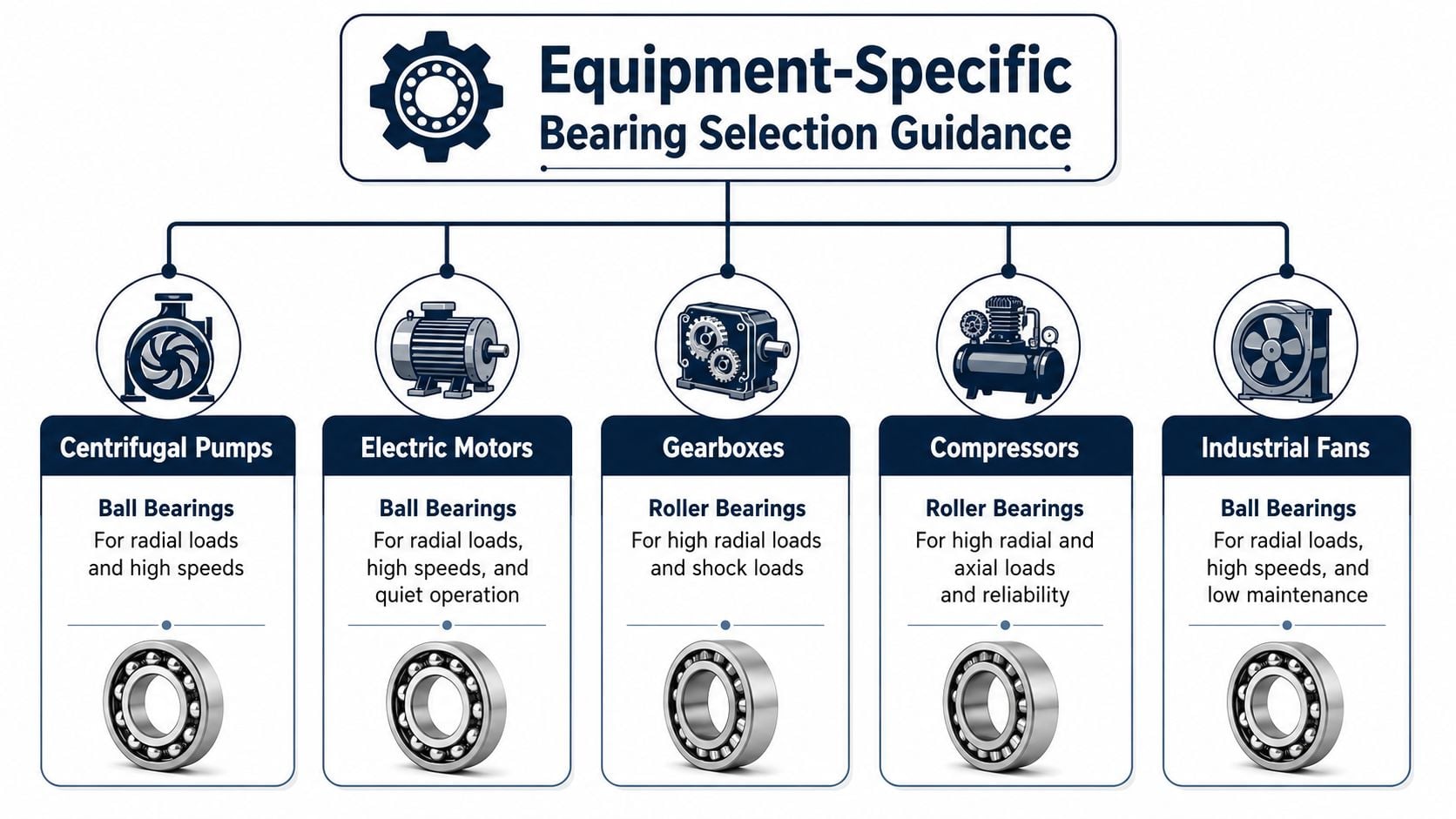
The correct choice usually becomes obvious once the machine class is named. The trick is to stop speaking in generalities and look at the dominant load, the speed range, and the way the machine is abused in real service.
Centrifugal pumps and electric motors
Centrifugal pumps usually lean toward ball bearings because speed is high and the load profile is often dominated by rotation rather than massive radial force. In a clean, stable service point, a deep groove ball bearing is often the simplest and most reliable answer. Variable speed drives complicate that picture because low-speed operation can reduce the lubricating film and expose the bearing to more time in boundary lubrication.
Electric motors are even more strongly associated with ball bearings, especially where the design goal is low friction and smooth operation. The familiar failure mode is not usually collapse under load. It's early noise, heat rise, grease degradation, and eventually spalling after contamination or electrical stress gets into the raceway.
Gearboxes, compressors, and industrial fans
Gearboxes usually push the selection toward roller bearings, especially when tooth loading, axial thrust, and housing stiffness matter. Shock loading from upstream process changes can make a roller family the safer choice because the line contact spreads force more effectively. Compressors often sit in the middle. The bearing choice depends on whether the machine is speed-driven, load-driven, or sensitive to axial thrust from the compression process.
Industrial fans frequently stay with ball bearings because speed is high and the load is often moderate. If the fan sees severe imbalance, process dust, or a harsher base structure, roller bearings may be considered, but the retrofit needs a hard look at heat, housing fit, and alignment tolerance.
A practical way to think about the five common classes
- Centrifugal pumps: Favor ball bearings when speed is the main challenge and the radial load stays moderate.
- Electric motors: Favor ball bearings for smooth high-speed duty and simpler installation.
- Gearboxes: Favor roller bearings where torque transmission and gear mesh loads dominate.
- Compressors: Match the bearing to the load direction, thrust behavior, and thermal profile.
- Industrial fans: Favor ball bearings unless the machine's environment or imbalance history argues for more stiffness.
For a gearbox mounted in a wind turbine, the same load logic still applies, but the consequence of a bad choice gets amplified by access difficulty and long service expectations, which is why the bearing choice has to be tied to inspection reality, not only nameplate data (gearbox in wind turbine reference).
Failure Modes and Predictive Maintenance Signatures
Bearing failures rarely look identical across families. A ball bearing that is misapplied often fails with cleaner-looking but more abrupt surface distress. A roller bearing that is overloaded tends to show different wear bands, edge loading, and stiffness-related vibration changes. The maintenance team needs to know which family is installed before it interprets the data.
What vibration, oil, and heat usually tell the team
Ball-bearing faults often stand out in frequency analysis because defect energy builds around the race and the rolling elements in a way that analysts can track with envelope methods and bearing defect frequencies. Roller-bearing faults show a different pattern, often with broader energy and signatures that reflect the line contact and the load distribution across the roller body. Cage issues can appear in either family, but the root cause is often not the cage itself. It's lubrication starvation, contamination, or sustained overload that lets the cage start striking surfaces it shouldn't touch.
Fatigue spalling, contamination damage, lubrication starvation, and electrical pitting all matter in both families. The difference is the way they present. Ball bearings under contamination often show more localized race damage and rising noise before the temperature climbs. Roller bearings under overload can develop edge wear and roughness that makes the vibration picture less clean long before catastrophic failure.
Oil analysis should be read with the bearing family in mind. Fine contamination is bad for both, but a roller bearing in heavy service can generate a different wear-metal pattern than a ball bearing in a clean, high-speed motor. Particle shape, debris trend, and the timing of the rise matter more than any single sample. Thermography usually confirms what the other tools already hinted at. A bearing running hotter than its neighbors is telling the team that friction, load, lubrication, or alignment has moved outside the expected window.
A useful housekeeping habit is to keep the bearing history tied to the work order trail. A straightforward tool maintenance system, including inspection intervals and defect notes, helps the team connect repeated symptoms to the actual failure pattern instead of resetting the story every time the bearing is changed (tool maintenance system resource).
Diagnostic rule: If the vibration signature changes after a bearing swap, the team should ask whether the bearing family changed too. A new family can make an old baseline almost useless.
For deeper root-cause work, a failure library that classifies bearing damage by mechanism helps separate lubrication mistakes from misalignment and overload patterns (failure of bearings reference).
Decision Framework and Retrofit Considerations
A bearing retrofit should start with the machine, not the parts bin. If the existing setup is failing, the goal is not to replace ball with roller, or roller with ball, as a reflex. The goal is to match the new bearing family to the actual load, speed, and condition monitoring environment, then make sure the housing, seals, and lubrication system can support the change.
The questions that should be answered first
- What loads dominate? Radial load, axial load, or combined load should be identified before any catalog comparison starts.
- How fast does the machine really run? Variable speed changes the thermal and lubrication picture, especially at the low end.
- How much misalignment exists? If the shaft or base cannot be held tightly, a more tolerant design may be needed.
- What is the contamination risk? Dust, moisture, process ingress, and cleaning practices all change the sealing strategy.
- What monitoring exists? Vibration, oil, and temperature baselines need to be updated if the bearing family changes.
Retrofit constraints that get missed too often
Housing compatibility is usually the first trap. A new bearing can fit the shaft and still fail because the shoulder geometry, internal clearance, or axial location wasn't updated. Seal changes come next. A better bearing won't survive long if the contamination path is still open. Lubrication systems also matter. A grease point that worked for one family can overfill another, or fail to reach the load zone the way the machine now needs.
The cleanest retrofits are the ones where the maintenance team resets the baseline. That means new alarm thresholds, new comparison spectra, and fresh thermal references after the installation settles in. If the bearing family changes, the machine's normal vibration and heat profile may change with it, and the old limits can create false alarms or hide a real problem.
For teams building a formal selection process, a bearing installation and life guide helps connect the retrofit choice back to fit, preload, lubrication, and service expectations (bearing selection and installation guide).
Optimize Your Bearing Strategy with Expert Support
The right bearing is a reliability decision, not just a purchasing decision. Roller vs ball bearing selection changes load capacity, speed behavior, vibration signatures, oil analysis targets, and the way a failure grows before it becomes visible. The best results come when bearing choice, lubrication, alignment, and condition monitoring are treated as one system instead of four separate tasks.
Forge Reliability helps plants sort out bearing misapplications, recurring failures, and monitoring gaps before they turn into more downtime. Their plant-floor specialists can review your critical assets, connect bearing choice to the data your team is already collecting, and build a practical reliability plan around vibration analysis, oil analysis, and root cause failure analysis. Visit Forge Reliability to request a free reliability assessment and get a bearing strategy that matches the way your equipment runs.