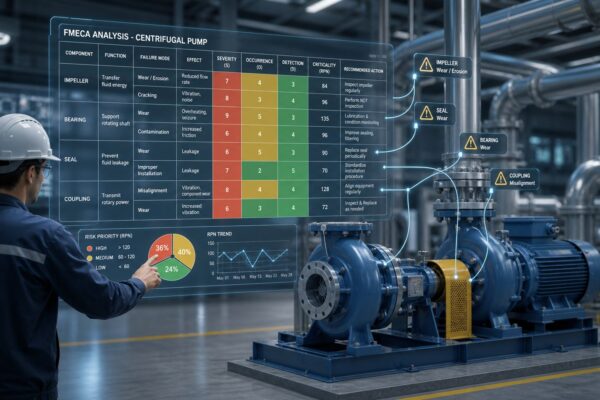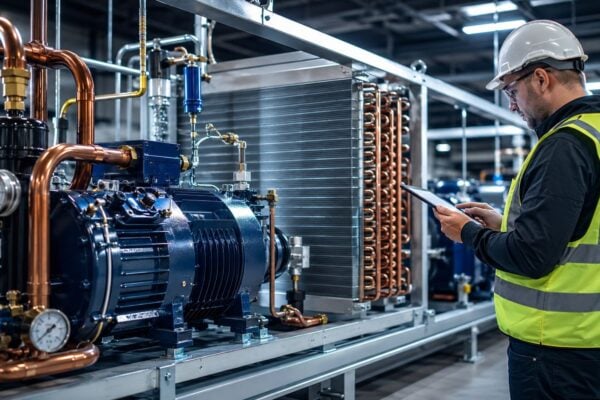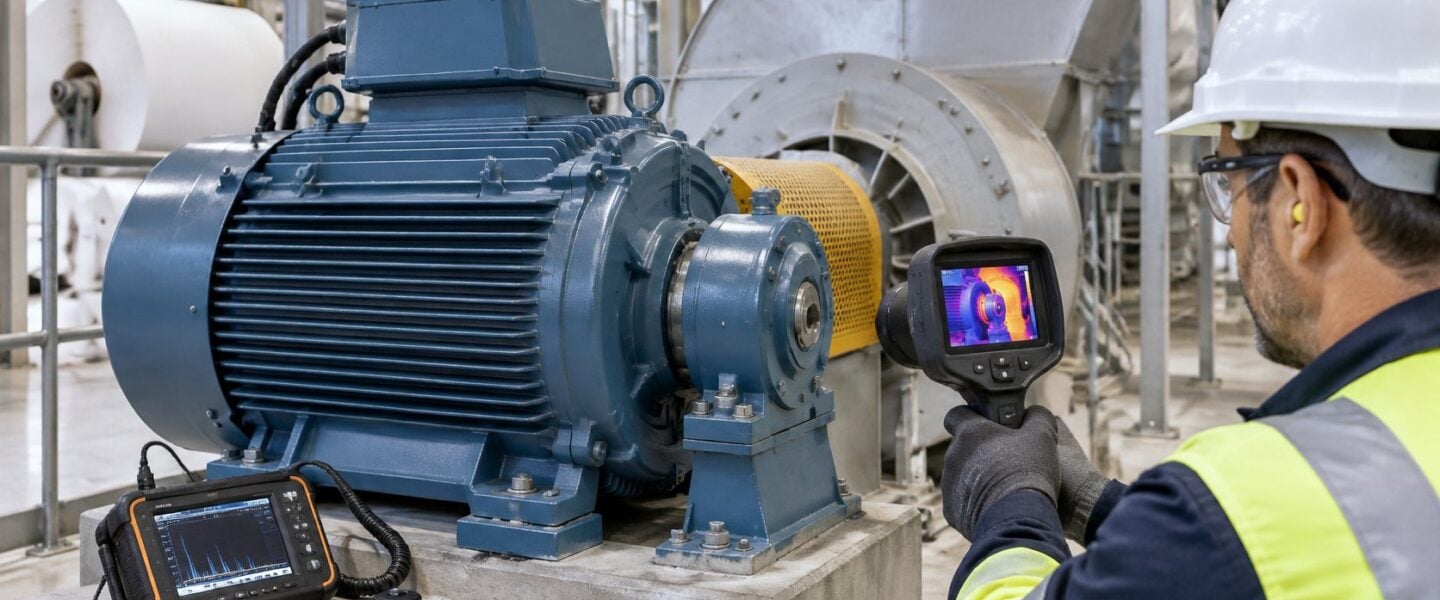
Consider a 250 hp, 480 V induction motor driving a paper-mill exhaust fan for more than 6,000 hours a year. In this hypothetical operating case, it still starts reliably, but one bearing housing runs warmer, a thermal image shows one phase hotter than the others, and power draw exceeds what the fan load should require. The next work order could prevent an outage, or cause one if the response is another shot of grease without a diagnosis.
Table of Contents
- What Poor Motor Care Costs a Plant
- Risk-Based Intervals for Motor Maintenance
- How to Check Bearings Alignment and Couplings
- Thermography, Balancing and Rotor Checks
- Insulation Resistance, Winding Tests and MCSA
- Shaft Voltage on VFD-Driven Motors
- Failure Patterns and Post-Repair Proof
- Request a Free Reliability Assessment
What Poor Motor Care Costs a Plant
Planned maintenance is scheduled work performed before failure. Condition monitoring means measuring vibration, temperature, current, and insulation condition to detect degradation. Criticality rates how much production, safety, or environmental performance a failure would affect.
For the paper-mill fan, successful starting isn't evidence of healthy operation. A dirty cooling filter, soft foot, meaning uneven contact between the motor feet and mounting surface, or degraded grease can increase losses and operating temperature while the shaft keeps turning.
The Department of Energy's electric-motor standards material notes that motors commonly fail or require replacement or rewinding within roughly 5–15 years, depending on size. Repair quality and maintenance decisions therefore matter to lifecycle cost, not just breakdown prevention.
Cost discipline: Evaluate energy consumption, maintenance effort, repair quality, and production exposure together. A motor that runs isn't necessarily economical to keep running.
For plants that also maintain utility fleets, UTV maintenance insights from Campus EV offer a separate vehicle-cost perspective, not an industrial motor-testing standard. The fan itself needs a connected investigation of motor overheating causes and solutions, rather than separate mechanical and electrical work orders that never meet.
Effective maintenance of electric motors connects risk-based intervals, bearing and alignment checks, electrical screening, drive-related bearing currents, and documented post-repair acceptance.
Risk-Based Intervals for Motor Maintenance
Motor checks by interval and when to tighten them
| Check | Baseline interval | Acceptable result | Shorten when |
|---|---|---|---|
| Noise, vibration, and temperature | Daily or weekly | No new tone; bearing temperature stable versus baseline | Failure stops the line, or a rising trend appears |
| Winding and winding-to-ground resistance | About twice a year | Stable versus baseline; insulation above the applicable screening limit | Washdown, humidity, contamination, or a prior low reading |
| Bearing lubrication | Condition-based, not a generic chart | Correct grease type and quantity; no purge onto windings | High temperature, contamination, or many starts per hour justify reassessment |
| Shaft alignment, coupling, and belts | After installation and when vibration rises | Within site tolerance; no soft foot | Any move, base repair, or coupling work |
| Predictive-route coverage | Motors over 1,000 hours per year | Asset is on a route or continuous monitor | Critical spare or single-train process asset requires closer coverage |
The daily or weekly operating checks and approximately twice-yearly resistance tests follow DOE motor-system maintenance guidance. The coverage screen for motors operating more than 1,000 hours per year comes from DOE's motor-efficiency guidance; it identifies candidates for surveying and testing, not an automatic requirement for permanent sensors.
Turn the baseline into an asset-specific route
A computerized maintenance-management system, or CMMS, should hold each motor's inspection tasks, measurement history, and corrective work. Each task needs an owner, a repeatable measurement point, an acceptable condition, and an escalation rule.
For the paper-mill fan, weekly vibration and temperature measurements provide operating warnings. Semiannual electrical testing addresses winding changes that an external operating route might miss.
Shorten inspection intervals when washdown, abrasive dust, humidity, frequent starts, or variable-speed operation produce measurable deterioration. A variable-frequency drive, or VFD, controls motor speed by changing the electrical supply frequency and voltage; it also changes the motor's operating context.
A rising trend should trigger confirmation under comparable load and speed, followed by a named reliability or maintenance owner reviewing the evidence. An alarm without an assigned response is only a stored measurement.
Use historical findings without turning them into a calendar
A 1985 IEEE large-motor reliability study reported failure probability of 0.0124 failures per unit for maintenance intervals shorter than 12 months, compared with 0.0506 failures per unit at 13–24 months, more than four times higher. The same analysis reported that continuous temperature and vibration monitoring could reduce failure rates by approximately two-thirds.
Bearings led the failure categories, followed by stator windings, rotors, and other faults. Its description of excellent maintenance combined inspection, insulation testing, cleaning, lubrication or filter service, vibration, bearing checks, current and temperature trends, air-gap checks, alignment, and brush inspection where applicable.
Those findings support coordinated maintenance, not annual dismantling. Stable condition can justify extending disturbance-heavy tasks when manufacturer requirements and operating evidence support the change.
Don't set one plant-wide grease or overhaul month. Shorten the observation interval when risk rises, not automatically the interval between intrusive tasks.
The practical distinction between preventive, predictive, and corrective work matters when choosing types of industrial maintenance. Inspection frequency and intervention frequency shouldn't be treated as the same decision.
How to Check Bearings Alignment and Couplings
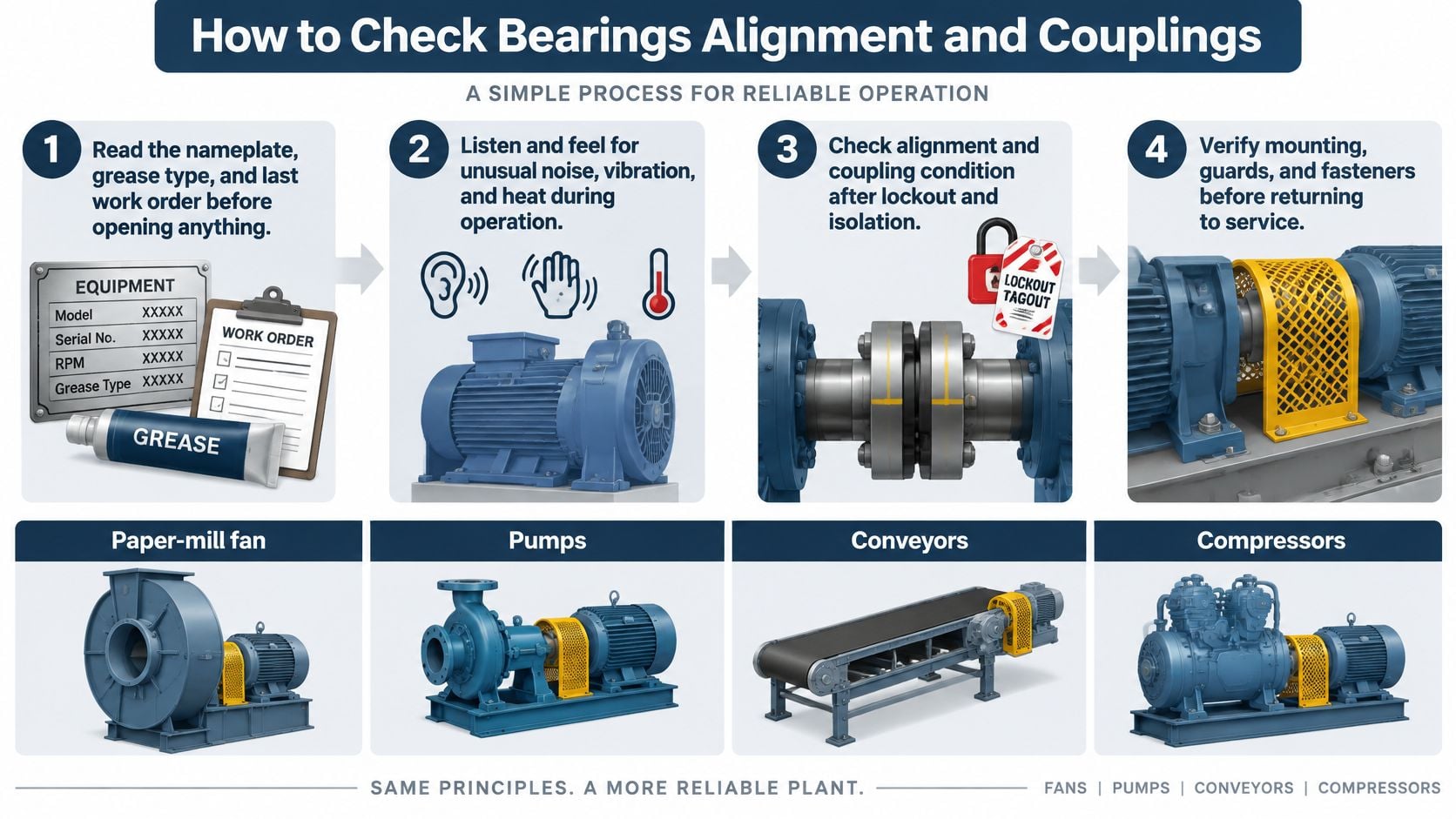
The paper-mill fan needs a repeatable inspection sequence that also transfers to pumps, conveyors, and compressors. Operating observations come first; physical inspection, guard removal, and adjustments require lockout, isolation, and control of stored mechanical energy.
Establish the failure evidence before lubricating
Read the asset record before opening anything. Match the nameplate to the work order, confirm bearing arrangement and specified lubricant, and review the last repair. A replacement motor may have different lubrication requirements from the unit it replaced.
Listen for a new tone and assess abnormal vibration or heat from safe, designated observation points. Compare measured bearing temperature at similar load, rather than using hand contact with hot or rotating equipment.
Collect a repeatable vibration reading. Use the same measurement point, direction, sensor mounting, and speed range. Separate bearing-related frequencies from shaft-speed vibration, misalignment, and looseness before selecting a repair.
Don't add grease because the calendar says so. Starvation, excess grease, incompatible grease, contamination, incorrect bearing fit, soft foot, load change, and electrical erosion require different interventions. More frequent preventive maintenance can introduce dirt, drive lubricant into unwanted spaces, or disturb a healthy assembly.
When lubrication is justified, use the specified grease and a measured quantity. Clean the fitting before connecting the applicator, follow the bearing arrangement's relief procedure, and remove expelled grease safely; sealed bearings shouldn't receive an improvised relubrication task.
Check the installation as a system
Inspect the coupling or belt drive under isolation. Look for damaged flexible elements, abnormal wear, belt condition, sheave wear, and guard clearance. MA Hydraulics Ltd's guidance on testing and troubleshooting shaft couplings provides useful coupling-specific context when evaluating the connection between motor and driven shaft.
Verify alignment with the fasteners at their specified final torque, accounting for expected operating-temperature movement. Check soft foot before correcting shaft misalignment; otherwise, tightening the motor may distort the frame and change the alignment just established. Alignment work occurs with the machine isolated, not running.
Inspect the cooling path. Check inlet screens, fan cover, cooling fins, and filters. Restricted airflow can heat both the frame and bearing area, making a cooling problem look like a lubrication problem.
Record asset identifier, operating load, speed, instrument, measurement location, and technician. Before release, verify guards, mounting hardware, and fasteners, then attach findings to the same motor record.
For the fan, the key decision sits in the middle of the sequence: whether lubrication addresses the observed mechanism. A hot housing alone doesn't answer that question.
Work-method warning: A repeat bearing failure soon after grease maintenance is evidence to challenge the interval, quantity, cleanliness, and diagnosis, not permission to grease more often.
Thermography, Balancing and Rotor Checks
Thermography, the use of infrared imaging to compare surface temperatures, adds spatial information that a single temperature reading misses. Scan bearing housings, the frame, and accessible electrical connections under comparable load and ambient conditions, using approved electrical-safety procedures for energized inspections.
A hot phase connection with balanced current warrants investigation of connection resistance and the electrical circuit, rather than immediate bearing work. Surface temperature alone cannot distinguish a defective connection from an internal winding problem.
Rule out mechanical defects before balancing
- Correlate heat with sound. Ultrasound uses high-frequency sound measurements to investigate friction and impact activity. It can help resolve an unclear bearing symptom, but a noisy reading still needs operating context and corroborating evidence.
- Compare equivalent spectra. A vibration spectrum separates vibration by frequency. Check the 1× running-speed component, meaning vibration occurring once per shaft revolution, alongside bearing-related frequencies and directional measurements.
- Balance only a mechanically sound assembly. A dominant running-speed component after rotor work or impeller buildup suggests unbalance, but looseness, alignment, and bearing condition must be checked first.
For the paper-mill fan, a hot bearing and strong running-speed vibration justify inspecting impeller buildup and the support structure before adding correction weights. Motor vibration analysis should establish whether the pattern supports balancing rather than merely showing higher overall vibration.
A qualified balancing procedure uses secured trial weights in the appropriate correction plane and verifies the residual against the approved tolerance. Suspected broken rotor bars instead call for current-spectrum investigation. Store thermal images with ambient temperature, load, speed, and inspection location so later comparisons remain meaningful.
Insulation Resistance, Winding Tests and MCSA
Insulation resistance measures opposition to leakage current through insulation. Low or declining readings can indicate moisture, contamination, corrosion, aging, or physical damage, but they don't identify the defective component by themselves.
For a 480 V motor, Fluke's motor-testing guidance describes testing near 1,000 V, approximately up to twice working voltage, and identifies 300 kilohms as a minimum acceptable reading for motors rated 240–480 V in that guidance. Those are screening values within that document's scope, not universal release criteria or permission to override the motor manufacturer's test procedure.
Winding and insulation screening values
| Test | Method | Screening value |
|---|---|---|
| Insulation resistance, motor voltage range described above | Isolated motor, using the test voltage permitted by the applicable equipment procedure | Minimum described above is a screening floor, not an acceptance verdict |
| Insulation-resistance trend | Compare phase-to-ground and phase-to-phase results | Investigate decline before reaching the stated screening floor |
| Winding resistance | Low-resistance ohmmeter, phase to phase | Compare with manufacturer value or temperature-corrected baseline; investigate an increase |
| Current unbalance | Phase-current comparison and current-spectrum analysis with balanced supply voltage | Investigate significant departure from the established balanced baseline |
Separate the motor from the circuit
A washdown motor in a food plant may return a low insulation reading because of the feeder cable, starter, control circuit, or motor itself. Electronic controls must be disconnected or isolated as required by their equipment procedures before insulation testing.
Qualified personnel should lock out the equipment, verify absence of voltage, isolate the relevant sections, and discharge the tested circuit afterward. A test instrument can leave stored charge even though the plant supply is disconnected.
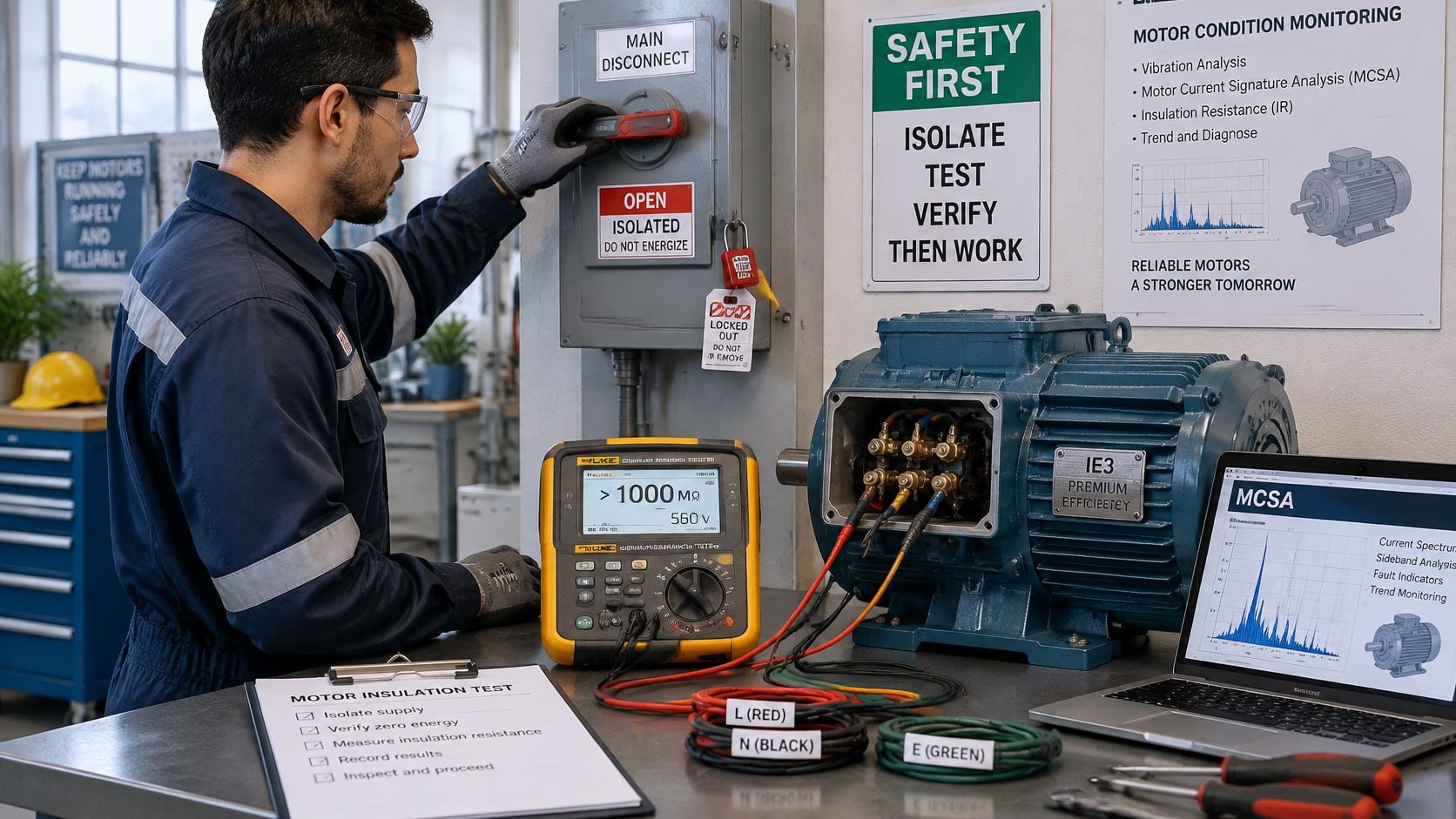
Document test voltage, winding temperature, humidity, and the isolated circuit boundaries. Compare equivalent measurements and investigate deterioration before a low limit is reached. A disciplined motor insulation-resistance testing procedure prevents a wet cable from becoming an unnecessary motor rewind.
Distinguish winding resistance from current signatures
Winding resistance measures the conductor circuit, not insulation leakage. Use a low-resistance ohmmeter with suitable lead compensation, compare phases, and account for winding temperature before interpreting a rise as overheating, a poor connection, or undersized rewind wire.
Motor current signature analysis, or MCSA, evaluates frequency components in operating current. Rotor-bar defects can produce sidebands, frequency components beside the main supply component, whose interpretation requires operating load, speed, and motor characteristics.
Online current measurements require qualified personnel and approved energized-work controls. Significant current unbalance with balanced voltage points toward winding defects, connections, or rotor-cage damage and warrants electrical investigation before assuming mechanical overload.
For the fan, plant staff should retain voltage, phase current, winding resistance, and operating load together. No single pass/fail result justifies condemning the winding.
Shaft Voltage on VFD-Driven Motors
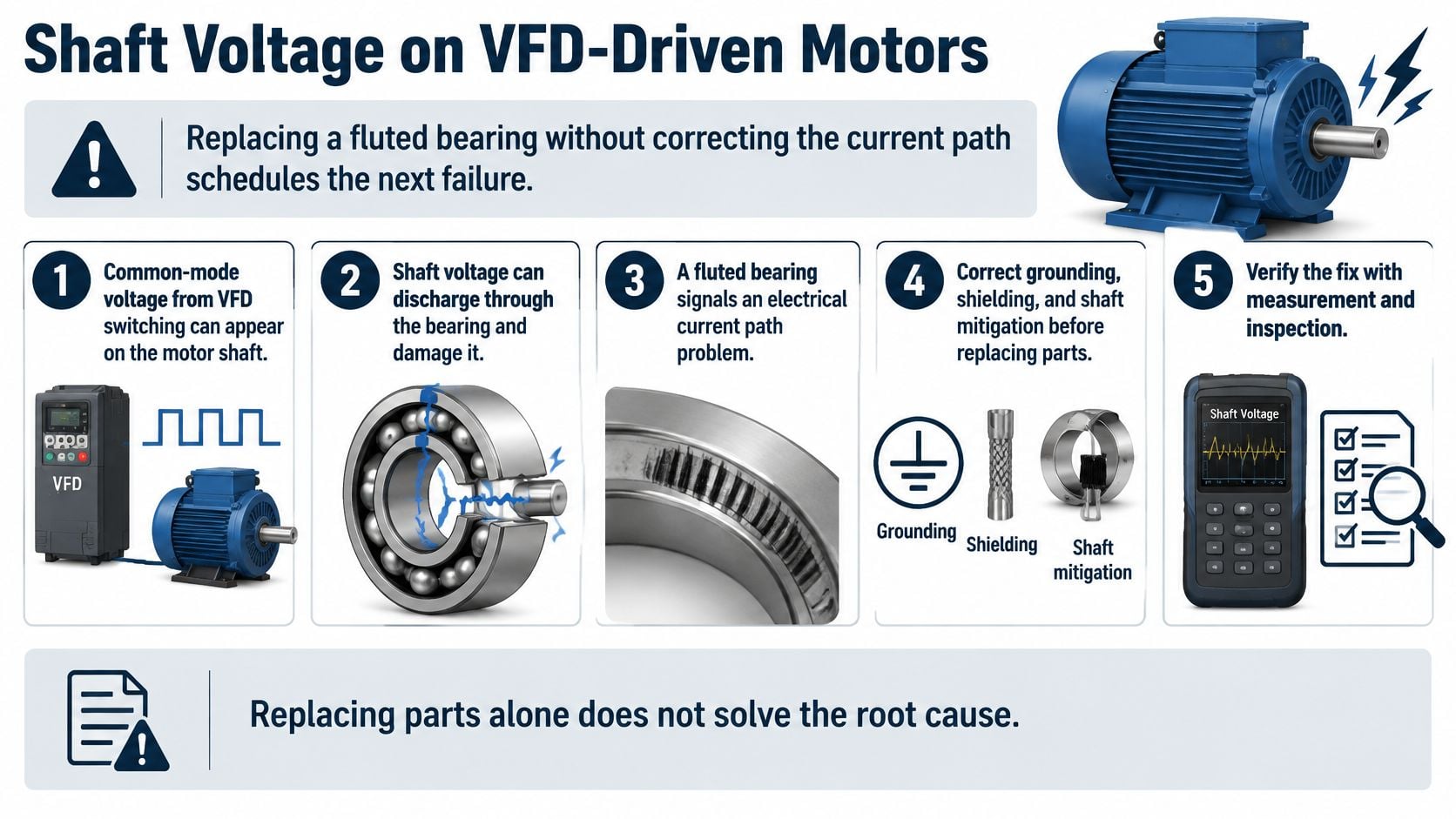
Replacing a fluted bearing without correcting its electrical current path can schedule the next failure. A fresh bearing doesn't remove the mechanism that damaged the previous one.
VFD switching can create common-mode voltage, a voltage component shared by the drive outputs relative to ground. As described in Malloy Electric's motor-troubleshooting guidance, discharge through the bearing can cause electrical discharge machining, or EDM, damage, including pitting and fluting, followed by noise, heat, and vibration.
Diagnose the path before choosing the replacement
Record the drive installation. Capture motor size, cable length, grounding and shielding arrangement, drive topology, switching settings, and whether the drive was original equipment or a retrofit. Drive topology means the electrical arrangement used to generate the output waveform.
Inspect the failed bearing under magnification. Distinguish electrical erosion from lubrication distress and brinelling, permanent raceway indentations caused by loading or impact. Preserve photographs and the bearing itself when the cause remains uncertain.
Measure shaft voltage and grounding continuity. Qualified personnel should use suitable high-frequency measurement equipment and safe access arrangements with the drive operating under representative switching conditions. An ordinary continuity result alone doesn't establish high-frequency effectiveness.
Verify the installed mitigation. A grounding ring needs an effective conductive path; an insulated bearing needs verified isolation; filters, shielding, and grounding need correct installation. These devices serve different purposes and aren't interchangeable fixes.
Then finalize the bearing, lubrication, and alignment work. Replacement remains necessary when damage warrants it, but electrical correction belongs in the repair scope before release.
Treat comparison motors as evidence, not proof
On pumps, fans, conveyors, mixers, and extruders retrofitted with drives, a comparable direct-on-line motor, connected directly to the supply without a speed-controlling drive, can provide useful context. If only the drive-fed unit develops fluting, electrical investigation takes priority over another grease adjustment.
That comparison isn't conclusive unless load, bearings, mounting, and environment are also considered. Vibration can identify bearing damage without proving its electrical origin, and an ordinary current signature doesn't rule out bearing discharge.
Retain shaft-voltage waveforms, grounding measurements, bearing photographs, and mitigation details in the motor file. Verification after correction matters more than the presence of a grounding component on the purchase order.
Failure Patterns and Post-Repair Proof
The symptom should determine the next diagnostic action, not the trade assigned to the first work order.
Motor symptoms, likely causes, and the next action
| Symptom | Likely cause | Next action |
|---|---|---|
| Vibration up with bearing temperature | Lubrication, bearing damage, looseness, or misalignment | Confirm the mode before adding grease; then correct fit, lubrication, or alignment |
| Winding resistance above baseline | Overheating or undersized rewind wire | Compare temperature-corrected phases; evaluate derating, repair, or replacement |
| Current unbalance with balanced voltage | Winding defect, bad connection, or rotor-cage damage | Compare phases and run MCSA before mechanical teardown |
| Insulation resistance falling | Moisture, contamination, age, or cable and starter leakage | Isolate sections; don't condemn the motor from one reading |
| Fluted bearing only on a VFD motor | Electrical discharge from common-mode voltage | Perform shaft-voltage and grounding tests, not only bearing replacement |
| Repeat failure soon after preventive maintenance | Contamination, excess grease, or missed soft foot | Suspend the automatic task pending work-method review |
Make acceptance a release gate
The DOE post-maintenance testing standard recommends resistance, rotation, vibration, bearing-temperature, and current checks after maintenance. Any corrective repair, or preventive task capable of changing performance, needs a documented acceptance sequence.
- Record electrical test results. Capture insulation and winding resistance, plus polarization index where applicable. Polarization index compares insulation resistance over a timed test; a high-voltage dielectric test belongs only where the approved program requires it.
- Verify phase relationship and rotation direction using a safe procedure appropriate to the driven equipment.
- Run at representative operating conditions. Listen for abnormal noise; an unloaded workshop run doesn't reproduce the installed duty.
- Capture baseline vibration promptly after reassembly and controlled startup.
- Record bearing temperatures after a defined operating period at documented load.
- Measure starting and running current on each phase.
- Verify lubrication and cooling. Confirm grease type and quantity or oil level, as applicable, and inspect cooling-air filters.
Compare results with the motor's own baseline as well as applicable acceptance limits. Keep nameplate information, repair scope, test records, and maintenance history together.
Release gate: Testing only the repaired component isn't enough. The installed motor and driven equipment must demonstrate acceptable operation together.
Skipping phase-current comparison, accepting only a no-load run, or delaying vibration capture can leave reversed rotation, incorrect bearing installation, soft foot, or phase imbalance undetected.
For facilities also managing light-vehicle fleets, Solana EV's guide to compare motors for golf carts addresses that separate replacement context. Industrial acceptance still requires proof under the actual process duty, not just a compatible replacement label.
Request a Free Reliability Assessment
A fan that can stop a paper machine needs a monitoring decision tied to production exposure. The same applies to a chemical-transfer motor or wastewater lift-station drive whose loss removes the operating train.
The practical next step is a ranked motor population: which assets need continuous monitoring, which belong on a periodic route, and which can safely remain on basic inspections. That ranking should account for available redundancy, warning time, access restrictions, and the plant's ability to respond.
Prepare evidence for the review
- Nameplate and duty information: Include driven equipment, speed range, operating environment, and drive configuration.
- Work-order history: Bring the last year's repairs, lubrication tasks, repeat failures, and changes in operating load.
- Condition records: Include vibration trends, insulation-test results, thermal images, grease or oil evidence, and unresolved alarms.
A no-cost assessment can establish where outside diagnostic support is needed and where existing plant routes are adequate. Failure-mode analysis, meaning systematic identification of how an asset can fail and what follows, helps turn that evidence into defensible intervals.
Maintain the motors that can stop the plant, and prove each repair before it goes back online.
Forge Reliability offers a free reliability assessment to rank critical motors and identify suitable route-based or continuous monitoring using vibration, thermography, ultrasound, lubricant evidence, and motor-current analysis, with shaft-voltage checks where needed. Plant teams can visit Forge Reliability to request the assessment and bring their motor list, recent work orders, and condition trends for an evidence-based maintenance review.