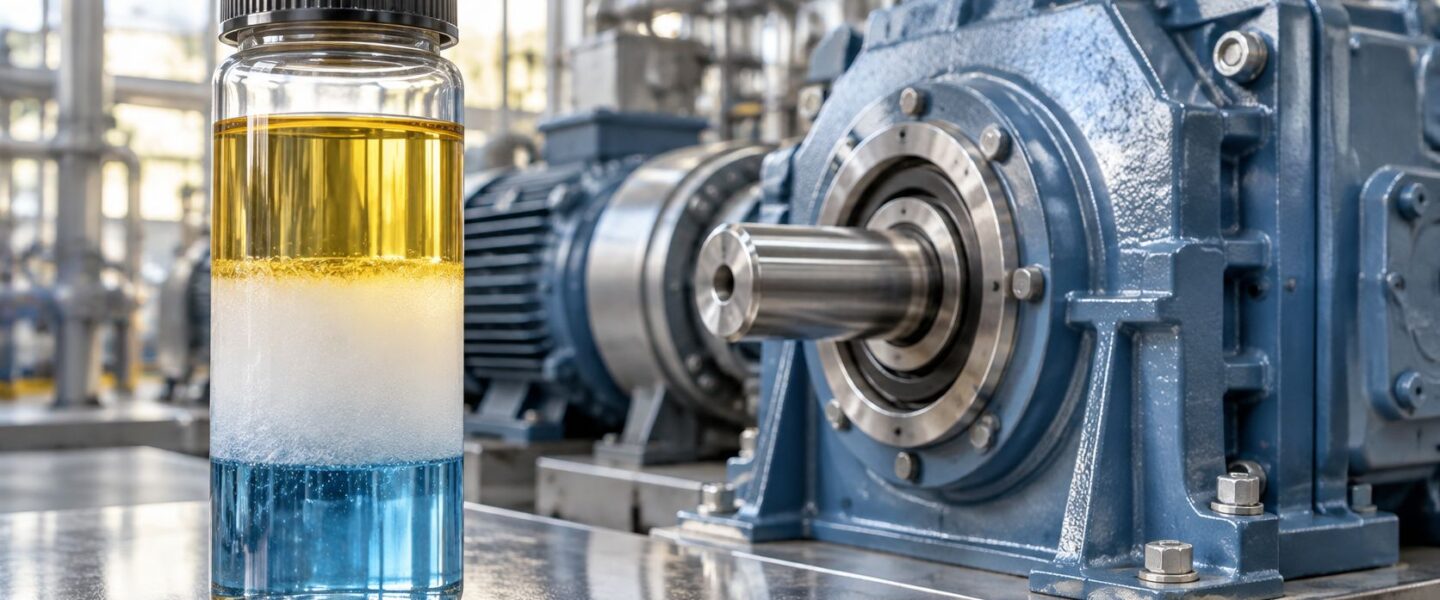
Water and oil do not form one liquid. Fresh water sits near 1.00 g/cm³, and a documented light hydrocarbon phase measured 0.776 g/cm³ beside water at 0.998 g/cm³, so free water can settle, yet dissolved, emulsified, and free water still damage lubricated machines.
The popular shop line is "they don't mix, so drain what you see and keep running." That line fails the assets that lose availability. A food-plant gearbox after hose-down can show a puddle, a haze, and clear oil that is still wet. A bearing housing that never gets hot enough to drive moisture off will hold water the sight glass never flags. A sharp interface is not a dryness certificate. The work order has to name the water state, put a number on it, and pick a removal tool that matches that state. A low-point drain, a dehydrator, and an oil change are not substitutes for one another.
Table of Contents
- Can Water Mix with Oil or Only Separate
- How Water Enters Gearboxes Pumps and Reservoirs
- What Water Does to Bearings Gears and Seals
- Tests That Quantify Water Oil Color Misses
- How Much Water in Oil Cuts Bearing Life
- How to Remove Free and Emulsified Water
- Set Water Limits and Request an Assessment
Can Water Mix with Oil or Only Separate
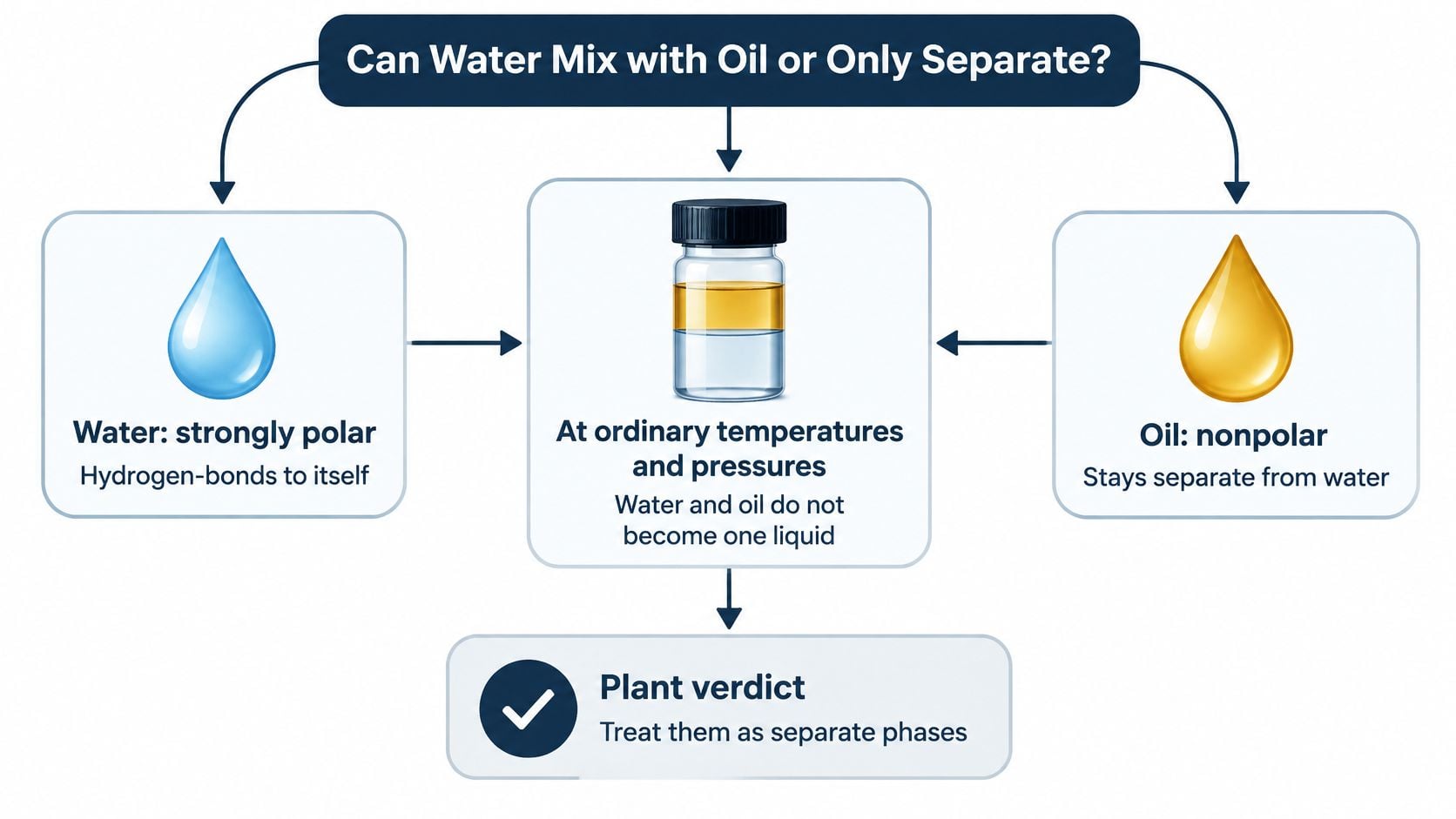
At ordinary temperatures and pressures, water and mineral oil do not become one liquid. Water molecules are strongly polar and hydrogen-bond with one another. Most petroleum oils, and most PAOs, are largely nonpolar hydrocarbons, so the liquids meet at an interface instead of blending molecule by molecule.
Density makes the split visible once droplets coalesce. A KRÜSS application report on an immiscible water-oil system lists a cyclohexane-water pair with the light oil phase at 0.776 g/cm³ and the water phase at 0.998 g/cm³. Oil rises and water settles. That report also notes that mutual solubility is small but real, and that the IUPAC-NIST Solubility Database compiles those liquid-liquid data. Temperature, pressure, salinity, and aromatic content all shift how much of each liquid the other can hold.
A bright line in a reservoir is therefore not proof the circulating charge is dry. Dissolved water still changes viscosity, promotes corrosion, and speeds additive depletion in pumps, gearboxes, compressors, and hydraulic systems. Karl Fischer testing, a crackle screen, or an online oil-quality sensor is what tells you whether the "dry" layer is actually dry.
Three states that set the work order
Dissolved water is below saturation. The oil stays clear while ppm still climbs with humidity or temperature, and the film still gets thinner.
Emulsified water is droplets held up by shear, dirt, soaps, or spent additives. The oil looks stable and milky, and it often will not clear on the bench.
Free water is a separate phase at a low point. A petcock or sight glass shows it, and a drain takes that layer only.
Say a food-plant gearbox comes back from weekend washdown. A puddle sits in the sump, the return line is hazy, and the clear portion still carries dissolved water the eye misses. Classify the state before anyone picks a drain, a dehydrator, or a change-out.
| State | Appearance | Plant clue | First action |
|---|---|---|---|
| Dissolved | Clear oil | Below saturation while ppm still rises with humidity or temperature | Trend Karl Fischer and stop ingress |
| Emulsified | Stable haze or milky oil | Does not clear after 30 to 60 minutes standing | Dehydrate and find shear, dirt, or surfactant |
| Free | Layer or puddle at the low point | Drains from a petcock or shows in the sight glass | Drain, then retest the circulating oil |
Plant verdict: Treat water and oil as separate phases, then name which of the three states is actually in the circuit.
How Water Enters Gearboxes Pumps and Reservoirs
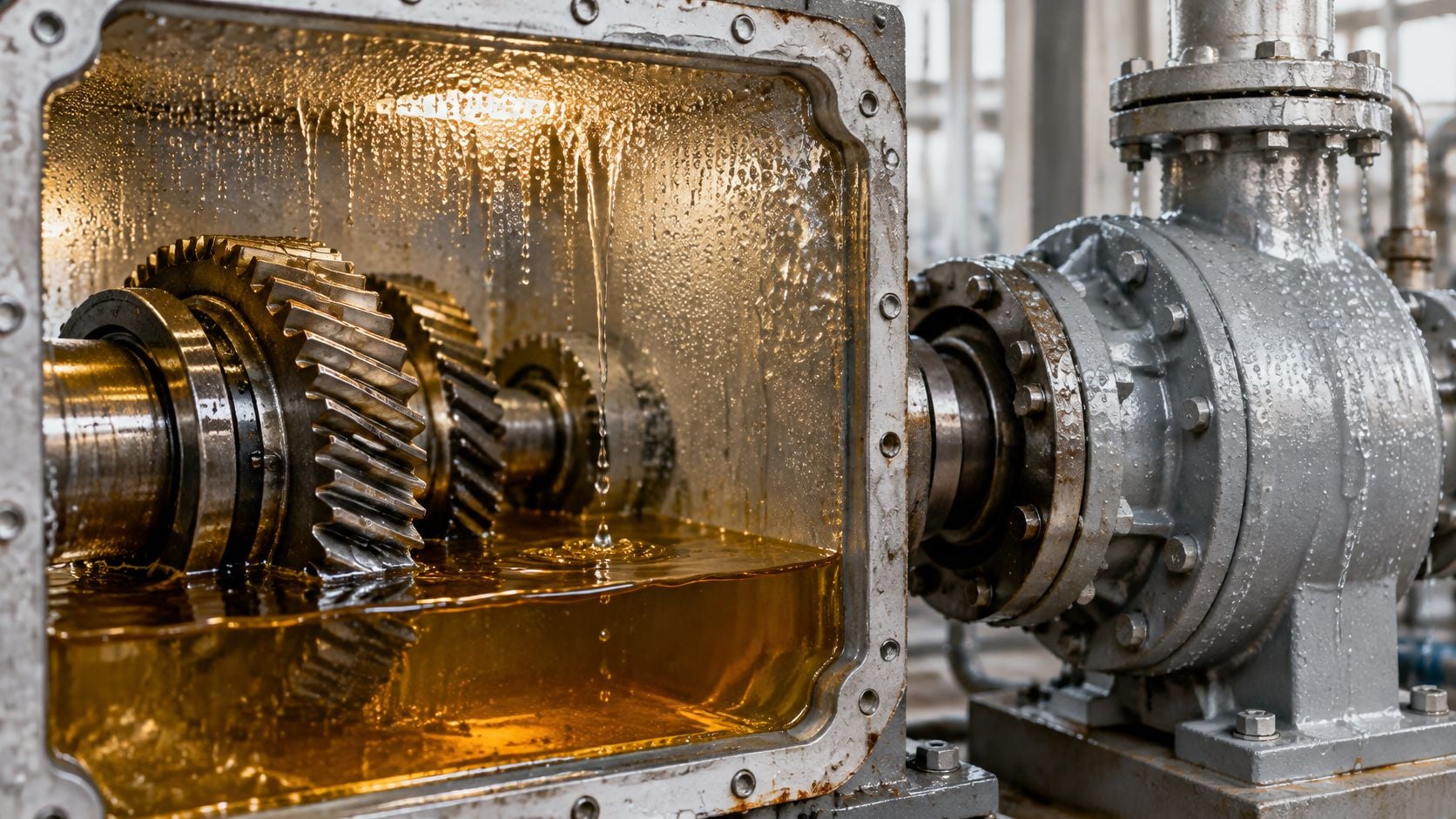
Water reaches oil through a short list of plant paths. Naming the path matters more than blaming the lubricant brand. The U.S. Bureau of Reclamation's bearing-lubrication guidance.pdf) notes that bearing oils should readily separate from water because housings often do not run hot enough to evaporate it. Warm humid air condenses on tank walls and inside housings as a machine cools. That condensate does not leave on its own.
Walk the paths in inspection order
Check the easy openings first, then the parts that need a shutdown.
- Breathers and hatches: A cracked breather, a missing desiccant cartridge, or a loose fill cap is the usual washdown route on a food and beverage gearbox. Spray hits the vent and the next sample is wet. A practical gearbox walkdown is laid out in this industrial gearbox inspection and lubrication guide.
- Shaft seals: On a centrifugal process pump, a failed mechanical seal lets process fluid or wash water into the bearing housing. Look for wet stain at the seal drain and oil level that climbed with no top-up.
- Cooler tubes: A leaking oil-cooler tube puts cooling water straight into the charge. That path keeps feeding water after the breather is perfect.
- Shutdown condensation: A turbine or pump bearing reservoir that sits cold overnight sweats. Hazy oil on a Monday start is a reason to test, not a reason to keep running.
- Storage and transfer: Outdoor drums, open transfer cans, and wet totes add water before the machine turns. Steam leaks around paper machines and chemical pumps do the same at the skid.
Gear mesh, pump recirculation, and a control-valve pressure drop then turn a drainable puddle into a stable haze. Agitation and surfactants disperse droplets so they circulate through bearings, gears, and hydraulic valves instead of settling in the sump.
Close the path in the same week you dry the oil, or the next sample will match this one.
A hazy turbine or pump reservoir should trigger confirmation testing rather than another week of operation. The crackle test can show that water is present. It cannot tell you how much. Follow it with laboratory Karl Fischer, drain the low points, and identify the ingress path before anyone replaces the oil alone.
What Water Does to Bearings Gears and Seals
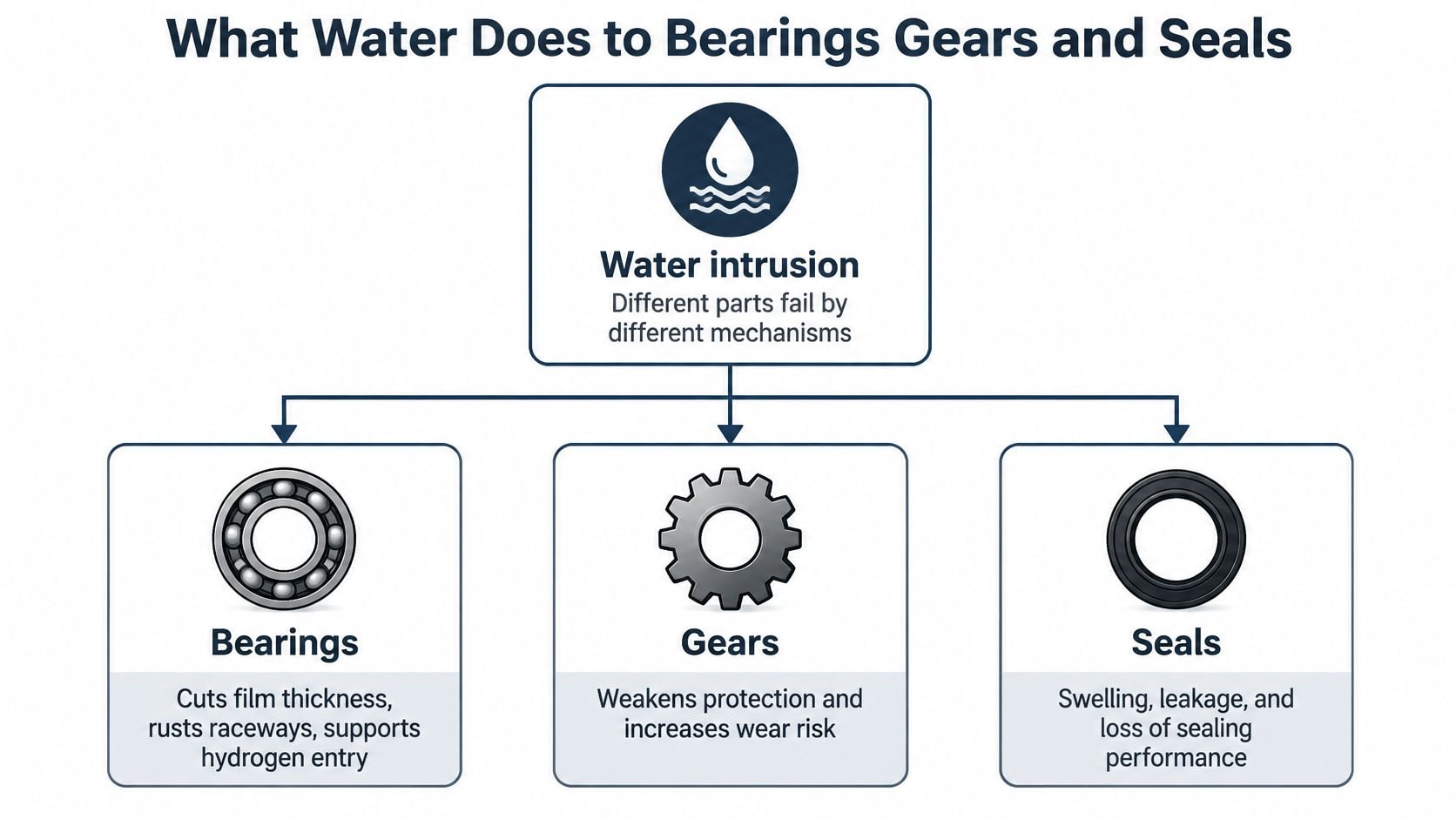
Water does not fail every part the same way, so the work order should name the part at risk. Film loss, rust, and hydrogen-assisted cracking hit rolling bearings. Washed-out additives and hotter tooth contact hit gears. A damaged elastomer or a rusted shaft turns a seal into a new leak.
Bearings
In a rolling bearing, water cuts lubricant-film thickness under high contact stress. Raceways rust. Water also supports hydrogen entry into the steel, which speeds subsurface cracks, micropitting, and spalling. A paper-machine dryer gearbox can keep turning while that fatigue life is spent. Vibration, bearing temperature, and ferrous debris should be read with the water result so pitting is planned into the next outage instead of found in a wreck. Interpreting those parts together is the point of a structured bearing, gear, and seal failure analysis.
Gears and seals
Gear teeth see the same thin film, plus antiwear and extreme-pressure additives that water has started to strip. Teeth rust, run hotter, and pit. At the seal, rust on the shaft and swell or shrink of a water-sensitive elastomer open a leak that admits still more water. That loop is why a "small weep" after a wet sample is not a housekeeping item.
What the hydraulic circuit shows first
A review of lubrication-system varnish reports that contamination and degraded products can plug filters, make hydraulic valves or fuel-injection pumps stick, obstruct flow passages, reduce clearances, and raise friction and wear. An emulsion is worse because pumps, gears, and bearings keep the droplets dispersed, so settling does nothing.
On a hydraulic power unit for an injection-molding machine, that shows up as unstable valve response, climbing filter differential pressure, corroded servos, and poor shot repeatability, often before the pump fails. In oil-filled transformers and oil-lubricated motor bearings, the same moisture lowers dielectric strength and insulation resistance well before a mechanical alarm.
Let a representative sample stand, watch whether it clears, and back that look with water content and demulsibility. Review filter differential pressure, reservoir temperature, valve response, pump noise, and particle count together. If the oil will not release water, plan dehydration or a controlled change-out, not a drain-and-fill. Then check cooler leaks, condensation, washdown, open hatches, the breather, and seal condition.
Tests That Quantify Water Oil Color Misses
Sight and a crackle test only prove that some water is present. They do not tell a reliability engineer whether the asset is inside its limit.
From a pop on a hot plate to a number
On a hot plate, free or emulsified water pops as it flashes off. Dissolved water at levels that already cut bearing life often stays silent. The test never returns a ppm.
Coulometric Karl Fischer, commonly run as ASTM D6304, is the lab method that resolves the low hundreds of ppm. Volumetric Karl Fischer fits very wet samples that would exhaust a coulometric cell. Ask which method was used and what the detection limit was before you accept a zero. A reported zero with a detection limit of several hundred ppm is not a clean bill.
| Method | What it returns | Strength | Limit |
|---|---|---|---|
| Crackle test | Yes or no for water | Fast on a hot plate | No number; dissolved water often stays silent |
| Volumetric Karl Fischer | Quantitative water in very wet samples | Handles high water content | Less suited to trace levels |
| Standing sample, 30 to 60 minutes | Free water versus stable emulsion | Visual and field-ready | Qualitative only |
| Patch test | Staining and debris | Quick check for particles | Not a water measurement |
| Oil analysis report | Karl Fischer ppm with viscosity, acid number, demulsibility, ISO 4406, and ferrous density | Context for the decision | Useless if the method and detection limit are missing |
How to read one bottle
Draw from the live zone at operating temperature, not from a dead drain leg. Record oil temperature and time since shutdown. Set a clear bottle aside for 30 to 60 minutes.
- Clears with a bottom layer: That is free water. Drain the low point, then retest what is still circulating.
- Haze that remains: That is a stable emulsion. Settling will not finish the job.
- Stays clear: You still need the Karl Fischer number. Clear oil can be over the alarm.
On the report, read water beside viscosity at 40°C, acid number, demulsibility, ISO 4406 particle count, and ferrous density. A patch or membrane can show staining and debris. It is not a water measurement. Sample practice for that live-zone draw is covered in this oil sampling and analysis note. Act on the Karl Fischer number against the asset limit, not on the color of yesterday's bottle.
How Much Water in Oil Cuts Bearing Life
Turn the water-state result into a run-or-stop number. Many mineral-oil programs use roughly 100 to 200 ppm as a working control band. The governing limit is still the one on the lubricant data sheet and the bearing or gear builder's note, because esters, PAGs, and phosphate esters hold and shed water differently.
A peer-reviewed tribology study found that oil with as little as 0.01% water cut rolling-contact-fatigue life by about 32% to 48% under high-pressure contact, as reported in Mechanics & Industry. A technical lubrication note ties about 400 ppm (0.04% water) to as much as a 44% loss in tapered-roller-bearing fatigue life versus dry oil, and it gives that 100 to 200 ppm control range for many lubricants, in Extending Pump Life Through Precision Lubrication. A widely cited lubrication-failure summary on Reliabilityweb reports that even 1,000 ppm water in oil can reduce bearing life by 75%, and that particles compound the loss.
| Level | What reports show | What to do |
|---|---|---|
| About 100 ppm (0.01%) | Rolling-contact life cut about 32 to 48 percent in high-stress tests | Treat as an alarm, not a clean bill |
| 100 to 200 ppm | Practical control band for many industrial oils | Hold the trend and confirm OEM and lubricant limits |
| About 400 ppm (0.04%) | Tapered-roller fatigue life down by up to 44 percent | Find the leak and plan dehydration |
| About 1,000 ppm | Bearing life reported down about 75 percent, and particles worsen it | Do not dilute; remove water and inspect |
One gearbox, one response band
Saturation rises with oil temperature, so a gearbox that looks clear while it is hot can throw free water and haze after a weekend cooldown. Sample a steel-mill pinion gearbox from the active return line, not a drained dead leg, so the reading matches what the bearings see. Combined contact on that pinion is harsher when radial and axial load share the same raceway, which is why a "small" water number is not a free pass.
At the alarm band, start the ingress check and keep the trend. Around the 400 ppm band, find the leak and schedule dehydration. At the 1,000 ppm band, do not top up with new oil to dilute the result. Remove the water and inspect for corrosion or micropitting. Dissolved water can be invisible, emulsified water looks hazy, and free water sits at the bottom. None of those looks is a life calculation. Pumps, gearboxes, turbines, hydraulics, and compressors that run continuously turn a small leak into an unplanned outage.
How to Remove Free and Emulsified Water
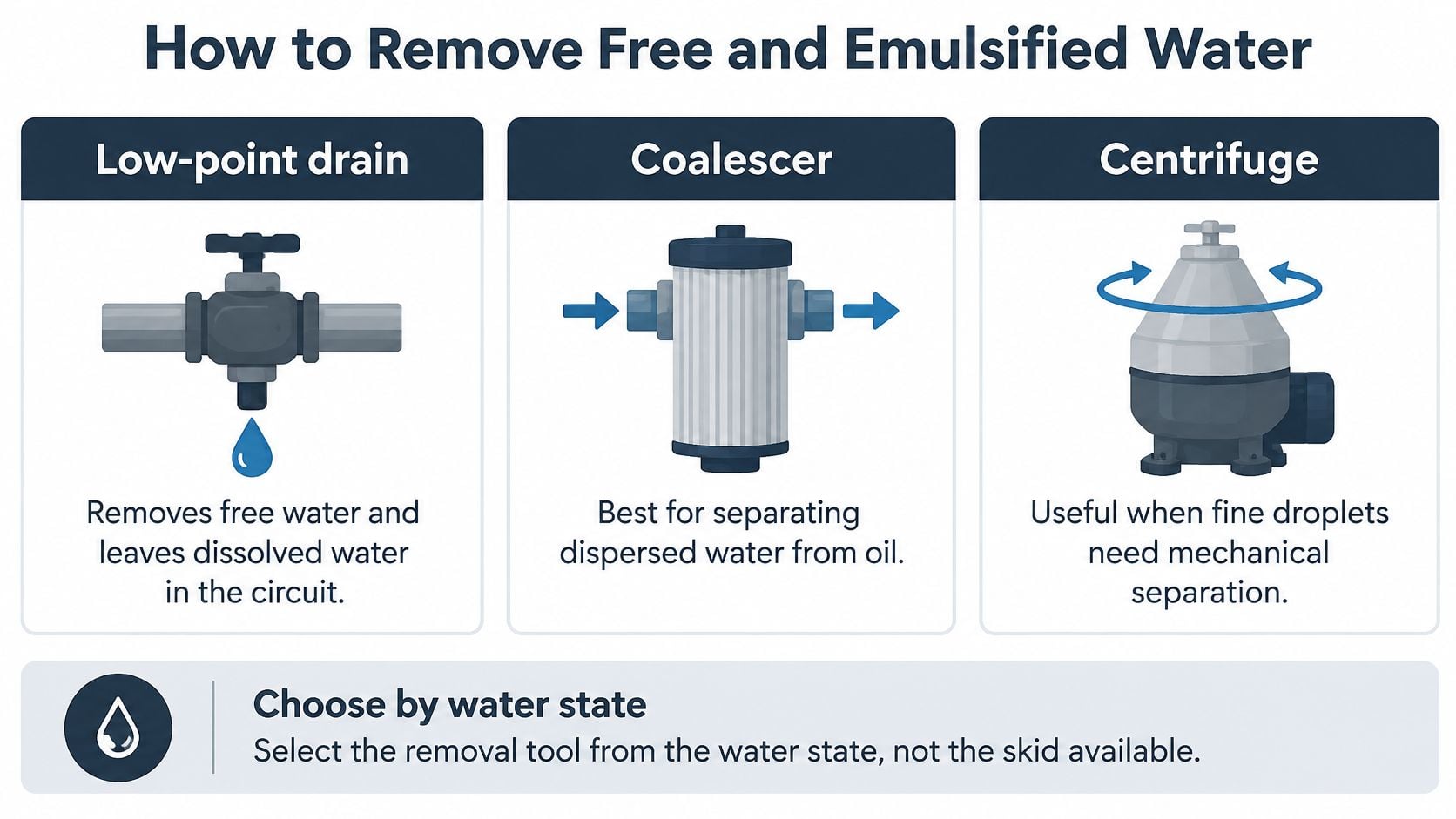
Choose the removal tool from the water state, not from whichever skid is parked in the shop. A centrifuge that suits a large turbine reservoir is the wrong first tool for dissolved water in a small food-plant gearbox.
Where each method stops working
A low-point drain takes free water and leaves dissolved water in the circuit. It also leaves a tight emulsion untouched. Use it when a real layer is visible, then retest the oil that is still moving.
Coalescers and centrifuges merge droplets that are still large enough to release, and only if the oil will give the water up. Stable haze from very fine droplets, and some high-detergency fluids, go straight through. They fit large reservoirs that still demulsify.
Vacuum dehydration warms the oil under vacuum so dissolved and emulsified water leave without a full-temperature cook of the whole charge. Check the additive package and the synthetic type with the dehydrator supplier before a multi-day run. It fails when ingress is faster than the unit, or when the additive system is not compatible.
Desiccant breathers and dry-air blankets block humid air at the vent. They do not rescue a reservoir that is already full of water. Put one on every vented reservoir as prevention, including the vents on lubrication systems that feed several machines from one tank.
A kidney-loop filter is for the particles water helped create, after the water itself is gone. It is not a dryer.
| Method | Water it removes | When it fails | Best fit |
|---|---|---|---|
| Low-point drain | Free water only | Dissolved water and tight emulsions remain | Sumps with a real low-point layer |
| Coalescer or centrifuge | Free water and loose droplets | Stable sub-micrometre emulsions and some detergent oils | Large reservoirs that still demulsify |
| Vacuum dehydration | Dissolved and emulsified water | Incompatible additives or ingress faster than the unit | Gearboxes, turbines, and hydraulics above the limit |
| Desiccant breather | Humid air before it condenses | Will not dry a sump that is already very wet | Every vented reservoir as prevention |
| Oil change | All states if the charge is replaced | New oil wets again if the path stays open | Failed demulsibility or depleted additives |
Change the charge when acid number has climbed, antiwear additive is gone, demulsibility has failed, or the emulsion will not break. New oil poured into an open path is a temporary color change. Resample by Karl Fischer before the job is signed off, and look for rust or micropitting if the asset ran wet.
A drain on a milky gearbox and a dehydrator on a sump that only needed a petcock are both wasted outages.
Set Water Limits and Request an Assessment
Set a water limit for each critical asset. A plant-wide slogan hides the gearbox that should alarm at a much lower number than a large turbine reservoir. Take the number from the lubricant data sheet and the equipment builder's note, and enter it as the alarm on every oil report.
High shear is why a single slogan fails. A chemical-engineering study of water-in-oil emulsions notes that droplets below approximately 1 micrometre are especially hard to separate by gravity, because Brownian and colloidal forces can dominate settling. Pump recirculation, control-valve pressure drop, and mixing zones can turn drainable free water into a persistent dispersion. A milky sample needs confirmation and a root-cause look, not dilution or a blind oil change.
When the sample is over the limit
- Resample the active oil zone at operating temperature and record time since shutdown.
- Confirm the number with coulometric Karl Fischer and note the detection limit.
- Name the state. Drain free water from the low point. Dehydrate dissolved or emulsified water. Do not top up with new oil.
- Inspect the entry path in order: breathers, hatches, shaft seals, cooler tubes, condensation after shutdown, and washdown exposure.
- Close the path, dry the charge, and resample after the next operating cycle. The trend should flatten.
Sample monthly on gearboxes, turbines, hydraulics, and compressors that cannot stop, and again after washdown season, cooler repair, or a seal change. Trend water with viscosity, ferrous debris, and vibration so a climb becomes a work order before the bearing is the work order.
Food and beverage plants should put breathers and shaft seals first. Chemical, wastewater, and pulp sites should put mechanical seals and cooler tubes first. Power generation should keep large reservoirs on vacuum dehydration plus desiccant breathers. If the trend will not flatten after that fifth step, Forge Reliability can review the oil results with vibration and condition-monitoring data and set asset-specific limits through a free reliability assessment.
Forge Reliability helps plant teams turn water-in-oil results into asset-specific alarms, sampling practice, and removal choices for gearboxes, pumps, hydraulics, and turbines. If a wet trend will not flatten after the leak path is closed, a free reliability assessment is the practical next step. Visit Forge Reliability to request that assessment.