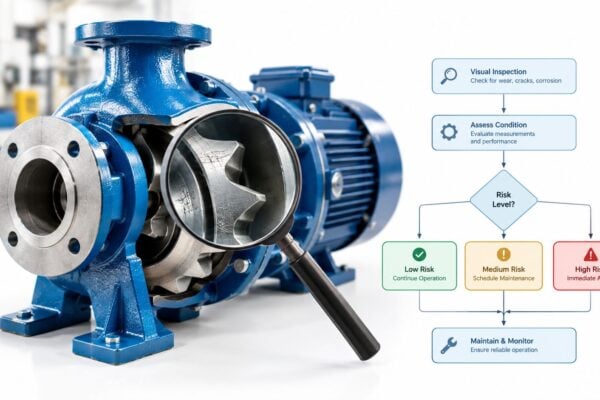
A pump trips at 2:17 a.m. The vibration route had shown a rising trend for weeks, but the CMMS history sat under three naming conventions, two failure code lists, and a stack of half-complete work orders. The warning existed. The plant could not trust the record set fast enough to act on it.
That scenario sits behind a large share of data governance work in industrial plants. Reliability teams need asset identities they can trust, failure history that stays usable over time, condition-monitoring data tied to the correct equipment, and controls that block bad records without slowing urgent maintenance. When those controls are weak, bearing wear gets missed, lubrication problems hide inside vague work-order text, root cause analysis loses traction, and planners chase the wrong failure mode.
In practice, bad governance rarely looks dramatic at first. It shows up as duplicate assets, mismatched meter readings, failure codes no one uses consistently, and alerts from condition monitoring that never connect cleanly to a work order. Then the cost appears during an outage, a repeat failure, or a planning meeting where nobody agrees on what happened last time.
Teams that want a stronger foundation for CMMS asset management and reliability workflows usually do not need more policy documents. They need operating rules that fit maintenance reality. A valve tech closing a corrective work order at shift change will not tolerate five extra screens. A planner trying to compare motor failures across sites needs naming and coding that survive personnel changes, software upgrades, and contractor turnover.
This article focuses on nine practices that connect core data governance to CMMS execution and condition monitoring in a way reliability teams can use. The examples span multiple industries and stay tied to return on investment. Less wasted wrench time, faster fault recognition, cleaner failure history, and better uptime decisions on pumps, motors, gearboxes, compressors, and other critical assets.
Table of Contents
- 1. Establish a Centralized CMMS Data Dictionary and Taxonomy
- 2. Implement Data Quality Governance with Automated Validation Rules
- 3. Define Data Ownership and Stewardship Roles with Clear Accountability
- 4. Establish Real-Time Data Integration Between Condition Monitoring Tools and CMMS
- 5. Implement Asset Criticality Ranking with Risk-Based Data Retention Policies
- 6. Establish Baseline and Trending Protocols with Statistical Control Limits
- 7. CMMS Taxonomy Rollout Plan Pilot Approach
- 8. Validation Rule Design and Tuning Best Practices
- 9. Integration Prioritization and Data Transformation Strategy
- 9-Point CMMS Data Governance Comparison
- From Governance to Measurable Uptime Gains
1. Establish a Centralized CMMS Data Dictionary and Taxonomy
A CMMS falls apart when two technicians describe the same failure in different ways. One writes “brg fail,” another writes “bearing damage,” and a third closes the work order with “mechanical issue.” Trend analysis becomes noise, especially across multiple plants.
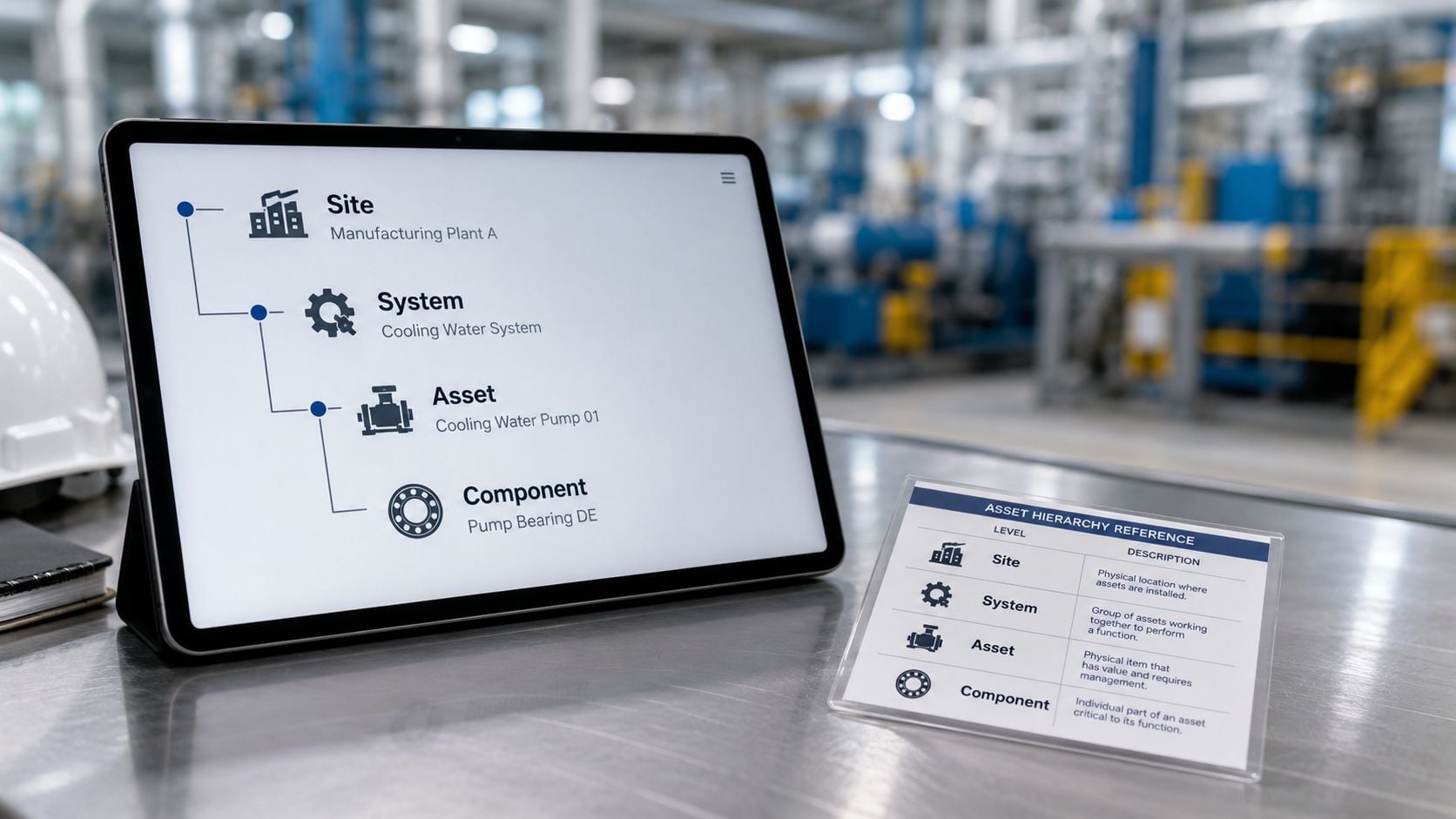
That's why the first of the best practices for data governance is a centralized dictionary. It should define asset names, equipment hierarchy, failure codes, component names, and work order closeout terms. For rotating equipment, that means standard terms for bearing wear, misalignment, cavitation, lubrication failure, seal leakage, winding insulation degradation, and similar failure modes.
A manufacturing site also needs master data standards across ERP, MES, SCADA, and IoT systems. Without that alignment, predictive maintenance breaks down because vibration or oil analysis tags can't be mapped reliably to a specific pump, compressor, or motor, which can hide early warnings for failure modes such as bearing wear or misalignment, as discussed in manufacturing data governance guidance.
Why taxonomy matters on real equipment
Consider a wastewater plant with six similar centrifugal pumps. If the suction recirculation failures on Pump P-201 are coded as hydraulic issues at one site and bearing issues at another, the engineering team won't see the pattern that points back to system design and low-flow operation.
A clean taxonomy fixes that. It lets planners compare failure history across units, connect condition-monitoring alarms to the same fault family, and benchmark maintenance intervals without arguing over naming.
Practical rule: Standardize the top twenty percent of asset classes first. Pumps, motors, gearboxes, compressors, and VFD-driven assets usually produce most of the useful reliability history.
What good rollout looks like
The rollout should start with a field audit, not a conference room debate. Pull the highest-frequency asset types, compare how technicians currently describe them, and build the first version from real work order language. Frontline technicians need to help shape the terms or the taxonomy won't survive first contact with the shop floor.
Useful support tools are simple:
- Visual hierarchy guides: Post laminated asset trees and failure-code references at maintenance desks and lube rooms.
- QR-linked definitions: Give technicians one-scan access to naming standards and closeout examples.
- Mapped CMMS structures: Align the hierarchy with practical CMMS asset management workflows so planners and reliability engineers use the same structure.
Quarterly audits keep the taxonomy alive. If a plant sees free-text drift returning, that's usually a training problem, a workflow design problem, or both.
2. Implement Data Quality Governance with Automated Validation Rules
A compressor throws a high-vibration alarm at 2:10 a.m. The route technician entered the reading under the standby unit, the work order closed without a problem code, and the oil lab sample arrived with a date that does not match the outage window. By the time a reliability engineer reviews the event, the plant has three systems describing three different versions of the same failure.
That is how bad governance shows up in maintenance. It rarely starts with a dramatic system outage. It starts with small entry errors that distort condition trends, delay root cause work, and weaken the CMMS history teams rely on for repair and replacement decisions.
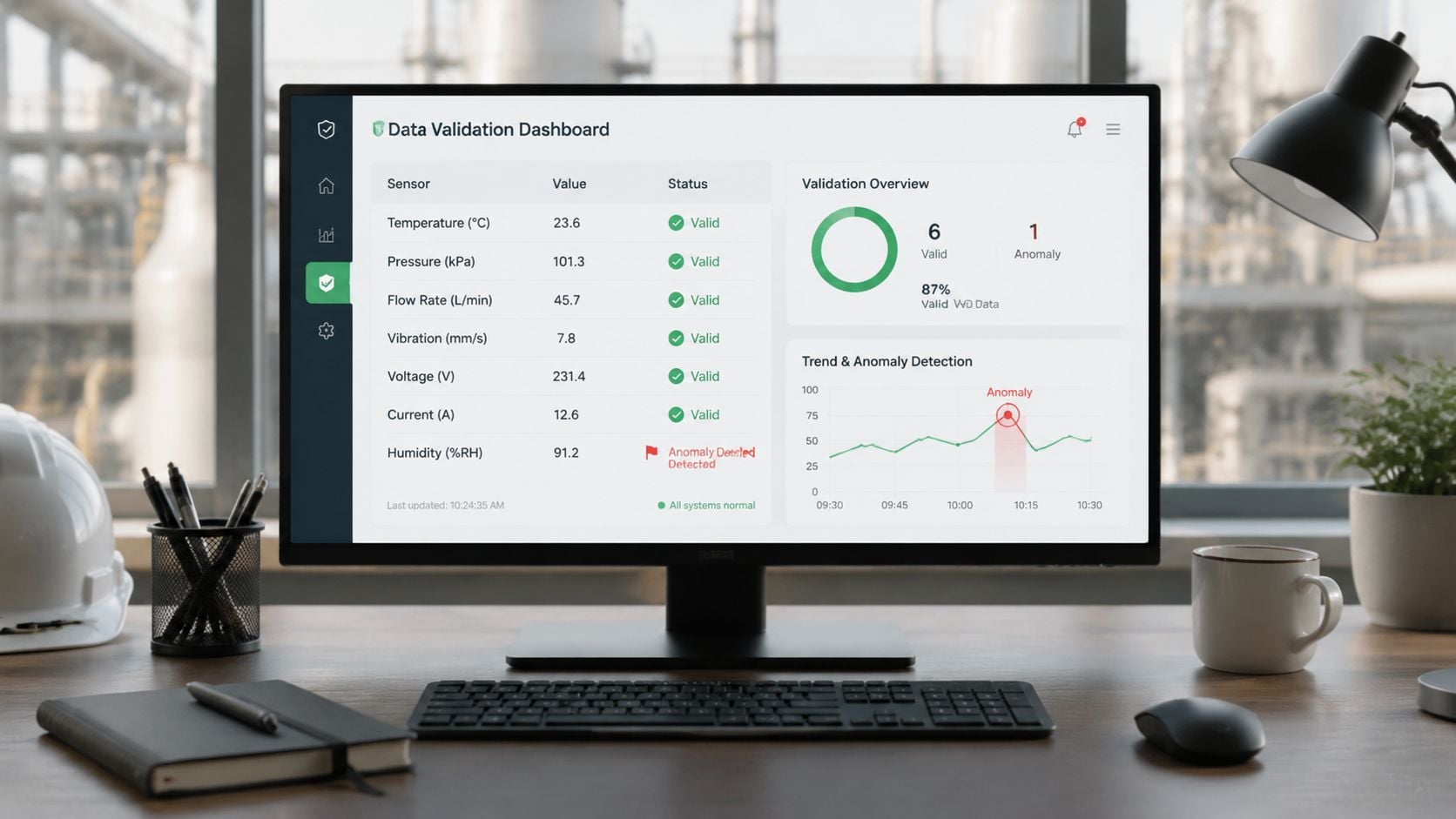
Automated validation rules reduce that drift by checking records for completeness, sequence, value range, and logical consistency before those records drive planning or analysis. Industry guidance from DAMA on data management and data quality controls aligns with that shift toward defined controls and repeatable quality checks instead of ad hoc cleanup after the fact.
Catch bad data before it spreads
On a paper machine drive, a velocity reading outside the instrument's realistic range may point to a loose sensor mount, the wrong measurement point, or a unit-entry mistake. In a food plant, a lubrication record with the wrong asset ID can shift compliance history onto the wrong conveyor. In a mining operation, duplicate meter entries can make component life look better than it is.
The rule should do more than reject the record. It should flag the exception, preserve the attempted value, and guide the user toward the likely fix. That matters for ROI. Plants get more value when validation supports decisions at the point of entry and also creates a trail of recurring exception types that reliability teams can investigate. Repeated failures of the same rule often expose training gaps, route design issues, or equipment-state problems. A structured method for defining contributing factors in investigations helps teams separate bad data entry from a bad process.
Start with the checks that pay back fast
The best first rules are the ones with clear business impact and low dispute rates. Use checks such as:
- missing asset IDs on work orders tied to condition alerts
- impossible dates, including sample dates before shutdowns or failure closeout before fault detection
- duplicate meter or runtime entries
- invalid combinations between failure codes, repair codes, and asset class
- sensor readings outside known instrument or operating ranges
- required fields for critical assets, with stricter checks than noncritical support equipment
That last point matters in mixed environments. A refinery compressor train, a hospital backup generator, and a packaging line motor do not need the same rule set. Governance should follow asset risk and decision consequence, not a one-size-fits-all template.
Poorly tuned rules create their own failure mode
Plants often set thresholds too tight, then flood technicians and supervisors with warnings. People stop trusting the screen. They click through exceptions just to close the job, and the governance process turns into noise.
Test rules on historical records before turning them on for everyone. Review false positives with planners, technicians, and the reliability engineer who will use the data. In many sites, the maintenance supervisor's role in work quality and closeout discipline is what determines whether validation becomes part of the daily routine or another bypassed control.
A useful pattern is three-tier handling: block records only when the error makes the data unusable, warn when the entry is possible but suspicious, and log low-risk exceptions for trend review. That gives teams control without creating friction on every closeout.
Condition-monitoring contractors and oil labs should help set tolerances. Their field experience keeps range checks realistic when load, contamination, ambient conditions, and sample handling affect the result. Security controls matter here too. Validation rules and approval paths should support preventing data incidents in workflows, especially where outside parties submit readings or reports into the CMMS.
One practical rule set can prevent a lot of bad analysis. If a plant blocks unmatched asset IDs, requires failure coding on repeat faults, warns on impossible sequence dates, and reviews override logs weekly, the CMMS starts acting like an engineering record instead of a text box. That is the standard to aim for.
3. Define Data Ownership and Stewardship Roles with Clear Accountability
A plant can spend months cleaning CMMS records, tuning alarm limits, and standardizing condition routes, then lose the gain in one turnaround. Operations changes equipment names to match the new line layout. Maintenance adds replacement assets with local shorthand. A contractor updates monitoring points to fit the field route. Three months later, analysts cannot match a thermal alert to the right motor history, and planners are arguing over whether the fault is new or just mislabeled legacy data.
That failure starts with accountability, not software.
Data ownership has to be assigned by domain and tied to decisions people make. In reliability programs, that usually means one owner for the business rules and one steward for day-to-day control. The owner decides what the standard is, who can approve exceptions, and what happens when groups disagree. The steward keeps the records usable by reviewing changes, resolving exceptions, and making sure the field process matches the written standard.
In practice, the split should follow operational reality. A reliability engineer may own vibration and condition-monitoring standards for critical rotating equipment. A planner or maintenance supervisor may steward work order closeout fields, failure coding, and asset hierarchy updates. Lubrication data often works better with maintenance ownership and a designated lube steward, because route discipline, sample timing, and point naming are controlled on the floor, not in a meeting.
Clear ownership matters most during failure analysis. If a recurring hot connection appears in thermography inspection findings tied to motor terminal defects, someone needs authority to decide whether the issue is an electrical defect, a route definition problem, a mislabeled asset, or a threshold that no longer fits operating load. Without that named owner, the finding sits in review loops and the CMMS record keeps drifting.
A good stewardship model also accepts a trade-off. Central control improves consistency, but it can slow down legitimate changes during outages, capital projects, and major asset replacements. Site teams avoid that bottleneck by separating high-risk changes from routine ones. Renaming an asset class, deleting points, changing failure codes, or altering alarm logic should require owner approval. Correcting a typo, updating a route sequence, or fixing an obvious duplicate can sit with the steward, with a documented audit trail.
Stewardship duties should be explicit:
- Standards control: Maintain naming rules, hierarchy conventions, and required fields for the assigned domain.
- Change review: Approve or route requests for new points, deleted tags, baseline resets, and asset record changes.
- Exception handling: Investigate recurring quality issues, assign corrective actions, and close the loop with maintenance, operations, or contractors.
- Field alignment: Confirm that what technicians collect in routes, inspections, and samples still matches the CMMS structure and reporting needs.
- Access discipline: Review who can edit master data, who can override controls, and where workflow gaps create avoidable errors.
The last point gets missed often. Ownership without edit control is only paperwork. Plants that define steward responsibilities alongside access rules do a better job of preventing data incidents in workflows, especially when outside labs, PdM contractors, and site planners all touch the same records.
Use a simple RACI if the site is starting from scratch, but keep it grounded in real transactions. Who approves a new asset class after a capital project. Who can retire a tag. Who signs off on a baseline reset after a rebuild. Who reviews recurring bad actors in closeout data. If those answers are vague, accountability is still vague.
The payoff is operational, not administrative. Better ownership shortens root cause reviews, reduces duplicate records, and keeps condition data tied to the right asset history, which is where governance starts turning into uptime.
4. Establish Real-Time Data Integration Between Condition Monitoring Tools and CMMS
A late alert is often the same as no alert. If a route analyst sees rising acceleration on a pump outboard bearing but the finding sits in a separate platform until the next planning meeting, the plant loses the time window where a short outage could prevent a seized bearing and shaft damage.
Real-time integration solves the lag. Condition-monitoring systems, lab systems, and the CMMS should pass findings directly into work management with asset context, failure mode, severity, and a recommended action. That's especially important for high-speed rotating equipment where degradation can accelerate between weekly review cycles.
Speed matters when failure modes move fast
Take a process compressor with a lubrication issue. Oil analysis may point to varnish precursors or wear debris before vibration crosses a high alarm. If those systems don't connect, maintenance planners may never see the combined signal until temperature rises and the machine forces an outage.
Integrated alerts should create a work order draft or task recommendation that includes the asset ID, point location, reading date, likely fault family, and escalation path. For thermal defects, that means linking the thermographic finding to a corrective action in the CMMS, not leaving it in an isolated PDF. Plants that use thermography inspections this way shorten the path from detection to action.
Start with one path that operators trust
The best rollout doesn't start with every data source. It starts with one high-value stream on a small set of critical assets. Pumps on a boiler feed system or motors on a finishing line are good candidates because operators already understand the production risk.
A few design choices matter more than software branding:
- Map fields before connecting systems: Asset ID, component, severity, timestamp, and recommendation need consistent destinations.
- Validate before ingestion: Don't let malformed source data create junk work orders.
- Review auto-generated jobs monthly: Canceled or ignored work orders usually reveal poor thresholds or weak descriptions.
If the first integrated alerts create noise, crews will stop trusting automation. Clean mapping and conservative thresholds matter more than speed on day one.
5. Implement Asset Criticality Ranking with Risk-Based Data Retention Policies
Not every asset deserves the same level of governance effort. A standby washdown pump and a reactor agitator motor don't carry the same production, safety, or quality risk. Treating them the same creates waste and slows the team.
A risk-based model fixes that. Criticality ranking tells the plant where to invest in higher data quality standards, longer retention windows, tighter workflows, and richer condition-monitoring integration. For reliability consulting, the cross-functional piece is essential. Governance teams need IT, OT, production, quality, and maintenance involved so ownership and quality rules support criticality scores used in FMEA and RCM, helping avoid misallocation of maintenance attention while high-risk assets such as VFDs or turbines remain under-monitored, as described in manufacturing data governance for criticality decisions.
Not every asset needs the same governance burden
A plant-wide retention rule can become expensive and cluttered fast. High-criticality assets often justify long trend histories because slow degradation matters. Low-criticality assets may only need enough retained history to support warranty, recurring work identification, and spare planning.
This is also where governance needs restraint. Overly rigid policy can reduce OEE if engineers spend too much time waiting on access requests, metadata approvals, or new tag definitions. Some recent governance guidance highlights the need to quantify the cost of current gaps, but the operational drag from governance excess still isn't well measured in industrial settings, a tension discussed in DataGalaxy's governance best practices commentary.
Build the committee before the matrix
Criticality scoring works best when the plant agrees on the factors before rating equipment. Typical factors include safety impact, production loss, quality risk, maintenance cost, and detectability. The exact scoring model can vary, but the ownership of the model has to be shared.
A practical setup includes:
- Operations input: Confirms true bottlenecks and process dependencies.
- Maintenance input: Brings known failure history and repair burden.
- Engineering input: Connects failure modes to consequences and detection methods.
- Finance input: Grounds retention and monitoring effort in business impact.
For single-point-of-failure systems, the ranking should also trigger design questions, not just data policy. In many cases, redundancy planning is the right corrective action when a critical pump or compressor has no backup path.
6. Establish Baseline and Trending Protocols with Statistical Control Limits
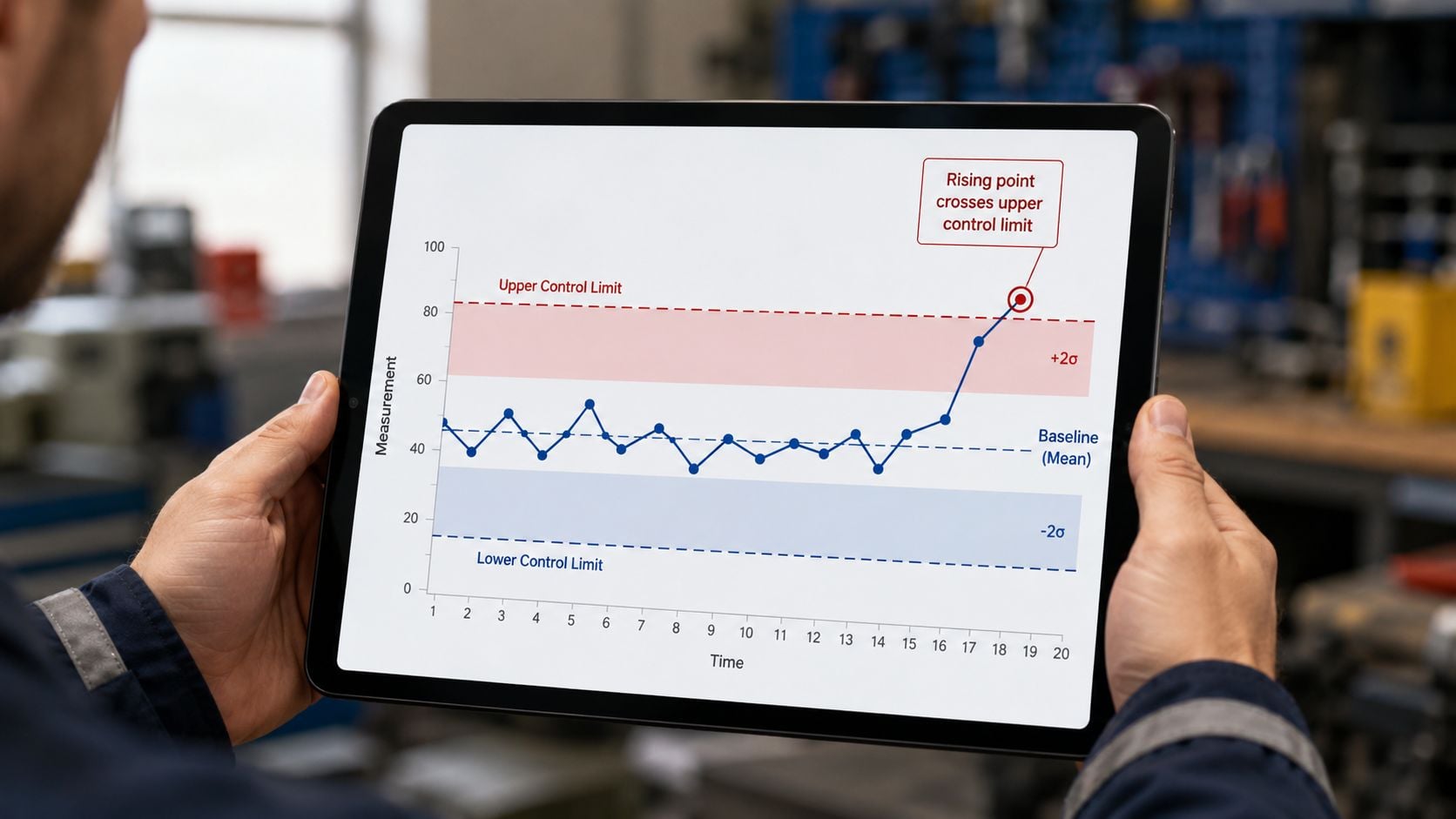
A trend without a baseline is just a moving line. Reliability teams need a reference point that reflects normal operation, plus limits that separate real degradation from process variation.
For a motor, compressor, or gearbox, that baseline should be captured at commissioning or immediately after major repair. It should include representative loads, speeds, and temperatures. From there, statistical control limits can flag drift before the machine reaches a hard alarm. In plain terms, a control limit is a data boundary used to detect abnormal change rather than a one-time bad reading.
A baseline is the reference for every later decision
A centrifugal compressor offers a good example. If vibration and motor current signature data are captured at several operating points after overhaul, the plant can spot not just a threshold breach but a change in slope. That's often what reveals early bearing distress, rotor issues, or developing looseness before the machine enters obvious failure behavior.
The same logic applies to oil analysis. A clean baseline for viscosity, wear metals, contamination indicators, and additive condition makes later deviation meaningful. Without it, technicians may chase normal process effects as if they were faults.
Keep limits useful, not stale
Plants often build baselines once and never update them. That's a mistake after process changes, mechanical upgrades, or sensor replacements.
Good protocol includes:
- Representative capture: Record data across real operating states, not just one idle shift.
- Documented measurement points: Use repeatable sensor locations and naming.
- Periodic review: Recalculate limits after enough history accumulates so they still reflect reality.
- Overlay tools: Use software views that let technicians compare current trends against baseline and limit bands.
A drifting baseline can be as dangerous as no baseline. Teams start normalizing deterioration because the reference no longer matches the machine.
7. CMMS Taxonomy Rollout Plan Pilot Approach
A multi-site rollout usually fails in a familiar way. Corporate publishes a long asset hierarchy, each plant maps it differently, technicians keep their old closeout habits, and six months later the reporting looks standardized only on paper. Reliability teams then spend review meetings arguing about labels instead of failure patterns.
A pilot avoids that trap because it exposes where the taxonomy breaks under real operating conditions. Start with one production area, one asset family, and one clear business question. In practice, the best pilot scope is narrow enough to govern by hand for a few months and important enough to show a measurable effect on planning, troubleshooting, or repeat failure analysis. Guidance from the DAMA Data Management Body of Knowledge supports phased implementation and controlled domain rollout rather than broad policy-first deployment across the enterprise.
Start where condition data and work history already intersect
The strongest pilot areas sit at the boundary between maintenance execution and condition monitoring. Rotating assets are usually the best place to begin because technicians already record symptoms in one system and analysts store evidence in another.
Consider a packaging line with frequent motor and gearbox issues. If the CMMS taxonomy standardizes component names, failure modes, and remedy codes for that line first, the team can connect vibration exceptions, oil analysis comments, and work-order closeout data without cleaning the whole plant at once. That is where governance starts paying for itself. Better coding improves repeatability of failure analysis, and it also reduces wasted time hunting through attachments, spreadsheets, and loosely named reports.
I have seen bearing-related pilots work well because the trade-off is favorable. The failure modes are common, the cost of miscoding is high, and the technician training load stays manageable.
Keep the pilot small enough to survive contact with the field
A pilot should fit normal work. If it needs a special project team to keep data clean, it is too large or too abstract.
Use a short approved list for:
- asset class and component names
- failure mode and cause codes
- inspection finding terms tied to condition routes
- closeout rules for labor, parts, and follow-up actions
- attachment naming for vibration, thermography, and oil reports
That last point matters more than many teams expect. The National Institute of Standards and Technology has documented the operational cost of poor data quality across U.S. industry, and a large share of that cost comes from data that exists but cannot be trusted, matched, or found when needed. In a plant setting, that often means condition monitoring files sitting outside the CMMS with inconsistent names and no governed asset reference. A taxonomy pilot should cover those side files from day one.
Control change before local edits multiply
Version control gets harder after the first expansion. Once each site starts adding local terms for the same defect, the taxonomy drifts back into the disorder it was supposed to fix.
Useful controls include:
- Formal change review: Route new codes and hierarchy changes through a small review group with maintenance, reliability, and master data representation.
- Field reference sheets: Give technicians and planners a one-page visual guide at the point of entry.
- Pilot scorecards: Track duplicate asset creation, free-text usage, coding exceptions, and time spent finding prior failure history.
- Promotion criteria: Expand only after the first pilot shows stable usage and the exception list is shrinking.
The pilot also needs an exit test. Do not scale because the taxonomy was published. Scale because planners can find parts history faster, analysts can group failures without manual recoding, and reliability engineers can compare condition findings against work-order outcomes with less cleanup. That is the point where governance stops being administrative overhead and starts improving uptime.
8. Validation Rule Design and Tuning Best Practices
Validation rules need tuning, not just activation. Plants that skip tuning usually create one of two problems. Either the rules are so loose they miss obvious bad data, or they're so strict that technicians override them out of habit.
Historical data is the best place to start. It shows where the plant's normal operating range sits and which records were clearly wrong. A steel mill's intermittent sensor dropout on a rolling mill motor, for instance, may look like machine instability until the historical pattern points to a mounting issue and periodic signal loss.
Tune with history before enforcing
A staged rollout works best. Run rules in shadow mode first so the team can see what would have been blocked. Then move to alert-only mode. Enforcement should come after the false positives are understood and reduced.
Strong tuning practice usually includes these steps:
- Domain review: Involve analysts, technicians, and lab personnel who understand how the reading is produced.
- Date and sequence logic: Catch impossible orderings, such as sample results arriving before collection or PM completion before work release.
- Exception triage: Separate likely entry mistakes from possible process or equipment signals.
- Remediation triggers: Auto-request resampling, route rechecks, or steward review where that response is appropriate.
Use exception logs as reliability evidence
The exception log isn't just an admin artifact. It can reveal repeating plant problems.
A recurring pattern of rejected thermography records may point to poor image labeling. Repeated date-sequence failures in PM records may expose planner shortcuts that distort compliance reporting. If a lube route constantly produces inconsistent units or sample timing, the plant may have a training problem or a route design issue.
That's where validation becomes more than governance. It becomes a feedback system that improves diagnostic quality for actual failure analysis on pumps, motors, and gearboxes.
9. Integration Prioritization and Data Transformation Strategy
A common failure pattern shows up after the interface goes live. Condition monitoring events start landing in the CMMS, auto-generated work orders rise, and within a few weeks planners stop trusting the feed because asset IDs do not match, severity codes mean different things by source, or timestamps arrive in the wrong time zone. The integration technically works. The maintenance process does not.
The fix is a prioritized integration plan paired with a controlled transformation layer. Raw source data should be checked, mapped, and enriched before it reaches the CMMS. That is how reliability teams keep useful alerts and filter out records that create noise.
Prioritize integrations by operational risk and response value
Start with the signals that can change maintenance action on assets where downtime is expensive or safety exposure is high. In practice, that often means vibration exceptions on critical pumps, oil analysis results for large gearboxes, motor current findings on constrained production lines, or temperature alerts on assets with a known failure history.
I usually rank candidates with three questions:
- Will this signal trigger a different maintenance decision than the team makes today?
- Can the CMMS route the event to the right asset and component without manual cleanup?
- Will the plant be able to see avoided troubleshooting time, fewer repeat inspections, or faster work identification within the first rollout?
If the answer is unclear, that feed should wait. Integration capacity is limited, and low-value data feeds create governance work without improving uptime.
Transform data before it becomes a work candidate
Field mapping deserves design effort up front. Source systems rarely agree on asset keys, component labels, unit conventions, status codes, or event timestamps. A transformation layer handles those differences before records create notifications, defects, or work orders in the CMMS.
For CMMS-driven reliability, the minimum translation set usually includes asset identifier, maintainable component, event class, severity, observation time, source system, and recommended action. Teams also need rules for duplicate suppression and event correlation. Without them, one bearing issue can appear as three separate maintenance candidates from vibration, ultrasound, and operator rounds.
A good pattern is to keep raw values for traceability while writing standardized values to operational fields used for planning and reporting. That preserves diagnostic detail without forcing planners to interpret every vendor-specific code.
Industry guidance from the National Institute of Standards and Technology on data interoperability reinforces the same principle. Data exchanged across systems needs defined structure, context, and transformation rules to remain usable across business processes and system boundaries, as described in NIST's discussion of interoperable information exchange. In a plant, that translates directly to less manual reconciliation and fewer bad maintenance triggers.
Keep change control tight, but not slow
Integration governance fails in the opposite direction too. If every mapping update takes a month, the plant ends up bypassing the process with spreadsheets, manual imports, or direct edits in downstream systems. That usually creates a second, undocumented integration model.
A workable operating model keeps a controlled library of approved mappings and transformation rules, then applies faster review to low-risk changes such as adding a new sensor tag to an existing event type. Higher-risk changes, such as altering asset matching logic or auto-work creation rules, deserve fuller review because they affect maintenance history and labor planning.
Useful controls include:
- Standard field templates: Reuse approved mappings for common event types such as alerts, inspections, and lab results.
- Versioned transformation rules: Record who changed the mapping, when it changed, and which sites or asset classes were affected.
- Pipeline monitoring: Flag failed loads, delayed loads, and record rejection spikes before planners notice gaps.
- Replay capability: Reprocess corrected records after mapping fixes without re-entering data by hand.
- Feedback from canceled or merged work orders: Review these records to find threshold problems, duplicate event creation, or poor source-to-asset matching.
The trade-off is straightforward. More control lowers the chance of bad records entering the CMMS. More speed helps plants absorb new sensors, asset changes, and monitoring methods without losing momentum. Good governance sets the review depth by operational impact, not by habit.
In mature programs, integration strategy becomes an ROI decision, not just a technical one. The best feeds reduce diagnosis time, improve planner confidence, and connect condition monitoring to maintenance action with less manual interpretation. That is where data governance starts paying for itself on the plant floor.
9-Point CMMS Data Governance Comparison
| Title | Implementation complexity | Resource requirements | Expected outcomes | Ideal use cases | Key advantages |
|---|---|---|---|---|---|
| Establish a Centralized CMMS Data Dictionary and Taxonomy | High, cross-site alignment and governance | Data governance team, CMMS customization, training | Consistent naming, better benchmarking, reduced data cleaning | Multi-site operations with inconsistent terminology | Removes semantic ambiguity; improves analytics and query accuracy |
| Implement Data Quality Governance with Automated Validation Rules | Medium, rule design, testing, enforcement | Domain experts, validation engines/MDM, integration effort | Fewer corrupted records; faster detection of anomalies; lower remediation costs | High-volume sensor/lab data and regulated sites | Prevents GIGO; real-time anomaly detection; audit trails |
| Define Data Ownership and Stewardship Roles with Clear Accountability | Medium, organizational change and role definition | Executive sponsorship, trained stewards, ongoing meetings | Clear escalation, reduced threshold drift, improved traceability | Matrix organizations and multi-domain data programs | Clarifies authority; improves accountability and knowledge retention |
| Establish Real-Time Data Integration Between Condition Monitoring Tools and CMMS | High, APIs, middleware, mapping, security | Integration engineers, middleware/ETL, cybersecurity controls | Near-instant alerts to work orders; fewer manual errors; faster response | Critical assets needing rapid intervention; IoT-enabled plants | Faster interventions; accurate auto-generated work orders; richer ML inputs |
| Implement Asset Criticality Ranking with Risk-Based Data Retention Policies | Low–Medium, scoring and policy alignment | Cross-functional workshops, CMMS tagging, periodic reviews | Focused governance spend; lower storage costs; improved availability | Large fleets with limited monitoring budgets; risk-prioritized programs | Aligns investment to risk; reduces TCO; improves critical asset uptime |
| Establish Baseline and Trending Protocols with Statistical Control Limits | Medium, baseline capture and statistical modeling | Measurement expertise, representative data collection, trending tools | Earlier degradation detection; fewer false alarms; actionable trends | Assets with variable operating conditions and condition-monitoring programs | Detects slow degradation early; reduces false positives; supports predictive scheduling |
| CMMS Taxonomy Rollout Plan (Pilot Approach) | Low–Medium, pilot planning and iterative scaling | Pilot team, frontline involvement, governance board | Validated taxonomy, frontline buy-in, lower rollout risk | Organizations beginning taxonomy standardization | Low-risk testing; quick wins; smoother enterprise adoption |
| Validation Rule Design and Tuning Best Practices | Medium, iterative testing and exception management | Historical data, domain experts, tuning dashboards | Fewer false positives; improved rule accuracy; cleaner model inputs | Teams deploying validation rules or anomaly detection | Minimizes alert fatigue; improves long-term data quality; traceable exceptions |
| Integration Prioritization and Data Transformation Strategy | Medium–High, prioritization, mapping, middleware | Integration architects, ETL/middleware, security review | Early value from top assets; reduced ingest failures; consistent context | Multi-vendor environments and phased integration programs | Focused integrations; normalized data flows; fewer failed ingests |
From Governance to Measurable Uptime Gains
At 2 a.m., a vibration alarm on a critical pump crosses its limit, but the work order history is split across three asset names, the failure code was entered three different ways, and the oil report sits in a separate system with no equipment match. The team still has to make a call before morning production starts. Data governance matters in that moment because it determines whether the maintenance response is fast and accurate or delayed by avoidable confusion.
In plants that run a CMMS alongside condition monitoring, governance has one job. Make asset data reliable enough that supervisors, planners, and technicians can trust it under operating pressure. That means standard names, validated fields, clear ownership, and integrations that preserve context from the sensor reading to the corrective work order. It also means accepting trade-offs. Tighter controls improve consistency, but if the workflow becomes slow or brittle, technicians will work around it and data quality will fall anyway.
The return shows up in uptime, schedule quality, and troubleshooting speed. A cleaner taxonomy produces failure histories that support better root cause analysis. Validation rules catch bad meter readings, duplicate assets, and incomplete closeout data before those records pollute reports. Named stewards keep alarm limits, route structures, and reference tables current as equipment changes. Integrated condition data helps teams act on bearing defects, lubrication issues, cavitation, insulation degradation, and thermal anomalies while there is still time to plan the work.
I have seen the strongest programs treat governance as part of reliability engineering, not as an IT exercise. A paper mill may use it to connect lubrication lab findings to repeat dryer bearing failures. A food plant may use it to standardize motor and gearbox records across packaging lines so planners stop scheduling against the wrong asset. A water utility may use criticality-based retention to keep years of history on high-consequence pumps while applying lighter rules to low-risk support equipment. The pattern is consistent. Better structure around maintenance data improves the odds of making the right intervention at the right time.
The same approach scales across industries because the economics are similar. In mining, cleaner hierarchy data reduces delay when a mobile maintenance team has to identify the exact component that is failing. In chemicals, clear ownership of inspection and condition records reduces the risk of acting on stale thresholds. In discrete manufacturing, integration between monitoring systems and the CMMS cuts down on hand-carried findings that never become planned work. In power generation, baseline discipline matters because small trend shifts often carry more value than a single alarm event. In each case, governance supports a maintenance decision with real cost and production consequences.
Good governance also needs limits. A site does not need every field controlled to the same standard. Critical assets deserve stricter validation, longer history, and tighter stewardship because the cost of bad data is higher. Low-consequence assets often need simpler rules so the team can keep work moving. That balance is where many programs either gain credibility or lose it.
A practical rollout usually starts where data quality is already affecting reliability results. Pick one asset group with visible pain and measurable value, such as compressor trains, wastewater blowers, kiln drives, or packaging conveyors. Set the naming standard. Add a few validation checks with low false-positive risk. Assign ownership for the records that drift most often. Connect one trusted condition source to the CMMS and track whether the response time, work order quality, and repeat failure rate improve over the next planning cycles.
That is how governance turns into measurable uptime gains. It gets the asset record, the condition signal, and the maintenance action aligned closely enough that teams can plan earlier, diagnose faster, and avoid repeat mistakes.
Ready to turn data governance into better maintenance decisions and fewer surprises? Contact Forge Reliability for a free reliability assessment and start building a cleaner, faster, more reliable maintenance data foundation.
Forge Reliability helps industrial teams turn CMMS data, condition monitoring, and asset strategy into practical uptime gains. If recurring pump, motor, gearbox, compressor, or turbine failures are being masked by bad history, weak taxonomy, or disconnected systems, schedule a free reliability assessment with Forge Reliability.