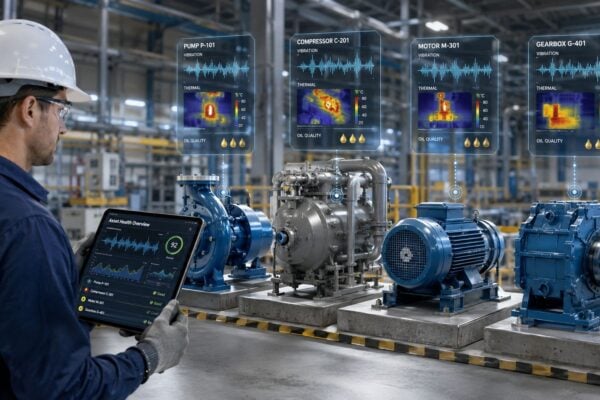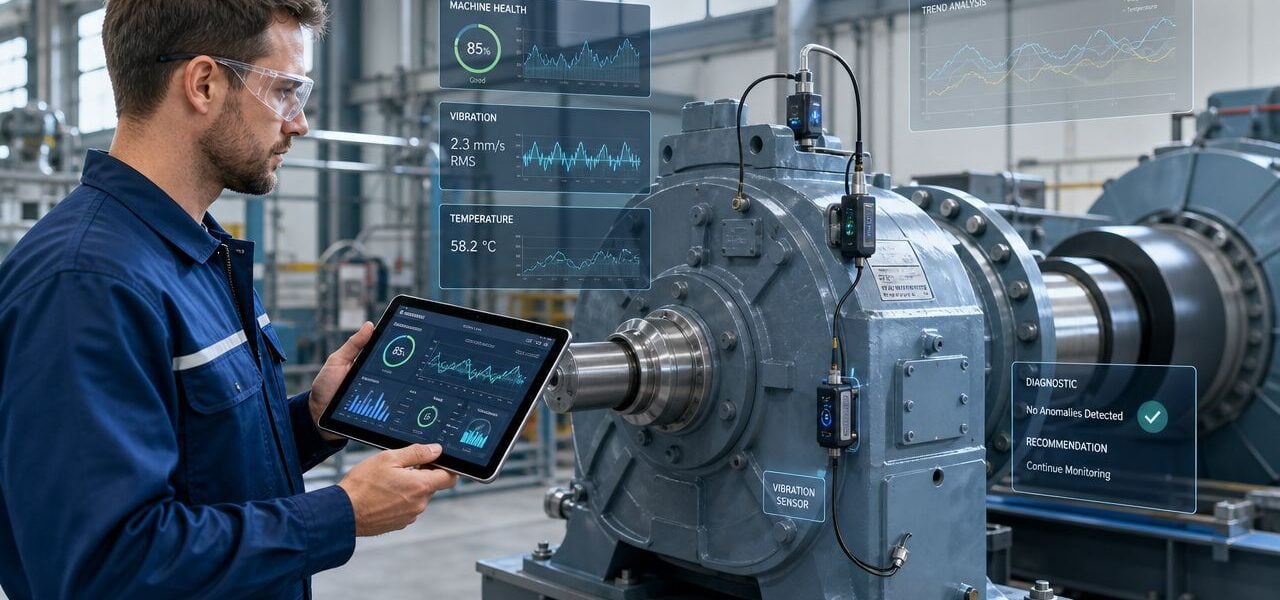
A critical pump trips at 2:00 a.m. Production stops. The maintenance planner checks the history and finds the pump was inspected on schedule, lubricated on schedule, and cleared during the last preventive task. That scenario is common in plants that still rely too heavily on the calendar.
The problem isn't discipline. The problem is assuming equipment fails on a neat timetable. It doesn't. Reliability leaders already know that a gearbox, motor, compressor, or process pump can move from healthy to unstable between PM intervals, especially when load, speed, contamination, and operating context keep changing. Condition-based maintenance matters because it ties maintenance action to asset condition, not to a date on a work order.
For reliability engineers, maintenance managers, and plant operations leaders, the hard part isn't defining condition-based maintenance. The hard part is deciding where it belongs, which technologies fit which failure modes, how to keep alarm systems from becoming noise, and how to defend the investment in front of leadership. Those are the decisions that determine whether a program cuts downtime or just creates more data.
Table of Contents
- Beyond the Calendar Why Time-Based Maintenance Fails
- CbM vs Preventive and Predictive Maintenance
- The Core CbM Diagnostic Technologies
- Setting Thresholds and Interpreting Alarms
- Data Collection and CMMS Integration
- Building a Business Case for CbM
- Implementing Your CbM Program A Checklist
Beyond the Calendar Why Time-Based Maintenance Fails
A maintenance team can do everything the schedule requires and still lose a critical asset. A food and beverage plant might rebuild a conveyor gearbox during a planned outage, put it back in service, and then lose it weeks later because water ingress or mounting looseness developed after the PM. The calendar was satisfied. The failure mode wasn't controlled.
That gap is why time-based maintenance fails on many high-value assets with measurable degradation. In industrial facilities, 82% of equipment failures occur at irregular intervals that do not align with fixed calendar-based schedules, according to this overview of condition-based maintenance. A fixed interval works when wear is predictable and the task directly prevents the failure. It fails when the operating environment changes faster than the schedule.
A familiar failure pattern
A process pump in a chemical unit is a good example. The monthly PM might confirm lubrication, check coupling condition, and record general observations. Then process conditions shift. Suction quality changes, the pump starts operating away from best efficiency point, bearing loads rise, and vibration climbs between inspections. By the time the next calendar task arrives, the bearing defect has already progressed into a production event.
Practical rule: If the failure mode gives off a measurable signal before functional failure, a calendar task alone is usually the wrong primary control.
The right response isn't to discard preventive maintenance entirely. Plants still need scheduled tasks for inspections, compliance requirements, and simple recurring activities. But critical assets need a strategy that listens to the machine while it's running. That's where condition-based maintenance becomes more than a buzzword. It becomes an operating discipline tied to actual failure development.
Maintenance leaders trying to reduce repeat breakdowns usually find the same thing. Their operation and maintenance system improves when asset decisions are based on condition signals rather than blanket intervals. That shift also changes planning quality, because teams can schedule work before the failure forces them into emergency mode. A useful starting point is a stronger operation and maintenance approach for industrial assets.
CbM vs Preventive and Predictive Maintenance
Condition-based maintenance gets mixed up with preventive maintenance and predictive maintenance all the time. The confusion usually starts when every sensor-driven program gets labeled "predictive." That isn't accurate, and the distinction matters when selecting technology, setting expectations, and asking for budget.
What condition-based maintenance actually does
Condition-based maintenance means maintenance is performed when measured equipment condition shows it's needed. ISO 17359 defines the approach around monitoring parameters such as vibration, temperature, pressure, and lubrication to detect deviation from normal condition and intervene before functional failure. That definition is summarized in this explanation of ISO 17359 and condition-based maintenance.
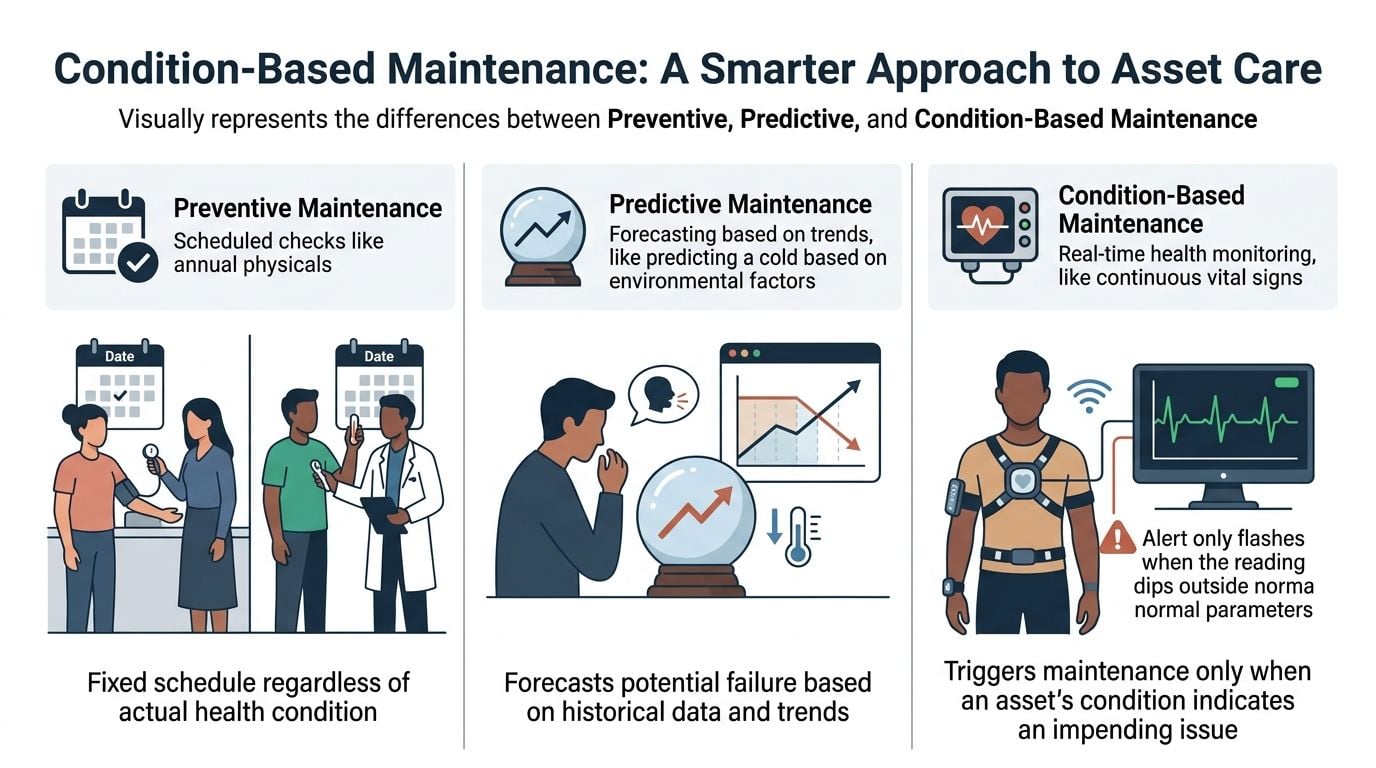
A simple analogy helps. Preventive maintenance is like going to an annual physical whether anything feels wrong or not. Condition-based maintenance is like wearing a monitor that alerts when blood pressure, temperature, or heart rhythm moves outside an acceptable range. Predictive maintenance goes one step further and estimates when a problem is likely to occur in the future based on trends and models.
That difference is operationally important:
- Preventive maintenance acts on elapsed time, cycles, or calendar intervals.
- Condition-based maintenance acts on current measured condition.
- Predictive maintenance estimates future failure probability or timing.
Some plants need all three. A critical gearbox may justify vibration and oil monitoring. A safety inspection may stay time-based because there isn't a useful live condition indicator. A mature site with strong data history may layer predictive analytics on top of condition monitoring.
A more detailed reliability planning discussion sits in this guide to predictive vs preventive maintenance.
Maintenance Strategy Comparison
| Criterion | Preventive Maintenance (Time-Based) | Condition-Based Maintenance (CbM) | Predictive Maintenance (PdM) |
|---|---|---|---|
| Primary trigger | Calendar time, runtime, or cycles | Measured condition crossing a defined threshold | Forecast from historical and real-time data |
| Main question answered | "Is it time to do the task?" | "Is the asset showing evidence of degradation now?" | "When is this asset likely to fail?" |
| Best fit | Simple recurring tasks, inspections, compliance work | Critical assets with measurable failure indicators | Large programs with strong data quality and analytical maturity |
| Typical signals | None required beyond schedule | Vibration, temperature, pressure, lubrication, electrical condition | Trend models built from condition, process, and failure history |
| Main advantage | Easy to administer | Acts on actual equipment health | Improves planning horizon |
| Main weakness | Can over-maintain or miss between-interval failures | Requires good thresholds and disciplined response | Requires more data governance and analytical capability |
| Example | Scheduled filter replacement | Replace a motor bearing after vibration and ultrasound confirm degradation | Forecast likely compressor failure window based on trend behavior |
The practical mistake isn't choosing one strategy. It's applying the wrong strategy to the wrong failure mode.
The Core CbM Diagnostic Technologies
A condition-based maintenance program is only as good as the diagnostic method matched to the failure mode. Too many programs start with available sensors instead of failure physics. That leads to poor coverage, weak alarms, and executive skepticism when the data doesn't translate into better work.
Vibration analysis
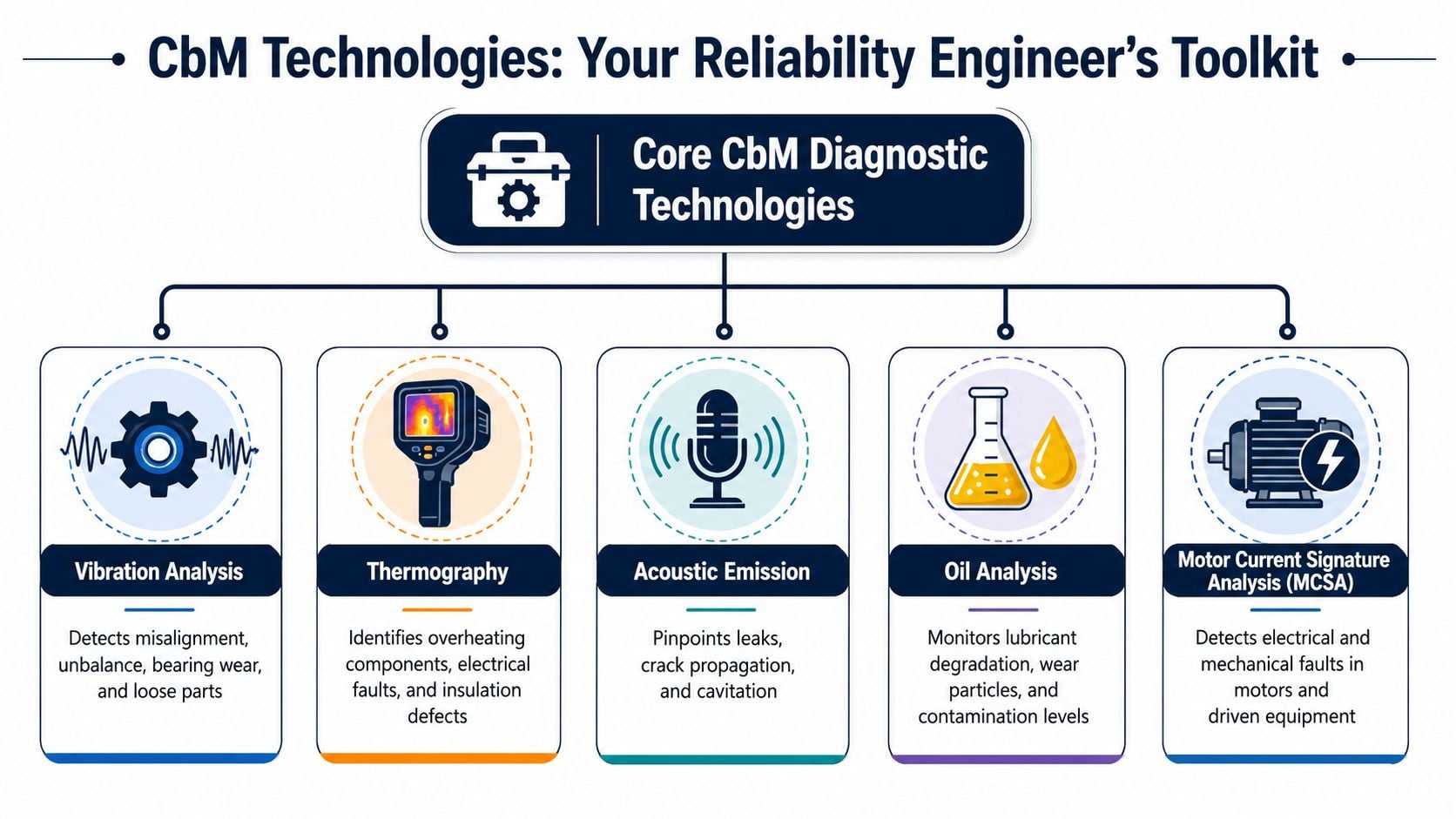
Vibration analysis is the core tool for rotating equipment. It measures dynamic motion and helps detect failure modes such as bearing defects, imbalance, misalignment, looseness, resonance, and some hydraulic issues.
For a process pump, vibration is often the fastest way to separate a simple alignment problem from a developing rolling element bearing fault. If the spectrum shows running speed energy, harmonics, and directional differences, that points the team toward mechanical correction rather than blind component replacement.
A route program works well for medium-critical pumps, motors, and fans. Continuous monitoring makes more sense when failure consequence is high or access is difficult. A plant that wants to sharpen diagnosis on electric machines should also understand the basics of vibration analysis of motors and driven equipment.
Infrared thermography
Infrared thermography finds temperature anomalies. It doesn't diagnose every root cause by itself, but it quickly identifies where energy is being lost or resistance is building.
In an electrical room, thermography is excellent for:
- Loose connections: Increased resistance creates localized heating at lugs, breakers, and bus connections.
- Load imbalance: Phase temperature differences can reveal unequal loading.
- Insulation problems: Hot spots on motors, panels, or process heating systems often expose hidden degradation.
A common plant example is an MCC bucket feeding a packaging line motor. The line may still be running, but a thermal image shows one termination hotter than adjacent phases under similar load. That creates a controlled repair opportunity before the connection burns, trips, or damages the component upstream.
Oil analysis
Oil analysis answers questions vibration cannot. It evaluates lubricant condition, contamination, and wear debris, making it especially useful for gearboxes, hydraulic systems, compressors, and large bearings.
In a paper mill gearbox, oil analysis can expose:
- Contamination: Water, process dust, or debris entering the lubricant.
- Lubricant degradation: Viscosity shift or additive depletion.
- Internal wear: Wear particles that suggest gear tooth distress or bearing surface damage.
The major advantage is that oil tells the history of what the machine has been experiencing internally. Vibration might show that a fault exists. Oil often helps explain why it developed.
A strong example comes from rotating assets such as compressors and motors. Effective condition-based maintenance systems that integrate lithium-based oil analysis with ultrasonic bearing testing can detect micro-pitting at less than 10 µm depth, eliminate 20%+ of unnecessary scheduled interventions, prevent 90%+ of surprise breakdowns, and achieve 3–5x ROI, according to this discussion of condition-based maintenance methods. That matters because early surface distress is exactly the kind of defect maintenance teams want to catch before it becomes audible, hot, or catastrophic.
Field insight: If a gearbox keeps failing and the team only changes oil on schedule, the plant is managing lubricant age, not gearbox health.
Airborne ultrasound
Airborne ultrasound picks up high-frequency sound that humans can't hear directly. It is particularly effective for bearing friction, compressed air leaks, steam trap issues, valve leakage, and electrical arcing.
In a food plant, ultrasound often finds leaks in compressed air systems that operators have stopped noticing. In a bearing application, it can flag friction changes before vibration severity rises enough to cross alarm. That's why ultrasound is valuable for slow-speed assets where standard vibration methods may be less sensitive in the earliest stages.
For steam systems, ultrasound also helps separate a failed-open trap from a functioning one. That turns a vague energy loss concern into a targeted corrective action.
Motor current signature analysis
Motor current signature analysis, often shortened to MCSA, examines electrical current waveforms to identify faults in motors and the systems they drive. It is useful when teams need to distinguish between electrical and mechanical sources of trouble.
MCSA can support diagnosis of:
- Rotor bar issues
- Air gap irregularities
- Some stator-related concerns
- Load-related mechanical effects reflected into motor current
A wastewater facility offers a practical example. An aeration blower motor begins showing unstable operation. Vibration alone suggests something is wrong, but current analysis helps determine whether the issue originates in the motor or in the driven load. That keeps the team from pulling a healthy motor when the actual problem sits in the coupling, gearbox, or process side.
Setting Thresholds and Interpreting Alarms
Collecting data isn't the difficult part anymore. The difficult part is deciding what deserves a work order and what deserves a second look. Most failed condition-based maintenance programs don't fail because sensors were unavailable. They fail because alarm logic was simplistic, static, or disconnected from the process.
The P-F interval drives inspection timing
The P-F interval is the time between potential failure and functional failure. Potential failure means a detectable condition has appeared. Functional failure means the asset can no longer perform its required duty.
That concept matters because monitoring frequency has to be shorter than the P-F interval. If a pump bearing shows early vibration and moves from a low defect signal to a damaging condition quickly, the inspection interval must catch it before production does. One published example shows a pump bearing moving from 0.5 mm/s to 4.0 mm/s within 14 days, which means the alert and review process must occur within 7 days to allow action before failure, as outlined in this explanation of the P-F interval in condition-based maintenance.
A route that runs monthly on an asset with a short P-F interval isn't a condition-based strategy. It's delayed confirmation.
Why alarms fail in real plants
The common assumption is that thresholds are straightforward. Set a warning alarm, set a danger alarm, and let the system trigger work. Real plants don't behave that cleanly.
A chemical processing line shows why. A pump on a variable frequency drive changes speed with process demand. As speed, pressure, and flow shift, the vibration signature shifts too. If the alarm threshold is static, the system may trigger every time the process moves into a normal but different operating zone. The team then starts ignoring alerts, and trust in the program drops.
Two problems usually sit underneath that noise:
- Sensor drift: The instrument itself changes behavior over time, creating alarms that don't reflect machine condition.
- Process volatility: Normal operating changes alter the measured signal enough to look like degradation when there isn't any.
A better workflow separates alerting from diagnosis:
- Validate the operating state. Check speed, load, flow, pressure, and recent process changes first.
- Compare against baseline in the same operating regime. A pump at one speed shouldn't always be judged against a baseline from another.
- Check sensor health. If the trend is inconsistent with process behavior and physical inspection, calibration or installation issues may be involved.
- Escalate only after correlation. The work order should include condition evidence, process context, and suspected failure mode.
Alarm thresholds should be tied to failure development, not just to what looked reasonable during commissioning.
Teams building route logic and exception workflows usually benefit from standardization. A practical starting point is a vibration monitoring route setup guide for maintenance teams.
Data Collection and CMMS Integration
Condition-based maintenance becomes useful when a condition event turns into planned work with the right scope, labor, and parts. If the data stays in dashboards and never changes scheduling behavior, the plant hasn't improved reliability. It has only increased visibility.
Route-based versus continuous monitoring
Most plants need both route-based and continuous monitoring. The selection should come from asset criticality, failure consequence, access difficulty, and how quickly the failure develops.
Route-based monitoring fits assets such as balance-of-plant pumps, non-critical motors, secondary fans, and general utility equipment. A technician collects data on a defined interval using handheld instruments or portable sensors. This approach is cost-conscious and flexible, but it depends on route discipline and may miss fast-moving failures.
Continuous monitoring belongs on assets such as main compressors, large refrigeration machines, steam turbines, and process-critical pumps where failure consequence is severe or access is hazardous. Permanently installed sensors collect data all the time and support faster response when condition changes quickly.
A simple decision screen helps:
- Use route-based monitoring when the failure mode develops gradually and the asset can tolerate interval-based review.
- Use continuous monitoring when the P-F interval is short, the process can't tolerate sudden loss, or the machine is difficult to inspect safely.
- Use neither as a default unless the asset ranking and failure mode justify it.
From sensor event to planned work order
The workflow should be simple enough that planners and technicians trust it.
- Condition data is captured. That may be vibration, thermal data, oil sample results, ultrasound findings, or motor electrical data.
- The signal is screened against rules. Rules should account for operating context, not just fixed thresholds.
- The condition is reviewed by a qualified person. Raw alarms shouldn't always create labor demand automatically.
- A CMMS work order is created with context. The order should state the symptom, likely failure mode, recommended inspection scope, and urgency.
- Execution results feed back into the record. Findings, replaced parts, and root cause notes improve the next decision.
Consequently, data quality becomes a reliability issue, not just an IT issue. The same principles discussed in observability for product data apply in industrial maintenance. If asset IDs are inconsistent, sensor points are mapped poorly, or work order closeout data is incomplete, alarm quality degrades and trend interpretation becomes unreliable.
The CMMS has to support the process rather than sit beside it. That means clean asset hierarchies, standard failure codes, and work order templates that preserve the reason the alert mattered. This guide to CMMS implementation for maintenance teams is a useful reference when building that structure.
Building a Business Case for CbM
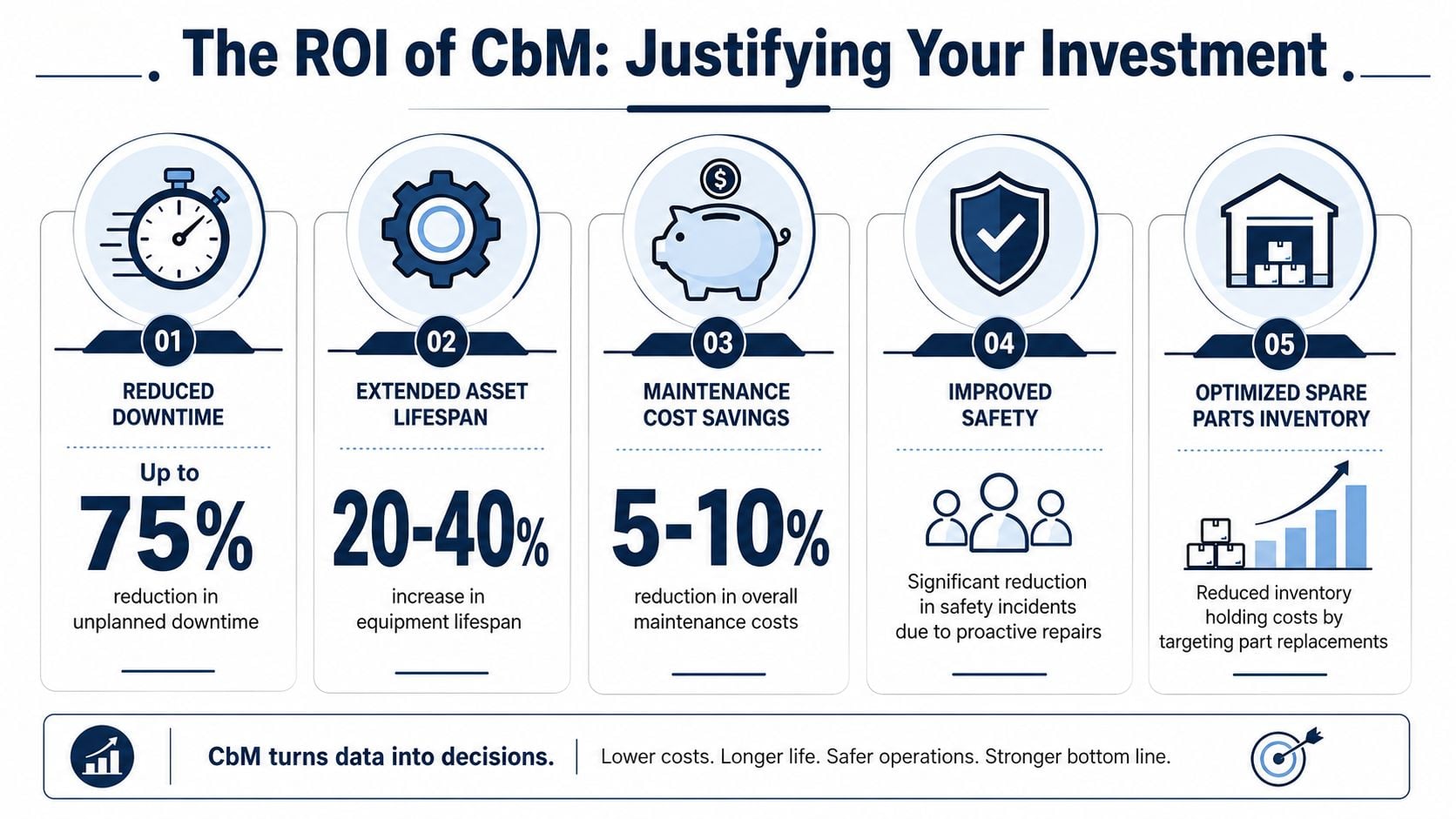
Most executives won't fund condition-based maintenance because it's technically elegant. They'll fund it when the reliability team shows how it reduces operational risk, protects throughput, and improves maintenance efficiency in terms the business already understands.
What leadership actually approves
The strongest business case starts with assets that hurt the plant when they fail. In a food and beverage facility, that may be a critical compressor feeding production air or refrigeration support. In a chemical plant, it may be a process pump train whose trip forces reduced rates or a shutdown. In a power facility, it might be an auxiliary machine whose failure escalates into a larger generation loss.
The business argument becomes much easier when tied to outcomes with published benchmarks. Condition-based maintenance can reduce machine downtime by 30% to 50%, lower maintenance costs by 25% to 30%, and eliminate breakdowns by 70% to 75% when properly implemented, according to this review of condition monitoring and maintenance outcomes.
That doesn't mean every asset deserves sensors. It means critical assets with detectable failure development deserve an economic review instead of blanket PM logic.
The best executive case is usually narrow at first. Monitor the assets that create the most pain, then expand after the site sees the maintenance behavior change.
A practical ROI framework
A defensible business case doesn't need a complicated model. It needs disciplined scope.
Use this framework:
- Start with one asset class: Compressors, process pumps, gearboxes, or critical motors are usually easier to justify than a plant-wide rollout.
- Capture the cost of failure: Include lost production, contractor callout, overtime labor, expedited parts, quality loss, and schedule disruption.
- Define the monitoring scope: Decide whether the asset needs route-based collection, permanent sensors, oil sampling, thermography, ultrasound, or a mix.
- Estimate internal response cost: Someone still has to review alarms, plan work, and execute repairs.
- Compare against current waste: Look at emergency work, repeated failure modes, and PM tasks that don't control the failure.
One option in that process is using a structured service model such as Forge Reliability, which supports route-based and continuous monitoring, vibration analysis, oil analysis, thermography, ultrasound, and motor current signature analysis for industrial assets. The value isn't the brand name. The value is having a method that links failure modes, diagnostics, and work execution.
For leadership approval, the message should stay simple. Condition-based maintenance doesn't replace maintenance spending. It reallocates spending from emergency response and unnecessary intervention toward planned, evidence-based action.
Implementing Your CbM Program A Checklist
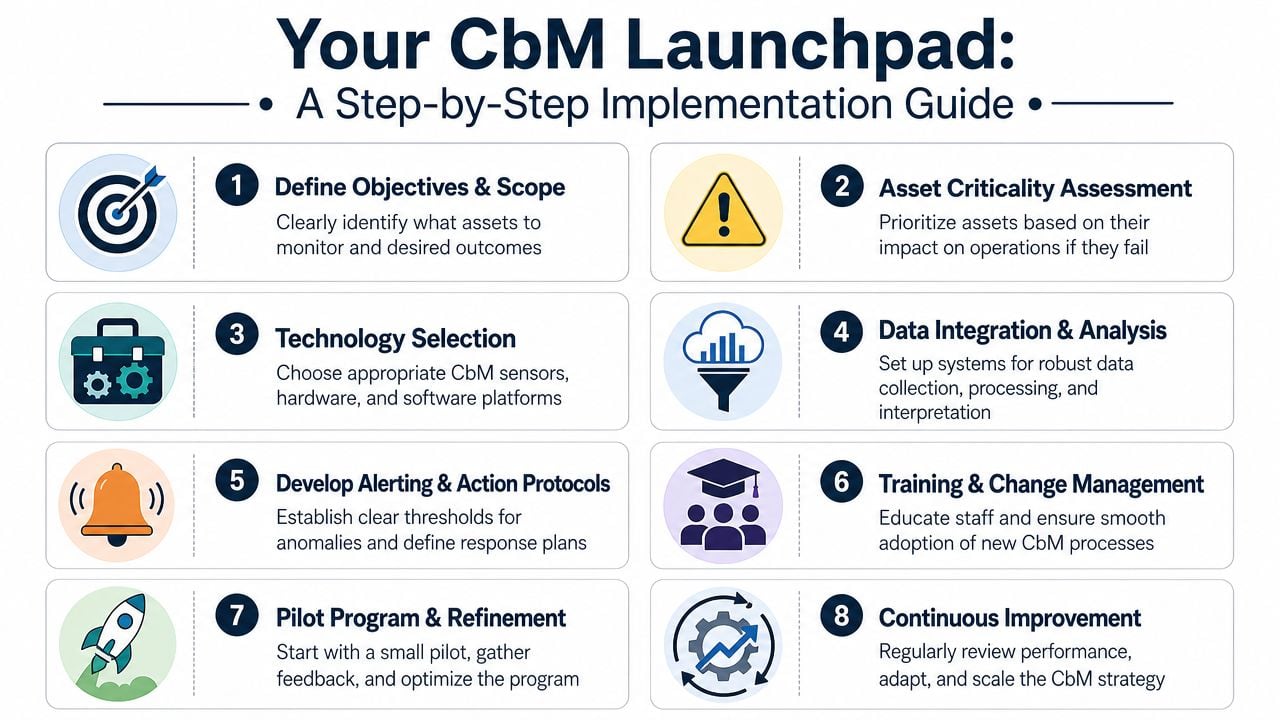
Condition-based maintenance usually succeeds when plants start with a narrow pilot, clear ownership, and failure modes that produce measurable signals. It usually fails when the site buys hardware first and decides strategy later.
A focused launch sequence
Condition-based maintenance is best implemented as a hybrid strategy. It should be used on critical assets with measurable P-F intervals, while time-based preventive maintenance stays in place for failure modes that don't present useful measurable indicators, and run-to-fail remains acceptable for low-cost non-critical components. That hybrid approach is summarized in this discussion of condition-based maintenance strategy selection.
A workable launch checklist looks like this:
- Rank asset criticality first. Start with equipment whose failure drives safety risk, production loss, or major repair cost.
- Define the dominant failure modes. A sensor doesn't help unless the failure mode creates a detectable change.
- Match technology to the physics. Bearings, lubrication distress, electrical resistance, leakage, and motor electrical faults don't all show up in the same data stream.
- Set baselines under known operating conditions. Baselines taken during unstable operation create weak alarms later.
- Build alarm review rules before rollout. Someone must decide what gets monitored, who reviews it, and what creates a work order.
- Run a pilot. Choose a contained asset group and prove that alerts lead to useful maintenance action.
- Train planners and technicians. Data without interpretation only shifts confusion downstream.
- Close the loop on findings. Every confirmed fault and every false alarm should refine the program.
What usually breaks the rollout
Most problem deployments trace back to a small group of avoidable mistakes:
- Poor asset selection: Teams monitor everything instead of the assets where condition data can change maintenance decisions.
- Weak failure mode definition: The site installs sensors without clarifying what failure is being detected.
- Static alarms in variable processes: Process changes create alert noise and technicians stop trusting the system.
- No response discipline: Alerts arrive, but nobody owns validation, planning, or corrective action.
- No learning loop: Work orders close without documenting what was found.
A strong program doesn't try to digitize old habits. It changes how the plant decides when to act, what to inspect, and how to schedule intervention before the failure becomes an event.
Condition-based maintenance works when the strategy fits the asset, the alarm logic fits the process, and the work management system turns data into action. For plants that want to reduce repeat failures, improve planning, and focus monitoring where it will pay off, Forge Reliability offers a free reliability assessment.