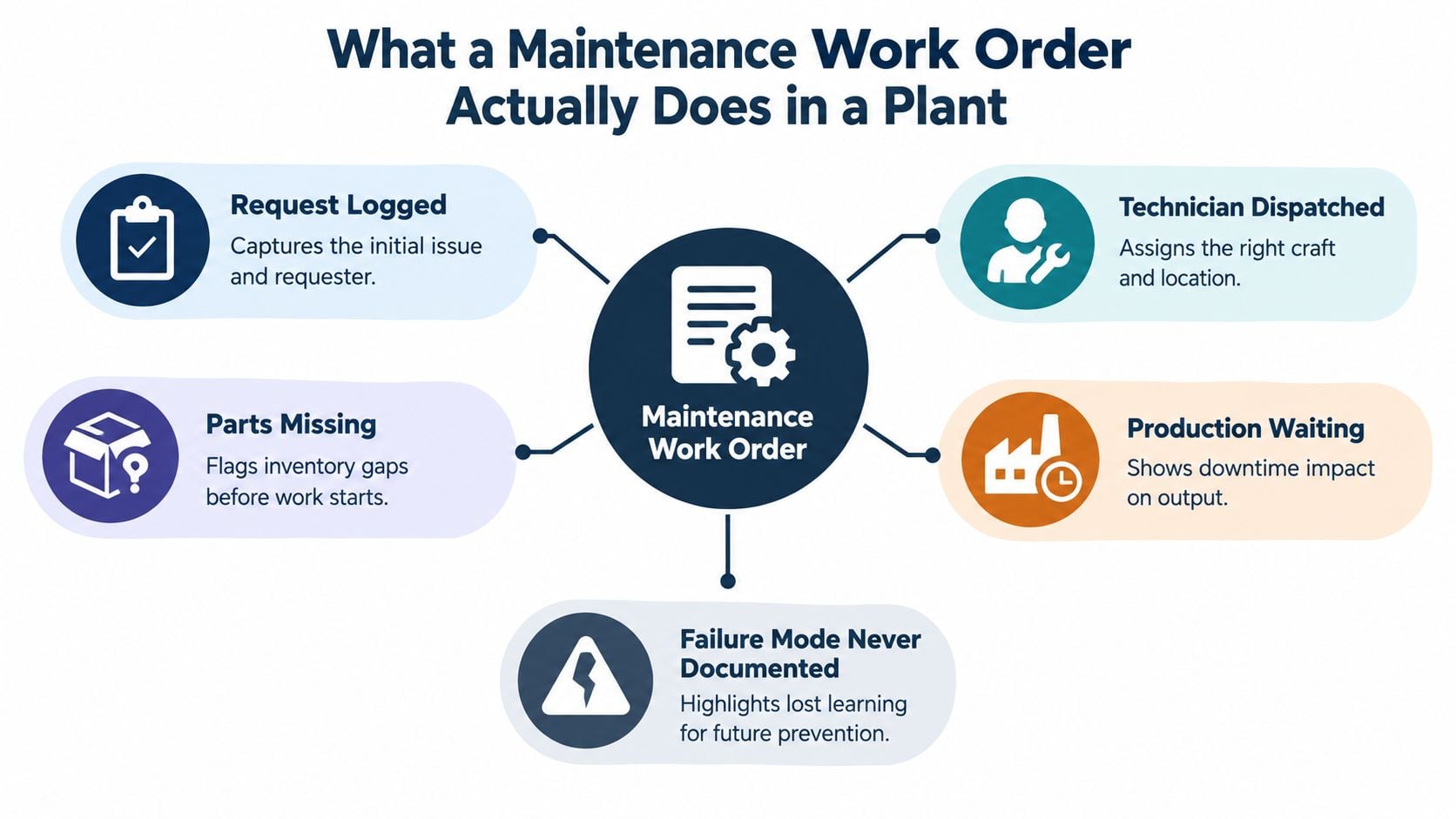
A request arrives for a pump that's running hot. A technician gets dispatched, but the required bearing isn't available, production waits, and the work order closes with “repaired” and no failure code. The equipment may be running again, but the plant has lost the information needed to prevent the next failure.
A maintenance work order should do more than authorize labor. It should guide safe execution, make the job ready before the crew arrives, and preserve the evidence needed to improve reliability. When those functions are missing, the CMMS records activity without helping the plant control risk or repeat failures.
Table of Contents
- What a Maintenance Work Order Actually Does in a Plant
- Required Fields and Metadata for Every Work Order
- The Request to Closeout Workflow That Actually Holds Up
- Prioritization, Criticality, and When Work Orders Become Safety-Critical
- Integrating CMMS, Predictive Monitoring, and Data Governance
- KPIs, Sample Templates, and an RCM-Aligned Work Order Example
What a Maintenance Work Order Actually Does in a Plant
A work request reports a problem or need. A work order is the approved, actionable record that defines the job, its resources, safety controls, execution, and closeout. Treating the request and work order as interchangeable lets unverified reports enter the schedule as if they were already scoped jobs.
Work orders also need clear types. Corrective work restores equipment after a defect or failure; preventive work is performed at planned intervals to reduce failure risk; predictive work is triggered by evidence of changing condition; and emergency work addresses an immediate threat to safety, production, the environment, or asset integrity. These categories shouldn't be blurred. If an emergency repair is coded as routine corrective work, the backlog and labor reports hide the disruption that displaced planned maintenance.
Connect the symptom to an executable job
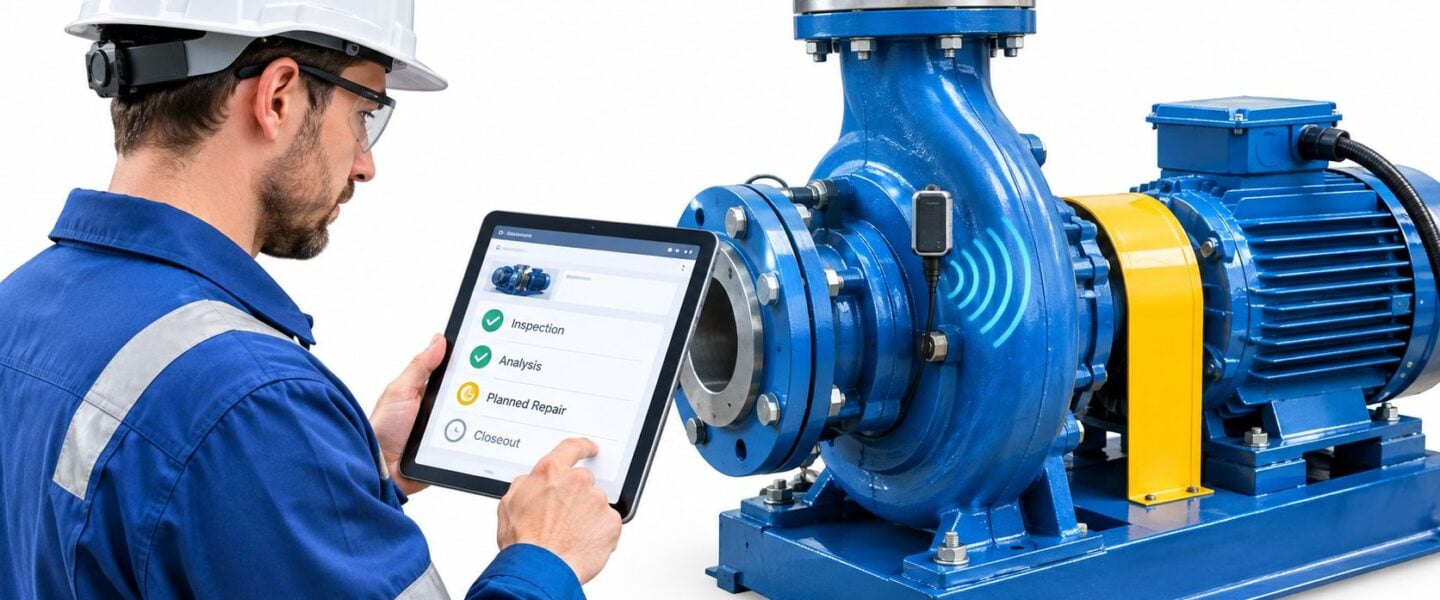
Consider a centrifugal pump with a rising bearing-housing temperature alarm. The operator's observation, vibration readings, and alarm history should feed one structured record tied to the correct pump and bearing. That record can then support screening, a condition-based priority, a parts check, and a planned inspection that records what the technician finds.
This matters even when the backlog looks manageable. A documented industrial case study began with more than 25,000 backlogged work orders, while crews processed roughly 8,000–10,000 every two weeks (1998 industrial maintenance case study). The point isn't that every plant has the same backlog. It's that a raw count says little without age, work type, emergency demand, and labor capacity.
Practical rule: A work order isn't ready because it exists in the CMMS. It's ready when the task, risk, resources, and acceptance criteria are clear.
A useful overview of industrial maintenance types helps teams distinguish planned strategies from reactive work. For the operational resources required to keep maintenance moving, ATEK Distribution for plant operations is a relevant supply reference. A well-designed work-order process lets plant teams build complete fields, screen requests, prioritize by consequence, connect CMMS records to condition data, and audit closed jobs for planning and data quality.
Required Fields and Metadata for Every Work Order
A work order template should make the job easier to execute, not just collect more entries. The useful test for every field is direct: does it help identify the asset, define the work, control risk, coordinate resources, or preserve learning? If not, it probably doesn't belong in a mandatory workflow.
Five field groups that make the record useful
| Field group | Required information | What fails when it's missing |
|---|---|---|
| Identification | Unique order number, asset tag, parent system, location, and requestor | Work gets assigned to the wrong equipment, and reports can't be reconciled to an asset. |
| Scoping | Failure mode, symptoms, trigger source, and job-plan reference | The technician receives a vague complaint instead of a defined task. |
| Safety and isolation | Energy sources, isolation requirements, permit type, and group-lockout coordinator where needed | The crew may arrive without an agreed safe-work method or accountable coordination. |
| Execution | Required craft skills, planned and actual labor, parts consumed, and condition data snapshots | Planners can't compare estimates with actual work or understand the condition that prompted the task. |
| Closeout | Failure and cause codes, as-found and as-left condition, downtime, and follow-up recommendations | Repeat failures disappear into free-text notes, weakening asset history and analysis. |
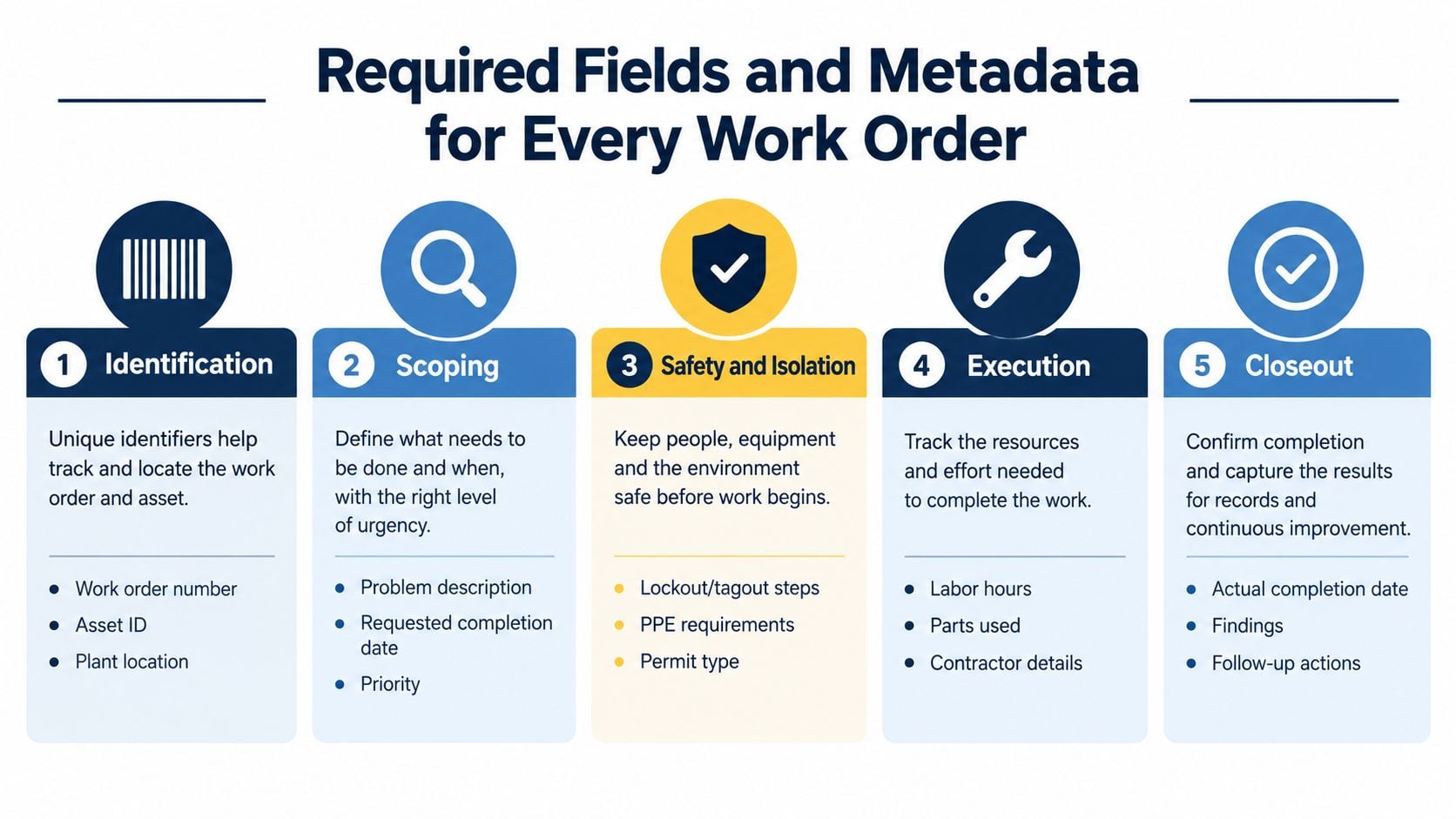
The distinction between failure mode and cause code is important. A failure mode describes how the equipment failed to perform, such as a pump bearing overheating. A cause code records why, such as lubrication breakdown or contamination. Without both, a plant can count repairs but can't reliably distinguish symptoms from mechanisms that need to be eliminated.
That gap undermines more than dashboards. Pareto analysis, which ranks recurring problems by frequency or impact, depends on consistent categories. FMEA, or Failure Modes and Effects Analysis, depends on credible failure histories to assess how equipment can fail and what those failures mean. In a study of 39,093 U.S. Air Force work orders, labor was the primary driver of average work-order cost, and preventive-maintenance activity had an inverse relationship with corrective and emergency labor hours (peer-reviewed work-order studyCF.1943-5509.0001569)). For plant teams, accurate labor-hour and work-type fields are essential to understanding capacity and maintenance burden.
Adaptable CMMS checklist
- Identity: Order number, asset tag, parent system, location, requestor.
- Scope: Symptoms, failure mode, trigger source, job-plan reference, acceptance criteria.
- Safety: Energy sources, isolation points, permit, group-lockout coordination if applicable.
- Resources: Craft skills, planned labor, tools, parts, drawings, and condition data.
- Closeout: Actual labor, parts used, downtime, failure and cause codes, as-found/as-left condition, follow-up.
A required field only helps when it's usable and meaningful. A short, controlled list of failure codes beats a sprawling menu that technicians select at random.
The Request to Closeout Workflow That Actually Holds Up
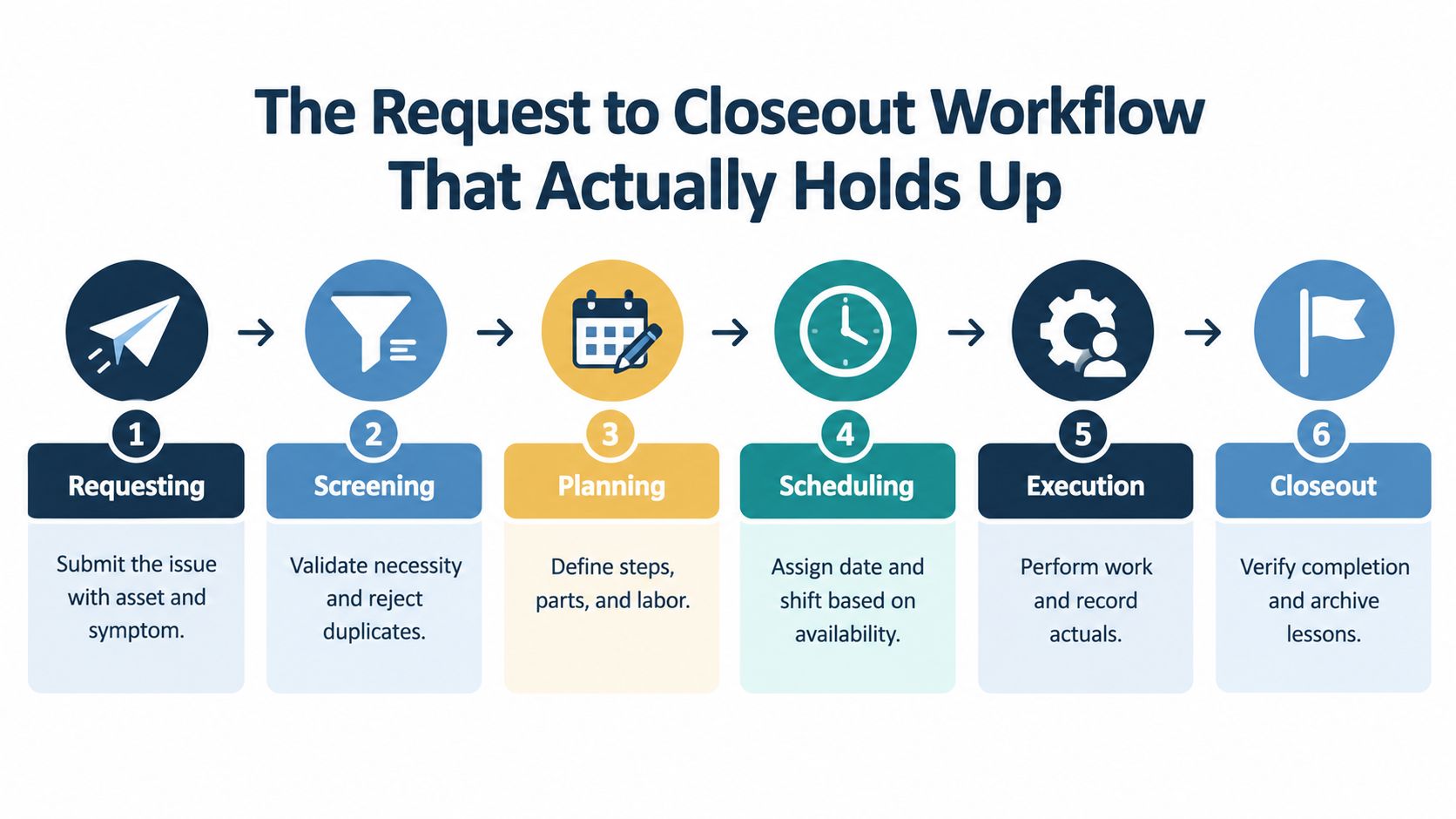
A mature workflow has six stages: requesting, screening, planning, scheduling, execution, and closeout. Each stage needs an owner and a clear handoff. Skipping screening or planning doesn't save time. It transfers unresolved decisions to the technician, usually when the equipment is already unavailable.
Screen before assigning
A request begins with the person who sees the defect. The planner or supervisor screens it against asset identity, the existing backlog, asset criticality, and available evidence. That's where duplicates get merged, vague requests get clarified, and work is accepted, deferred, or rejected with a reason. If a request concerns a gearbox already on the open list, creating another order inflates the backlog without improving control.
Planning turns an accepted request into an executable job. The planner defines scope, safety and isolation needs, craft skills, labor estimate, parts, drawings, and test criteria. Scheduling comes only after readiness: materials, access, permits, and labor capacity must be confirmed before the order receives a slot.
Follow the job through execution and learning
For example, a gearbox condition route flags rising vibration and an operator reports a new noise. The planner attaches the readings, checks the failure history, and scopes an inspection. Operations and maintenance coordinate an outage window; the crew then records the as-found gear and bearing condition, completes the repair, and documents the acceptance test. If the inspection identifies a recurring lubrication or alignment issue, closeout should trigger a revised PM task or a separate corrective action, not leave the finding buried in notes.
Execution belongs to qualified personnel working from the approved scope and safety controls. Closeout belongs to the technician, with supervisor review for exceptions or high-consequence work. Before an order is complete, it should capture actual labor, parts, downtime, failure and cause codes, as-found/as-left condition, and any follow-up work. A “fixed” note isn't a closeout standard.
The reason to fix planning rather than blame technicians is visible in wrench-time measurement. Average direct maintenance time was 28%, with crew results ranging from 20% to 35% and craft-specific results from 13.3% to 45.5% (industrial wrench-time study). Wrench time means direct time spent performing maintenance, rather than waiting or handling delays. Audit closed orders and separately code time lost to parts, permits, production access, missing information, and supervision before drawing conclusions about technician performance. Clear maintenance supervisor responsibilities help establish who owns these handoffs.
Prioritization, Criticality, and When Work Orders Become Safety-Critical
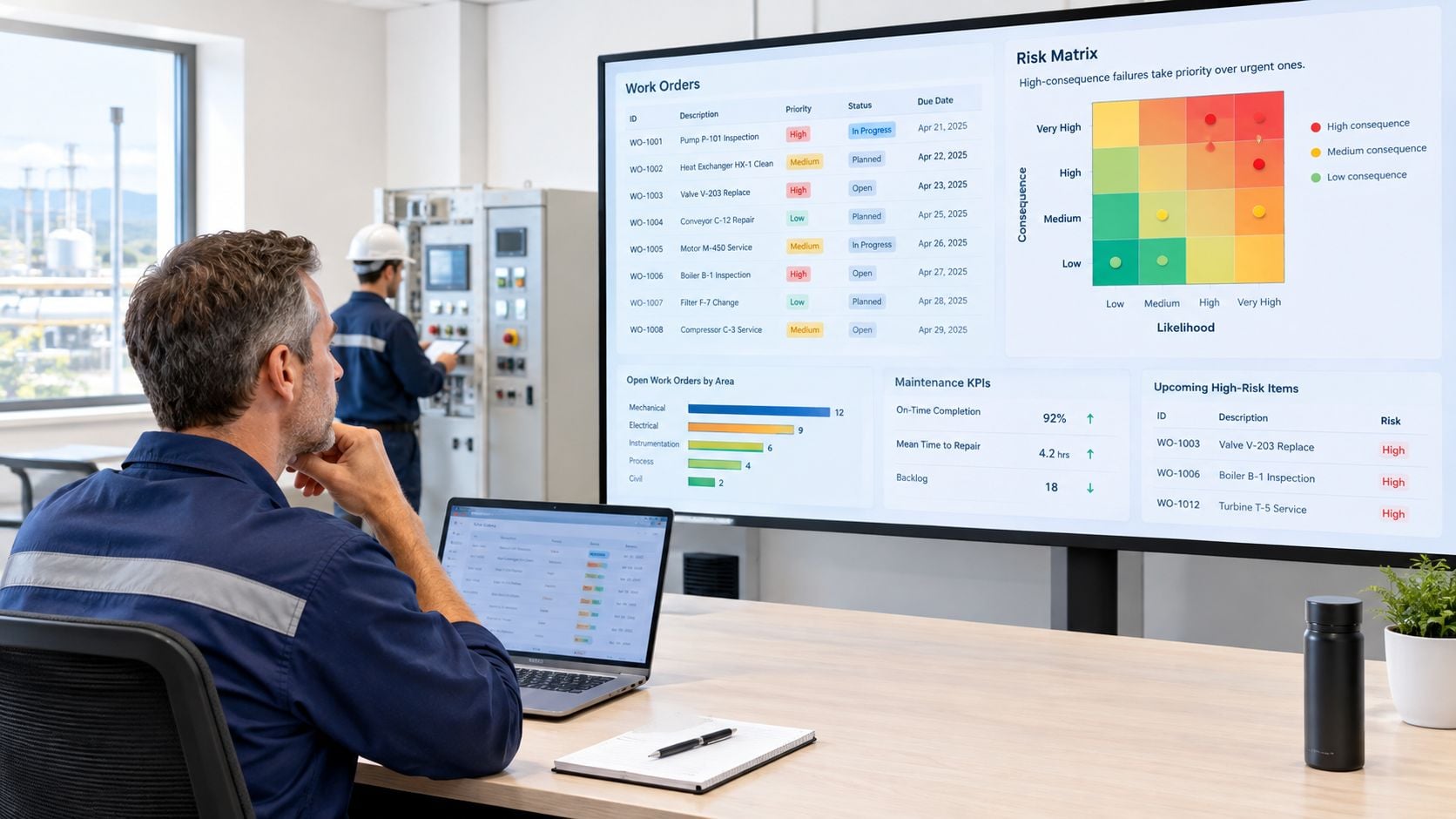
Most priority schemes over-weight urgency and under-weight consequence. A loud complaint or an alarming color on a screen doesn't tell a planner what happens if the job is deferred. Priority should combine asset consequence across safety, environmental, production, and quality outcomes with the probability and mode of failure, using criticality, FMEA, or RCM information.
Turn risk into a resource decision
Priority bands should determine response expectations and resource allocation, not just label the queue. A high-consequence failure mode may warrant immediate screening and a controlled intervention even when the symptom is intermittent. A low-consequence defect may be batched into a planned outage, provided its condition is monitored and the deferral is explicit.
This is also where the work order becomes a safety control. OSHA's hazardous-energy requirements apply to servicing, cleaning, unjamming, lubrication, adjustments, and tool changes when unexpected startup or energy release could injure an employee. For group maintenance, protection must be equivalent to personal lockout/tagout. A coordinating authorized employee implements the energy-control procedure, while each worker applies and removes their own personal device (OSHA group lockout/tagout requirements).
Use a field-level safety gate
For a multi-trade gearbox replacement, the work order should connect the job scope to the plant's permit-to-work and LOTO process. LOTO means lockout/tagout, the procedure for isolating hazardous energy and preventing unexpected release.
- Identify the affected asset and energy sources. Include electrical, mechanical motion, stored pressure, and other relevant hazards.
- List isolation points and verification steps. The crew must establish and verify a zero-energy state before work begins.
- Name the responsible authorized employee. For group work, record the coordinator and group-lockbox arrangements, not just “LOTO required.”
- Document handoffs. Specify contractor coordination, shift-change transfer, and restart authorization.
A checkbox alone can't show who controlled the isolation or whether every worker was protected. Nor should emergency repairs bypass the permit process just because the equipment has already stopped. The practical test is whether the CMMS status and required approvals match the site's actual permit and isolation controls. For risk-based planning tied to labor and equipment constraints, maintenance resource allocation optimization can be considered alongside the plant's own criticality process.
Integrating CMMS, Predictive Monitoring, and Data Governance
A CMMS can create a work order from a condition trigger, but automation doesn't make poor records reliable. A vibration alert without asset identity, trend context, or a defined response can create noise in the queue. The trigger should carry the measurement, threshold or condition that prompted action, and the job plan or screening path that applies.
| Work-Order Trigger Sources Compared | Typical Latency | Data Richness | Planning Effort | Best Used For |
|---|---|---|---|---|
| Manual request | Depends on when someone reports it | Operator description, observations, and attachments | Often high until the issue is clarified | Visible defects, leaks, unusual noise, and operator concerns |
| Route-based monitoring | At the next inspection route and review | Trend readings such as vibration or oil condition | Moderate, with a defined review and planning step | Developing defects that benefit from comparison across readings |
| Continuous monitoring | Alert-based | Time-series condition data and event context | Depends on alarm quality and response rules | Assets where rapid condition change warrants prompt review |
Condition triggers can include vibration thresholds, oil-analysis results, thermography findings, ultrasound alerts, and motor current signature analysis. The plant should define what happens after each trigger: who reviews it, how urgency is assigned, and what evidence is required before a work order is released.
The tougher problem is missing data. Informal operator interventions, deferred defects, and jobs abandoned for production reasons may never make it into the CMMS. That creates a bias toward recorded breakdowns, so a high count of corrective orders can reflect weak reliability, better reporting discipline, or both.
Audit whether history deserves trust
A high-quality maintenance record includes the correct asset, accurate start and finish times, downtime, failure and cause codes, labor hours, and parts consumed. A 90%+ completeness target is recommended in 2025 benchmarking guidance (maintenance benchmarking guidance). The same source reports a survey of 1,320 maintenance professionals in which lack of resources was the leading challenge at 45%, followed by aging infrastructure at 33% and skilled-labor shortages at 30%. Those constraints make a small, consistently completed dataset more valuable than a complex form no one finishes.
Audit failure-code entropy, meaning how scattered or inconsistent failure coding is; repeat-order intervals at the asset level; CMMS downtime against production records; and planned-versus-unplanned labor share. Check operator logs, stores issues, alarms, and production-loss records for events that never became orders. Don't trust raw MTBF, or mean time between failures, across asset-number changes or inconsistent coding. A CMMS asset-management framework should support governance first. Advanced FMEA, RCM, and predictive-maintenance decisions need a credible minimum failure dataset.
KPIs, Sample Templates, and an RCM-Aligned Work Order Example
A useful work-order KPI changes a decision. A plant doesn't need a crowded dashboard; it needs measures that expose whether planned work is getting displaced, the backlog is aging, or repeat failures are consuming capacity. Trends should be reviewed at the level where someone can act on them.
Track measures that point to action
- Planned-versus-unplanned labor share: A rising unplanned share signals reactive demand is crowding out scheduled work. Review emergency causes and protect capacity for risk-ranked planned jobs.
- Schedule compliance: Falling compliance calls for a review of readiness, access, and production coordination, not a demand for more aggressive scheduling.
- Backlog by age band: An aging queue shows which work is repeatedly deferred. Rank it by consequence and disposition each item as scheduled, monitored, or formally deferred.
- Wrench time: Low direct time should trigger analysis of delay codes, parts readiness, permits, and job scope.
- Mean time to repair: A rising measure can point to poor diagnosis, access constraints, missing spares, or an incomplete job plan.
- Repeat-order rate by asset: Recurring orders for the same failure mode call for root-cause work, not another routine repair.
- PM-to-CM ratio: A shift toward corrective work warrants a check of PM quality and whether preventive tasks address actual failure modes.
Planning teams should review readiness, backlog aging, and schedule compliance routinely. Plant leadership needs a concise view of unplanned labor, critical-asset repeat failures, downtime, and safety exposure. A KPI without an owner and a response is decoration.
Liftable work-order template
Order identity: Unique number, asset tag, parent system, location, and requestor.
Trigger and scope: Work type, symptoms, failure mode, trigger source, job-plan reference, and acceptance criteria.
Risk controls: Criticality, energy sources, isolation points, permit requirements, responsible authorized employee, and group-work handoff if applicable.
Readiness: Required craft skills, planned labor, tools, parts, drawings, and access window.
Execution and closeout: Actual labor, parts consumed, downtime, as-found/as-left condition, failure code, cause code, test result, and follow-up recommendation.
RCM example for a standby firewater pump
NASA's RCM methodology starts with what an asset must do, how it can fail functionally, the causes and effects of each failure, and why those failures matter. It then selects proactive tasks, including predictive, preventive, corrective, or failure-finding work. Failure-finding is a specific activity designed to reveal a hidden failure that operators wouldn't normally detect during operation (NASA RCM methodology).
For a standby firewater pump, the defined failure mode could be loss of the automatic start circuit. The work order should require a scheduled start test, confirmation of discharge pressure, inspection of the starting battery and control relay, and recorded pass/fail evidence. That task tests the protective function directly. A generic monthly inspection may confirm that someone looked at the pump, but without a functional test and documented result, it doesn't establish whether the pump will start when demanded. A structured reliability-centered maintenance approach helps tie tasks to failure modes and consequences rather than applying intervals by habit.
Forge Reliability offers reliability consulting, condition monitoring, and CMMS data-governance support to help plants connect work orders with recurring-failure elimination and predictive maintenance. For a no-cost reliability assessment of work-order quality, backlog controls, and condition-based maintenance opportunities, visit Forge Reliability.