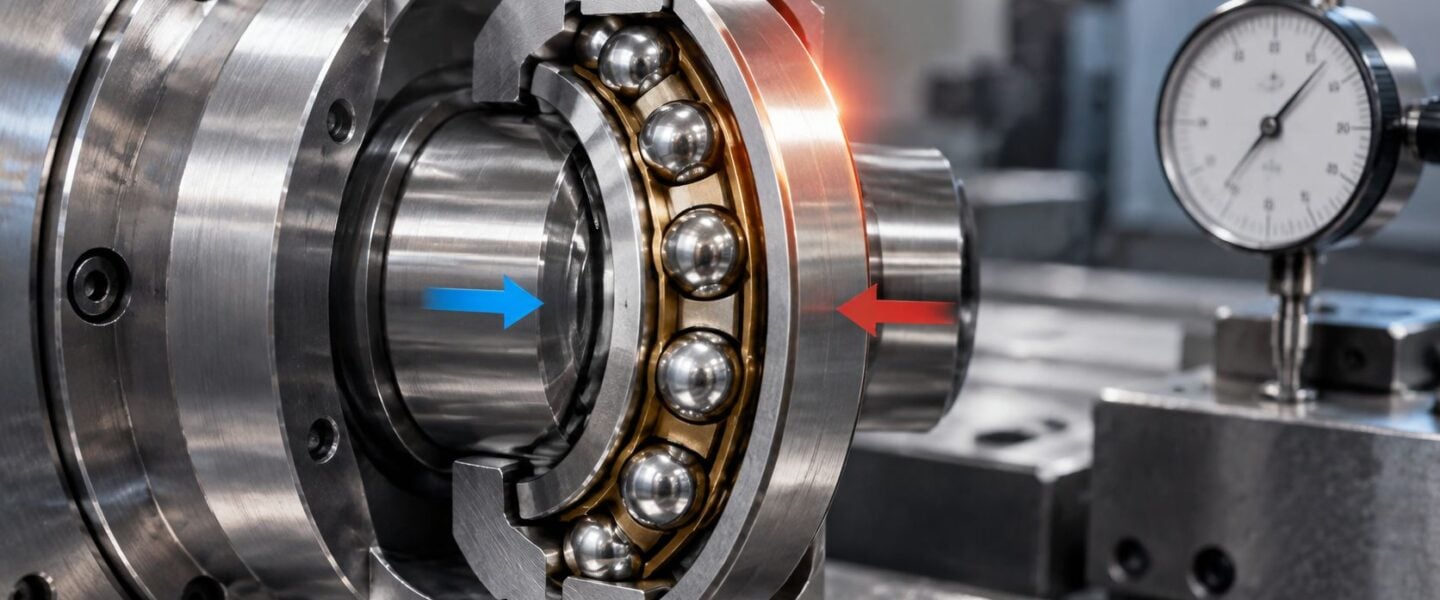
The replacement bearing passes its cold checks, the machine returns to production, and the temperature starts climbing after warm-up. Maintenance has the correct part number and a signed torque record, but the same bearing position is becoming noisy again. Before another replacement goes on the schedule, the team needs to establish whether the bearing's operating preload still matches its intended condition.
Table of Contents
- What Bearing Preload Is and Why It Matters
- Preload Methods for Each Bearing Arrangement
- Why More Preload Is Not Always Better
- How to Set and Verify Preload During Assembly
- Diagnosing Preload Drift From Temperature and Vibration
- A Process Pump Bearing That Failed After Warm-Up
- Decide Whether a Bearing Change Needs a Preload Review
What Bearing Preload Is and Why It Matters
Consider a spindle that runs smoothly on a test stand but chatters at production speed. If unwanted internal clearance allows its rolling elements to lose stable contact and skid, tightening the assembly without measuring the result can exchange a vibration problem for an overheating problem.
Bearing preload is an intentionally applied internal force between the rolling elements and raceways, the tracks on which they roll. In engineering terms, it's negative internal clearance: instead of leaving internal play, the arrangement holds the contact surfaces under load. The bearing preload guidance identifies improved stiffness, reduced noise, better shaft guidance and running accuracy, and reduced skidding risk as principal reasons for applying it.
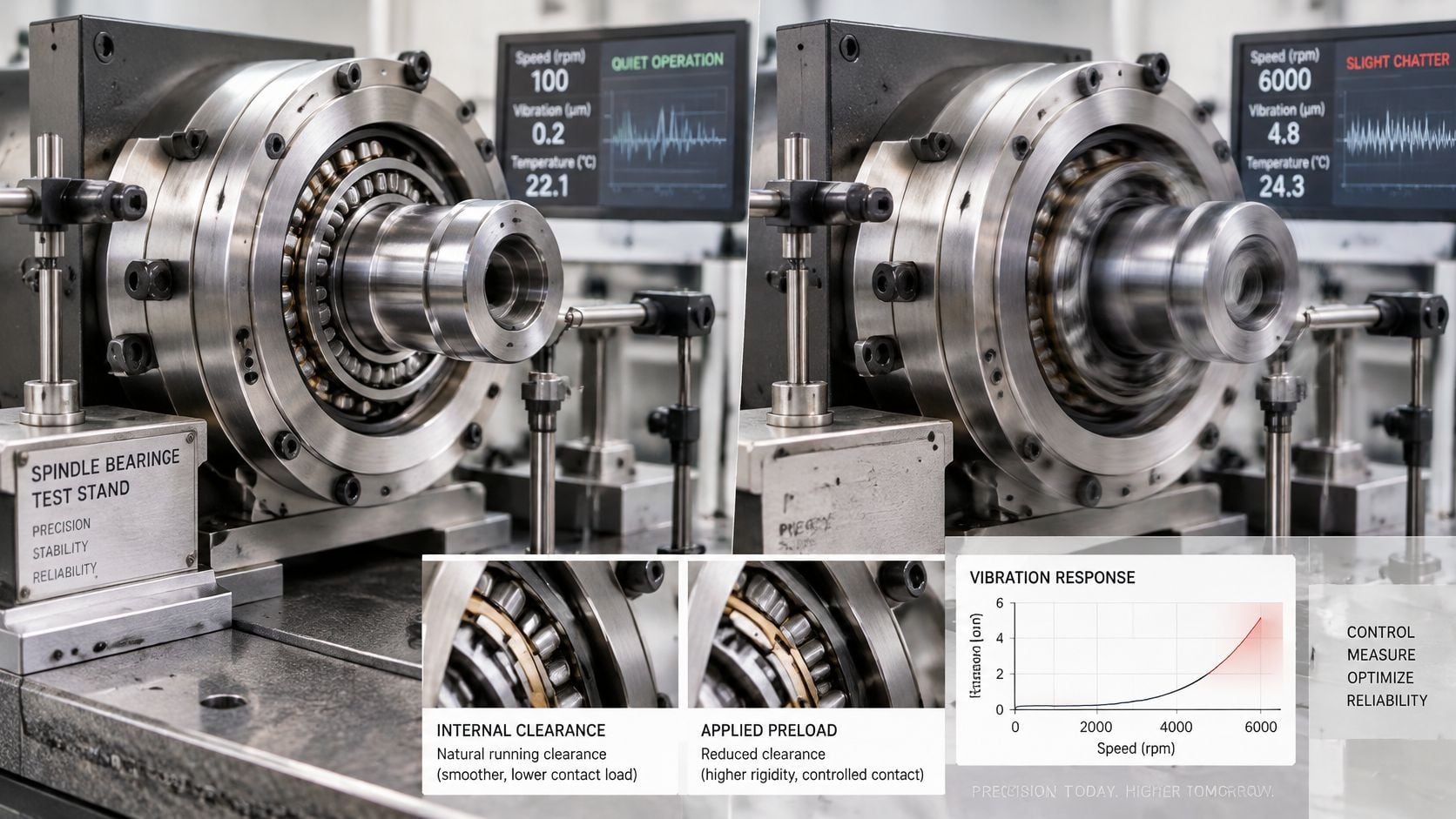
Contact that doesn't go slack
A useful analogy is a shaft held between opposing springs that never go slack. An applied load can shift the balance, but the supporting contacts remain engaged within the arrangement's intended operating range.
The practical benefits are distinct:
- Greater stiffness: The shaft moves less under an applied load.
- Lower noise: Stable contact reduces irregular rolling-element motion.
- Better guidance and accuracy: The arrangement locates the shaft more precisely.
- Lower skidding risk: Contact is maintained during rapid starts, stops, or very light-load operation.
These benefits matter in high-speed spindles, machine-tool screw drives, and precision gearboxes, where small shaft movements can affect machining finish, positioning, or gear contact. Stiffness means resistance to displacement, not an assembly that feels tight by hand.
Practical rule: Preload in bearing arrangements is an engineered contact condition, not a general instruction to tighten until play disappears.
The correct value depends on bearing series, contact angle, internal geometry, size, speed, lubrication, and temperature. Contact angle describes the angle through which the bearing transmits its combined radial and axial load.
For recurring noise or overheating, the reliability record should identify the bearing designation, matched-set class, mounting arrangement, adjustment method, lubricant, and stabilized operating temperature. Without that information, technicians can't reliably distinguish an installation change from an operating-condition change.
Preload Methods for Each Bearing Arrangement
Preload type and setting method by bearing arrangement
| Arrangement | Preload type | How it is set | Verify by |
|---|---|---|---|
| Matched angular-contact pair, back-to-back (DB) or face-to-face (DF) | Axial | Factory class A, light, or B, moderate, where specified, or spacer length | Axial displacement or frictional torque |
| Tapered roller bearing pair | Axial setting, expressed as end-play or intentional preload | Shim pack or specified locknut procedure, shaft rotated during setting | Rotation torque and axial play at the adjusting nut |
| Super-precision cylindrical roller bearing | Radial | Specified ring offset via shims or clamping | Radial displacement and running temperature |
| Angular-contact thrust ball bearing, screw drive | Axial | Spring or hydraulic preload where designed | Spring force and temperature trend |
| Deep groove ball bearing | Usually none; clearance near zero or slight preload | Specified fit and clamping | Temperature and vibration baseline |
| Spherical or CARB toroidal roller bearing | None; residual clearance required | Clearance set by fit and internal design | Operating clearance, not preload |
The table separates load direction, adjustment method, and acceptance measurement. Axial means along the shaft; radial means perpendicular to it. Understanding radial versus axial load prevents a common mistake: treating an axial mounting movement as proof that the resulting preload is also axial.
Matched angular-contact pairs
Matched bearings have controlled face relationships that establish the intended condition when assembled correctly. DB and DF describe the orientation of their contact lines, not interchangeable installation choices. Spacer length can also establish the relative positions of the rings.
Factory class labels apply only where the relevant product specification defines them. Class A and class B shouldn't be treated as universal labels across bearing families. Sets containing additional bearings may require a heavier preload specification, but technicians shouldn't achieve that by adding an arbitrary amount of nut torque.
A fixed spacer controls position. A spring can accommodate axial thermal movement while maintaining relatively constant force, while a designed hydraulic system can vary force with operating conditions, as described in the super-precision preload guidance.
Tapered rollers and retained clearance
For tapered roller pairs, end-play means measurable axial freedom. Positive end-play and preload aren't the same condition, even though the same adjustment mechanism can establish either.
During adjustment, rotating the shaft several revolutions helps the rollers seat against the guide flange, the ring feature that guides their ends. Measuring an unseated assembly can produce an apparently acceptable setting that changes after startup.
The preload, clearance, and stiffness guidance specifies arrangement-dependent selection and verification by force, displacement, or frictional torque. It also supports calculating a preload range with a bearing-system model and confirming it through application testing.
Residual clearance is intentional, not an unfinished preload adjustment. Ordinary cylindrical roller arrangements, spherical roller bearings, and CARB toroidal roller bearings shouldn't be treated like specially designed preloaded spindle bearings. Preload values aren't standardized across manufacturers or product families, so the exact product table remains the controlling reference.
Why More Preload Is Not Always Better
In a paired arrangement, external axial load increases the load on one bearing while unloading the opposing bearing. At the natural lifting force, the external force at which the opposing bearing loses its preload contact, that bearing can become vulnerable to skidding. Skidding occurs when a rolling element slides rather than maintaining its intended rolling motion. The operating envelope therefore needs to include thrust reversals, startup, shutdown, and minimum-load operation.
Preload selection is a window with a failure mode at each edge.
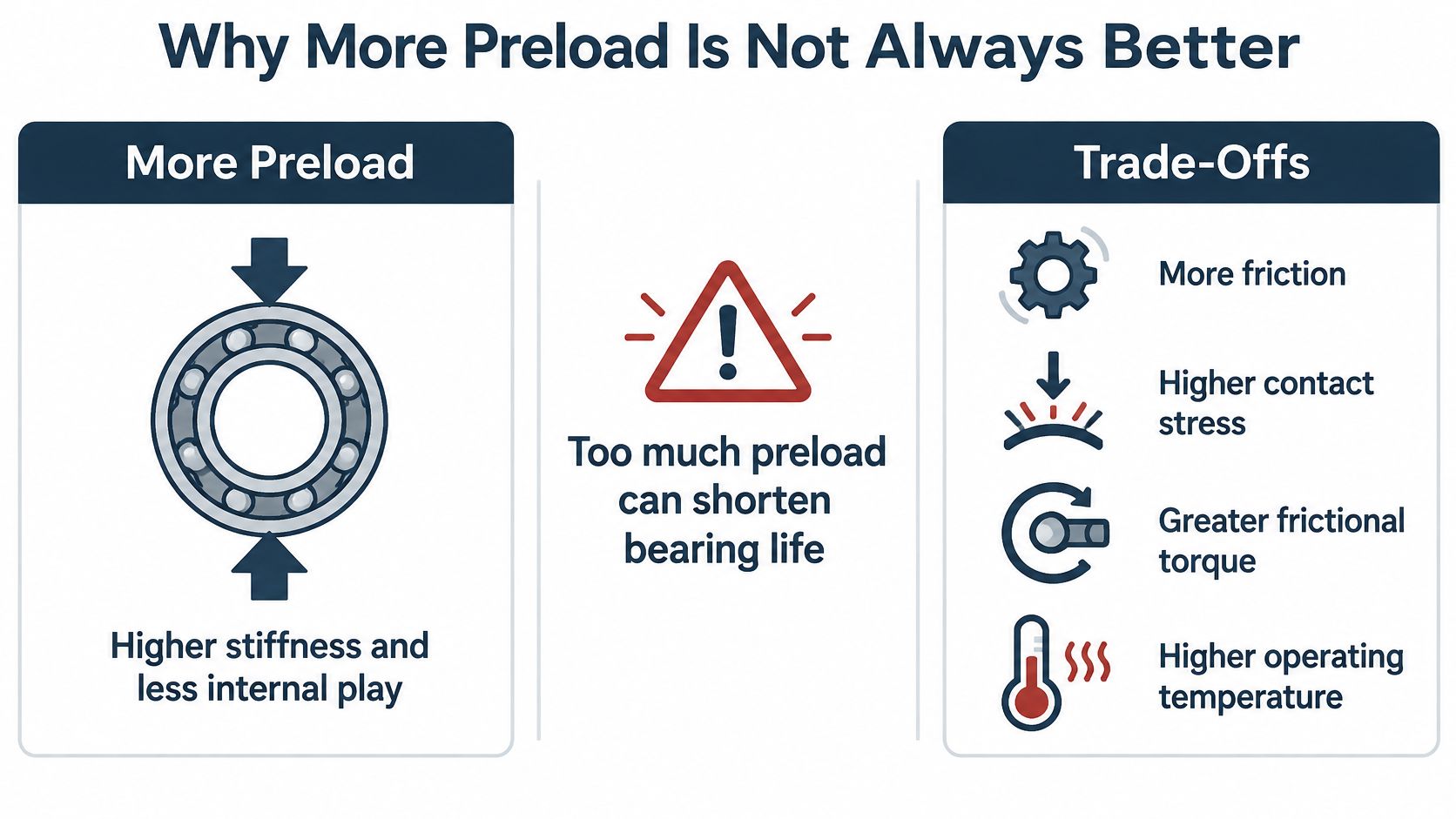
The operating window has two boundaries
Excessive preload increases rolling and sliding friction, contact stress, frictional torque, and temperature. Frictional torque is the turning resistance generated by the bearing and its associated contacts. Continued overheating can degrade lubricant, damage roller side faces, and accelerate fatigue. A cooler, lightly loaded test run doesn't establish that a heavier setting will remain acceptable at production speed.
Insufficient preload permits unstable contact, skidding, vibration, and loss of positional control. Surface marks must still be interpreted carefully: fluting, a pattern of repeated raceway ridges, isn't proof of under-preload because electrical damage can produce similar evidence.
| Setting error | Immediate concern | Reliability consequence |
|---|---|---|
| Excessive preload | High contact load and frictional heat | Lubricant damage and premature fatigue |
| Insufficient preload | Unloading and unstable rolling motion | Skidding, vibration, and positioning error |
Assembly Force Sets Installed Preload, Not Operating Preload
For certain universally matchable arrangements, the preload and stiffness guidance describes class A as light and class B as moderate, notes that sets containing three or four bearings generally receive heavier preload than two-bearing sets, and gives a documented tapered-roller application with an inner-ring clamp force of 80–100 kN.
That figure is the force that seats the rings and establishes the installed preload. It says nothing about the contact load the bearing carries once the machine is running and thermal growth has moved the rings.
The target is the lowest controlled preload that prevents unacceptable unloading while meeting the application's stiffness and positional requirements.
Choose the lightest preload the design allows that still prevents unloading. A structured investigation of bearing failure mechanisms should connect the setting to the damage rather than assume that additional tightening improves reliability. A cold setting can produce a substantially different operating condition once the machine reaches operating temperature, and the assembly record is what lets you trace that shift back to a specific decision.
How to Set and Verify Preload During Assembly
The procedure must establish the specified contact condition without allowing fit errors, ring distortion, or incomplete records to conceal an incorrect installation.
Confirm the exact bearing configuration. Check the designation, matched-set class, and arrangement against the applicable product table. The common slip is accepting a similar bearing with a different suffix, internal geometry, or preload class because its external dimensions match.
Measure the shaft and housing seats. Use micrometers, bore gauges, and suitable runout and geometry checks. Cylindricity describes departure from a true cylinder; perpendicularity describes squareness; concentricity concerns the alignment of component centerlines. The angular-contact mounting guidance explains that excessive interference and seat geometry errors can increase installed preload. An oversized shaft seat can add interference without an obvious visual change.
Verify pair orientation before clamping. Confirm DB or DF orientation from the design and bearing markings. A correctly identified bearing installed backward doesn't create the intended arrangement, and orientation errors become harder to detect once spacers and covers conceal the faces.
Install the specified spacer, shim pack, or adjusting nut. Keep mating faces clean and check that shoulders seat fully. Rotate tapered roller assemblies during adjustment so the rollers settle against their guide flange. The frequent mistake is recording nut torque before the bearing has seated, then treating that number as the completed acceptance check.
Measure the result using the specified method. Verify force, axial displacement over a defined movement, or frictional torque. Use calibrated springs when the design requires controlled spring preload. Seal resistance and lubricant drag can affect turning resistance, so a total shaft torque reading shouldn't automatically be treated as bearing friction alone.
Create a usable assembly record. Enter measured torque or displacement, shaft rotation resistance, spacer or nut dimensions, lubricant, ambient temperature, and assembly temperature in the computerized maintenance management system, or CMMS. A checked box marked installed correctly can't support a later thermal-growth investigation.
Run to thermal stabilization. Compare temperature, vibration, and motor current with a healthy baseline at comparable speed and load. Thermal stabilization means temperatures have settled under the operating condition being evaluated. Stopping the acceptance run while the temperature is still rising leaves the operating preload unverified.
Revalidate after changes that affect the bearing system. Housing or shaft replacement, bearing interchange, coupling work, lubricant changes, and speed changes can invalidate the previous acceptance record. The common slip is assuming that an unchanged part number means unchanged operating conditions; it doesn't.
Make acceptance repeatable
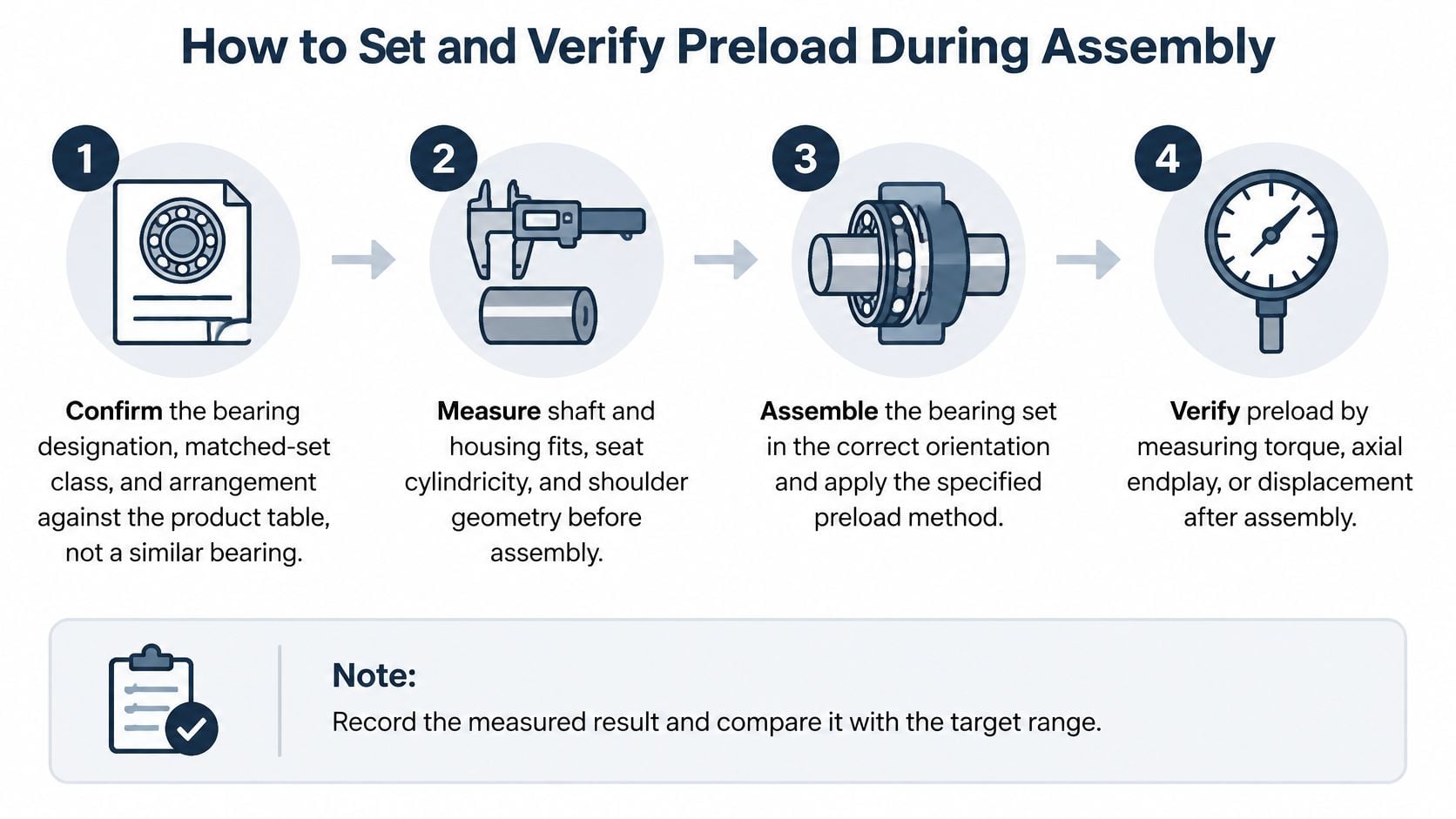
The acceptance record should contain both the target range and the measured result, with the measurement method identified. A reading without its method, temperature, or assembly state can be misleading during the next overhaul.
Installation control: A torque record documents an action. A measured setting and stabilized operating trend document the result.
A practical bearing selection and installation plan should assign responsibility for dimensional inspection, assembly verification, and commissioning data before the machine returns to production.
Diagnosing Preload Drift From Temperature and Vibration
Temperature rising after warm-up, accompanied by increasing current or torque, deserves an immediate preload review. Shaft and housing temperatures change fits and internal clearance, so a bearing can pass a cold check yet operate outside its intended range after warming. The operating preload guidance identifies differential shaft and housing temperatures as a factor in preload and notes that back-to-back arrangements are less thermally sensitive than face-to-face arrangements.
Preload drift symptoms, likely causes and first checks
| Symptom | Likely cause | Check first |
|---|---|---|
| Temperature rises after warm-up with current or torque up | Excess or thermal preload growth | Shaft-to-housing temperature difference and axial displacement |
| Broadband vibration or high-frequency energy rising | Preload or fit outside design range | Spectrum at bearing frequencies and housing fit |
| Fluting or skid marks on rollers | Insufficient preload or light load for skid marks; electrical damage must also be checked for fluting | Minimum radial load, axial load reversals, and electrical damage evidence |
| Discolored or coked lubricant | Excess preload or lubricant starvation | Oil level, viscosity, and wear metals |
| Vibration peaks at shaft speed and twice shaft speed | Misalignment or imbalance may be involved, not necessarily preload | Alignment and balance readings before changing preload |
| Temperature rises with no vibration change | Seal drag or grease overfill are possible | Seal condition and grease fill quantity |
Separate correlated symptoms from proof
Record speed, process load, ambient conditions, lubricant condition, and measurement locations with every trend. A hotter shaft can change effective preload, but housing surface temperature alone doesn't reveal the internal contact force.
Broadband vibration means energy spread across a frequency range rather than concentrated at a single frequency. Rising high-frequency energy warrants comparison with bearing defect frequencies, the characteristic repetition rates associated with rolling-element and raceway defects. Neither observation uniquely identifies preload.
Misalignment can produce strong components at shaft speed and twice shaft speed; imbalance often produces a prominent shaft-speed component. Those patterns require supporting phase, directional, alignment, and balance measurements. Seal drag and excessive grease can raise temperature without an immediately obvious change in vibration.
A bearing fault detection assessment using vibration analysis should therefore compare the spectrum with the operating history before anyone changes the setting. Forge Reliability deploys continuous vibration monitoring at all bearing locations to detect blade erosion, imbalance, and bearing degradation, and performs lube oil analysis to track bearing wear metals and oil condition.
Add ultrasound and displacement measurements
Ultrasound readings, expressed in decibels, should be collected at repeatable housing locations using consistent instrument settings. Comparison with a healthy baseline can reveal increasing friction-related noise associated with skidding or lubrication problems, sometimes before conventional vibration trends become obvious. Ultrasound alone can't distinguish those mechanisms.
For axial play, mount a dial indicator against the adjusting nut or shaft end and apply the specified reversing axial force with the machine safely isolated. Compare movement with the product-table end-play requirement. An out-of-range reading confirms an unacceptable setting or movement condition, but further checks are needed to establish whether preload drift, wear, or looseness caused it.
Steam turbine journal bearings require a different interpretation because they support the shaft on an oil film rather than rolling elements. Their key wear symptom is increasing shaft orbit size with higher bearing metal temperature. An orbit plot traces shaft motion, and oil analysis helps determine whether bearing wear or lubricant deterioration accompanies the change.
A Process Pump Bearing That Failed After Warm-Up
The drive-end bearing on a process pump was replaced twice in six months. In this hypothetical case, both replacements pass the cold assembly check, then temperature begins climbing about ninety minutes into operation. The operator also records rising motor current, and the vibration trend shows increasing broadband energy. I would treat the second failure at the same position as a reason to inspect fits before ordering another bearing. The repeated warm-up pattern gives a better starting point: compare the assembly record with the machine's thermal behavior.
Follow the operating sequence
The team records shaft and housing temperatures at comparable speed and process load. The shaft runs hotter than the housing. The internal clearance and preload guidance explains that a large shaft-to-housing temperature difference can reduce internal clearance enough to produce unwanted preload and high operating temperatures.
During the planned shutdown, dimensional inspection finds a housing shoulder out of square to the bore axis and excessive interference at the shaft seat. The shoulder tilts the bearing's seating condition, while the shaft fit further reduces internal clearance. The cold acceptance check cannot capture the resulting condition at operating temperature.
Loosening the locknut to make the shaft turn more freely would be the wrong correction. It can compromise retention without fixing either dimensional defect.
| Evidence in the scenario | Maintenance decision |
|---|---|
| Heating follows the warm-up cycle | Evaluate the stabilized operating condition |
| Shaft runs hotter than housing | Assess thermal clearance reduction |
| Seat geometry and interference are outside specification | Restore dimensions before installing another bearing |
| Previous records contain torque but incomplete fit measurements | Expand the CMMS acceptance record |
Correct the system before the replacement
The repair restores shaft interference to the approved tolerance and corrects the housing shoulder geometry. The team then establishes the clearance or preload specified for that exact bearing arrangement, rather than assuming every pump bearing should operate preloaded. Fit measurements, assembly torque, lubricant, and stabilized temperatures go into the CMMS. Commissioning includes current and vibration trends under comparable process conditions, so the repair has a measurable acceptance basis.
For a centrifugal pump reliability decision, the lesson is direct: replacing a bearing does not correct a defective seat or fit. Temperature trends become diagnostic evidence only when read alongside speed, load, lubrication, and the dimensions that established the installed condition.
Decide Whether a Bearing Change Needs a Preload Review
Trigger a preload review when the same position is replaced twice, when heating follows warm-up with rising current or torque, or when broadband and bearing-frequency vibration keep climbing. Preload drifts in service. Temperature, vibration, and the next teardown only mean something when they are set against the assembly record that fixed the original setting.
Build that comparison before the bearing is ordered:
- Retrieve the position history. Collect the exact designation, matched-set class, arrangement, spacer or nut dimensions, measured setting, lubricant, and stabilized operating temperature.
- Match the last teardown to those records. Skid marks, discoloration, coked lubricant, and fluting call for separate checks on fit, heat, lubrication, and shaft current.
- Fill the missing dimensions. Measure shaft and housing sizes on this machine and write them into the work order.
- Order against the exact product specification. Schedule setting verification and warm-up trending inside the planned outage.
In Forge Reliability's predictive maintenance programs, roughly 80% of mechanical failures are caught with 200 to 1,500 hours of lead time, depending on the failure mode. Planners use condition monitoring to pick that outage window. For a bearing already heating after warm-up, set the review to the window you have, because lead time changes with the failure mode.
Forge Reliability offers a free reliability assessment of bearing preload, installation controls, vibration data, and recurring rotating-equipment failures. Before the next replacement, visit Forge Reliability to request a review that connects assembly records, warm-up trends, and teardown evidence to a practical corrective plan.