A maintenance kaizen works best when it targets one high-impact loss stream, not broad waste reduction. Durable gains come from connecting the event to predictive maintenance data and RCM asset criticality decisions, with the implementation study identifying preparation at 16.056%, process control at 10.286%, and planning at 9.996% as leading success factors in a manufacturing kaizen study.
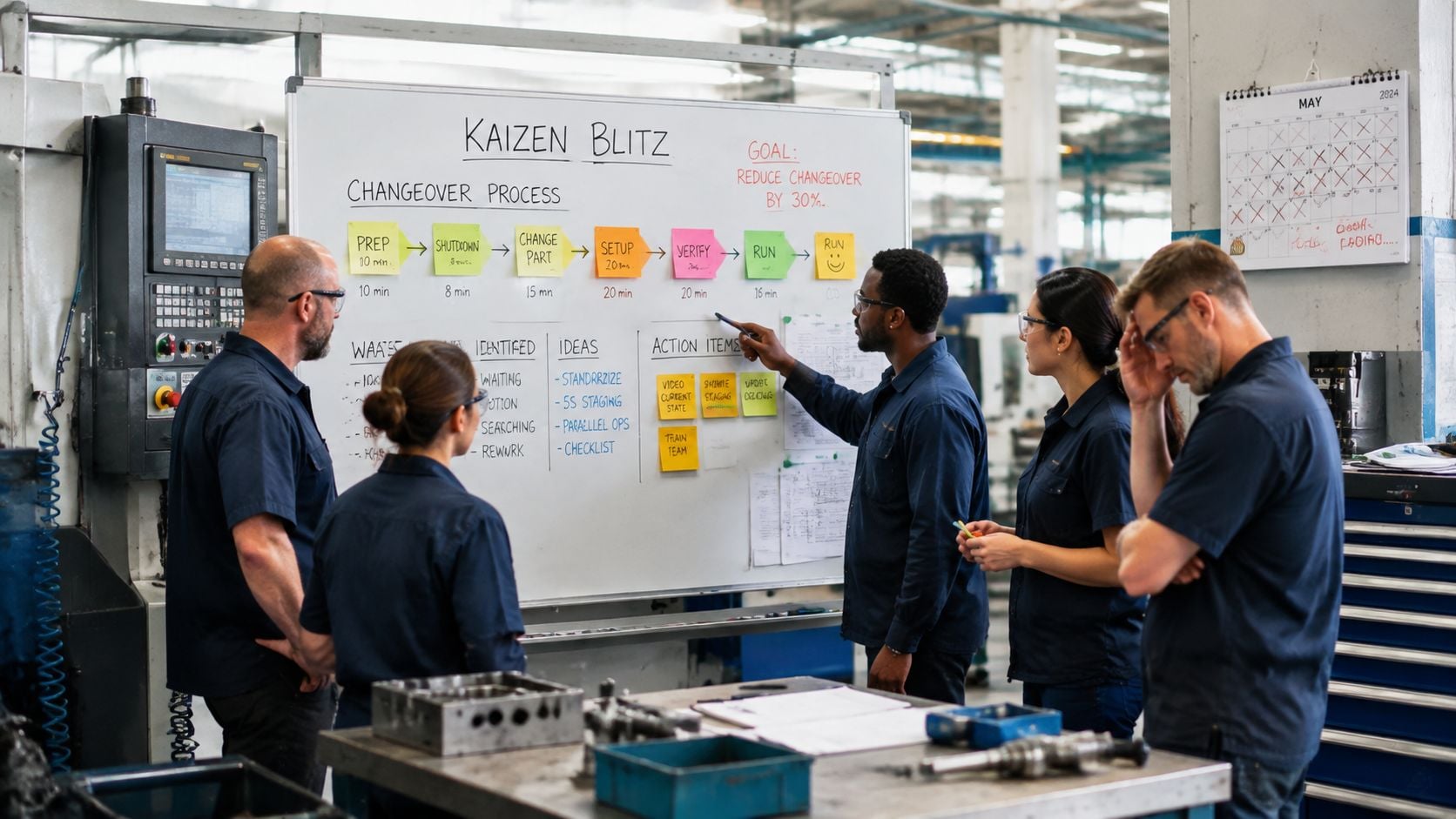
A familiar scene plays out in many plants. A team runs a kaizen blitz to shorten a pump changeover, reorganizes tools, creates a new checklist, and celebrates a faster restart. A few weeks later, the same pump is down again because the loss was a recurring seal failure driven by misalignment, contaminated oil, or an ineffective lubrication task. The event improved motion and housekeeping, but it never addressed the failure mechanism.
That distinction separates generic kaizen from reliability-centered kaizen. Lean removes activities that don't create value, while kaizen creates a disciplined habit of employee-driven improvement. Maintenance adds another requirement: every improvement must account for equipment condition, hidden failure modes, asset criticality, and the quality of the data stored in the CMMS.
Table of Contents
- Why Lean and Kaizen Transform Maintenance Programs
- Planning Your First Kaizen Event for Maintenance
- Linking Kaizen to Predictive Maintenance and RCM
- Practical 5S and Standardized Work for Maintenance Teams
- Measuring Kaizen Impact on Maintenance Metrics
- Common Kaizen Pitfalls in Maintenance and How to Avoid Them
- Your Action Plan to Start with a Free Reliability Assessment
Why Lean and Kaizen Transform Maintenance Programs
Toyota's modern organizational roots for kaizen are commonly traced to its postwar improvement system. Toyota launched its Creative Idea Suggestion System in 1951, adopted the motto “Good Thinking, Good Products” in 1953, and by 1973, roughly 43,000 employees submitted more than 250,000 suggestions in one year, with well over half implemented. By the system's 30th anniversary in 1981, annual suggestion volume had reached 1.4 million, demonstrating how kaizen developed from a shop-floor idea into a management discipline centered on continuous, employee-driven improvement as documented in this history of kaizen.
Lean later moved beyond Toyota's production system. The U.S. Environmental Protection Agency describes lean implementation in American automotive and aerospace sectors during the 1980s, and notes that nearly 70% of U.S. plants had adopted lean manufacturing as an improvement methodology by the 2007 IndustryWeek/Manufacturing Process Improvement Census of Manufacturers in its guide to lean and Six Sigma. For maintenance leaders, the important point isn't historical trivia. Lean became powerful because it provided a system for identifying and eliminating waste, while reliability engineering explains why equipment creates that waste in the first place.
The maintenance gap
A production kaizen can often show immediate improvement by removing unnecessary movement, waiting, excess inventory, or rework. Equipment reliability behaves differently. A bearing may be deteriorating for months before a failure stops a line. A compressor trip may result from lubrication breakdown, cooling restriction, process upset, or a control-system interaction. A CMMS may record each incident as “mechanical failure,” which hides the actual recurring cause.
That's why a changeover event can succeed operationally and still fail as a reliability intervention. If the team doesn't examine failure history, vibration trends, oil condition, thermography, motor current, or inspection quality, it may optimize the response to failure rather than prevent the failure.
Practical rule: A maintenance kaizen should improve a defined failure or loss mechanism, not simply make the work area look more organized.
From event activity to asset improvement
The strongest approach treats kaizen as an asset-improvement loop:
- Define the problem and its production consequence.
- Measure the current-state loss using work orders, downtime records, and condition data.
- Identify the likely failure mechanism through root-cause analysis.
- Test one countermeasure.
- Verify the result with the same metric and condition-monitoring signal.
- Standardize the change in the maintenance system.
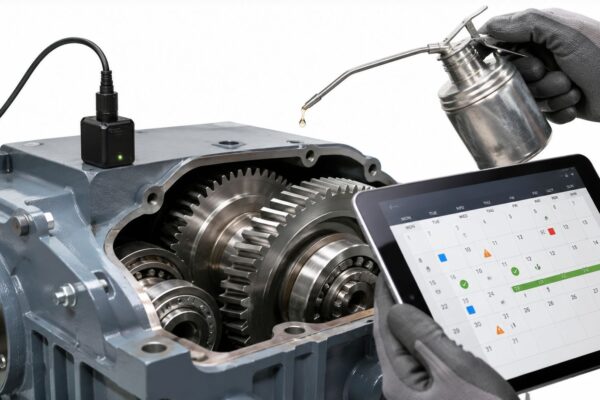
A recurring pump seal failure provides a useful example. The team may discover that technicians install seals correctly but receive no alignment check after motor replacement. The countermeasure might combine soft-foot verification, laser alignment, a revised work instruction, and vibration confirmation after startup. That is different from staging tools closer to the pump.
Maintenance leaders should also review the basics of their operation and maintenance practices before selecting the event. If asset records, task instructions, failure codes, or job plans are unreliable, preparation must include data cleanup. The kaizen event cannot compensate for a maintenance system that doesn't describe the equipment accurately.
Planning Your First Kaizen Event for Maintenance
The first event should be narrow enough to finish and important enough to matter. A broad objective such as “improve maintenance efficiency” gives the team no clear boundary, no defensible baseline, and no reason to stop investigating. A better objective identifies one asset, one loss stream, and one outcome, such as recurring bearing failures on a packaging-line pump measured through unplanned downtime and mean time between failures.
Select the loss stream
Start with CMMS work orders, downtime reports, operator logs, and condition-monitoring records. Rank candidates by production impact, safety or environmental consequence, recurrence, and the quality of available evidence. A highly critical compressor with poor data may require a deeper reliability study before a short event, while a moderately critical conveyor with a well-understood lubrication failure may be suitable for a focused quick win.
| Situation | Suitable kaizen scope | First evidence to gather |
|---|---|---|
| Repeated failure, clear cause, accessible asset | Quick countermeasure event | Failure history, job plans, operator observations |
| Critical asset, uncertain failure mechanism | Deeper asset-improvement loop | RCM criticality, FMEA, predictive trends, failure records |
| Low criticality, high administrative waste | Process kaizen | Work-order flow, approval delays, material availability |
| Poor asset or failure data | Preparation before event | Asset hierarchy, failure codes, task history |
A food and beverage plant might select a packaging-line pump that repeatedly stops because of a bearing problem. The team can examine lubrication type, quantity, application method, contamination exposure, bearing temperature, and vibration measurement location. The objective should specify the desired maintenance outcome, such as improving MTBF or reducing corrective work, rather than using a vague productivity label.
Build the baseline before the meeting
The baseline needs more than a downtime total. Record the affected asset, failure mode, operating context, detection method, repair steps, parts used, labor, and restart conditions. Check whether technicians have been using the same failure code for seal damage, coupling problems, bearing damage, and motor faults. Poor coding can create an apparent pattern that doesn't reflect the physical cause.
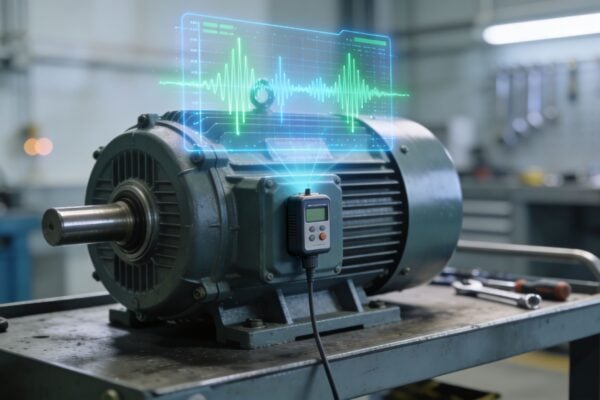
Condition monitoring supplies the technical reference point. For the pump, capture vibration spectra and overall readings at repeatable locations, inspect oil or grease condition where applicable, and document process conditions such as flow, temperature, and operating speed. The event then has a before-state that can be compared with a post-change state.
Design the event around people and control
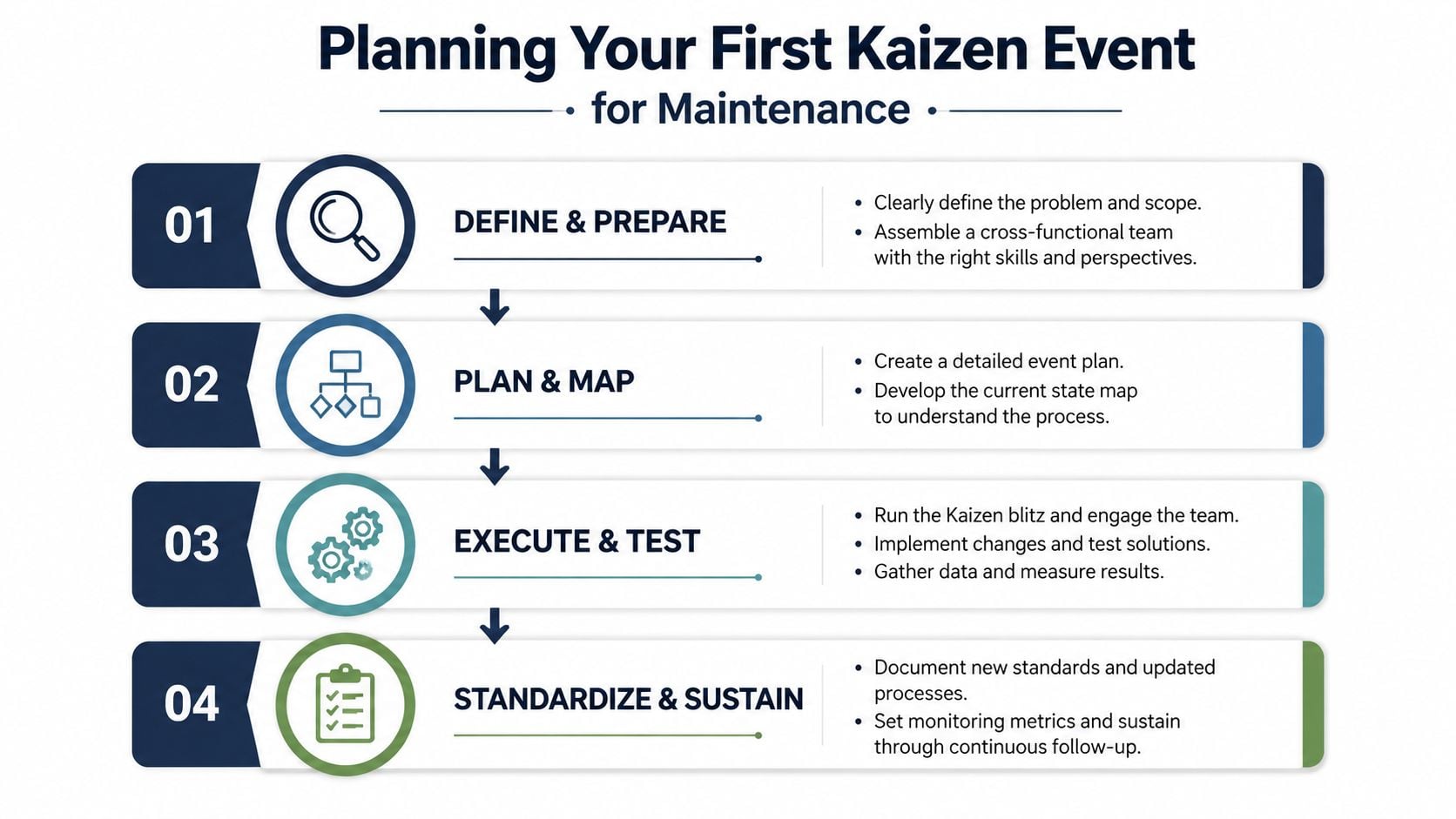
A practical team includes a maintenance technician who performs the work, a reliability engineer who frames the failure mechanism, an operations representative who understands operating behavior, and a planner or supervisor who can change job plans and schedules. The group should have authority to test the countermeasure and a named owner responsible for sustainment.
Use the event to produce tangible controls:
- Standardized task: Define the exact lubrication, inspection, alignment, or torque sequence.
- Visual control: Mark access points, grease points, tool locations, or inspection positions.
- Measurement plan: Specify the metric, collection method, owner, and review date.
- CMMS update: Revise the preventive-maintenance task, failure code, bill of materials, and job plan.
- Follow-up cadence: Review the result after implementation, then continue checking the condition trend.
A one-point lesson can support the new method when technicians need a concise visual reference. The one-point lesson example should be treated as a task-control document, not a substitute for technical diagnosis. It needs the correct asset, task sequence, acceptance criteria, and escalation point.
Linking Kaizen to Predictive Maintenance and RCM
Reliability-centered maintenance, or RCM, determines what an asset must do, how it can fail, what causes each failure, and which maintenance task is technically justified. Criticality ranking adds consequence to that analysis. An asset that can stop a high-throughput process, create a safety exposure, or damage a batch deserves more disciplined kaizen investment than equipment with limited operational consequence.
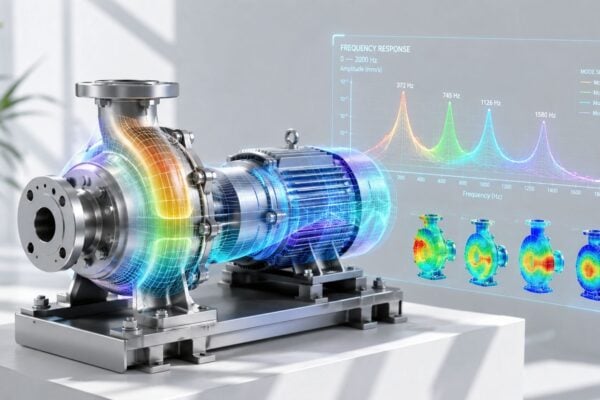
Predictive maintenance supplies the evidence. Vibration analysis can expose imbalance, misalignment, looseness, and bearing deterioration. Oil analysis can indicate contamination, wear, or lubricant degradation. Thermography can identify abnormal electrical or mechanical heating. Motor current signature analysis can reveal electrical and driven-equipment conditions. These techniques become more valuable when the event uses them both to establish the baseline and to verify that the countermeasure changed the failure path.
A compressor trip example
Consider a compressor that trips repeatedly during production. The first response may be to reset the trip, replace a component, or adjust an alarm threshold. A reliability-centered kaizen team instead defines the trip condition, reviews operating history, checks condition data, and applies the Five Whys method. Five Whys asks “why” repeatedly to move from a visible symptom toward a controllable underlying cause as described in this explanation of Five Whys root-cause analysis.
A maintenance example can follow this chain: the compressor trips because of high temperature, the motor overheats because cooling is inadequate, cooling is inadequate because the fan has failed, the fan has failed because its bearing seized, and the bearing seized because a lubrication task was missed. A comparable conveyor example follows a stopped conveyor to motor overheating, a failed cooling fan, a seized bearing, and finally a missed lubrication task on the preventive-maintenance schedule as outlined in this maintenance root-cause example.
The countermeasure should address the verified cause. That may include a revised lubrication interval, a specified lubricant, a contamination-control step, a visual confirmation, and a CMMS task with clear ownership. The team should also use temperature or vibration data to confirm that the bearing remains healthy after the change.
Test, verify, standardize
Testing one countermeasure at a time makes attribution easier. If the team changes lubrication, alignment, bearing specification, and operating speed simultaneously, a favorable result won't show which change mattered. A staged approach also limits the risk of introducing a new failure mode.
The new control belongs in the reliability system. Update the RCM task, PM schedule, route instructions, asset history, spare-parts information, and escalation rules. For teams comparing approaches across mobile or distributed assets, a practical 2026 fleet guide to predictive maintenance can provide useful context for organizing condition data and maintenance decisions beyond a single plant.
A sound reliability-centered maintenance framework also prevents kaizen from becoming a collection of isolated events. The event improves a task or failure response, RCM confirms that the task remains technically appropriate, and predictive monitoring checks whether the physical condition supports the decision.
Practical 5S and Standardized Work for Maintenance Teams
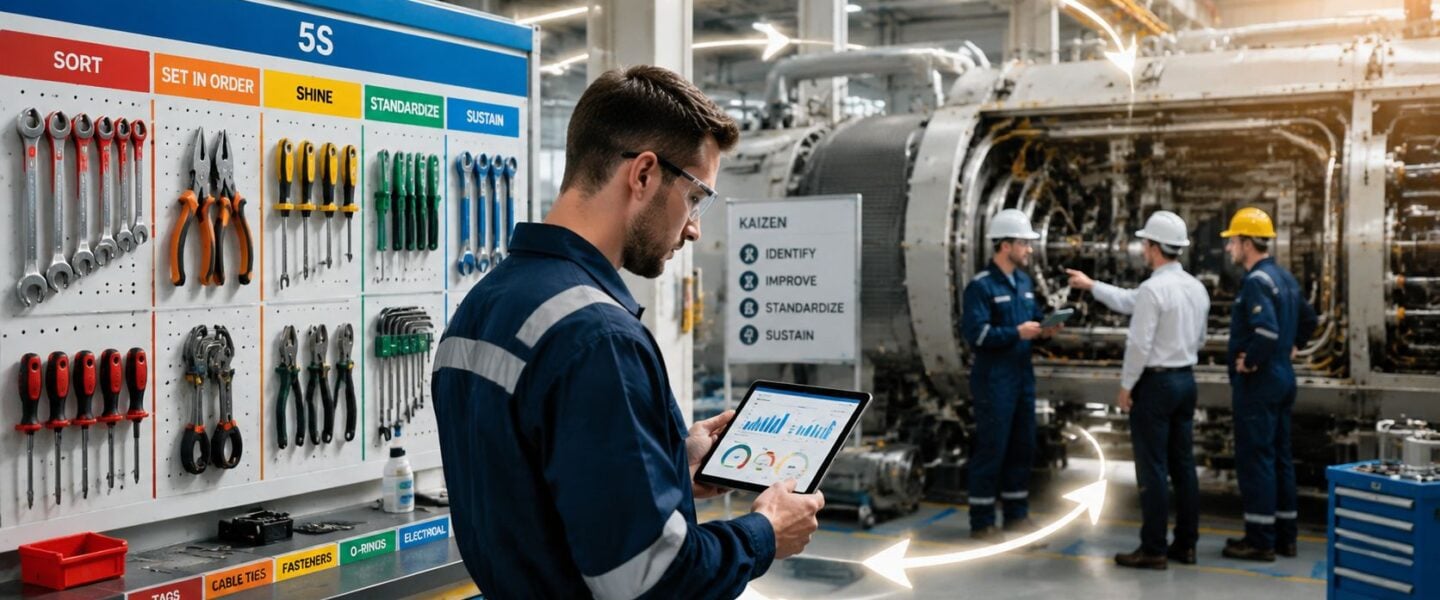
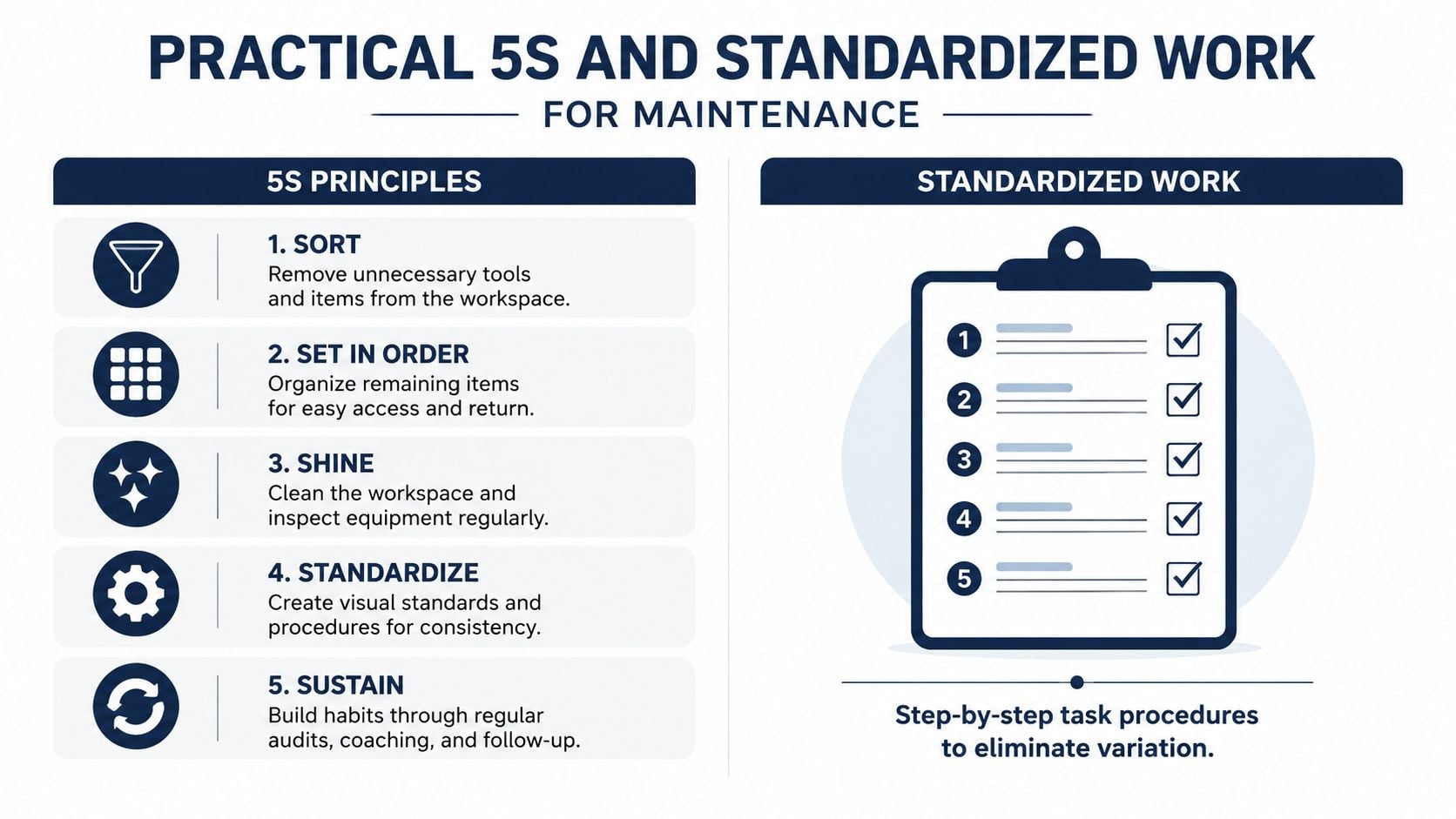
5S means sort, set in order, shine, standardize, and sustain. In maintenance, it isn't a cosmetic cleaning campaign. It creates a controlled work environment where technicians can find the correct tool, identify abnormal equipment condition, perform an inspection consistently, and return the area to a known state.
A pump alley illustrates the difference. If grease guns, alignment tools, temporary hoses, guards, and spare seals are scattered across several locations, technicians lose time and may use the wrong item. If the floor, coupling guard, and baseplate aren't clean enough to inspect, oil leaks and looseness remain hidden. 5S improves the conditions under which reliability work takes place.
A maintenance-specific 5S checklist
- Sort: Remove obsolete tools, duplicate fittings, damaged lifting equipment, and unidentified spare parts. Quarantine anything that needs technical disposition.
- Set in order: Place tools and consumables at point of use, label storage locations, and define where removed components wait for inspection.
- Shine: Clean the asset and surrounding area while inspecting for leaks, loose fasteners, cracked guards, unusual heat, and contamination.
- Standardize: Photograph the correct condition, identify inspection points, and connect the visual standard to the PM or predictive route.
- Sustain: Audit the area, assign ownership, and treat recurring deviation as a management problem rather than a technician failure.
The “shine” step deserves special attention. Cleaning a motor, gearbox, pump, or valve exposes changes in condition. It should never be separated from inspection. A clean surface makes an oil leak visible, while a clean coupling guard makes it easier to detect dust patterns associated with misalignment or looseness.
Standardized work that technicians can trust
Standardized work defines the safest and most repeatable method for a task. It should specify the correct equipment state, tools, materials, sequence, measurements, acceptance limits, and escalation requirements. A lubrication instruction, for example, needs more than “grease bearing.” It should identify the grease, application point, quantity method, contamination precautions, and signs that require a reliability review.
The same principle applies to alignment and balance. A technician needs a controlled setup, reference condition, measurement sequence, and documented result. The instruction should tell the technician what to do when the value falls outside the acceptance range.
Field standard: A visual instruction should help a qualified technician perform the task correctly without guessing what “complete” means.
Connect each standard to the CMMS work order and the appropriate RCM task. The work-order management guidance can help maintenance leaders connect task instructions, labor feedback, parts usage, and follow-up actions. Without that link, 5S remains a local improvement that disappears when personnel, shifts, or supervisors change.
Measuring Kaizen Impact on Maintenance Metrics
A kaizen event needs a metric that reflects the loss it was designed to change. MTTR, or mean time to repair, measures how long restoration takes. MTBF, or mean time between failures, indicates how long the equipment operates between defined failures. Neither metric is useful if the failure definition, operating window, or data-entry practice changes during the event.
Use a baseline that maintenance and operations both accept. For a bearing intervention, record failure events, repair duration, operating hours, and the condition-monitoring trend. For a job-plan improvement, measure wrench time, waiting, parts availability, and first-time completion quality. Energy consumption can be relevant when the failure causes compressed-air loss, excess friction, poor pump performance, or repeated restarts.
Match the metric to the intervention
| Kaizen focus | Primary metric | Verification evidence |
|---|---|---|
| Lubrication standardization | MTBF and repeat-failure count | Vibration, temperature, lubrication records |
| Bearing replacement redesign | MTTR and repair quality | Work-order duration, alignment results, post-repair condition |
| Inspection-route improvement | Condition-detection effectiveness | Route completion, defect escalation, trend history |
| Valve or seal leak control | Availability and energy loss | Leak inspection, process stability, utility readings |
OEE, or Overall Equipment Effectiveness, separates three loss categories. It is calculated as Availability × Performance Efficiency × Rate of Quality according to this OEE calculation reference. That structure helps a plant determine whether a kaizen changed downtime, speed loss, or defect loss instead of treating every production shortfall as the same problem.
A pharmaceutical facility might run a focused event on valve stem packing leaks and compressed-air losses. The event could improve OEE availability by 4.2%, provided the result is documented against the facility's baseline and attributed to that defined intervention [as specified in the verified maintenance example]. The team still needs to confirm whether the change reduced repair frequency, shortened restoration, stabilized production, or changed reporting behavior.
Review results with operations, maintenance, and finance. If the metric improves but the condition trend worsens, the event hasn't created a reliable gain. If MTTR falls because technicians are closing work orders earlier, the data needs correction before leadership treats the result as performance improvement. A structured guide to MTBF, MTTR, and OEE reliability metrics can support consistent definitions across departments.
Common Kaizen Pitfalls in Maintenance and How to Avoid Them
Kaizen enthusiasm doesn't guarantee financial or reliability results. Survey data reports positive employee engagement effects at 75%, positive profit impact at 65%, and benefits to business growth and sustainability at 41%. Yet 29% of organizations rate their continuous-improvement culture at 3 or below on a 0–10 scale, while only 17% report payback in under six months and 44% report payback between six months and one year in the independent kaizen survey results.
The gap reflects execution friction. A team can feel engaged during an event and still lack the governance needed to sustain a new lubrication task, update the CMMS, or protect time for follow-up.
Failure patterns that deserve attention
Weak sustainment is the most common technical failure. The event produces a new standard, but no supervisor checks compliance, no planner updates the job plan, and no reliability engineer reviews the condition trend. Assign one owner, set a review cadence, and place the result in the normal management system.
Overburdened staff create another problem. If technicians must complete the event while responding to breakdowns, the team rushes the analysis and leaves documentation unfinished. Limit the scope, protect participation time, and defer lower-value ideas.
Resistance to change often signals that the proposed control doesn't fit the work. A lubrication standard that ignores access restrictions or production windows won't survive. Involve the technician who performs the task and the operator who sees the equipment during operation.
Poor data can send the event toward the wrong cause. Review asset identity, failure codes, event duration, and condition-monitoring locations before drawing conclusions. Launching early may feel decisive, but an unverified baseline makes the result difficult to defend.
Smaller can be stronger
The assumption that kaizen must be large-scale is counterproductive in maintenance. A tightly scoped event on one pump, one compressor trip mechanism, or one inspection route often produces clearer learning than a plant-wide waste campaign. Research on lean and kaizen continues to discuss gains in cycle time, defects, output, and labor productivity, but maintenance leaders still need to ask whether those gains persist when equipment condition, product mix, and staffing fluctuate as highlighted in this review of durability questions in industrial environments.
A durable event connects the countermeasure to asset criticality, predictive evidence, and CMMS control. It also examines recurrence, lifecycle cost, spare-parts behavior, and data quality, areas that determine whether an improvement survives after the event team leaves as discussed in the reliability integration gap for lean programs.
Your Action Plan to Start with a Free Reliability Assessment
Choose one pilot asset and one high-impact loss stream. Gather CMMS history, downtime records, and condition-monitoring data. Rank the asset through RCM criticality, assemble maintenance and operations representatives, define an MTBF, MTTR, or OEE objective, and schedule a focused event. After implementation, verify the physical condition and update the PM, job plan, and standard work. Expand only when the result is sustained, repeat the method on a similar loss, or pivot if the evidence disproves the assumed cause.
Forge Reliability helps industrial teams connect predictive maintenance, condition monitoring, RCM, root-cause analysis, and CMMS governance to focused kaizen opportunities. Visit Forge Reliability to request a free reliability assessment and identify the equipment losses most likely to produce measurable uptime improvement.