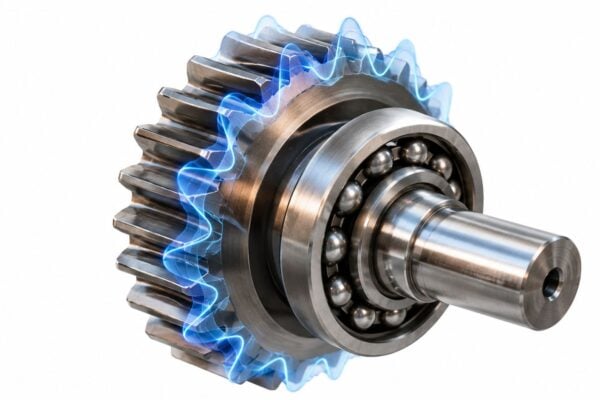
A centrifugal process pump trips on high bearing temperature during a production run. The crew changes the bearing, checks the oil level, and returns the pump to service. Four months later, the replacement fails with the same alarm. That pattern is familiar because the bearing is often treated as the failed part instead of the component reporting a wider system problem.
Bearings in pumps respond to lubrication quality, contamination, hydraulic loading, alignment, pipe strain, installation fit, and operating temperature. Bearing distress is a major contributor to centrifugal-pump failures, and lubrication-related mechanisms dominate the documented failure pattern. A replacement can restore operation briefly, but it won't correct water ingress, a soft foot, cavitation, excessive thrust, or an overfilled housing.
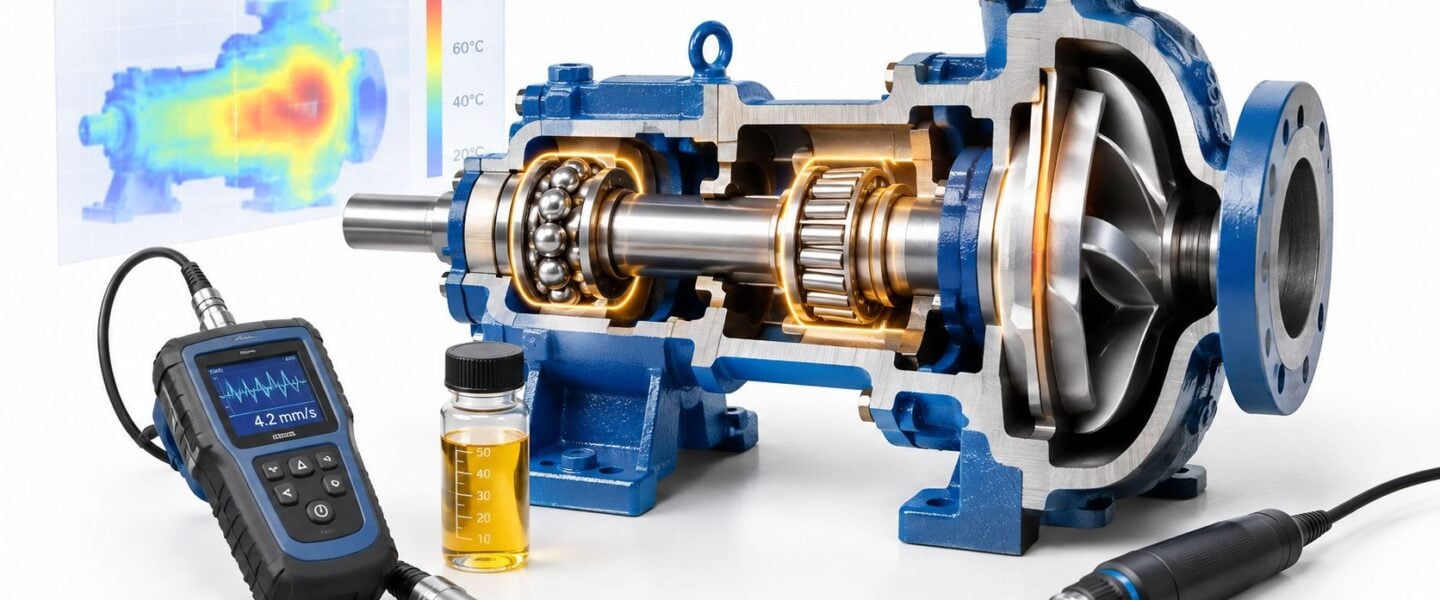
The practical answer is a diagnostic picture built from vibration, oil analysis, ultrasound, thermography, and shaft displacement. Overall RMS vibration matters, but it isn't a verdict by itself. The useful work starts when several independent indicators point toward the same failure mechanism.
Table of Contents
- The True Cost of a Pump Bearing Failure
- How Pump Bearings Actually Work
- Failure Modes and What Causes Them
- A Diagnostic Toolkit That Goes Beyond Vibration
- Matching Bearings, Lubrication, and Mounting to the Pump
- Building a Risk-Based Condition Monitoring Program
- Troubleshooting and Deciding When to Relubricate, Flush, or Replace
- Your Next Step Toward Reliable Pump Bearings
The True Cost of a Pump Bearing Failure
A pump bearing can fail before it trips an alarm. As rolling elements lose smooth contact with the raceways, vibration can disturb rotor alignment, damage seals, increase shaft loading, and force an overhaul. On a process pump, the production interruption and secondary damage may exceed the cost of the bearing itself.
A five-year refinery pump study found that more than 80% of pump failures collectively arose from seals, overhauls, impellers, and bearings. Bearings represented 9% of reported failures, compared with 11.7% for impellers and 6.3% for shafts. The calculated characteristic life of the pump bearings was 29.4 months (refinery pump failure study). These figures place bearings in the wider pump reliability plan rather than treating them as an isolated maintenance item.
The replacement trap
A replacement work order often closes the visible symptom while leaving the initiating condition untouched. The new bearing may enter a contaminated housing, face the same failed seal, or carry the same misalignment. If the pump runs away from a stable hydraulic point, abnormal radial or axial forces remain in service.
A strip-down report that says “bearing damaged” is not a root-cause finding. It should document the damage pattern, lubricant condition, contamination path, mounting evidence, shaft condition, and operating history. Without those details, the plant has paid for a component exchange, not a corrective action.
Practical rule: A bearing replacement should trigger a cause investigation, not end one.
The lubrication review cited in pump-maintenance literature assigns 47% of pump-bearing failures to particle contamination, 11% to insufficient lubrication, and 5% to corrosion. Together, those mechanisms account for 63% of reported pump-bearing failures (pump lubrication review). Start with lubricant cleanliness, moisture exclusion, viscosity, oil level, seals, breathers, and contamination-control practices.
Then combine vibration, oil analysis, ultrasound, thermography, and shaft displacement. Overall RMS vibration can support the diagnosis, but it should not decide the case alone. Agreement among independent indicators shows whether the bearing is reporting a lubrication problem, installation defect, hydraulic load, or broader pump-system issue.
How Pump Bearings Actually Work
Most small and medium process pumps use anti-friction rolling-element bearings. Balls or rollers separate the rotating and stationary rings, reducing sliding friction while carrying radial load, axial load, or both. The bearing's job is to maintain a controlled contact geometry under changing speed, temperature, and hydraulic force.
A deep-groove ball bearing handles radial load and a limited axial load. A cylindrical roller bearing carries high radial load but generally needs a separate arrangement for substantial axial load. A double-row angular-contact bearing can handle combined radial and axial loading, making it useful where the pump's thrust direction and load envelope require greater axial capacity.
Larger process pumps may use sleeve bearings, also called journal bearings. Instead of rolling elements, the shaft runs inside a lubricated sleeve, with the lubricant film supporting the journal. Rolling-element bearings are compact and common on ANSI process pumps, while sleeve-bearing arrangements appear on larger, heavily loaded API 610 services.
Load paths matter more than the catalog label
The bearing's equivalent dynamic load combines radial and axial forces into a calculated load used for life evaluation. L10 life is the calculated life at which 90% of an identical bearing population is expected to survive under defined conditions. It isn't a promise that an individual bearing will reach that life, especially when contamination, poor fits, misalignment, or lubricant breakdown dominate the service.
Consider a refinery cooling-water pump. The drive-end bearing may locate the shaft and carry a meaningful share of radial load, while the non-drive-end arrangement provides axial float or supports additional radial load, depending on the pump design. The thrust-bearing arrangement must absorb hydraulic axial force generated by the impeller and operating condition.
Impeller thrust isn't the only load source. Hydraulic recirculation can create unstable forces, and pipe strain can distort the casing or bearing-support geometry. A foot-mounted pump with soft foot, a condition where one or more feet don't sit flat before tightening, can pull the frame or bearing housing out of alignment. The bearing may then carry a cyclic load long before the overall vibration alarm becomes obvious.
For bearing selection and load-path decisions, the distinction between radial and axial load gives maintenance and engineering teams a common reference. The important point is practical: the bearing should be selected for the actual load path, and the installation should preserve that path after the pump is bolted, coupled, piped, and placed under operating temperature.
Failure Modes and What Causes Them
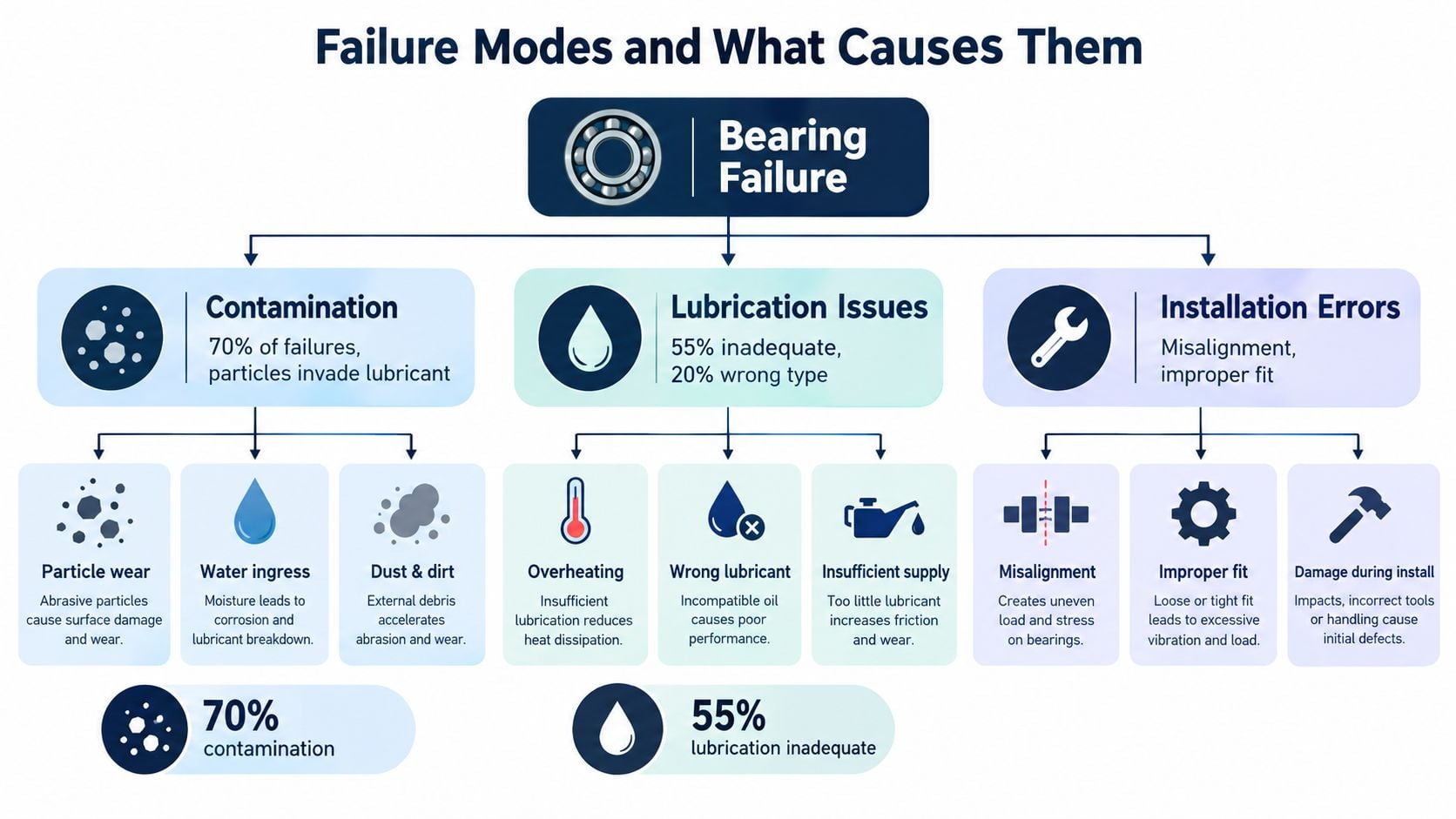
A pump can run in silence while its bearing is already being cut by contamination. In the documented pump-bearing distribution, particle contamination represents 47%, insufficient lubrication 11%, and corrosion 5%, as noted in the pump lubrication review cited earlier. These figures point to a practical priority: check how contaminants enter and how the lubricant is managed before treating vibration as the verdict.
What appears in the bearing
Particle ingress leaves dents, cutting, and abrasive wear on raceways and rolling elements. Water can cause rust staining, surface etching, emulsified oil, and a lubricant film too weak to separate the contact surfaces. In a washdown food-processing area, a failed seal or breather may provide the entry path. In chemical service, similar damage may reflect process-fluid incompatibility rather than ordinary moisture.
Insufficient lubricant starves the contact zone. Excessive lubricant causes churning and heat, so an over-greased bearing can resemble one carrying excessive load. Emulsified lubricant is particularly harmful because water changes viscosity and film behavior while promoting corrosion.
Other mechanisms require specific checks:
- Rolling-element fracture: Repeated overload, fatigue, or severe surface damage can produce cracks and loose fragments.
- Cage breakage: Poor lubrication, shock loading, or damaged rolling elements can destabilize the cage and create impulsive vibration.
- Electrical fluting: VFD-driven motors can pass electrical current through the bearing, leaving repetitive washboard-like damage on the raceways.
- False brinelling: Vibration with the shaft stationary can form small dents at loaded contact points, especially during transport or standby operation.
- Thermal overload: Over-lubrication, excessive load, poor fits, or restricted oil flow can raise temperature and reduce internal clearance.
Why one mechanism is rarely enough
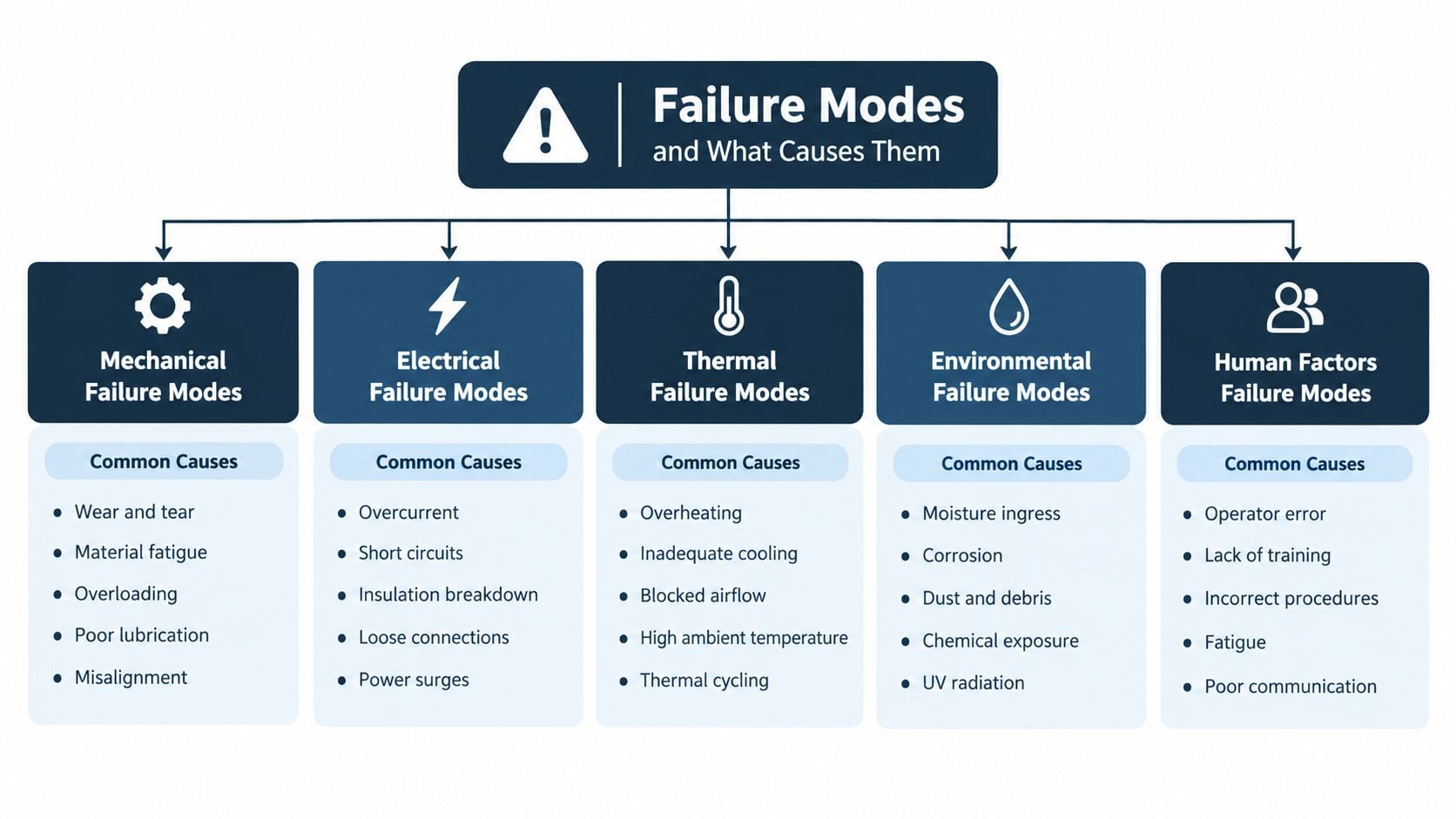
Failures usually develop as a chain. A failed seal admits water, the water degrades the lubricant, and the damaged film accelerates wear. Clearance then changes, while frequent starts and stops add thermal cycling and transient load. Dry running or cavitation can add hydraulic instability to the same event.
A strip-down needs supporting evidence. Review oil or grease condition, vibration history, temperature trends, seal condition, installation records, and process data alongside the bearing surfaces. A polished raceway, discolored surface, or broken cage shows the outcome. Combining those observations with ultrasound, thermography, oil analysis, vibration, and shaft displacement identifies the system condition that produced it. Overall RMS may confirm severity, but it rarely identifies the full failure path.
A Diagnostic Toolkit That Goes Beyond Vibration
Overall RMS velocity is useful for trending general machine severity, but it can't identify the cause on its own. Imbalance, coupling misalignment, looseness, cavitation, pipe strain, and bearing damage can all raise the value. The U.S. Department of Energy recommends vibration trending for pumps because it can detect impending bearing failure while also revealing imbalance and coupling problems caused by issues such as impeller erosion or misalignment (pumping-system maintenance guidance).
Start with repeatable measurement locations on the drive-end and non-drive-end housings. Record overall velocity, high-frequency acceleration, and bearing-envelope data, then compare the readings with the pump's operating condition. A rising 1× running-speed component supports an imbalance or bent-shaft investigation, while dominant 2× vibration or phase change can support a misalignment diagnosis. Bearing-defect-frequency activity with harmonics and high-frequency energy that is raised is more consistent with localized rolling-element or raceway damage.

Add independent evidence
Ultrasound listens for high-frequency friction and impacts. It can identify lubrication changes before overall vibration rises, but it needs a consistent test point and a stable operating state. Acoustic monitoring becomes more useful when technicians trend the same bearing under similar load rather than treating one decibel reading as a pass or fail. Practical guidance on acoustic monitoring for rotating equipment helps define that measurement discipline.
Oil analysis checks viscosity, water, particle contamination, additive condition, and wear debris. A single clean sample doesn't prove the bearing is healthy, and a single abnormal sample doesn't identify every source. Trend behavior, sampling location, sampling cleanliness, and the pump's operating history matter.
Thermography shows temperature distribution and can reveal a hot bearing housing, restricted oil flow, or an uneven thermal pattern across the coupling and supports. Temperature is a secondary signal, not a sufficient proof of health. One published pump-bearing case recorded temperatures of 30–40°C while vibration still indicated serious mechanical problems, and the drive-end bearing exceeded 22 mm/s in a condition classified as dangerous under the cited ISO 10816-3 Zone D threshold above 11.2 mm/s (pump-bearing condition case).
Shaft displacement or axial-position data helps identify thrust movement that housing vibration may not explain. When vibration, oil debris, temperature, ultrasound, and shaft position move together, the maintenance decision becomes far more defensible than a work order based on RMS alone.
Matching Bearings, Lubrication, and Mounting to the Pump
Bearing selection starts with the pump's load and environment, not with whichever bearing is already in stores. A small ANSI process pump may use grease-lubricated rolling-element bearings, while a heavier API 610 pump may use oil lubrication or a pressurized-oil system. Slurry and wastewater services add contamination, solids, moisture, and intermittent operation to the selection problem.
| Pump Class | Typical Bearing | Lubrication | Key Mounting Focus |
|---|---|---|---|
| ANSI process pump | Deep-groove ball or angular-contact rolling-element bearing | Grease or oil bath, depending on design | Fits, clearance, coupling alignment, seal protection |
| Heavy API 610 process pump | Rolling-element or sleeve-bearing arrangement | Oil bath or pressurized oil | Thrust control, oil flow, housing temperature, pipe strain |
| Slurry pump | Heavy-duty rolling-element bearing | Grease or oil selected for contamination risk | Shaft fit, housing rigidity, seal exclusion, soft-foot correction |
| Wastewater lift-station pump | Rolling-element bearing, often in a sealed assembly | Grease or oil sealed against moisture | Water exclusion, cable and seal condition, axial movement |
For pressurized-oil systems, API 610 limits oil outlet temperature to 160°F (70°C) and the inlet-to-outlet differential temperature rise to 50°F (28°C). The same standard defines the preferred operating region as 70–120% of best-efficiency-point flow, and permits bearing-housing vibration to increase by up to 30% outside that region while the pump remains within its allowable operating range (ANSI/API 610 reference). These limits belong in commissioning records and condition-monitoring logic.
Installation determines whether selection survives
Shaft and housing fits control ring movement and internal clearance. Excessive interference can reduce clearance and create heat, while an inadequate fit can permit fretting or ring creep. The installation team must also verify axial float, shaft runout, housing condition, coupling balance, and soft-foot correction before final alignment.
Grease isn't automatically safer than oil. It can work well on a compact ANSI pump when the quantity, compatibility, purge path, and seal design are controlled. It becomes a liability when technicians add grease to an already contaminated or overfilled housing.
Oil systems need clean storage, sealed transfer equipment, protected breathers, correct viscosity, and a defined sampling method. A pressurized system also needs reliable flow indication and temperature trending. Food and beverage washdown, chemical exposure, mining dust, and wastewater immersion each demand different sealing and breather decisions.
Teams evaluating bearing selection and installation for maximum life should treat the bearing, lubricant, seal, housing, shaft, and coupling as one engineered assembly. Pump service information can also clarify the difference between sewage and sump applications through this pump comparison from WaterJobsIntel.com, particularly when moisture exposure and intermittent duty influence the protection strategy.
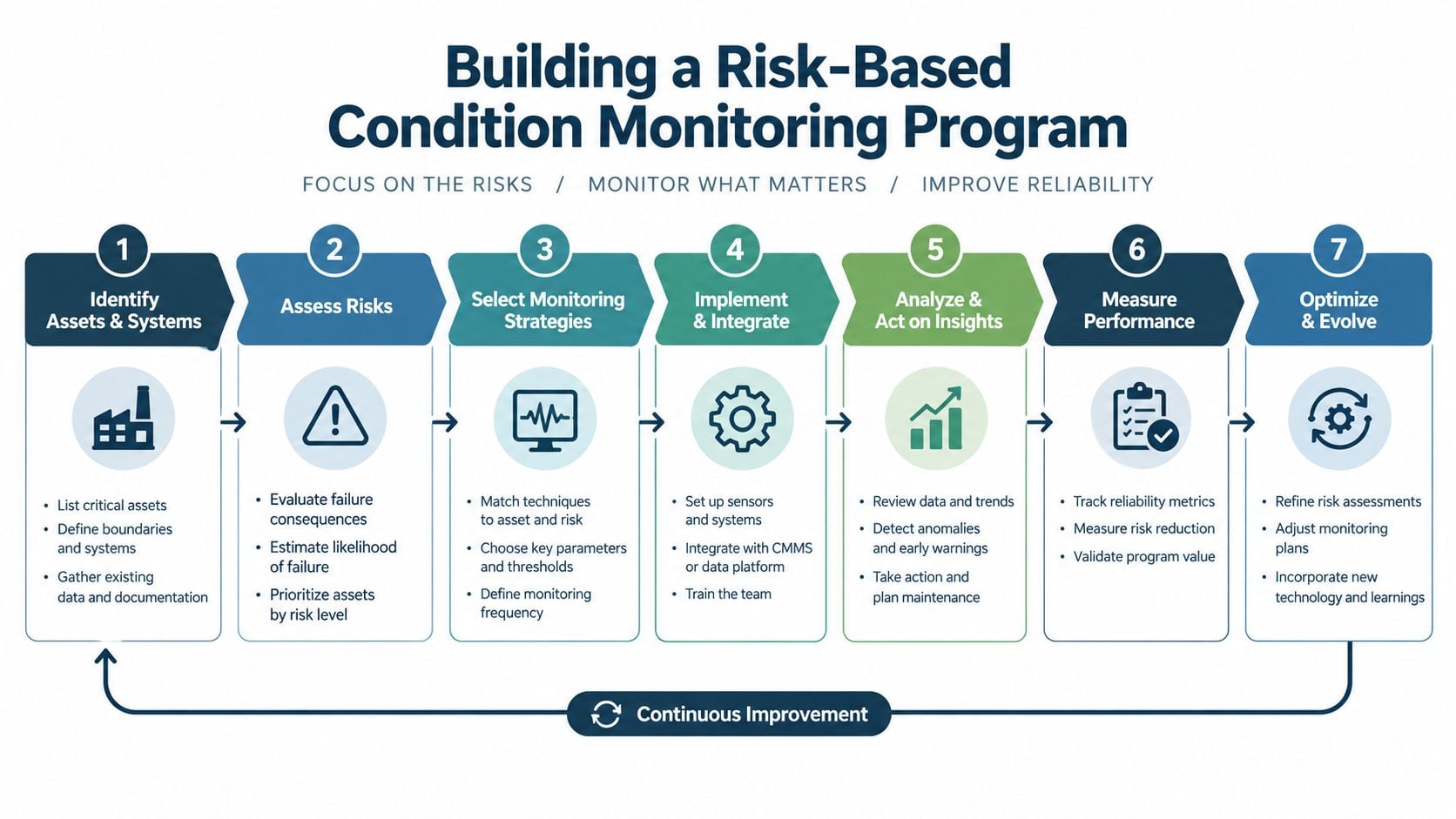
Building a Risk-Based Condition Monitoring Program
A condition-monitoring program should follow consequence and failure history, not a uniform calendar. A refinery cooling-water pump that can affect a critical process line deserves more frequent data capture or continuous monitoring than a spare transfer pump with a ready standby arrangement. The same principle applies across multi-site portfolios.
Build the program around decisions
A workable program connects asset criticality, failure modes, measurement routes, action thresholds, and CMMS history.
- Rank the pump: Combine production consequence, safety or environmental exposure, redundancy, repair difficulty, and documented failure history.
- Establish a baseline: Capture vibration, temperature, lubrication condition, and process state after alignment and commissioning.
- Choose the measurement method: Use route-based vibration for general assets, with oil analysis, ultrasound, and thermography added according to failure mode.
- Set action logic: Define an alarm as a request for diagnosis, not an automatic bearing replacement or shutdown.
- Correlate operating point: Record flow, suction pressure, discharge pressure, speed, and cavitation symptoms with every significant reading.
- Preserve the history: Link sensor results, inspection findings, lubricant changes, alignment work, and failure codes in the CMMS.
- Review the outcome: After each intervention, compare the original indicators with the confirmed mechanism and update the route or threshold.
API 610 operating-region rules are especially important during acceptance testing and troubleshooting. A vibration excursion at low flow or high flow should first be correlated with the pump's position relative to the preferred operating region. A sensor alarm may be valid while the bearing remains serviceable, because hydraulic forces can raise housing vibration outside the preferred region.
An alarm identifies a condition that needs a decision. It doesn't identify the repair.
Route intervals should reflect failure speed and asset consequence. Critical pumps may need continuous vibration and temperature monitoring, while less critical assets can use repeatable manual routes supported by periodic oil sampling and thermography. Plants adding expertise may also need hiring reliability engineers to own analysis, data governance, and failure-learning routines.
A condition-monitoring system should preserve the reason for every work order. Linking the reading to the corrective action prevents knowledge loss when personnel change, equipment is rebuilt, or a shutdown resets the operating context. Condition monitoring systems are useful only when the data leads to a controlled maintenance decision.
Troubleshooting and Deciding When to Relubricate, Flush, or Replace
A single high RMS value isn't enough evidence to replace a bearing. A municipal pump study recorded RMS vibration of 28.730 mm/s on the Y axis and 38.877 mm/s on the Z axis, both classified as damaging, while the X axis measured 4.670 mm/s and required attention (municipal pump vibration study). Directionality matters because looseness, misalignment, hydraulic forces, and structural response can produce a high reading without a localized bearing defect.
Use a decision path
Start with operating condition. Confirm speed, flow, suction pressure, discharge pressure, cavitation symptoms, recirculation, and recent process changes. A pump operating away from its preferred hydraulic region may need hydraulic correction before bearing replacement.
Separate the vibration components. A strong 1× component supports imbalance, bent-shaft, or rotor concerns. Dominant 2× vibration or phase behavior supports alignment and soft-foot checks. Bearing-envelope spectra, harmonics, high-frequency energy, and impulsive time waveform activity make a localized bearing defect more credible.
Add independent signals. Rising temperature, worsening ultrasound, oil debris, water contamination, and shaft displacement moving in the same direction create converging evidence. If only RMS is raised, inspect mounting, looseness, pipe strain, coupling alignment, and sensor attachment before ordering a bearing.
Match the intervention to the evidence
- Relubricate: Use the specified lubricant, quantity, and interval when ultrasound or lubricant condition indicates starvation without evidence of contamination or damage. Adding grease to an overfilled housing can increase churning and heat.
- Flush and correct the ingress path: Use this response when oil or grease contains water, solids, or process fluid. Inspect seals, breathers, housing covers, and transfer equipment before introducing clean lubricant.
- Realign and correct soft foot: Choose this path when phase, axial vibration, 1× or 2× components, coupling condition, or installation checks indicate mechanical loading rather than localized raceway damage.
- Investigate hydraulics: Check suction conditions, recirculation, cavitation, pipe strain, and operating point when vibration follows process changes or appears across multiple pump components.
- Replace the bearing: Replacement is justified when the envelope spectrum, impact pattern, oil debris, temperature trend, strip-down evidence, or shaft-position data confirms localized damage or when the bearing has suffered fracture, severe spalling, or cage failure.
Water ingress and emulsified lubricant shorten the safe relubrication interval because the lubricant's protective film and corrosion resistance deteriorate. The intervention should be based on contamination evidence and trend behavior rather than operating hours alone. A disciplined oil sampling and analysis program can distinguish a lubricant problem from a mechanical wear problem before the housing is opened.
Quick reference
| Evidence pattern | First action |
|---|---|
| High 1× with stable envelope data | Check balance, shaft condition, and hydraulic loading |
| Dominant 2× with phase change | Verify alignment, soft foot, and pipe strain |
| High-frequency impacts plus clean mounting checks | Inspect bearing condition and lubricant debris |
| Water or process fluid in lubricant | Find the ingress path, flush, and correct seals or breathers |
| Rising axial position with thrust symptoms | Investigate hydraulic thrust and thrust-bearing arrangement |
| High RMS without corroborating evidence | Diagnose before replacing the bearing |
Your Next Step Toward Reliable Pump Bearings
Bearings in pumps should be treated as system indicators, not isolated spare parts. Their condition reflects the quality of lubrication control, the integrity of seals and breathers, the accuracy of alignment, the stability of hydraulic operation, and the discipline of condition monitoring.
The strongest programs combine vibration with oil analysis, ultrasound, temperature, and shaft-displacement evidence. Each method sees a different physical response. Vibration identifies force and defect patterns, ultrasound detects high-frequency friction and impacts, oil analysis reveals contamination and wear debris, thermography shows heat distribution, and shaft position exposes thrust behavior that may remain hidden in a housing measurement.
Lubrication and inspection intervals should follow criticality, environment, lubricant condition, and trend behavior. A washdown pump, a chemical-service pump, a slurry pump, and a refinery cooling-water pump shouldn't receive identical maintenance intervals just because they share a bearing designation.
The maintenance decision should also respect uncertainty. If one direction shows high RMS but the envelope spectrum, temperature, oil, and process data remain stable, the correct response may be diagnosis, alignment verification, or hydraulic investigation. If several indicators converge, the work order can specify the likely mechanism and the corrective action instead of requesting a blind replacement.
A compact operating rule is simple:
- Trend the system, not only the bearing housing.
- Confirm the operating point before interpreting vibration.
- Check lubricant and contamination paths before adding lubricant.
- Verify alignment and soft foot after installation and piping work.
- Demand converging evidence before cutting a replacement order.
- Record the confirmed cause so the next failure doesn't repeat.
Forge Reliability offers free reliability assessments that review pump lubrication control, mounting and alignment practices, and condition-monitoring coverage across critical assets. Visit Forge Reliability to identify the gaps most likely to shorten bearing life and plan a practical diagnostic program for the plant's highest-consequence pumps.