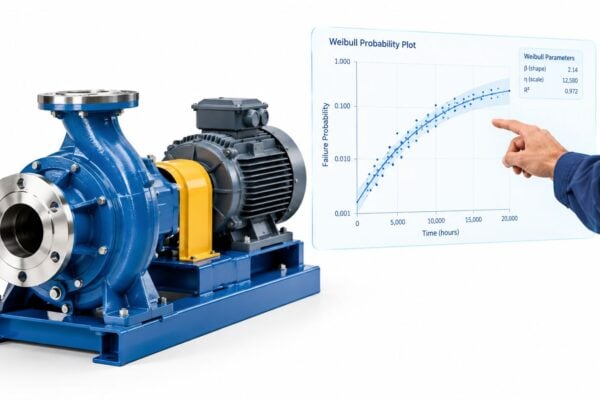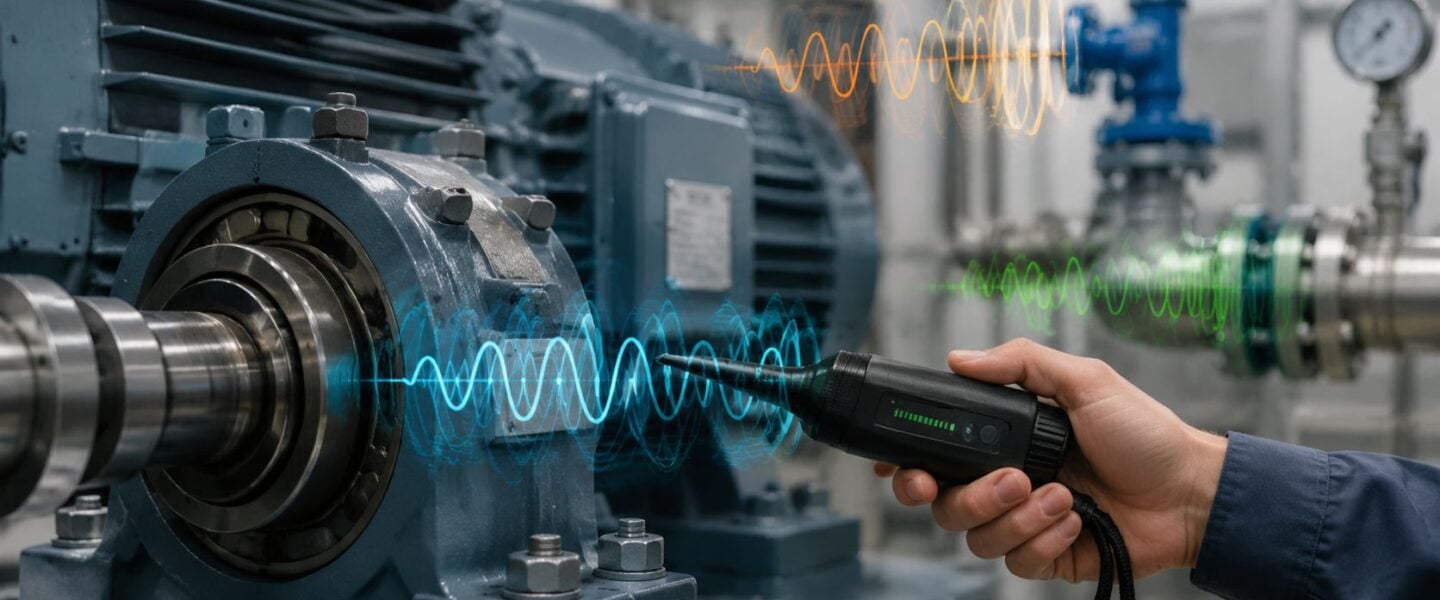
A plant can lose money for months before anyone sees the root cause. A compressed air leak hides behind normal production noise. A bearing starts running dry, but temperature and vibration still look acceptable. Switchgear develops an electrical discharge that isn't visible during a routine walkdown. By the time the failure becomes obvious, the plant is no longer dealing with detection. It's dealing with downtime, scrap, safety exposure, or wasted energy.
That's where acoustic monitoring earns its place. It gives maintenance and reliability teams a way to hear friction, turbulence, and electrical activity before those conditions become major failures. The underlying sensing approach has expanded far beyond niche use cases. The same remote listening principle now used to infer species behavior from audio alone has also grown into a practical industrial method for identifying wear, leaks, and improper operation early enough to prevent costly downtime, as described by WWF's acoustic monitoring overview.
For plant leaders trying to close the gap between reactive firefighting and disciplined condition monitoring, acoustics is often one of the fastest ways to find hidden losses. Teams that are already thinking seriously about hidden risk will also recognize the pattern in these proactive failure detection insights. The same logic applies on the plant floor. If the failure mode stays invisible until it becomes severe, the monitoring strategy is already too late. That's also why acoustic work often supports wider maintenance cost reduction efforts, especially when leaks, lubrication issues, and recurring machine defects have been draining operating budgets without a clear line of sight.
Table of Contents
- The Unseen Failures Costing Your Plant
- How Acoustic and Ultrasound Monitoring Works
- Key Failure Modes Detected by Acoustic Signatures
- Selecting Sensors and Planning Data Collection
- Implementing a Successful Monitoring Program
- Integrating Acoustics into a Total Reliability Strategy
- Your First Steps in Acoustic Monitoring
The Unseen Failures Costing Your Plant
A reliability manager usually doesn't need another lesson on why failures are expensive. The problem is that some of the most expensive failure modes don't announce themselves in a way the plant can catch early.
A paper mill is a good example. Steam systems can look stable on the surface while a failed steam trap pushes loss into the utility bill and process instability into the line. In another area of the same facility, a motor bearing may still pass a casual operator check because the housing isn't obviously hot and the machine still sounds normal to human hearing. The plant keeps running, but asset health is already moving in the wrong direction.
Hidden losses rarely start as visible damage
Acoustic monitoring is useful because many early defects generate sound before they generate obvious secondary symptoms. Friction creates a different signature than a healthy lubricated contact. Turbulence from a compressed air or nitrogen leak produces a different signature than normal flow. Electrical discharge has its own acoustic behavior long before a component fails outright.
Practical rule: If a failure mode creates friction, impact, turbulence, or electrical discharge, it may be audible to the right sensor before it becomes obvious to the rest of the program.
That matters in plants with large utility systems, rotating equipment populations, and high-consequence electrical assets. A chemical plant with extensive compressed gas piping can lose margin through small leaks spread across many lines. A food plant can run a pump population that looks healthy in production terms while lubrication condition is imperceptibly degrading. In both cases, the failure isn't silent. It's just outside what people can hear consistently during normal work.
Why plant teams adopt acoustics
Acoustic monitoring isn't a replacement for every other PdM method. It is, however, one of the clearest ways to find defects that don't show up well in a visual inspection. It is especially strong when the plant needs to answer practical questions fast:
- Is this bearing starved for lubrication
- Is this valve or fitting leaking
- Is this steam trap passing when it shouldn't
- Is this switchgear producing discharge activity that needs immediate follow-up
For managers trying to reduce unplanned work, that's its primary value. Acoustic monitoring shortens the time between defect inception and maintenance response.
How Acoustic and Ultrasound Monitoring Works
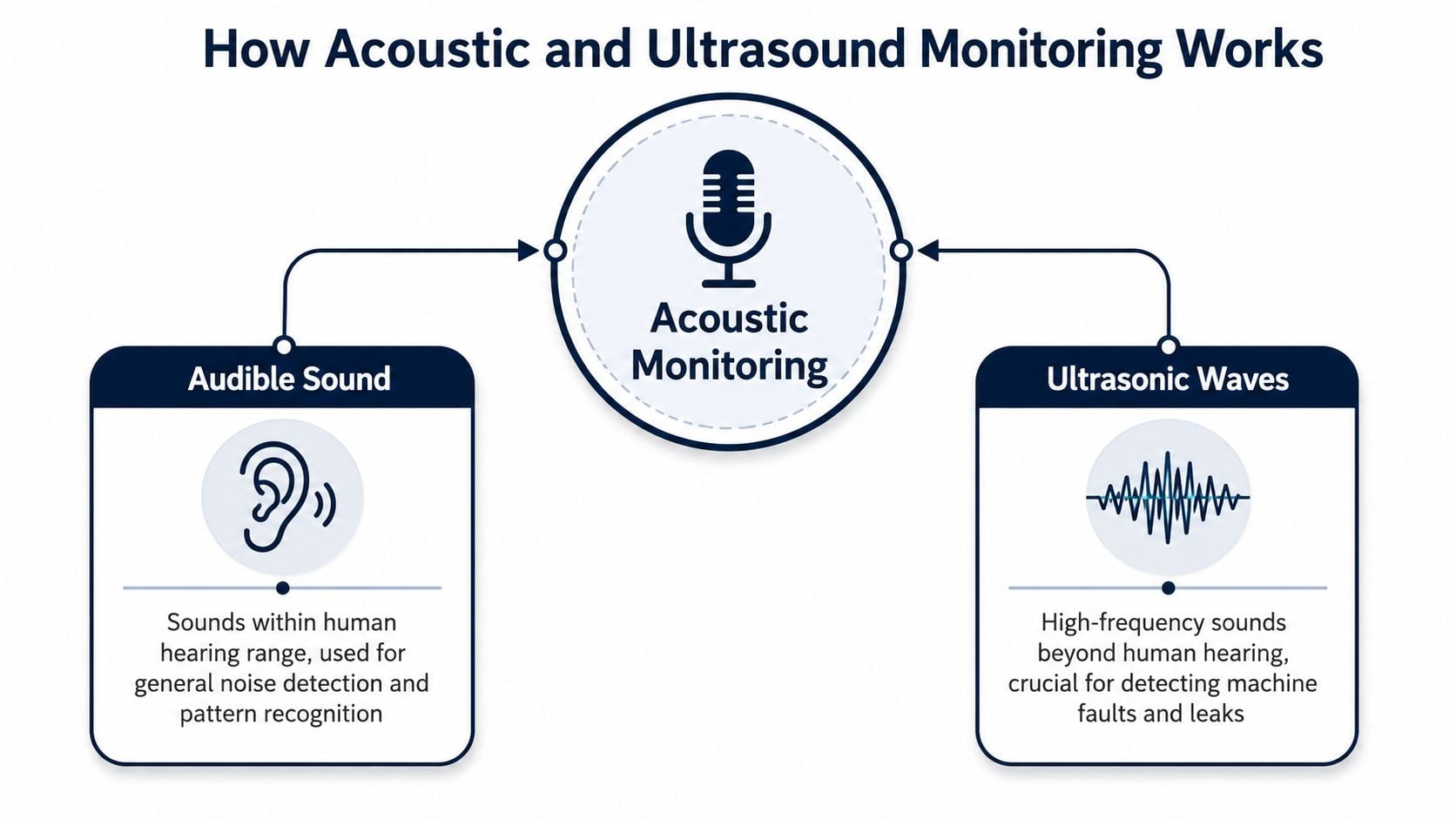
The easiest way to explain acoustic monitoring is to compare it to a stethoscope. A stethoscope doesn't just tell a clinician that sound exists. It helps isolate patterns that indicate normal or abnormal behavior. Industrial acoustic monitoring does the same thing for machines and systems.
Some sounds are within human hearing. Others sit in the ultrasonic range, above what people can hear directly. For maintenance work, that distinction matters because many early machine and leak signatures are easier to separate in the ultrasonic range than in the plant's normal audible noise.
What the sensor is actually hearing
Three physical phenomena show up again and again in industrial acoustic work:
- Friction: Bearings, sliding surfaces, and poorly lubricated contacts generate high-frequency energy when surfaces interact abnormally.
- Turbulence: Pressurized gas escaping through a leak creates chaotic flow that produces a distinctive airborne signal.
- Impact: Damaged gear teeth, looseness, and repetitive contact events can create short-duration bursts or clicks.
This is why acoustic monitoring isn't just "listening for loudness." A machine can be loud and healthy, or relatively quiet and unhealthy. The useful signal is the pattern, frequency content, and repeatability of the sound.
A technician tracing compressed air losses with an ultrasonic instrument isn't just hearing noise. The technician is isolating turbulent leakage from the rest of the plant soundscape. A technician checking a bearing housing with a contact sensor is listening for a friction pattern that differs from the asset's normal baseline. Plants looking to strengthen leak surveys often pair this approach with a more structured ultrasonic leak detection process.
Why a few sensors can cover a lot of machine area
One practical advantage of acoustic monitoring is coverage. Microphones capture integrative sound information, so a small number of sensors can supervise a large number of components simultaneously. In hydropower applications, ISA notes that acoustic systems can monitor broad machine areas with only a few sensors and can be deployed without physical modification of equipment, which supports continuous surveillance with minimal integration risk, as described in ISA's acoustic monitoring systems article.
A useful acoustic channel often covers more than one component. That's an advantage when screening for anomalies, but it also means diagnosis depends on knowing the machine layout and sound path.
Consider a hydropower unit or a large process compressor train. The machine is too complex for casual listening, and installing invasive instrumentation on every possible fault point isn't always realistic. Acoustic sensors can provide broad surveillance, then direct the team toward targeted follow-up with vibration, inspection, or lubrication checks.
That broad reach is one reason acoustics works well as a first-warning layer. It hears change across an area. The maintenance process then determines whether the change points to a leak, friction source, impact event, or electrical activity.
Key Failure Modes Detected by Acoustic Signatures
Acoustic monitoring is most valuable when the plant ties it to specific failure modes. Without that discipline, teams collect sound and call it insight. With that discipline, they identify defects early enough to plan work.
A refinery compressor building, a food plant utility room, and a pulp mill steam system all generate noise. Acoustic monitoring becomes useful only when the team separates normal process sound from signatures linked to known failure mechanisms.
Bearing distress and lubrication problems
Bearings are one of the clearest use cases. Early lubrication starvation often produces a steady high-frequency roughness before the defect progresses into more obvious mechanical damage. As damage develops, repetitive impacts from surface distress can create sharper, more distinct acoustic events.
A common example is a motor-driven pump in a wastewater facility. The pump still carries load and the operator doesn't hear anything unusual from a few feet away. A contact acoustic reading at the bearing point reveals a harsher signature than the machine's historical baseline. That doesn't automatically mean the bearing is failing catastrophically. It may mean the lubrication condition has deteriorated enough to justify relubrication and close follow-up. A disciplined ultrasonic bearing monitoring and acoustic lubrication approach helps prevent overgreasing as well as underlubrication.
Compressed gas and vacuum leaks
Compressed air systems are notorious for hidden waste because leaks are distributed, intermittent, and easy to ignore when production pressure still looks acceptable. Acoustic monitoring is effective here because gas leakage creates turbulence with a recognizable airborne signature.
In a chemical plant, the same logic applies to nitrogen headers, instrument air drops, and pneumatic actuators. Leaks at couplings, valves, hoses, and quick-connects often don't show up in a visual check. They do show up acoustically, especially when the inspector can isolate the leak path from ambient plant noise.
Steam trap problems
Steam trap inspection is another high-value application. A failed-open trap, a leaking trap, or a trap that isn't cycling properly changes internal flow behavior. Acoustic measurements help technicians judge whether condensate is discharging as expected or whether live steam is passing continuously.
A paper mill or food plant with a large steam distribution network benefits from this because trap failures spread their impact. One failed trap isn't just a maintenance issue. It can affect energy efficiency, downstream heating performance, and condensate management.
Electrical discharge in switchgear and motor systems
Acoustics also helps with electrical reliability. Arcing, tracking, and corona can produce ultrasonic signatures that technicians can detect without opening energized equipment beyond approved procedures and safety controls.
In a manufacturing plant main switchgear lineup, this is a major advantage. Thermal imaging may catch heating after the fault has advanced. Acoustic methods can indicate discharge activity earlier, provided the inspection route, access points, and safety protocols are well designed.
When electrical discharge is suspected, acoustics should trigger escalation, not casual observation. The purpose is to identify risk early enough for controlled intervention.
Acoustic Signatures of Common Industrial Failure Modes
| Failure Mode | Typical Sound Characteristic | Common Frequency Range (kHz) | Industrial Example |
|---|---|---|---|
| Bearing lubrication distress | Steady high-frequency roughness or hiss | Ultrasonic range | Pump motor bearing in a wastewater plant |
| Bearing surface damage | Repetitive clicking or impacting | Ultrasonic range | Fan shaft bearing in a process air system |
| Compressed gas leak | Airborne turbulent rushing signal | Ultrasonic range | Nitrogen line fitting in a chemical plant |
| Steam trap failure | Abnormal continuous flow sound or irregular cycling pattern | Ultrasonic range | Steam trap station in a paper mill |
| Electrical discharge | Intermittent crackling or buzzing pattern | Ultrasonic range | Medium-voltage switchgear in a manufacturing plant |
The table is a field reference, not a diagnosis by itself. Plants still need asset context, repeatable routes, and follow-up methods to confirm what the sound means.
Selecting Sensors and Planning Data Collection
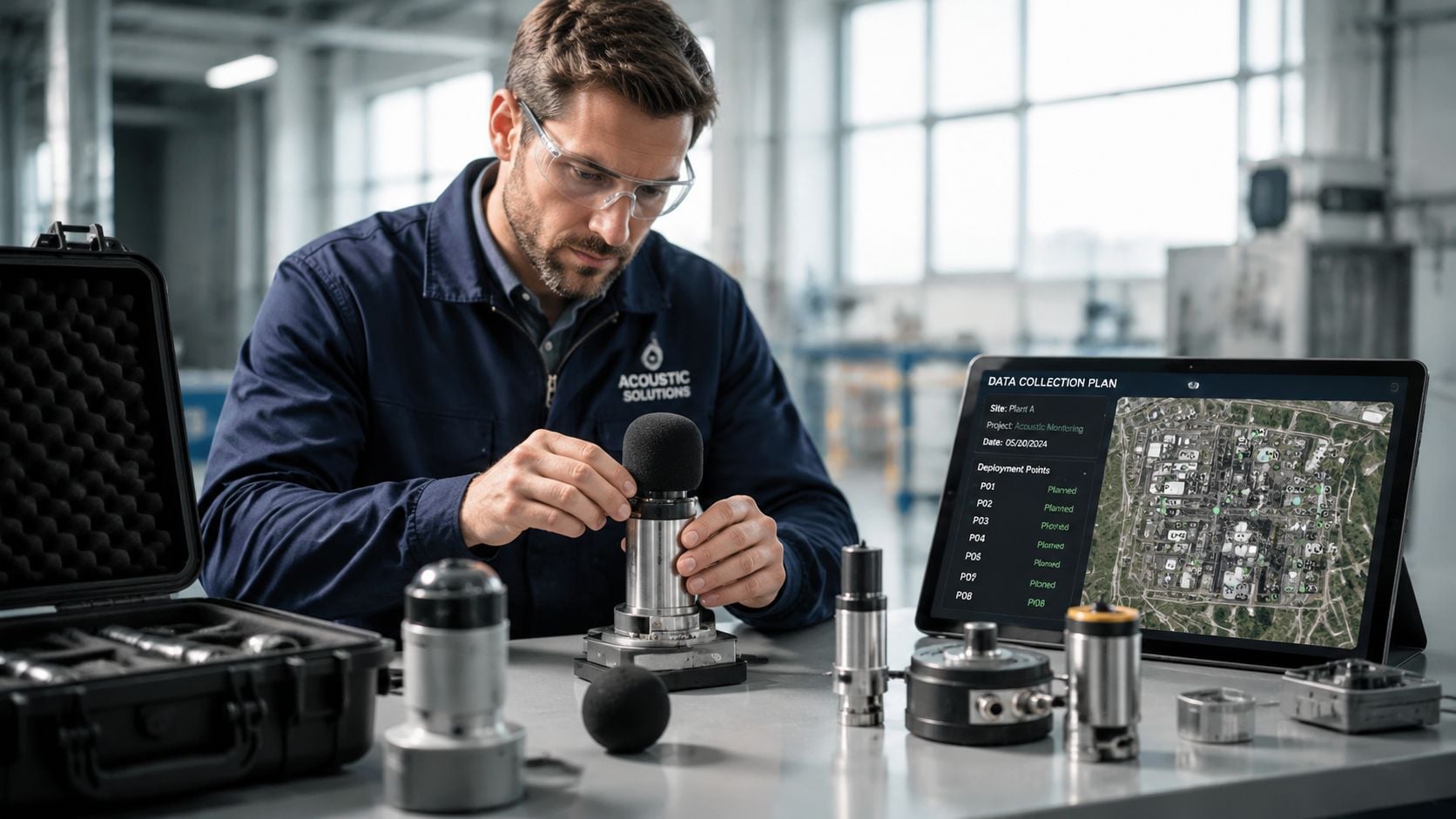
A weak acoustic program usually fails before the first inspection route starts. The plant buys a device, points it at a few assets, and expects immediate certainty. That's not how reliable data collection works.
The better approach starts with matching sensor type, collection method, and hardware capability to the failure modes that matter most on site.
Match the sensor to the failure mode
Airborne sensors and contact sensors do different jobs.
- Airborne sensing: Best for leaks, discharge detection, and other sound sources moving through air. This is the right fit for compressed air surveys, gas systems, valve leakage checks, and some electrical inspections.
- Contact sensing: Best when the sound travels through machine structure. Bearings, gearboxes, and some lubrication assessments are better served by contact probes or mounted sensors.
- Mixed programs: Most plants need both. A single production site may have compressed air losses in one area and chronic bearing lubrication issues in another.
A beverage plant is a good example. Utilities and packaging areas may justify airborne inspection routes, while filler motors, conveyor drives, and gearbox populations need contact-based trending.
Why hardware specifications matter
Not all acoustic hardware can resolve subtle defects. Higher-end systems can achieve 24-bit raw data capture, around 110 dB dynamic range, and listening bandwidth up to 200 kHz, with low self-noise, according to Abyssens' description of high-performance passive acoustic monitoring hardware. In practical terms, those specifications matter because weak fault signatures often sit close to background noise.
A plant manager doesn't need to become a sensor designer, but the questions do matter. Can the system separate faint fault energy from normal machine sound? Can it capture enough frequency detail to support early-stage detection? If the answer is no, the plant may only detect defects after they are already obvious by other means.
Better hardware doesn't guarantee better reliability. It does reduce the chance that the plant misses weak signals because the instrument couldn't resolve them.
Route-based versus continuous monitoring
Collection strategy should follow asset criticality and failure behavior, not preference.
A route-based approach works well when failures develop gradually and the plant needs broad coverage across many assets. Handheld collection is often enough for leak management, periodic steam trap surveys, and routine bearing checks on noncritical machines. Teams building these programs usually benefit from a formal vibration monitoring route setup guide because route discipline matters just as much in acoustic work.
Continuous monitoring makes more sense when the asset is critical, hard to access, or prone to defects that develop between inspection intervals. A critical compressor, turbine auxiliary system, or isolated gearbox may justify permanently mounted sensing because the cost of missed detection is high.
The right question isn't which method is more advanced. The right question is which method gives the plant actionable information early enough to intervene.
Implementing a Successful Monitoring Program
Plants don't struggle with acoustic monitoring because the physics is too complex. They struggle because the program often starts as an ad hoc leak hunt and never matures into a repeatable maintenance process.
A successful program has three disciplines. It establishes baselines on known-good equipment. It manages background noise instead of pretending noise doesn't exist. And it converts acoustic findings into work orders, inspections, and maintenance decisions.
Start with baselines, not alarms
Alarm thresholds are only useful when the plant understands what normal sounds like. That means collecting baseline readings on healthy assets under known operating conditions.
A centrifugal pump in a chemical process line shouldn't be compared casually to a similar pump running a different fluid, at a different load, with different piping conditions. Acoustic signatures are highly sensitive to operating state. The baseline needs to reflect reality on that machine, not an abstract fleet average.
Some plants now use analytics that learn normal sound patterns and identify deviations over time. That can help, especially for continuous monitoring. It also requires clean asset naming, operating context, and a maintenance workflow that validates what the model flags. Plants exploring more advanced analytics often connect acoustic data to broader predictive maintenance machine learning strategies rather than treating sound as a standalone feed.
Noise control is the real implementation test
The hardest part of acoustic monitoring isn't detecting clean signals in ideal conditions. It's making the method work in a noisy plant where airflow, adjacent machines, and structure-borne transmission can mask the target source.
The practical challenge is well recognized. Detection and classification depend strongly on propagation conditions, distance, and acoustic path, so sensor placement and path understanding are central to validating reliability in real-world interference, as described in WWF's acoustic monitoring guidelines.
That has direct implications on the plant floor:
- Reduce distance where possible: The farther the sensor is from the source, the more other sounds interfere.
- Choose the path intentionally: Airborne measurements can be overwhelmed in congested areas, while contact measurements may isolate the machine more effectively.
- Control the operating state: Compare like-for-like conditions. A loaded machine and an unloaded machine may produce very different signatures.
- Validate suspicious findings: If one reading looks abnormal, repeat it from a second point or with a second method before issuing a high-confidence diagnosis.
Background noise doesn't make acoustic monitoring unreliable. Uncontrolled measurement practices do.
Turn findings into maintenance action
An acoustic program only becomes valuable when the data leads to decisions. That means the inspection route should define what happens after each class of finding.
For example, a leak found on a compressed air header may go directly to corrective work. A suspected bearing lubrication issue may trigger relubrication followed by a verification reading. A potential electrical discharge finding should prompt escalation under the site's electrical safety and maintenance process.
One practical option for plants that need help formalizing this workflow is to use an outside reliability partner. Forge Reliability offers ultrasonic condition monitoring as part of broader predictive maintenance programs, alongside vibration, oil analysis, and thermography. That kind of arrangement can be useful when a site has critical assets but limited in-house PdM bandwidth.
Integrating Acoustics into a Total Reliability Strategy
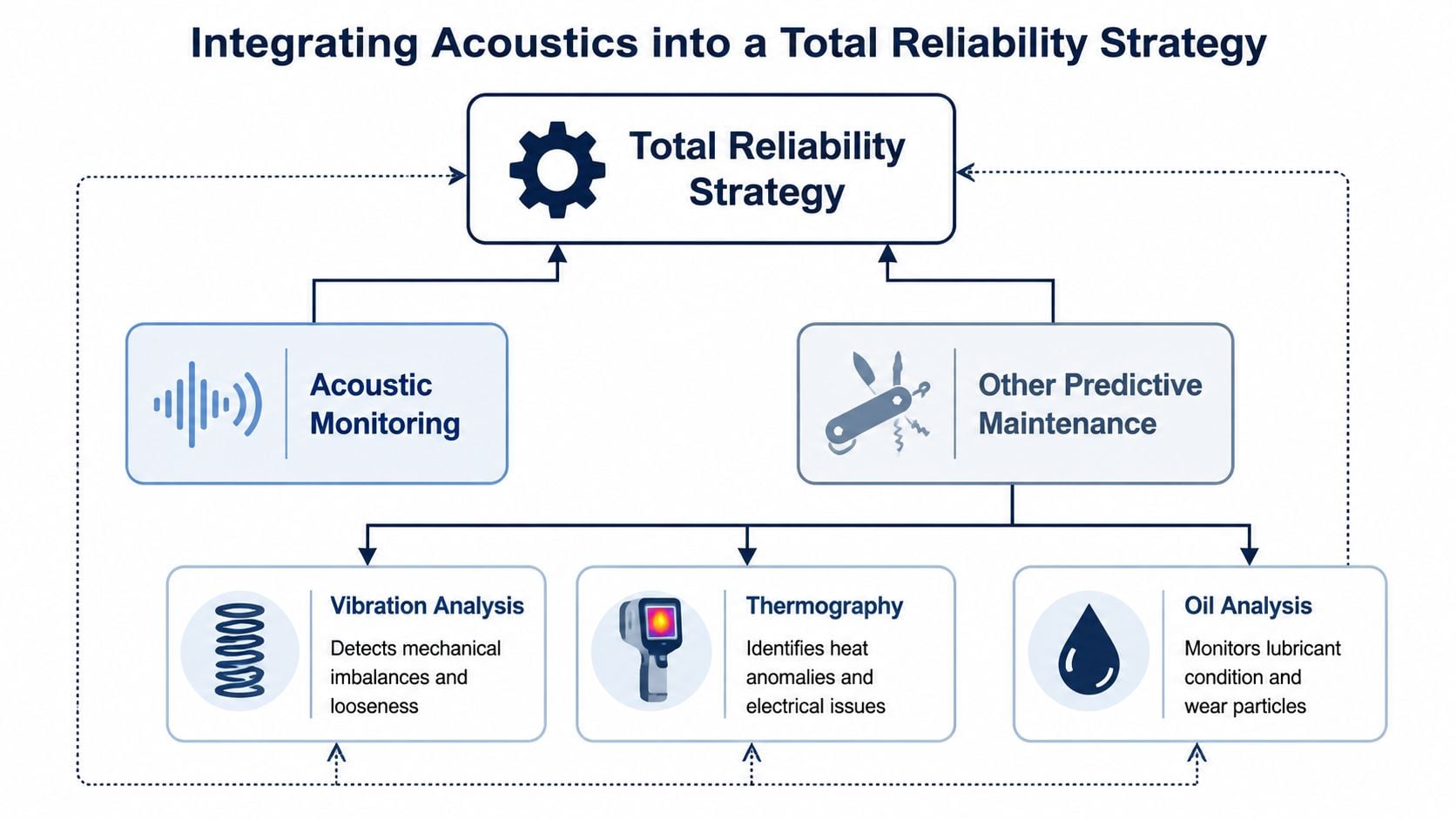
Acoustic monitoring is strongest when it fills a specific gap in the plant's reliability stack. It is not a universal answer, and it shouldn't be sold that way.
Its value comes from detecting failure mechanisms that are easy to miss by sight, touch, or periodic process review. The plant then uses other methods to confirm severity, understand progression, and decide the right corrective action.
Where acoustics fits best
A practical example is a critical pump train in a process plant. Acoustic readings may pick up early lubrication-related distress before physical damage produces stronger vibration indicators. Vibration analysis then helps determine whether the condition is progressing into looseness, defect frequencies, or structural response. Oil analysis may clarify whether contamination or lubricant degradation is contributing to the problem.
The same layered logic applies elsewhere:
- Utilities: Acoustics finds compressed gas leaks quickly.
- Steam systems: Acoustics screens trap behavior and flags loss points.
- Electrical assets: Acoustics identifies discharge activity that needs further evaluation.
- Rotating equipment: Acoustics provides early warning on friction-related issues.
That integrated model matters because a reliability team doesn't need more alarms. It needs better decisions.
Building the business case asset by asset
The cost-effectiveness question is real. Acoustic monitoring isn't automatically the best method for every failure mode. Recent literature is moving toward hybrid AI pipelines using raw audio, spectrograms, CNNs, and LSTMs, but operators still need practical guidance on when acoustics adds value over other methods, how to set alarm thresholds, and how to avoid false positives in continuous monitoring, as discussed in this review of AI-enabled acoustic monitoring.
A plant manager should frame the business case around specific assets and decisions, not around generic innovation language.
For example, ask:
- Which failures are currently discovered too late
- Which systems waste energy through hidden leakage
- Which electrical assets would benefit from non-invasive screening
- Which chronic machine problems might show acoustic change before other indicators move
If the answers point to compressed air systems, steam networks, switchgear, or lubrication-sensitive bearings, acoustic monitoring usually has a clear role. If the plant needs shaft alignment quality, resonance diagnosis, or lubricant chemistry detail, another method may carry more weight.
Your First Steps in Acoustic Monitoring
The most effective way to start is small, targeted, and tied to known losses. Plants don't need a site-wide rollout to prove value.
A practical three-step starting plan
Choose one pilot area with clear consequences
Compressed air systems, steam traps, switchgear screening routes, or a population of chronic pump and motor bearings are all sensible starting points. The pilot should focus on assets where the plant already suspects hidden loss or late detection.Run a focused survey and document findings by failure mode
Don't just collect readings. Record location, operating state, suspected defect type, and recommended action. A leak list, a lubrication exception list, or an electrical follow-up list is more useful than a folder full of sound files.Use the pilot to define the long-term program
The pilot should answer practical questions. Which failure modes were detectable. Which routes were repeatable. Where did background noise interfere. Which findings led to corrective work. Those answers shape the broader monitoring plan.
Acoustic monitoring works best when the plant treats it as a decision tool. It helps teams hear hidden defects earlier, but only if the program is built around real failure modes, disciplined collection, and follow-through from detection to action.
If hidden leaks, early bearing distress, or uncertain electrical conditions are still slipping past routine inspections, Forge Reliability can help define where acoustic monitoring fits in a practical predictive maintenance strategy. A no-cost reliability assessment can identify the assets, failure modes, and monitoring gaps that deserve attention first.