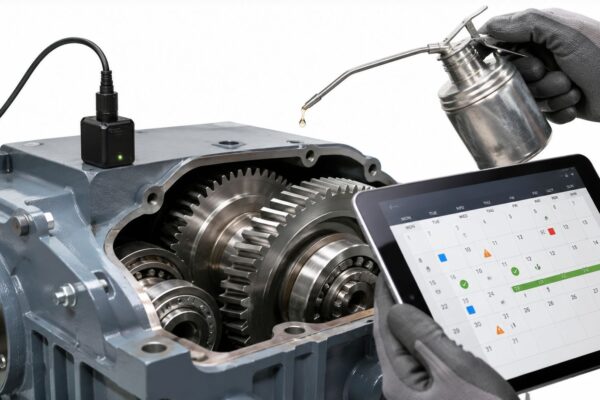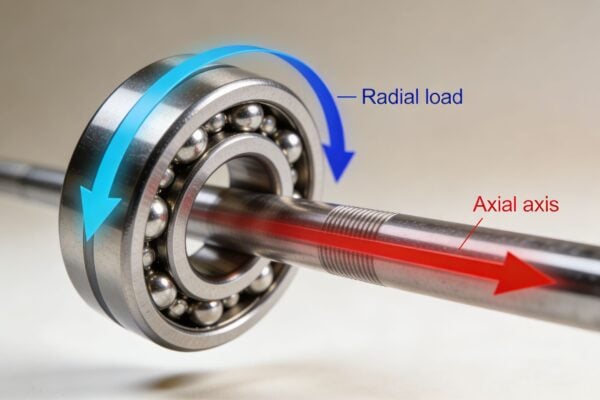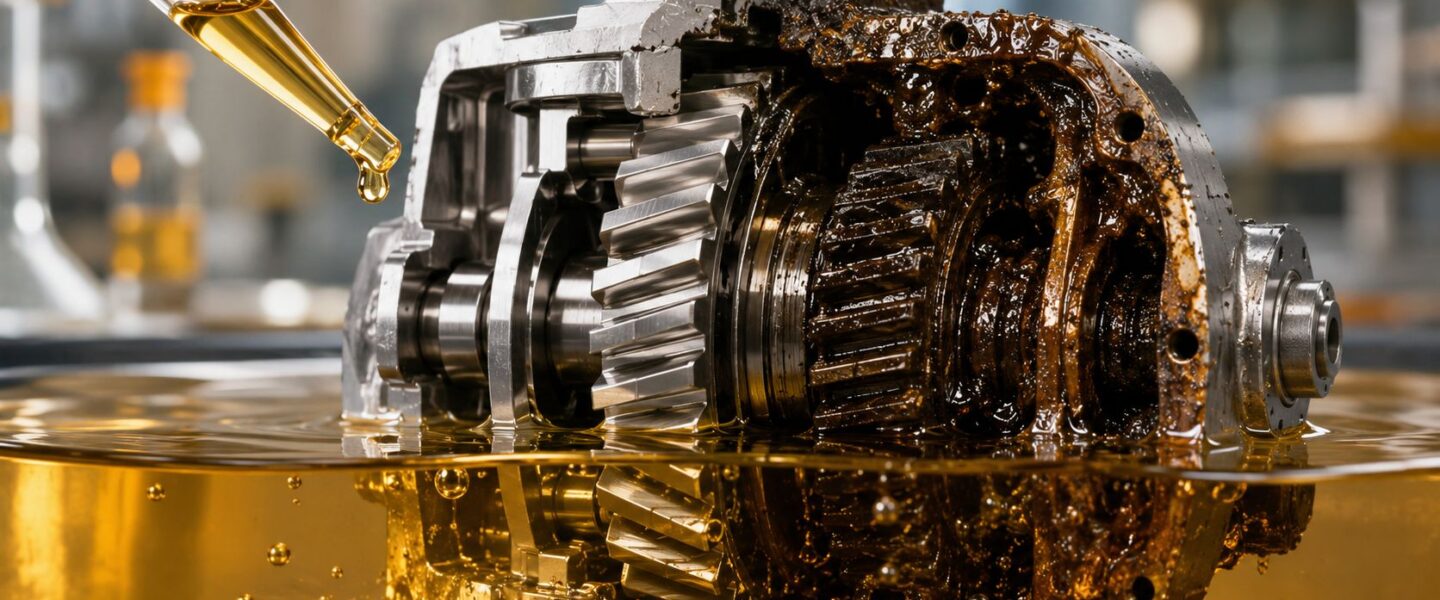
A maintenance manager opens a gearbox filter housing and finds dark varnish on the media. The oil still looks serviceable at a glance, but the filter tells a different story, one that often shows up first in rotating equipment like gearboxes, hydraulic reservoirs, and compressors. That's the hard part about the oxidation of oil, it usually starts long before a shutdown, and by the time the oil looks obviously bad, deposits have already begun loading filters, sticking valves, and stressing components.
Table of Contents
- Introduction to Oxidation of Oil in Industry
- Understanding the Key Concepts
- Diagnosing Oxidation in Service Oil
- Recognizing Equipment Failure Modes from Oxidation
- Setting Maintenance Thresholds and Trending Practices
- Mitigation Strategies to Control Oxidation in Oil
- Monitoring Workflows and Case Study Examples
- Conclusion and Call to Action
Introduction to Oxidation of Oil in Industry
A plant supervisor sees filter changes rising on a critical gearbox, then finds a sticky amber film inside the housing. That moment usually raises a practical question, is the oil oxidizing, or is another condition in the system creating the same symptom? In industrial service, the answer matters because oxidation does not stay a chemistry topic for long, it turns into sludge, varnish, acid formation, and deposit-related wear that makes equipment harder to trust.
Oxidation leaves a trail, and that trail can guide early in-service diagnostics before a reservoir design issue or a running condition problem turns into a larger reliability event. Analysts often look for acid number growth, FTIR signals, rising viscosity, and insolubles that point to deposit formation rather than simple oil age. The same pattern often lines up with heat, air ingress, water, and metal catalysts such as copper and iron, which can push the reaction faster in real plant systems. For a broader reliability view of those effects, see oxidation chemistry and reliability impacts.
Practical rule: if varnish is appearing in the filter, the oil program needs more than a pass-or-fail lab result. It needs a diagnosis that connects the chemistry to the machine.
That diagnosis becomes more accurate when teams separate the oil's condition from the reservoir and breathing arrangement that surround it. A gearbox, turbine, pump, or hydraulic tank can age oil quickly if hot surfaces, poor air exchange, trapped moisture, or dead zones in the reservoir keep oxidized fluid in circulation. The most useful maintenance response combines oil analysis, filtration checks, cooler performance review, and root-cause work on temperature and contamination control, so the team can see whether the oil is failing on its own or being pushed there by the system around it.
Understanding the Key Concepts
A gearbox can look healthy on the outside while oxidation is already building inside the sump. The chemistry starts small, then grows through the oil film around hot gears, bearings, and pump surfaces. Moist air entering through the breather, fine copper or iron wear particles, and heat from normal operation all help the reaction move faster in real plant equipment.
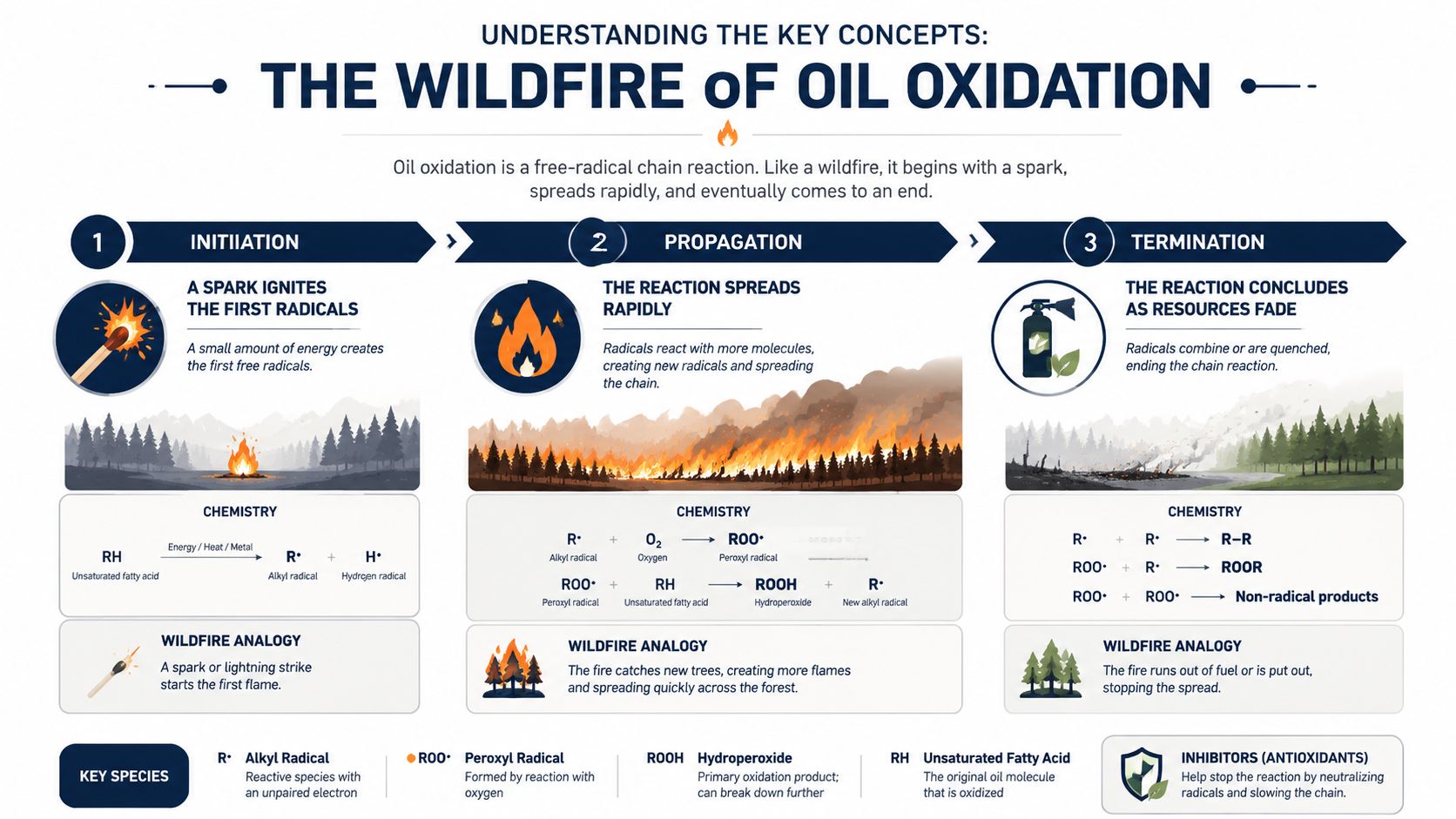
The three stages that matter in service oil
Oil oxidation follows a free-radical chain reaction with three stages. In initiation, heat or another trigger creates unstable radicals in the oil molecules. In propagation, those radicals keep reacting with oxygen and creating more reactive species, so the reaction spreads through the fluid. In termination, the chain reaction slows as reactants are used up or inhibitors interrupt the process, yet the by-products may already be circulating through the machine and beginning to affect performance.
For reliability teams, the sequence matters because each stage leaves a different clue in service oil. Early oxidation may show up as a change in the oil's chemistry before the machine shows an obvious fault. That makes early in-service diagnosis useful, especially in rotating assets where a small reservoir problem or breathing issue can keep reintroducing stressed oil back into the circuit. A closer look at dissolved oxygen behavior can help explain why the reaction keeps feeding itself, and a dissolved oxygen sensor for oil systems can help teams evaluate that part of the condition.
Oxidation also creates acids, resins, varnish, sludge, and carbonaceous deposits. Those products are not just signs of age. They can load filters, make valves stick, and leave deposit-related wear in gearboxes and hydraulic systems. Once the oil thickens, the machine no longer receives the clean, mobile fluid film it was designed to use.
Why the machine cares about chemistry
The hardware does not react to radicals directly. It reacts to the results. Viscosity rise changes how the oil moves, while sludge and varnish narrow clearances and block small passages that depend on free flow. In a hydraulic system, that can show up as slow valve response. In a gear reducer, it can leave a contaminated film on teeth and bearings. The chemistry turns a lubricant from a protective fluid into a deposit source.
A quick visual check can miss that change. Oil can still look acceptable while deposit growth is already starting in hidden zones.
A useful mental model keeps the diagnosis grounded. Heat speeds the reaction, oxygen feeds it, water creates a worse environment for the oil, and copper or iron can help the chemistry advance. That is why the reservoir, breather, cooler, seals, and metallurgy belong in the review, not only the oil sample. For a plant crew checking a turbine sump or compressor reservoir, the question is not only what the report says, but what in the system is driving the report.
Diagnosing Oxidation in Service Oil
The mistake many teams make is assuming TAN by itself can tell the whole story. It can't. Total acid number can rise from oxidation, but it can also reflect acids from contamination, so it doesn't separate cause cleanly. That's why a rising TAN in a hydraulic system with normal viscosity should be read as a clue, not a verdict.
How to choose the right test combination
FTIR is more direct for oxidative by-products, while color and odor usually show up late and are imperfect indicators (diagnostic gap and FTIR value). That matters for service oil because the best time to catch oxidation is before the oil crosses into a maintenance event. A practical sampling program therefore uses a mix of quick field screening and lab confirmation, especially on critical rotating assets.
| Diagnostic Test Comparison | |||
|---|---|---|---|
| Test | Parameter | Target Range | Sample Requirement |
| TAN or AN | Acid growth | Track trend, not a single value | Lab sample |
| FTIR | Oxidative by-products | Compare against baseline | Lab sample |
| Viscosity | Thickening | Match against new-oil reference | Lab sample |
| Insolubles | Deposit load | Trend upward movement | Lab sample |
| Visual and odor checks | Late-stage change | Use only as a warning sign | Small field sample |
For a gearbox program, that table supports a simple rule. If TAN is drifting up but viscosity stays stable, the team should not declare victory or failure from TAN alone. If FTIR shows oxidative by-products at the same time, the case for active oxidation gets much stronger. A clean field check still has value, but only as a fast triage step.
A decision path that avoids blind spots
Start with the asset's duty. Hot turbines, compressors, and hydraulic reservoirs deserve tighter trending than low-stress service equipment. If the machine is critical and the oil has changed behavior, send the sample to a lab and compare results to prior baselines. If the machine is noncritical but showing darkening, odor, or filter loading, the sample still needs confirmation, because late-stage appearance can lag behind the chemistry.
Field rule: when TAN, viscosity, and appearance disagree, the machine's operating history usually explains the mismatch better than the oil report does.
The most useful internal workflow is to pair the oil sample with a real inspection of breather condition, cooler performance, and contamination control. A service oil report only becomes a decision tool when the maintenance team connects it to what the asset is doing under load. For a fuller sampling workflow, a structured program like oil sampling and analysis guidance can help teams standardize how they collect and interpret the data.
Recognizing Equipment Failure Modes from Oxidation
Oxidation deposits do not fail equipment in one uniform way. They behave differently depending on where the oil sits, how the machine circulates it, and which clearances depend on clean flow. A hydraulic valve may stick because varnish coats the spool, while a gearbox may run hotter because sludge traps heat and slows lubrication movement. A pump may sound rough because deposits disturb inlet conditions or narrow internal clearances, and a turbine nozzle can foul when fine passages collect residue.
A plant example makes the pattern easier to see. A warm reducer with a weak breather can pull in moisture and air, then build a sticky film that interferes with motion and cooling. The oil may still move through the system, but it no longer behaves like a clean lubricant. That is how a small contamination issue turns into unexpected downtime.
What the deposits do inside the machine
The chemistry behind the damage follows a chain reaction, and the mechanical result is usually familiar to reliability teams. As oxidation progresses, the oil can thicken, form organic acids, and leave behind sludge, varnish, and other deposits. Those by-products can restrict filters, shorten oil life, and make the lubricating film less reliable under load, which is why the machine starts to show symptoms before a failure label appears. In a gearbox, that often shows up as more wear at the tooth contact zone and weaker heat transfer through the oil.
The same pattern appears in other enclosed systems. Heat, air ingress, water, and reactive metals can all push the reaction forward, so the issue is often a combination of operating conditions rather than a single defect. A hot unit with poor contamination control is much more likely to build deposits than a cooler machine with clean breathers and stable filtration.
Where to inspect first
Inspection should follow the symptom, because oxidation usually announces itself through the component most sensitive to deposit formation. If the symptom is valve sluggishness, inspect hydraulic spools and fine filtration first. If the symptom is gear noise or heat, inspect the gearbox sump, cooler, and filter condition. If the symptom is repeated pump cavitation-like noise, review oil cleanliness, suction conditions, and deposit buildup around strainers and inlets.
Inspection priority: trace the deposit to the component that depends most on clean oil flow, not just the part that looks dirtiest.
A practical gearbox review also needs a look at the oil's operating environment. Heat, air ingress, water, and metals in the system can accelerate the chemistry that creates acids and varnish, so metallurgy, seals, and operating temperature belong in the failure analysis. For a more structured approach to reducers, teams can use gearbox oil analysis guidance to connect visible deposit behavior with sample results and operating history.
A useful way to separate nuisance symptoms from true oxidation damage is to ask where the oil can no longer do its job. If the problem shows up first in a valve, a cooler, or a fine passage, the deposits are already affecting flow paths that have little tolerance for contamination. If the issue shows up as drag, heat, or discoloration in a reservoir, the reservoir design and breathing conditions may be part of the problem, not just the oil chemistry. For teams trying to support doing more with less while keeping rotating equipment stable, that distinction saves time and avoids chasing the wrong component.
Setting Maintenance Thresholds and Trending Practices
A good alarm limit is one that changes behavior before the machine changes behavior. That means the maintenance team has to set thresholds from trend data, not from calendar habit. A turbine that lives in high heat may justify tighter monitoring than a cooler-running compressor, even if both use the same lubricant family.
Use benchmark testing as a reference point
Accelerated oxidation-stability testing gives a benchmark for comparing oils and setting replacement thresholds. ASTM D943 TOST runs in oxygen, water, copper, and iron at 95 °C, and it ends when the oil neutralization number reaches 2.0 mg KOH/g or higher, with the elapsed hours reported as oxidation lifetime (benchmark test conditions and endpoint). That doesn't replace in-service trending, but it does tell a reliability team how one oil resists oxidation compared with another.
Build thresholds from the machine, not the calendar
For in-service oil, the right threshold is usually a combination of trend slope, operating temperature, and asset criticality. A hot gearbox that trends upward quickly needs earlier intervention than a lightly loaded reservoir with stable results. The key is to use the same sampling frequency long enough to see the slope clearly, then adjust based on what the machine is telling the team.
If a plant is trying to do more with less, this is one place where better trending beats more frequent blanket changes. A trend-based program reduces wasteful oil replacement while still catching the machines that are aging faster. That's especially useful in compressor skids, hydraulic power units, and turbine reservoirs where over-maintenance is costly and under-maintenance is risky.
| Trend decision | Meaning in practice | Action |
|---|---|---|
| Stable TAN, stable FTIR, stable viscosity | Oxidation reserve is holding | Keep monitoring |
| Rising TAN with FTIR confirmation | Oxidation is active | Review heat, moisture, and filtration |
| Rising viscosity plus deposits | Oil is moving toward service failure | Tighten action limit |
| Repeated fast upward trend | Operating condition is driving the problem | Investigate root cause |
A condition-based program works best when the team uses a consistent interpretation rule. For more structure on that model, condition-based maintenance guidance can support the internal process side of the decision.
The right limit is the one that triggers action while the oil still has usable life left, not the one that waits for obvious damage.
Mitigation Strategies to Control Oxidation in Oil
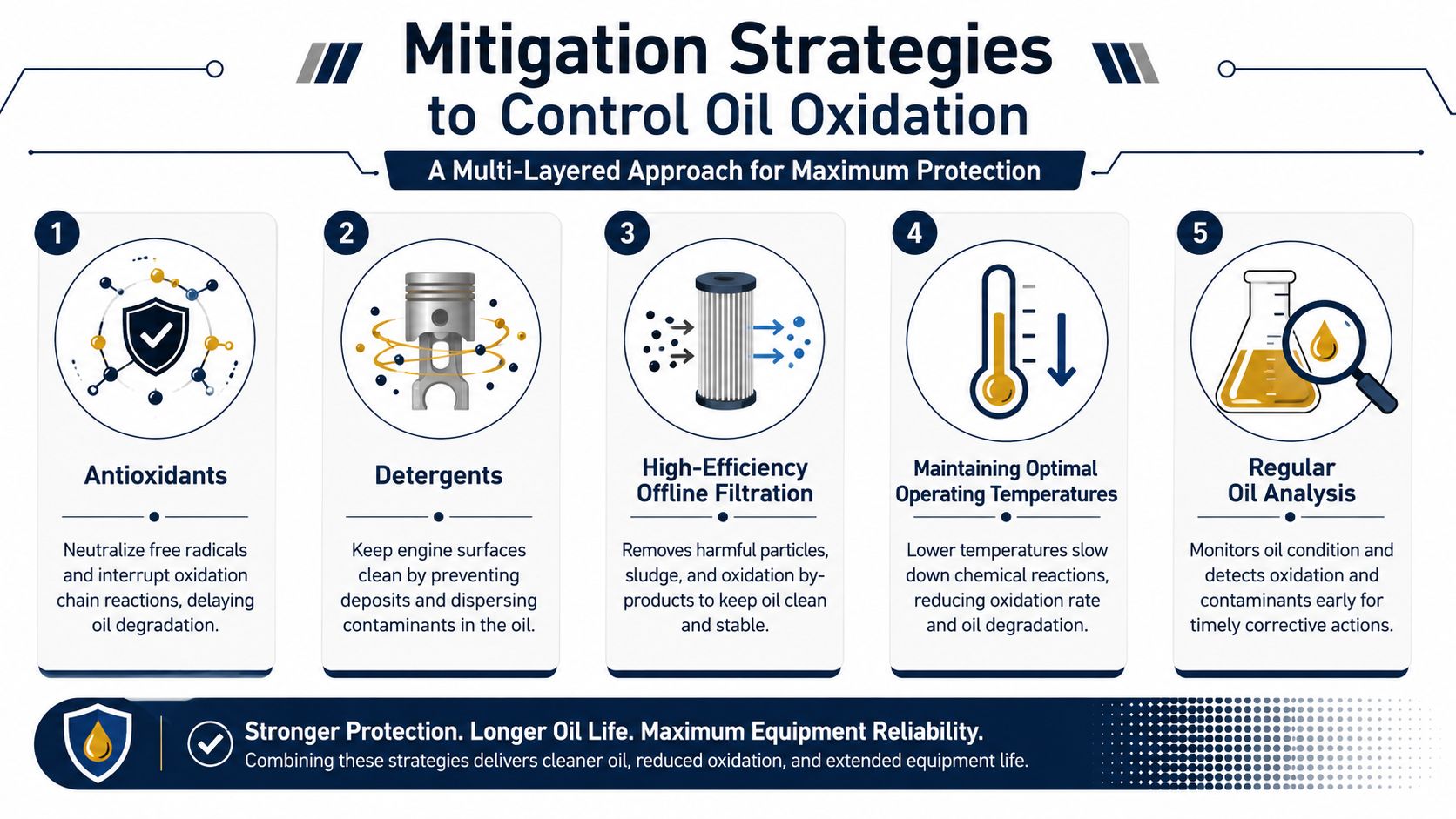
Controlling oxidation takes layers, not one magic fix. Additive chemistry matters, but so do reservoir design, contamination control, and operating temperature. A plant that relies only on oil changeouts will usually spend more time reacting than preventing.
What to control first
One strong lever is oxygen exposure. Research on bulk oil and storage conditions shows that geometry, headspace, and oxygen diffusion change oxidation risk, especially in bulk storage, shallow films, and low-headspace reservoirs. Reducing air contact, sealing containers with minimal headspace, and using inert gas can reduce oxidation (headspace and oxygen diffusion effects). That has direct plant relevance for reservoirs, transfer tanks, and any system that sits idle long enough to breathe.
Another lever is additive protection. Antioxidants slow the chain reaction, while detergents help keep contaminants dispersed instead of letting them settle into deposits. High-efficiency offline filtration then removes particles that can worsen wear and create catalytic surfaces. For a plastics plant with a stressed hydraulic system, a copper-free lubricant formulation plus varnish-control filtration is the kind of combined approach that makes sense when oxidation and deposits are the same problem.
Match the fix to the asset
A simple prioritization list helps:
- Antioxidants: Use when the oil still has oxidation reserve and the system is mainly fighting chain-reaction growth.
- Detergents: Use when contamination and deposit transport are part of the problem, especially in dirty service.
- High-efficiency offline filtration: Use when varnish, fine insolubles, or recurring filter loading shows the oil is carrying too much debris.
- Temperature control: Use when a hot sump, failed cooler, or poor heat rejection is driving the reaction faster.
- Regular oil analysis: Use when the team needs early warning before appearance, viscosity, or valve performance changes.
For teams formalizing a service program, oil analysis services can fit into that layered approach without replacing the plant's own operating discipline. It's one part of a broader mitigation strategy, not the strategy itself.
Best practice: treat reservoir design like part of the lubrication system. Headspace, venting, and surface exposure all change how fast the oil ages.
The biggest mistake is trying to fix oxidation only after deposits appear. By that point, the machine has already absorbed the cost in filtration, friction, and maintenance time. Reducing oxygen exposure and controlling temperature early usually gives the oil the most practical extension.
Monitoring Workflows and Case Study Examples
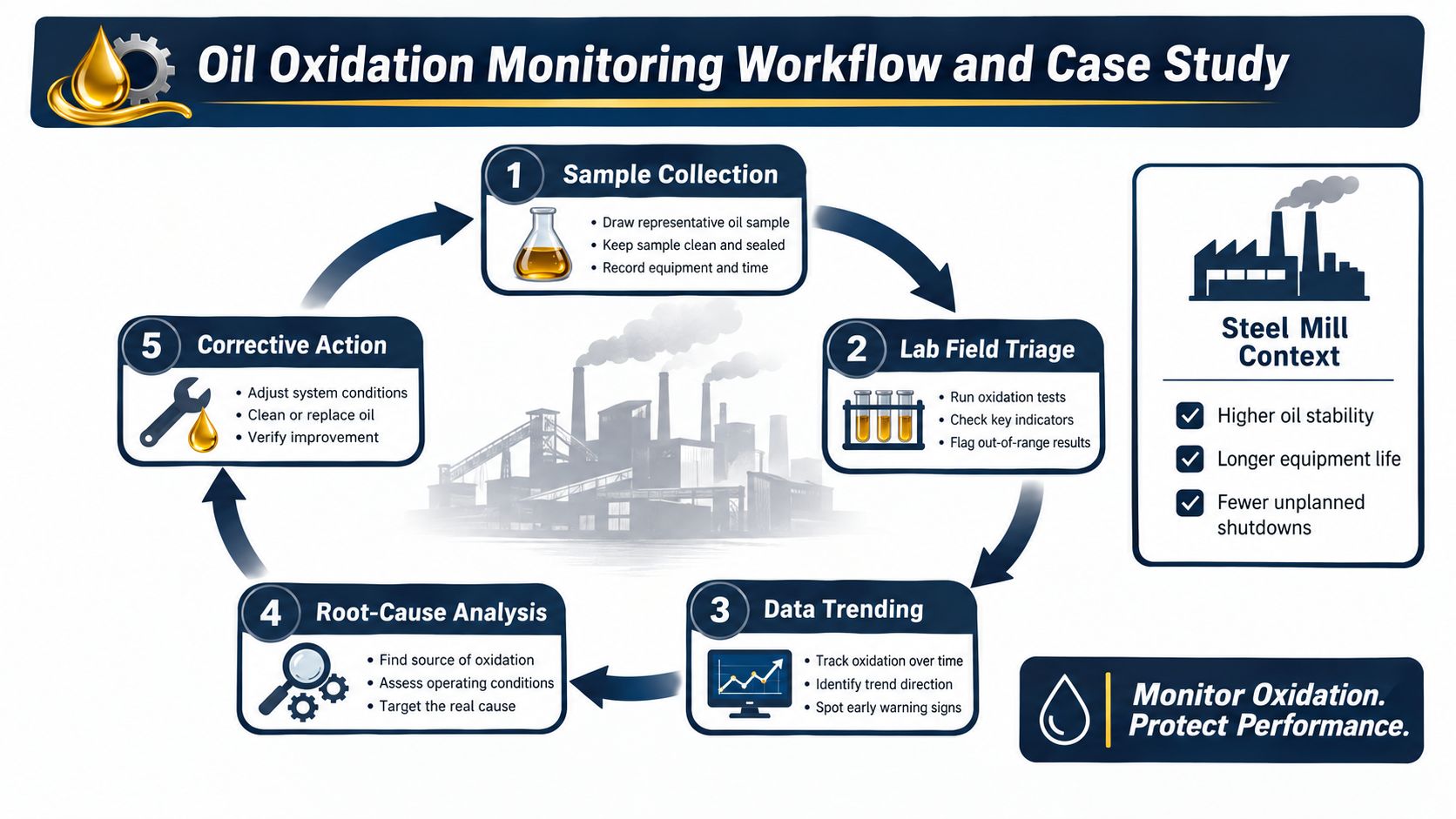
A reliable oxidation program follows the same loop every time, sample, compare, investigate, correct, repeat. The point isn't to collect more data, it's to make the data lead to action before the asset pays the price. That is especially important in a steel mill hydraulic system, where a dirty reservoir can affect more than one press or actuator circuit.
A repeatable workflow for the plant floor
The process starts with sample collection from a consistent point, at a consistent operating state. Then comes lab field triage, where the team decides whether the result looks like oxidation, contamination, or both. After that, data trending shows whether the problem is stable or accelerating. Only then should the team move into root-cause analysis and corrective action.
A useful way to think about this is to ask three questions at each sample point. Is the oil changing chemically, is the machine creating the change, and is the reservoir design helping or hurting the situation? That keeps the conversation on evidence instead of guesswork.
A steel mill hydraulic example
A hydraulic system in a steel mill can develop rising insolubles long before operators notice a performance issue. If the team finds moisture ingress, the first corrective move is usually to inspect breather performance and sealing, not to blame the lubricant alone. Follow-up FTIR then helps confirm whether oxidative by-products are still building or whether the corrective action has stabilized the oil condition.
That same workflow becomes stronger when the plant connects it to broader reliability planning. A digital record of samples, trends, and corrective tasks can support the steps to digital transformation ROI by showing where maintenance work is reducing repeat failures. The value is operational, not theoretical, because the maintenance history starts pointing to root causes instead of recurring surprises.
Checkpoint question: did the last corrective action change the trend, or only delay the next sample?
For equipment teams, the most important outcome is not a cleaner report, it's a better decision path. When sample results, breather checks, cooler inspections, and corrective actions all line up, the plant stops treating oxidation as a mystery and starts treating it as a controlled risk. A structured workflow does exactly that.
Conclusion and Call to Action
The oxidation of oil becomes manageable when the team understands the chemistry, tests the right indicators, sets trend-based thresholds, and addresses the machine conditions that feed the reaction. TAN, FTIR, viscosity, and deposits all tell part of the story, but the complete picture usually sits in the combination of oil condition, reservoir design, heat load, and contamination control. That's why proactive oxidation control protects more than lubricant life, it protects filters, valves, gears, pumps, and uptime.
Reliability teams that treat oxidation as a failure mechanism tend to find the hidden drivers faster. They see the role of headspace, oxygen ingress, and moisture. They also stop waiting for obvious varnish or sludge before acting, which is usually the most expensive moment to begin.
Forge Reliability can review oxidation risk in your critical assets, connect oil results to operating conditions, and help identify whether the problem starts in the reservoir, the lubricant, or the machine itself. Visit Forge Reliability to schedule a free reliability assessment and get a practical plan for your rotating equipment and storage systems.