For reliability engineers and maintenance managers, the specification "Lithium Soap Grease NLGI 2" on a bearing data plate is a familiar starting point. It's the industry workhorse for a reason, but relying on the name alone overlooks critical performance details that dictate asset life. This guide moves beyond the basics to focus on the practical reliability decisions, failure modes, and diagnostic techniques that industrial professionals face when managing lubricated assets.
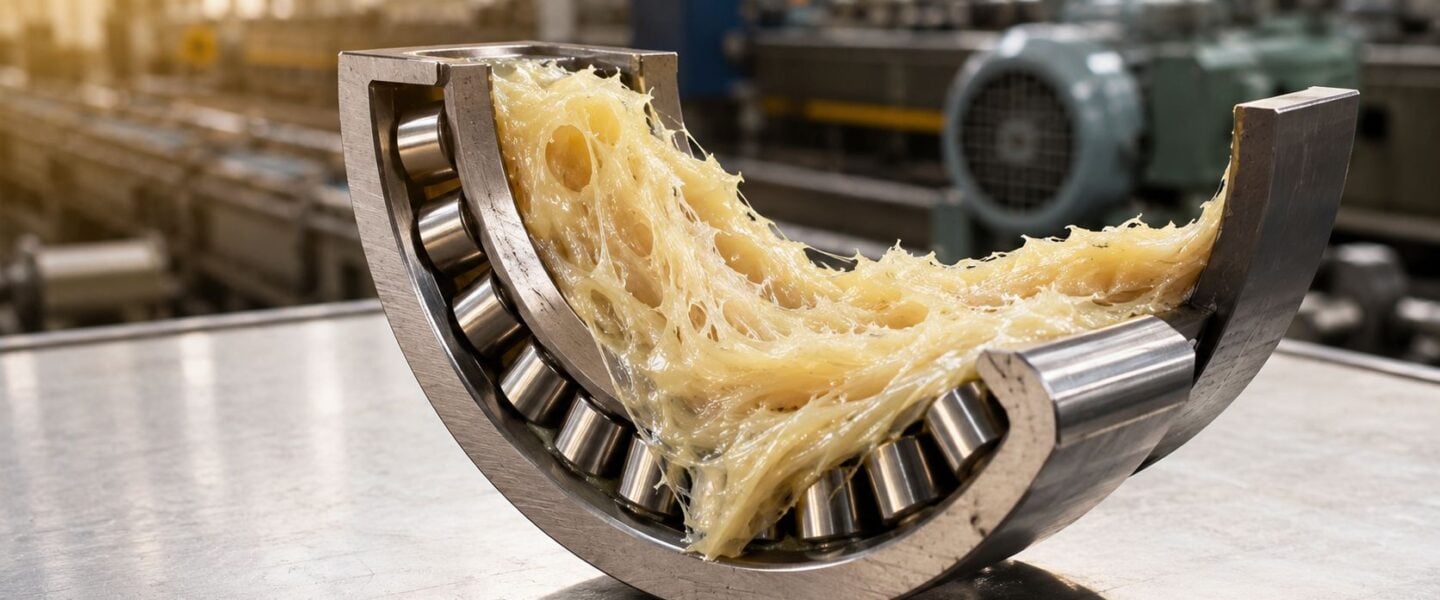
In technical terms, this grease consists of a mineral or synthetic base oil held within a fibrous matrix of lithium soap. The NLGI 2 grade denotes its consistency, as defined by the National Lubricating Grease Institute. This grade is firm enough to provide an effective seal against contaminants but soft enough to release oil under the shear stress of rolling elements, making it a versatile choice for a wide range of industrial equipment.
What Lithium Soap Grease NLGI 2 Means for Reliability Decisions
Technical Definition: A lithium soap thickened grease with an NLGI 2 consistency traps base oil in a fibrous mesh. Under the shear load of a rolling-element bearing, this mesh releases oil to form a hydrodynamic film, yet retains enough body to resist sling-off and seal out contaminants.
The thickener, typically lithium 12-hydroxystearate, creates a sponge-like fiber network that holds base oils, usually in the ISO VG 100–220 range. The NLGI 2 grade sits in a strategic "sweet spot": it is stiffer than NLGI 1 (which pumps easily but offers a weaker seal) and softer than NLGI 3 (which seals effectively but may not flow readily enough to lubricate contact zones, leading to starvation).
Industry Example: Consider a 150 kW fin-fan motor in a refinery cooling loop. The motor bearings run at a constant speed under moderate load, an ideal scenario for Lithium Soap Grease NLGI 2. The grease's consistency prevents it from being flung out by centrifugal force (sling-off), while its oil-release characteristics ensure a consistent lubricating film, preventing the metal-to-metal contact that leads to spalling and eventual bearing failure.
When reliability leaders evaluate an NLGI 2 grease, they focus on these key parameters:
- Thickener Role: The lithium soap mesh is the backbone. Its structure dictates the rate of oil bleed and its ability to withstand the cyclic shear forces within a bearing.
- Base Oil Choice: The viscosity of the base oil (e.g., ISO VG 100–220 mineral oil) determines the lubricating film's thickness and strength at operating speed and temperature.
- NLGI Grade Tradeoffs: While NLGI 2 provides reliable oil delivery to rolling elements, its stiffness can present challenges for long-run pumping in centralized lubrication systems compared to a softer NLGI 1 grade.
Lithium Soap Grease NLGI 2 Quick Reference for Engineers
| Property | Typical Value or Description | Reliability Implication |
|---|---|---|
| Thickener | Lithium soap (12-hydroxystearate) | Determines dropping point, water resistance, and mechanical stability. |
| Base oil | ISO VG 100–220 mineral or synthetic | Governs film thickness, operating temperature range, and oxidation stability. |
| Worked Penetration | 265-295 (NLGI 2 range) | Defines the grease's consistency under mechanical work; crucial for pumpability and sealing. |
| Common Applications | Motor bearings, conveyors, pumps, fans | Versatile for moderate speeds, loads, and temperatures. |
| Key Limitations | Lower max temperature vs. lithium complex; incompatibility with polyurea/calcium sulfonate. | Misapplication leads to premature hardening, bleed-out, or softening. |
Designing a new program? Our guide on lubrication systems and program design provides a framework for making system-level decisions.
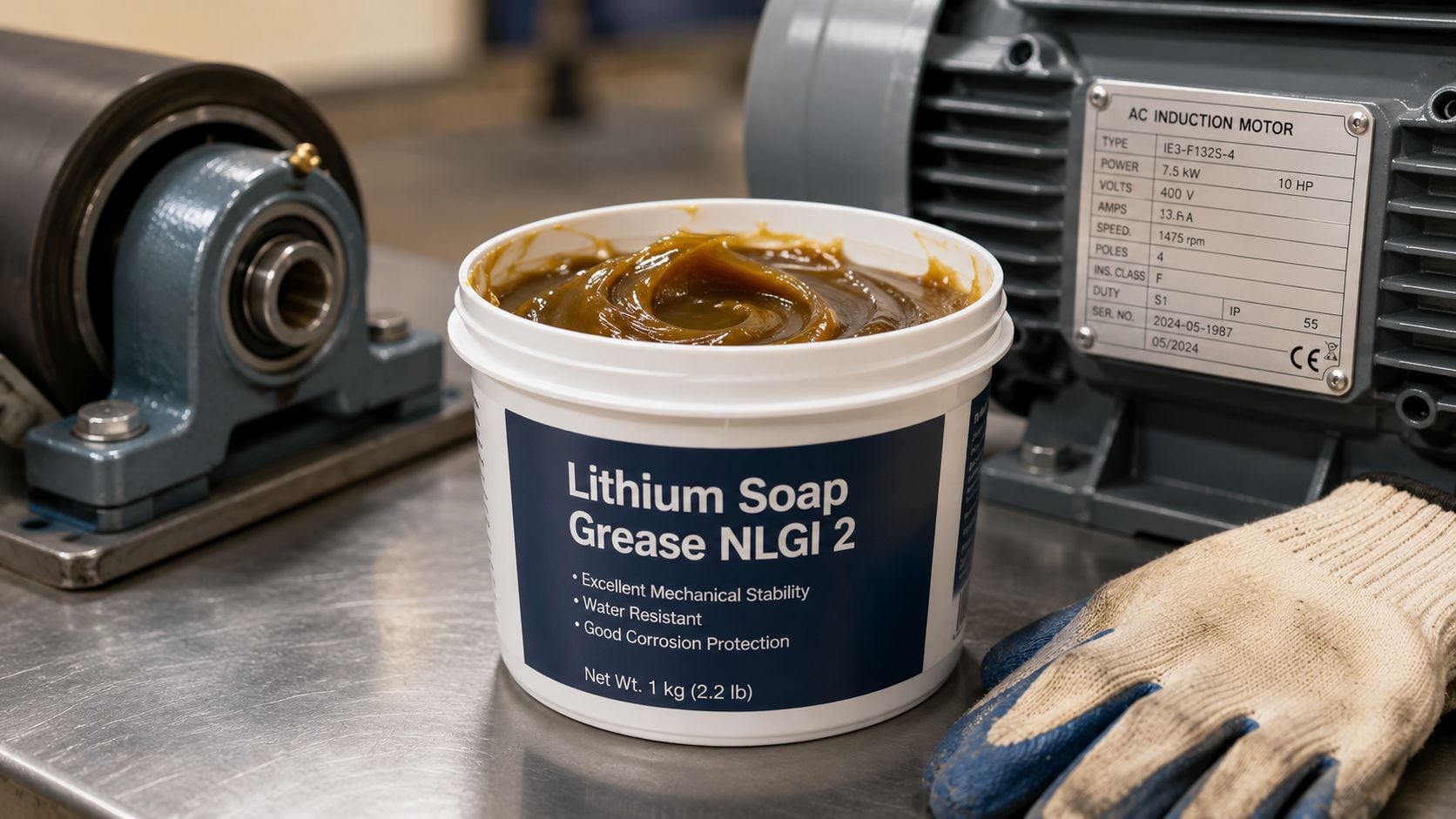
For a plant manager or engineer, the critical questions are: Is NLGI 2 still the right choice for this asset? Will it survive the operating temperature? Is it compatible with the grease currently in the bearing? And how do we determine the optimal relubrication frequency?
Table of Contents
- What Lithium Soap Grease NLGI 2 Means for Reliability Decisions
- Lithium Soap Grease NLGI 2 Quick Reference for Engineers
- How the Thickener and Base Oil Chemistry Dictate Performance
- Performance Characteristics That Drive Reliability
- Where NLGI 2 Lithium Soap Grease Excels (and Fails)
- Selection, Compatibility, and Mixing Decisions for Engineers
- Determining Relubrication Intervals with Condition Monitoring
- Troubleshooting Common Failures with a Diagnostic Flowchart
How the Thickener and Base Oil Chemistry Dictate Performance
To make informed reliability decisions, one must understand the two core components of the grease: the thickener and the base oil. Their interaction dictates how the grease performs in a bearing.
The thickener in modern Lithium Soap Grease is lithium 12‑hydroxystearate, a lithium salt of a fatty acid. This formulation largely replaced older lithium stearate greases due to its superior moisture handling and mechanical stability.
Think of the thickener as a three-dimensional fibrous mesh. This "sponge" traps the base oil until the shear forces from rolling contact squeeze the mesh, releasing oil precisely at the load zone to form a protective film. When the shear subsides, the thickener's structure re-absorbs the free oil. This dynamic oil release and re-absorption is the fundamental mechanism of grease lubrication.
The base oil, typically an ISO VG 100 to 220 mineral oil in general-purpose greases, is what actually forms the lubricating film and reduces friction. This viscosity range provides a robust film for the moderate speeds and temperatures found in most industrial plants.
Industry Example: Consider a gearbox input shaft bearing on a cement mill conveyor, operating at 1,500 rpm. An NLGI 2 grease with a heavier ISO VG 220 base oil builds a stronger hydrodynamic film, reducing the risk of asperity contact under load. However, this increases startup torque and can be difficult to pump through automated lubrication lines in cold weather. Conversely, an ISO VG 100 base oil offers lower startup torque and better pumpability but may bleed out too quickly at higher operating temperatures, leading to lubricant starvation. This trade-off analysis is central to proper grease selection.
Grease Thickener Families: A Reliability Comparison
Not all thickeners are interchangeable. Mixing them can lead to catastrophic softening or hardening. Here is how lithium soap compares to other common types:
- Anhydrous Calcium Soap: Superior water resistance but poorer low-temperature performance and typically higher cost.
- Polyurea: Excellent high-temperature and oxidative stability, enabling longer relubrication intervals. However, it is highly incompatible with lithium soap thickeners. Mixing them often results in a rapid loss of grease structure.
Lithium soap occupies a practical middle ground, delivering a balanced performance profile that makes it the default choice for a wide array of general industrial applications.
What this means for maintenance strategy:
- Confirm Chemistry Before Switching: Always verify the thickener family and base oil viscosity of a new grease. An unexpected bearing failure or motor trip on a cold morning can often be traced back to an incompatible grease mixture.
- Adjust Relubrication Intervals: Different base oil viscosities and thickener structures result in different oil bleed rates. A switch in grease formulation requires a re-validation of relubrication frequencies.
- Validate Pumpability: When commissioning or changing grease in a centralized lubrication system, test the pumpability of your chosen NLGI 2 formulation under system pressure and ambient temperature extremes before plant-wide implementation.
Grease chemistry is a system-level decision. The thickener and base oil—not the NLGI grade alone—define how lubricant is delivered to the bearing's critical surfaces.
Performance Characteristics That Drive Reliability
To move from a reactive to a proactive lubrication strategy, engineers must understand the key performance metrics that predict grease behavior in the field.
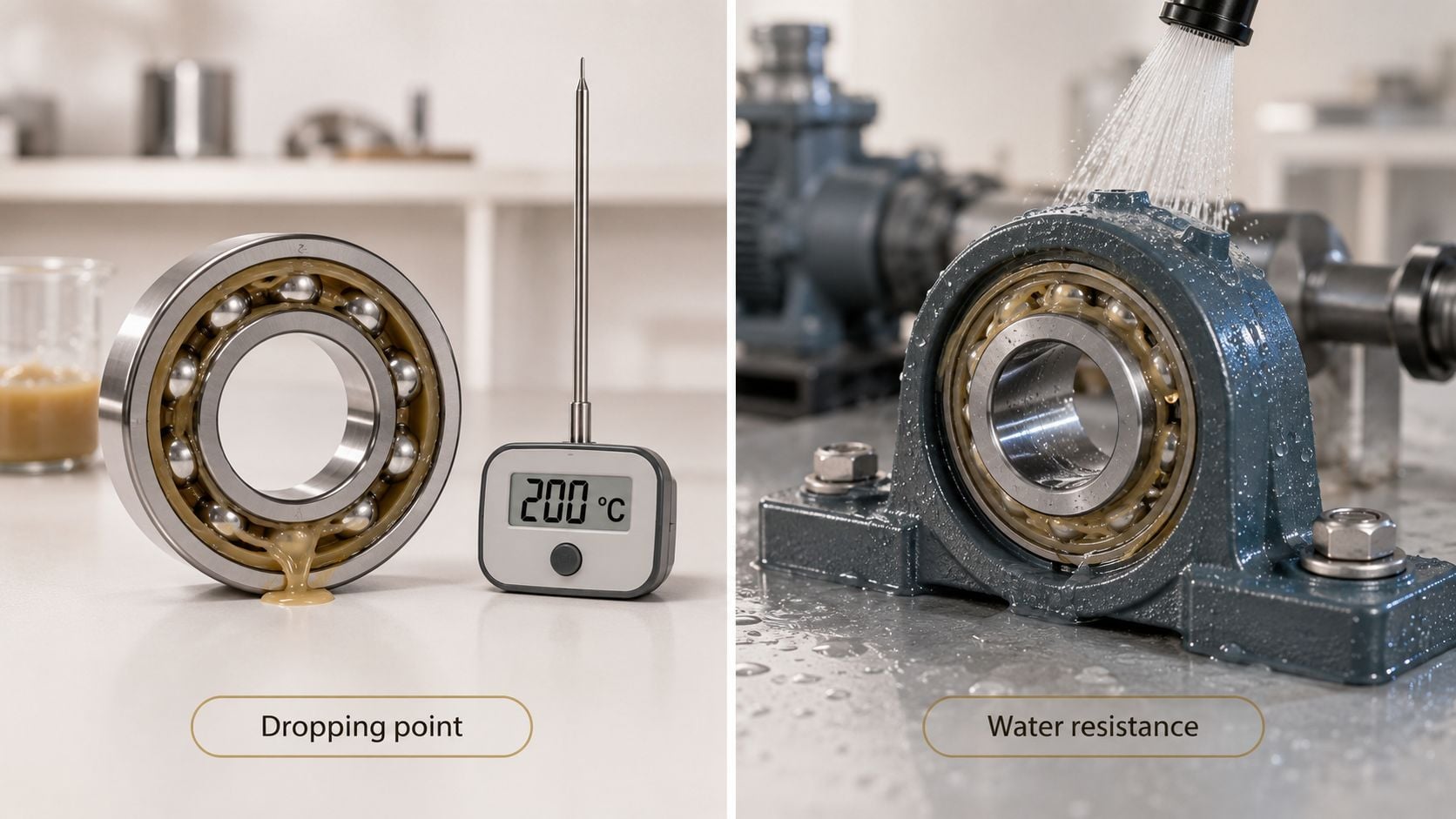
Dropping Point: This is the temperature at which the thickener can no longer hold the base oil, causing the grease to liquefy. A standard Lithium Soap Grease NLGI 2 typically has a dropping point around 200 °C (392 °F). Lithium complex greases, a common upgrade, push this limit past 260 °C (500 °F).
- Industry Example: For bearings on a continuous caster roll in a steel mill, intermittent temperature spikes can easily exceed 200°C. Using a standard lithium soap grease would lead to rapid breakdown and failure. Here, a lithium complex grease is required to survive the thermal load.
Mechanical and Shear Stability
Mechanical stability measures the grease's ability to resist structural breakdown (softening or hardening) under mechanical work. This is quantified by testing the grease's worked penetration. A grease that softens excessively under the constant kneading action of a bearing will leak from the housing, leading to lubricant starvation. Shear stability is its ability to maintain viscosity when forced through the tight clearances of a rolling contact zone. Poor shear stability results in a loss of film thickness and increased metal-to-metal contact.
- Diagnostic Technique: Compare the unworked penetration of a new grease sample to its worked penetration after 10,000 and 100,000 strokes in a grease worker. A significant drop in consistency flags a potential for in-service softening and leakage.
Water Resistance and Washout
Water resistance is a measure of the grease's ability to withstand degradation or displacement by water. It is typically reported as a percentage loss in a standardized water washout test (ASTM D1264).
- Industry Example: In a food processing plant, equipment is subjected to frequent high-pressure washdowns. A pump bearing lubricated with a grease rated "fair" for water washout may require relubrication after every cleaning cycle. A grease with a "good" or "excellent" rating, such as a specially formulated water-resistant NLGI 2 or a calcium sulfonate grease, maintains its protective film, preventing corrosion and contamination ingress.
Reliability Insight: If grease softens or washes out faster than the established relubrication interval, the bearing will exhibit rising friction and acoustic anomalies, detectable with ultrasound, long before a catastrophic failure occurs.
Worked Penetration and Roll Stability
Worked penetration and roll stability tests simulate the life of grease in a bearing. A grease that meets NLGI 2 specifications initially but loses its structure in a roll stability test (ASTM D1831) will fail to protect a high-speed (e.g., 3,600 rpm) motor bearing over time. Use these metrics to validate a grease's suitability for a specific application and to set data-driven relubrication intervals.
For a deeper understanding of diagnostic techniques, learn how Ultrasound Testing Equipment can detect early-stage lubrication failures.
Where NLGI 2 Lithium Soap Grease Excels (and Fails)
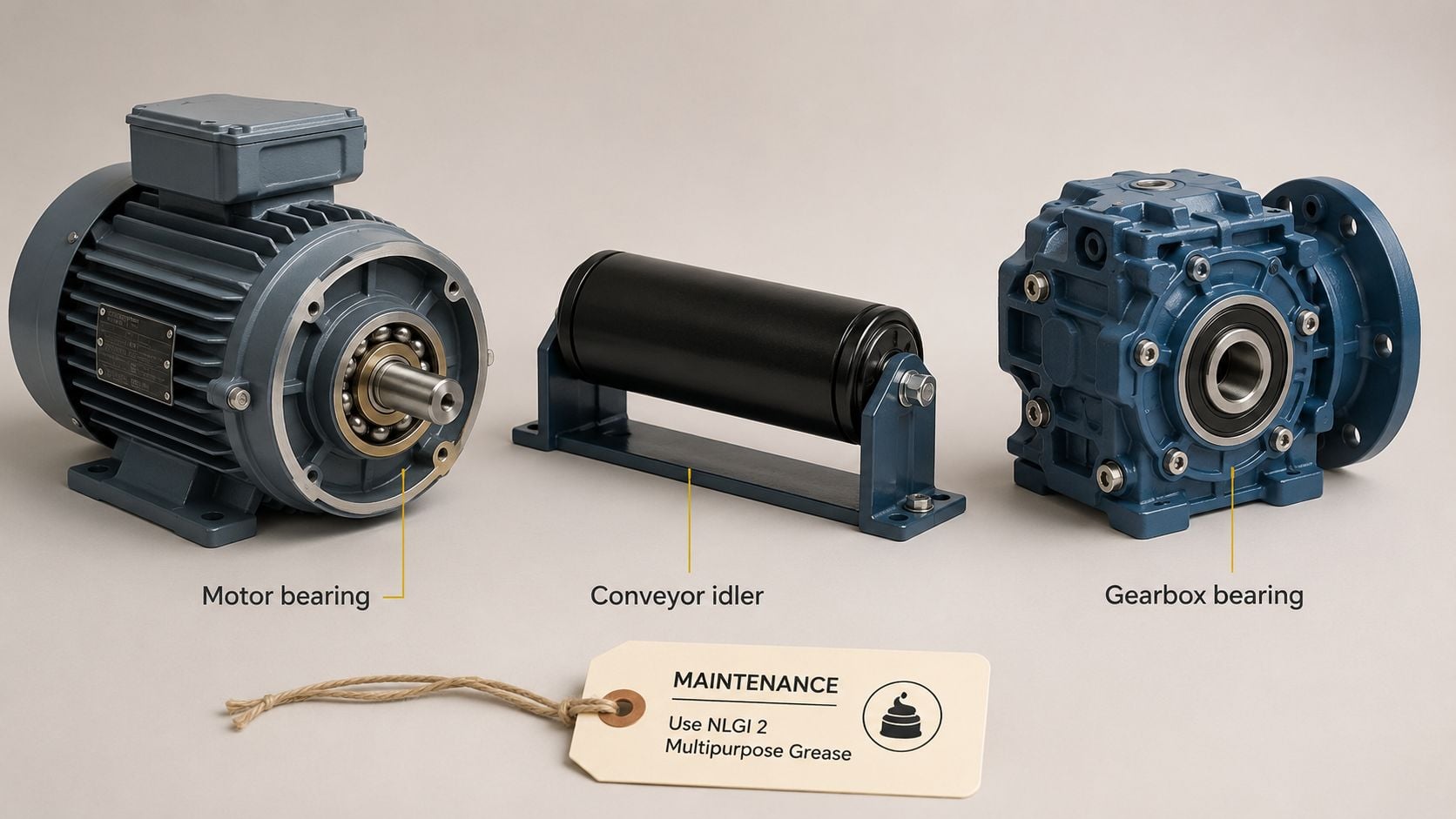
Lithium Soap Grease NLGI 2 is the default for many applications due to its balanced properties. Its primary domain is equipment operating under moderate loads, speeds, and temperatures.
- Electric Motor Bearings: Standard induction motors for pumps and fans operate in conditions where NLGI 2 provides an optimal balance of oil release and resistance to sling-off.
- Conveyor Components: The consistency of NLGI 2 is ideal for conveyor idlers and pulleys, where it stays in place and provides a durable seal against dust and dirt common in material handling environments.
- General-Purpose Plant Equipment: Lightly loaded gear couplings and small gearboxes benefit from NLGI 2's ability to lubricate bearings without excessive churning or heat generation.
Industry Example (Success): A 200 kW induced-draft fan motor in a pulp and paper mill, previously experiencing bearing failures every 14 months, was stabilized by implementing a proper lubrication strategy. The root cause was not contamination but incorrect relubrication volume leading to grease churning and overheating. By applying the correct volume of a high-quality Lithium Soap Grease NLGI 2 at an interval validated by ultrasound testing, the bearing life was extended beyond 36 months.
Common Failure Modes from Misapplication
Applying this grease outside its intended operating window leads to predictable failure modes:
- Grease Channeling: In very slow-moving bearings (<50 rpm), the grease can be pushed aside by the rolling elements, creating "channels" where no lubricant is present. This leaves the contact zone dry, causing wear. A softer NLGI 1 or 0 grade is often a better choice here.
- Churning and Overheating: In high-speed bearings (>500,000 nDm), NLGI 2 grease can cause excessive drag and heat buildup (churning), leading to thermal runaway and rapid oxidation. A channel-plate grease or a lower NLGI grade is required.
- Base Oil Migration: In vertically mounted motors, oil can bleed from the thickener and migrate down the shaft, potentially contaminating motor windings and causing electrical faults. A grease with lower bleed characteristics is necessary.
- Starvation under Heavy Load: In heavily loaded or misaligned bearings, the grease's film strength may be insufficient. The grease softens excessively under shear, failing to maintain separation between metal surfaces. An EP (Extreme Pressure) additive or a switch to a lithium complex or calcium sulfonate grease is warranted.
Practical Diagnostic Actions
When a lubrication-related failure is suspected, use a structured diagnostic approach:
- Check Temperature and Relube Volume: If a bearing is overheating, first verify the relubrication volume. Over-greasing is a common cause of heat generation.
- Pull a Used-Grease Sample: If vibration is increasing, analyze a grease sample for wear metals (iron, copper) and contaminants (dirt, water). Test its consistency to check for excessive softening or hardening.
- Use Ultrasound: Listen for the distinct sound of friction from under-lubrication or the impacts of early-stage spalling. Ultrasound provides the earliest warning of lubrication distress.
Learn more about identifying root causes in our technical article on the failure of bearings.
Selection, Compatibility, and Mixing Decisions for Engineers
Grease selection should be a structured engineering decision, not a purchasing habit. A robust process reduces unplanned downtime and ensures equipment reliability.
A 4-Step Selection Framework:
- Thickener Family: Confirm the thickener type (e.g., lithium soap, lithium complex, polyurea). This dictates thermal stability and compatibility.
- Base Oil Viscosity: Match the base oil's ISO Viscosity Grade (VG) to the bearing's speed, load, and temperature using the manufacturer's guidelines or standard engineering formulas (e.g., nDm factor).
- Operating Temperature: Ensure the grease's dropping point and recommended operating range exceed the asset's peak housing temperature.
- Additive Package: Specify additives like EP (Extreme Pressure), anti-wear (AW), or rust/oxidation inhibitors where required by the application.
Industry Example: A reciprocating compressor in natural gas service requires a grease that can handle the presence of hydrocarbons and prevent wear in its crankcase bearings. Simply specifying "Lithium Soap Grease NLGI 2" is insufficient. The engineer must specify a formulation with a hydrocarbon-resistant base oil and an EP additive package to prevent lubricant dilution and premature wear.
The Critical Rules of Grease Compatibility
Mixing incompatible greases is a leading cause of lubrication-related failures. The mixture can rapidly soften, leading to leakage, or harden, causing lubricant starvation.
Rule of Thumb: Mixing greases with different thickener families requires a complete purge of the old grease from the bearing and housing. Treat any unknown grease as incompatible.
Key Compatibility Principles:
- Incompatible: Never mix lithium soap with polyurea, calcium sulfonate, or clay (Bentonite) thickeners.
- Generally Compatible (with caution): Lithium soap and lithium complex greases are often compatible, but a lab test is recommended to confirm, as additive packages can sometimes react.
- Like-for-Like: Topping up with the same grease from the same manufacturer is always the safest practice.
Grease Thickener Compatibility Reference Chart
| Existing Thickener | Topping Up With Lithium Soap NLGI 2 | Recommended Action |
|---|---|---|
| Lithium soap (same NLGI) | Generally acceptable for small top-ups | Monitor for changes in consistency. Document in CMMS. |
| Lithium complex | Often compatible, but verification is critical | Perform a lab test (ASTM D6185) to confirm compatibility before mixing. |
| Polyurea | Incompatible | Full purge and clean required. Do not mix under any circumstances. |
| Calcium sulfonate | Incompatible | Full purge and clean required. Mixing leads to rapid softening. |
| Aluminum complex | Risk of softening; generally incompatible | Lab test first. A full purge is the safest approach. |
| Bentonite clay | Incompatible | Full purge and clean required. |
| Unknown | Treat as Incompatible | Sample and analyze the in-service grease before adding any new grease. |
If you are dealing with complex compatibility issues or need to audit your plant's lubrication practices, a professional assessment can provide clarity and prevent costly failures. For unrelated insights on industrial workflow management, see these monday.com workflow tips.
Determining Relubrication Intervals with Condition Monitoring
Relubrication intervals should not be based on arbitrary calendar schedules. They are a function of operating conditions and grease degradation, best determined through condition monitoring. The goal is to replenish the grease before its lubricating properties are exhausted.
The primary factors that shorten grease life are:
- Temperature: The oxidation rate of base oil roughly doubles for every 10 °C (18 °F) increase in temperature, leading to thickening, varnish, and oil bleed.
- Contamination: Water, dust, and process chemicals degrade the thickener and accelerate oil oxidation.
- Speed and Load: Higher speeds and loads increase shear stress on the grease, accelerating mechanical degradation.
Grease Analysis provides objective data on the health of the lubricant. Key tests for reliability engineers include:
- Wear Metals (ICP Spectroscopy): Tracking iron, copper, and other metals identifies active bearing wear.
- Consistency (Worked Penetration): Measures softening or hardening of the grease structure.
- Oxidation (FTIR Spectroscopy): Detects chemical degradation of the base oil.
- Contaminants: Quantifies water, dirt, and other foreign materials.
Condition-Based Relubrication Strategy
- Baseline & Criticality: Establish baseline grease performance and define asset criticality.
- Integrate Technologies: Use grease analysis in conjunction with vibration analysis and acoustic lubrication (ultrasound) to get a complete picture of asset health.
- Set Alarms: Define alarm limits for wear metals, oxidation, and consistency changes.
- Optimize Intervals: Use the combined data to extend or shorten relubrication intervals. Relubricate based on condition, not the calendar.
Industry Example: A chemical plant running a fleet of critical centrifugal pumps transitioned from a fixed three-month relubrication schedule to a condition-based program. By using quarterly grease analysis and monthly ultrasound readings, they found that the grease in many pumps remained healthy for over six months. They successfully extended intervals, reducing labor costs and the risk of over-greasing, with no increase in failure rates.
Read more about data-driven lubrication in our guide to Oil Sampling Analysis.
Troubleshooting Common Failures with a Diagnostic Flowchart
When a bearing fails or shows signs of distress, a systematic troubleshooting process is essential to identify the true root cause. This flowchart helps technicians and engineers move from symptom to solution efficiently.
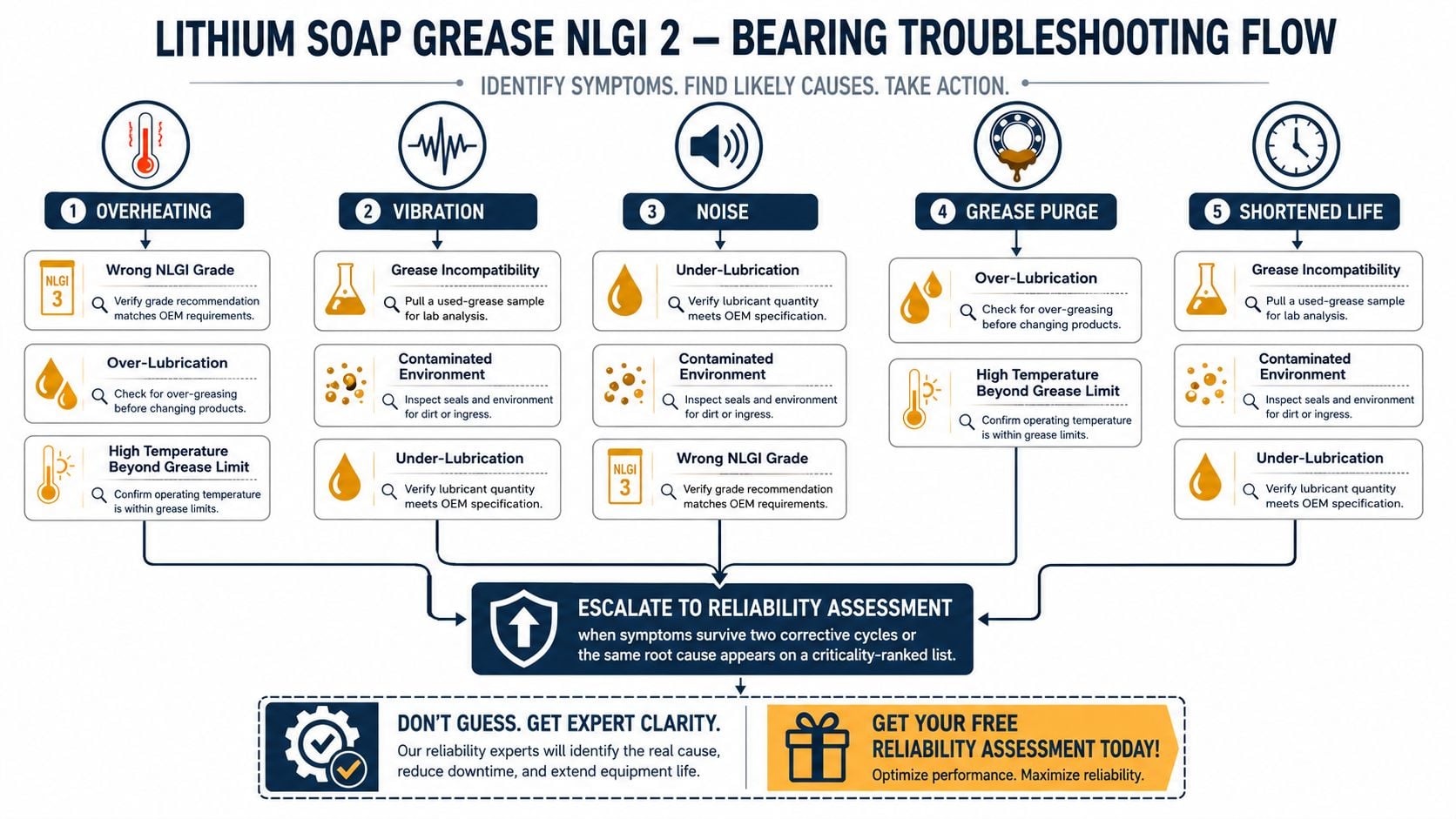
The chart connects common symptoms—overheating, noise, vibration—to their most probable root causes in applications using Lithium Soap Grease NLGI 2. Notice the overlap; for instance, overheating can be caused by over-lubrication, under-lubrication, or the wrong grease type. This highlights the need for diagnosis before action.
Diagnostic Checklist for Technicians
Symptom: Overheating
- Diagnostic Questions: Was the bearing just greased? How much was added? Is the housing temperature approaching the grease's dropping point (~200°C for standard lithium)?
- Immediate Action: If recently greased, open the drain plug to purge excess grease. If the temperature is too high for the grease, schedule a change-out to a high-temp grease (e.g., lithium complex).
Symptom: Noise / High-Frequency Vibration
- Diagnostic Questions: Is the noise a continuous "hissing" or discrete "ticking"?
- Immediate Action: Use an ultrasound device to listen to the bearing. A high, steady decibel level indicates friction from under-lubrication; apply a small amount of grease and listen for the sound level to drop. Sharp impacts indicate a mechanical defect.
Symptom: Grease Purging from Seals
- Diagnostic Questions: Is the purged grease discolored or hardened? Was the bearing over-pressurized during relubrication?
- Immediate Action: Collect a sample of the purged grease for visual inspection. If dark and hard, it indicates thermal degradation. Reduce relubrication volume and/or frequency.
Symptom: Recurring Short Bearing Life
- Diagnostic Questions: What is the common failure mode (e.g., spalling, corrosion, cage wear)? Is the grease compatible with what was used before?
- Immediate Action: Escalate for a formal Root Cause Analysis (RCA). Analyze a used grease sample for contamination, wear metals, and consistency. Verify grease compatibility.
Escalation Trigger: If a symptom persists after two corrective actions, or if the same root cause appears on multiple critical assets, it signals a systemic problem. Escalate from a component-level fix to a program-level review.
A single bearing failure is a data point. A pattern of failures is an opportunity to improve your entire reliability program.
Transform recurring lubrication problems into strategic reliability improvements. Request a free reliability assessment to analyze your current lubrication practices, diagnose chronic failures, and build a world-class program tailored to your plant's needs.