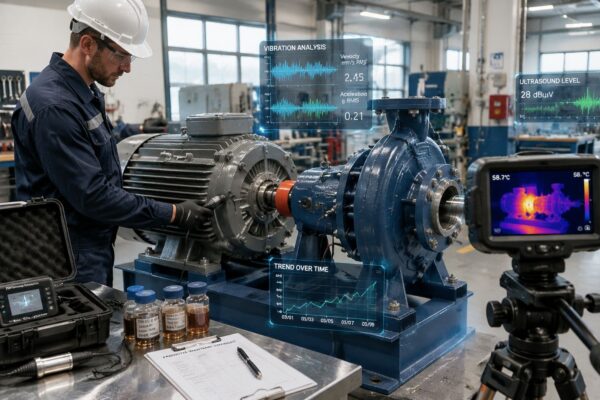
A predictive maintenance program can reduce machine downtime by 30% to 50% and extend equipment life by 20% to 40%, according to a widely cited McKinsey analysis of maintenance at scale. Those results don't come from installing sensors and waiting for an algorithm to produce alerts. They come from converting condition data into validated decisions, scheduled work, and completed repairs.
That distinction matters most in brownfield plants, where legacy equipment, inconsistent asset records, limited analytics expertise, and disconnected systems can stall a promising pilot. A pump may show a rising vibration trend, but the program still fails if nobody validates the signal, assigns an owner, creates the right work order, and completes the repair inside the P-F window, the period between potential failure detection and functional failure.
Table of Contents
- Why a Predictive Maintenance Program Pays Off Now
- Prioritize What Matters With Criticality and Failure Mode Analysis
- Choose the Right Diagnostic Technology for Each Failure Mode
- Design a Pilot That Proves Value Without Overextending
- Measure ROI and Integrate Data Into Your CMMS
- Scale Staff and Sustain Results Across Multiple Sites
Why a Predictive Maintenance Program Pays Off Now
Calendar-based maintenance assumes that equipment needs attention because a certain amount of time has passed. Reactive maintenance waits for the breakdown. A predictive maintenance program makes a different decision. It uses measurable condition changes, such as vibration, temperature, lubrication, and electrical signatures, to determine when intervention is justified.
That approach is particularly valuable for pumps, motors, compressors, gearboxes, and turbines. Bearing spalling, coupling misalignment, lubrication breakdown, rotor defects, and imbalance often create detectable changes before the machine stops. The maintenance team can then plan labor, parts, permits, and production coordination instead of mobilizing during an emergency.

The decision framework matters more than the sensor
The practical model has three connected layers:
- Inspection routes: Technicians collect repeatable measurements on assets that need periodic observation.
- Continuous monitoring: Permanently monitored assets produce data between route visits, particularly where failure consequences are severe or degradation can accelerate quickly.
- Work-order planning: Validated alerts become planned tasks with a diagnosis, priority, required parts, and execution timing.
This is why predictive maintenance isn't just a software layer. It's a decision framework that aligns inspection frequency and intervention timing with actual degradation behavior. The OEE improvement guidance from Forge Reliability provides useful context for connecting equipment condition with production performance rather than treating reliability as an isolated maintenance metric.
Consider a food-processing plant with a product-transfer pump feeding a bottleneck line. A failing bearing or mechanical seal can stop upstream production, create sanitation and restart work, and force maintenance to source parts under pressure. The cost of monitoring that pump is only one part of the decision. The more important question is whether the plant can detect degradation early enough to schedule the repair during a sanitation window.
A digna monitoring platform can be evaluated as part of a broader condition-monitoring architecture, but the technology should follow the plant's workflow. The team still needs an asset owner, a validation rule, a CMMS path, and a defined response to each alert.
The economics support a shift from assumptions to evidence
The McKinsey analysis links predictive maintenance with 30% to 50% lower machine downtime and 20% to 40% longer equipment life. A separate benchmark summary referencing the U.S. Department of Energy's O&M Best Practices Guide estimates 8% to 12% savings compared with preventive maintenance and 30% to 40% compared with reactive maintenance. The same benchmark literature reports 25% to 30% maintenance cost reductions, 70% to 75% fewer breakdowns, and 35% to 45% lower downtime in successful programs, as summarized by Reliability Magazine's predictive maintenance ROI benchmarks.
These ranges aren't a guarantee for every facility. They indicate why asset selection and execution discipline matter. A plant that monitors low-consequence equipment while ignoring a bottleneck compressor won't capture the available value.
Practical rule: A condition alert has no business value until a responsible person can turn it into a safe, correctly scoped maintenance action.
Prioritize What Matters With Criticality and Failure Mode Analysis
A plant shouldn't begin by monitoring every motor, pump, and gearbox. It should begin by identifying which failures can harm people, stop production, damage product, violate environmental requirements, or consume scarce maintenance capacity.
Criticality ranking provides that first filter. The team assigns each asset a consequence profile based on safety, production, quality, environmental exposure, repair complexity, and redundancy. A standby pump may have the same motor size as a duty pump, but its criticality is different if another pump can immediately carry the load.

Start with the failure, not the technology
Failure Mode and Effects Analysis, or FMEA, lists how an asset can fail, what causes the failure, how the failure appears, and what happens if the plant misses it. Reliability-Centered Maintenance, or RCM, then helps determine whether the appropriate response is predictive, preventive, run-to-failure, redesign, or another strategy.
For a chemical-processing agitator gearbox, the dominant failure modes might include gear tooth wear, bearing damage, lubricant contamination, shaft misalignment, and housing looseness. Each mode needs its own detection logic:
- Gear or bearing damage: Use vibration spectra and trend analysis to identify changes in frequency and amplitude.
- Lubricant contamination or wear debris: Use oil analysis and cleanliness trending.
- Misalignment or looseness: Combine vibration measurements with alignment checks and inspection of the base and coupling.
- Thermal stress: Use temperature trends as supporting evidence, not as the only diagnostic signal.
- Electrical loading on the drive motor: Apply current analysis when the motor is difficult to access mechanically.
The team should document the expected signal, the measurement point, the inspection method, the collection frequency, the alarm rule, and the required response. Failure mode analysis with Matil offers additional context for structuring this type of failure-focused review. For manufacturing teams formalizing the process, the FMEA resource for manufacturing can support a consistent analysis structure.
Set frequency by degradation behavior
Inspection frequency shouldn't be copied from a generic route template. It should reflect how quickly a failure can progress and how much warning the measurement provides.
A slowly changing lubricant condition may support a different sampling interval than a rapidly developing bearing defect. A critical gearbox with a short P-F window may require continuous measurement or more frequent route collection, while a lower-consequence fan may remain on a simpler inspection strategy.
A useful asset record contains:
- Criticality rating, including the consequence of failure and available redundancy.
- Failure-mode register, with causes, effects, and detectable symptoms.
- Monitoring method, selected for sensitivity to the specific failure mode.
- Inspection or sampling frequency, based on degradation rate and decision lead time.
- Action rule, defining who validates the alert and what work follows.
- Post-maintenance verification, confirming that the condition improved after intervention.
The most common prioritization mistake is treating all assets as equally important. A focused list of critical equipment gives analysts better data, gives planners clearer priorities, and prevents the program from producing a large volume of low-value notifications.
Choose the Right Diagnostic Technology for Each Failure Mode
No single diagnostic method can identify every failure mode. Vibration is powerful for rotating mechanical defects, but it won't replace oil analysis for contamination or electrical analysis for certain motor problems. A credible predictive maintenance program uses the smallest combination of technologies that can detect the failure modes that matter.
Match the signal to the physical change
Vibration analysis is well suited to bearing defects, imbalance, misalignment, looseness, gear-mesh problems, and structural resonance. RMS velocity is a common severity measure in ISO 20816/10816-style approaches. One cited implementation classifies a cutting process as in good condition below 0.720 mm/s and unacceptable or dangerous above 4.510 mm/s, as reported in the technical implementation of vibration criteria. Those values shouldn't become a universal alarm. Baseline condition, machine class, speed, mounting, and trend rate still matter.
Oil analysis detects lubricant degradation, contamination, viscosity changes, and wear particles. ISO 4406 cleanliness codes express particle contamination using three numbers for particles larger than 4, 6, and 14 micrometres per millilitre. An example code is 18/16/13. Because the scale is logarithmic, moving from 18/16/13 to 20/18/15 represents roughly a fourfold increase in debris load, according to this oil analysis guidance on ISO 4406 codes. That shift can matter in hydraulic systems, gearboxes, and turbine lubrication circuits.
Thermography identifies abnormal heat patterns associated with electrical imbalance, loose connections, overloaded components, poor heat transfer, and mechanical friction. It works best when the asset is operating under a comparable load and the inspection route records operating context.
Ultrasound can expose compressed-air leaks, steam-trap problems, arcing, and early-stage lubrication issues. It's especially useful where the sound signature changes before temperature or visible damage becomes obvious.
Motor current signature analysis, or MCSA, evaluates electrical current patterns to identify issues without adding mechanical sensors. Documented detectable modes include rotor bar damage, static and dynamic eccentricity, core damage, stator winding defects, bearing damage, misalignment, imbalance, loose foundations, and driven-machine problems, as described in this review of MCSA applications.
Use combined evidence on difficult assets
A pulp-and-paper dryer fan may need vibration for bearing and imbalance faults, temperature for abnormal heating, and current analysis to assess motor and driven-load behavior. A mining conveyor drive may require vibration at accessible bearings, current analysis at a hard-to-reach motor, and thermography at electrical terminations.
| Failure Mode | Best Detection Method | Typical Asset Example |
|---|---|---|
| Bearing spall | Vibration analysis, supported by temperature | Process pump or dryer fan |
| Lubricant contamination | Oil analysis using ISO 4406 cleanliness codes | Gearbox or hydraulic power unit |
| Electrical imbalance | Thermography and motor current signature analysis | Motor control assembly or conveyor drive |
| Steam-trap leakage | Ultrasound and temperature comparison | Process steam distribution |
| Rotor bar defect | Motor current signature analysis | Compressor or conveyor motor |
| Misalignment or imbalance | Vibration analysis with alignment verification | Pump, fan, or gearbox train |
A plant can use condition monitoring systems from Forge Reliability as a reference point when defining route-based and continuous monitoring requirements. Teams also benefit from clear principles for real-time data for customer excellence, particularly when condition data must support operations as well as maintenance.
Design a Pilot That Proves Value Without Overextending
A pilot should be large enough to test the workflow and small enough for the plant to manage every alert. A practical scope is 10 to 20 assets, combining high-criticality equipment with representative machines that expose different data and access conditions.
The pilot should include at least one asset where continuous monitoring is justified and several assets that technicians can inspect through repeatable routes. It shouldn't be a technology demonstration with no maintenance consequence. Every selected asset needs a known owner, an agreed failure-mode list, and a defined path from signal to work order.

Build the pilot around decisions
A water-treatment plant with 30 critical pumps might begin with weekly vibration routes across selected pumps and continuous monitoring on two assets with the highest production or regulatory consequences. That arrangement tests both operating models without forcing the plant to instrument the entire fleet.
The pilot charter should define:
- Asset scope: Include equipment with meaningful failure consequences and varied operating conditions.
- Baseline method: Record healthy vibration, temperature, current, and oil conditions under known load states.
- Alarm ownership: Name the analyst or reliability engineer who reviews exceptions.
- Validation process: Require confirmation of mounting quality, sensor position, operating state, transient conditions, and data quality.
- Work-order rule: Specify which validated conditions create a notification, planning task, or urgent intervention.
- Success criteria: Measure completed actions and avoided interruptions, not sensor installation alone.
Set thresholds that technicians can trust
Alarm thresholds should reflect machine class, baseline, trend rate, and consequence of failure. One industrial reference reports class-based vibration bands in which small machines below 0.71 mm/s RMS, medium machines below 1.12 mm/s, and large rigid-base machines below 1.8 mm/s are considered good, with escalation bands as vibration rises, according to industrial vibration monitoring guidance. These values support a starting framework, but the plant must validate them against actual equipment and measurement conditions.
A signal shouldn't automatically create a work order. Analysts should review whether the change repeats, whether the machine was operating normally, whether the sensor was mounted correctly, and whether a transient explains the reading. Independent predictive maintenance strategy guidance emphasizes validation for noise, mounting issues, and transients before teams generate work orders.
Alarm discipline: If technicians receive alerts that don't lead to a clear decision, they'll eventually treat every alert as background noise.
The P-F window determines urgency. If a developing defect can progress quickly, the planner must reserve labor and parts before the condition crosses into functional failure. The pilot should also include a post-repair measurement, because confirmation that the signal returned toward baseline is part of the diagnostic process.
A structured 12-month reliability program roadmap can help turn pilot controls into a repeatable operating rhythm. The pilot proves value when the plant can show not only that data was collected, but that validated findings changed maintenance execution.
Measure ROI and Integrate Data Into Your CMMS
A predictive maintenance program earns credibility through an evidence trail. The plant needs a baseline, a defined measurement period, consistent failure codes, and a method for separating condition-based interventions from unrelated production events.
The most useful indicators usually include unplanned downtime, mean time between failures, maintenance cost per unit, planned work percentage, emergency work, schedule compliance, and OEE. Mean time between failures, or MTBF, measures the average operating time between functional failures. OEE combines availability, performance, and quality to show how equipment losses affect production.

Define the financial case without overstating it
The DOE-linked benchmarks cited by Reliability Magazine estimate 8% to 12% savings versus preventive maintenance and 30% to 40% versus reactive maintenance. The relevant comparison depends on the plant's starting condition. A facility with disciplined preventive work may gain through better targeting and fewer unnecessary interventions, while a reactive facility may gain primarily by avoiding emergency stoppages and expedited repairs.
A metals plant can quantify the business case around a bottleneck rolling mill. If a validated bearing alert allows the planner to coordinate a repair with a scheduled outage, the avoided loss should include production impact, emergency labor, expedited parts, secondary damage, and restart consequences. The calculation should use the plant's own verified costs, not a generic downtime value.
Make the CMMS the execution system
The CMMS, or computerized maintenance management system, should remain the system of record for work history, asset hierarchy, labor, parts, failure codes, and completion status. Condition-monitoring software can identify an anomaly, but the plant needs controlled rules for what happens next.
A reliable integration includes:
- Asset identity: Sensor IDs, equipment tags, locations, and functional positions must match the CMMS hierarchy.
- Alert classification: Each alert should carry a failure mode, confidence level, severity, and recommended inspection or repair.
- Duplicate control: Repeated readings from the same developing fault should update an existing task rather than create competing work orders.
- Ownership: The reliability analyst validates the finding, the planner scopes the work, and the supervisor assigns execution.
- Closure evidence: The technician records the actual defect, repair, parts used, and post-maintenance condition.
- Data governance: The site defines naming conventions, units, measurement points, missing-data rules, and approval authority for threshold changes.
Brownfield integration often fails because legacy asset records are incomplete or inconsistent. A gearbox may have one tag in the historian, another in the CMMS, and a local nickname on the inspection route. That identity problem must be resolved before automation scales.
The CMMS asset management guidance from Forge Reliability provides a useful framework for connecting asset data, lifecycle decisions, spare-parts planning, and maintenance execution. Skills gaps also require attention. Analysts need diagnostic capability, planners need condition-based planning rules, and technicians need confidence that alerts correspond to real defects.
Scale Staff and Sustain Results Across Multiple Sites
Multi-site rollout requires standardization without pretending that every machine behaves identically. A central reliability group can define asset naming, failure-mode libraries, severity logic, reporting formats, and validation rules. Site teams still need authority over operating context, access conditions, production windows, and safe execution.
The staffing decision should follow workload and consequence. Plants with enough critical rotating equipment and sustained data volume may build internal vibration or oil-analysis capability. Smaller sites, or sites with limited specialist coverage, may outsource analysis while keeping route collection, inspection, and work execution under local control.
Troubleshoot the failure patterns that stop scale
- Alert fatigue: Reduce low-value notifications, separate advisory conditions from action-required conditions, and review every alert category that produces no completed decision.
- Poor data quality: Check sensor mounting, measurement points, operating state, units, calibration, and asset identity before changing alarm thresholds.
- Legacy integration gaps: Map historian, monitoring, and CMMS identifiers, then test one complete alert-to-work-order path before expanding.
- Unclear ownership: Assign responsibility for validation, planning, execution, and closure at each site.
- Skills shortages: Train technicians on collection quality and basic failure signatures, while giving analysts a controlled escalation path for ambiguous findings.
- Inconsistent reporting: Use common definitions for downtime, failure, intervention, avoided failure, and completed corrective work.
An automotive group might centralize analysis for common motor, pump, and gearbox families while allowing each plant to schedule work around its own production constraints. Each new site should reuse the pilot playbook, but it must revalidate baselines and thresholds against local equipment, mounting, speed, loading, and operating practices.
Research summarized in maintenance statistics and trends from MaintainX identifies cost, data quality, legacy integration, and skills shortages as recurring barriers, while also noting that scalability and broad ROI evidence remain limited. That is why governance belongs in the rollout design, not as an afterthought.
A sustainable program has a small number of trusted workflows, clear alarm confidence thresholds, and a regular review of confirmed findings. It grows when technicians see that the data improves job preparation rather than adding administrative work.
Forge Reliability provides a free reliability assessment for industrial plants, reviewing critical assets, failure modes, monitoring coverage, CMMS governance, and the path from alert validation to completed work order. Visit Forge Reliability to request the assessment and connect with plant-floor specialists who respond within 24 hours.