
A cooling-water pump that has run clean for months rarely fails without warning. The warning usually shows up first as a faint vibration change, a warmer bearing housing, or a process operator hearing a different pitch at startup. The problem is that plenty of plants see those signals and still end up with a delayed work order, the wrong spare on the shelf, or a planned stop that turns into an emergency.
A predictive maintenance strategy only works when those early signals become a maintenance decision. That means the team links a measurable condition, like vibration, temperature, oil debris, acoustic emission, or electrical signature, to a failure mode, an alarm limit, and a specific response in the CMMS. Predictive maintenance is not fixed-interval preventive work, it is a condition-based strategy that forecasts degradation before functional failure and creates enough lead time to plan labor, parts, permits, and production coordination (Wiley review on condition monitoring and predictive maintenance).
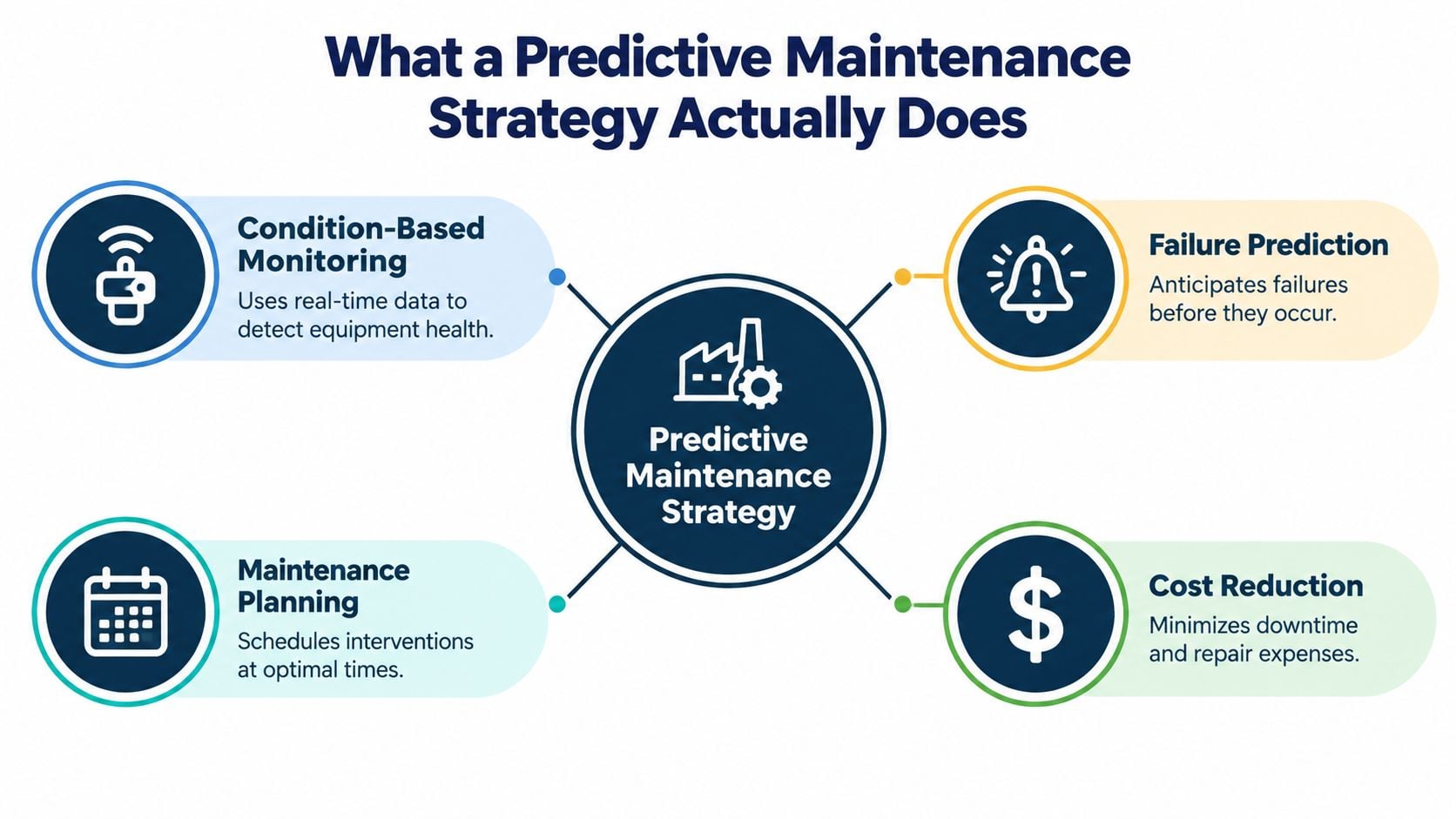
On a cooling-water pump, that difference is easy to see. A rising vibration trend can point to imbalance, misalignment, looseness, bearing damage, or cavitation, while temperature rise and acoustic changes can support the diagnosis. A preventive route might still swap a part on a calendar, but a predictive program waits until the evidence says the failure mode is developing, then schedules the repair before the pump trips.
For engineers who want a structured technical foundation, Ace Aviation maintenance qualifications is a useful example of how maintenance competence is often built around disciplined inspection, fault recognition, and repair planning. In plant work, the same logic applies, the signal only matters if it triggers the right work.
Practical rule: if the signal can't be tied to a work order, it's just data collection.
Table of Contents
- What a Predictive Maintenance Strategy Actually Does
- Rank Critical Assets and Map Failure Modes First
- How to Choose the Right Monitoring Technique
- Build Baselines Data Rules and a Focused Pilot
- Measure ROI and Decide When Not to Scale
- Scale Routes Enable the Team and Avoid Costly Pitfalls
What a Predictive Maintenance Strategy Actually Does
For a critical cooling-water pump, the right question is not whether vibration exists. It is whether the vibration trend is specific enough to tell the planner what failure is developing. A useful strategy turns that answer into a decision about inspection, parts, labor, and production access before the pump trips.
From signal to planned action
A rising trend may indicate bearing damage, imbalance, misalignment, looseness, or cavitation, but the response depends on the failure mode and operating conditions. The same reading can require confirmation, a controlled inspection, or scheduled repair. A dashboard that only reports an alert leaves that judgment to the maintenance team without defining the next step.
If the trend is specific enough, the team can verify the diagnosis, reserve the spare, obtain permits, and coordinate the outage. If it is not, the plant has collected data without creating a maintenance decision.
A signal becomes valuable only when the reliability team knows what to do with it.
The chain should be explicit for motors, compressors, gearboxes, turbines, and VFD-driven assets: identify the failure mode, define the observable indicator, set an alarm limit, and connect the alarm to a work-order response. Equipment-specific rules matter. A motor may need current, temperature, or vibration context, while a gearbox may require closer attention to lubrication condition and tooth or bearing signatures. A VFD asset also needs readings interpreted alongside speed and load.
Ace Aviation maintenance qualifications illustrates the value of disciplined inspection, fault recognition, and repair planning. Plant reliability work follows the same principle. A diagnostic signal earns its place when it supports a decision that planners and technicians can execute.
The decision test that matters
A predictive program works when its monitoring method detects the right failure early enough to buy usable time. That time may support parts ordering, permit preparation, operations coordination, and craft scheduling. The condition record also needs a clear route into the CMMS, where planners can act on it rather than leaving it in a separate dashboard.
The cooling-water pump example exposes the trade-off. Bearing vibration may provide an actionable trend, while cavitation may appear only at particular flow conditions and require operating context or targeted checks. Alarm governance should therefore limit alerts to signals with a defined response. Selective scale is stronger than fitting every pump, motor, gearbox, or VFD with the same sensor package.
Rank Critical Assets and Map Failure Modes First
A predictive program collapses fast when it starts with sensors instead of risk. The plant ends up monitoring assets that don't matter much while the high-consequence pump, gearbox, or fan is still running on hope. Criticality has to come first, because not every asset deserves the same level of attention or the same monitoring method.
Rank by consequence, not by habit
Start with five consequence buckets: safety, production, quality, environmental, and repair cost. A chemical-process pump that can leak seal fluid into a process line belongs in a different category from a utility fan with an easy workaround. The first can shut down a unit or create a contamination issue, the second may be inconvenient.
Once the critical list exists, use FMEA or RCM to define credible failure modes. For a pump, that often means seal leakage, bearing degradation, cavitation, and misalignment. Each failure mode needs its own detectability check, because a single sensor package usually won't cover every risk equally well.
The internal workflow is cleaner when the asset hierarchy is mapped down to the lowest replaceable unit, not just “pump” or “gearbox.” A gearbox on a conveyor, for example, may fail from overload, tooth damage, lubrication breakdown, or bearing fatigue. Those are different maintenance problems, and they shouldn't share the same response rule.
Decide whether prediction is even worth it
Some equipment is better left on run-to-failure or basic preventive work. If the failure gives no useful warning, or the consequence is low, continuous prediction may waste time and create alarm clutter. The better choice is usually the one that changes the outcome, not the one with the most impressive dashboard.
For teams doing the asset ranking work, FMEA for manufacturing is a practical reference point for failure-mode thinking in a plant context. Once the plant has a short list of assets and failure modes, monitoring decisions get much sharper.
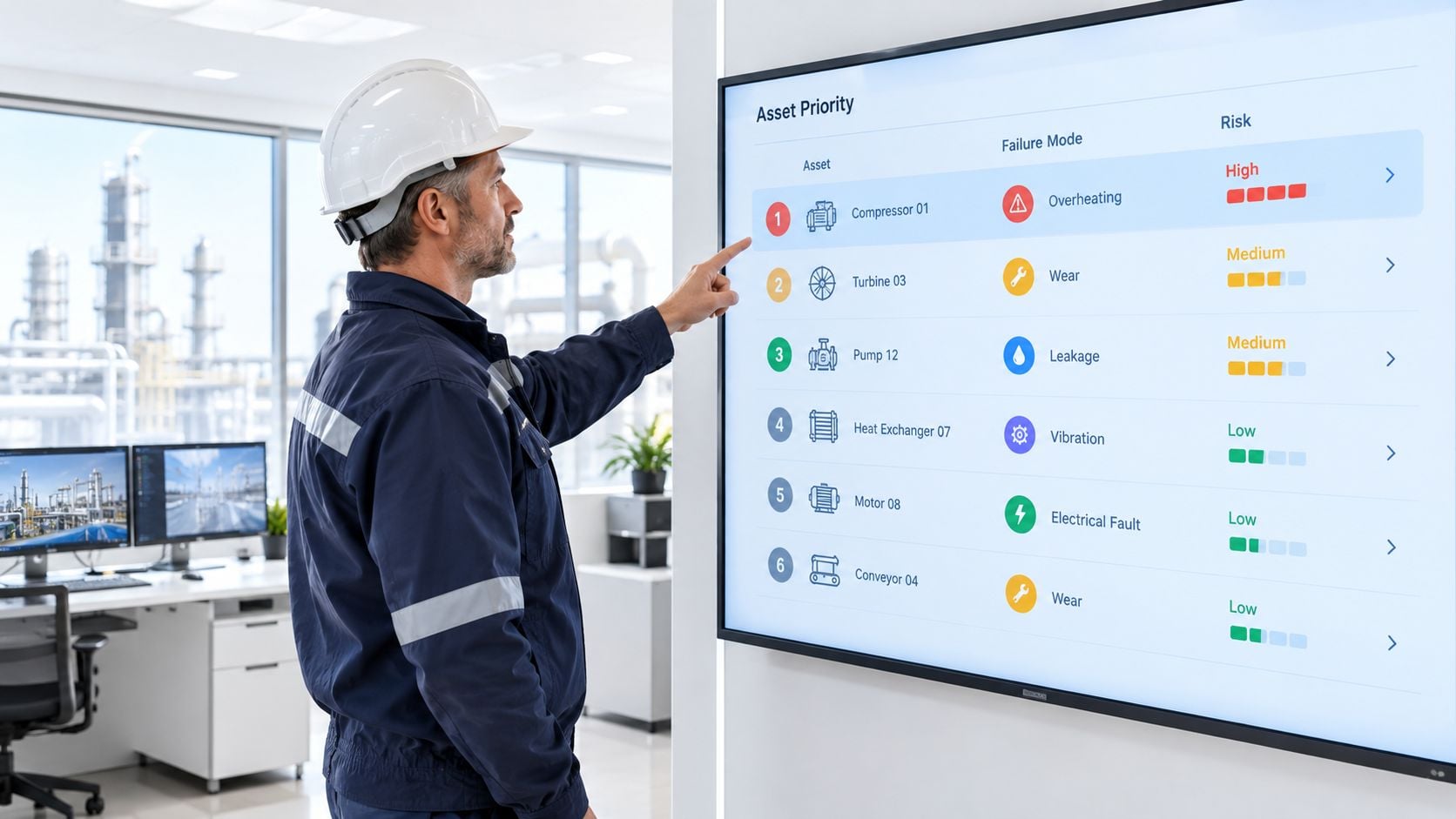
Field lesson: the best monitoring program is the one focused tightly enough that planners trust the alerts.
A chemical pump example makes this obvious. Vibration may catch bearing and alignment issues, pressure may reveal hydraulic trouble, temperature may corroborate seal distress, and visual inspection may be enough for certain leaks. The monitoring plan should match the failure mode, the available lead time, and the cost of being wrong.
How to Choose the Right Monitoring Technique
Technique choice should follow the physics of failure, not a preference for one instrument family. A gearbox, a motor, and a steam trap don't fail the same way, so they shouldn't all be monitored the same way. The plant needs to match the fault signature to the method that can see it early and reliably.
Match technique to failure mode
| Technique | Detects best | Use when |
|---|---|---|
| Vibration and phase analysis | Imbalance, misalignment, looseness, rolling-element bearing faults, gear-mesh damage | Rotating assets with accessible measurement points and enough runtime to build a trend |
| Oil debris and oil condition | Wear particles, contamination, lubrication breakdown, gear wear | Gearboxes, loaded bearings, and assets where lubricant health changes matter |
| Thermography | Hot connections, overloaded circuits, deteriorating insulation | Electrical panels, MCC buckets, and motors with thermal access |
| Ultrasound | Air leaks, steam leaks, early bearing distress | Leak-prone systems, hard-to-see mechanical issues, and route-based checks |
| Motor current signature analysis, MCSA | Rotor, stator, and air-gap issues | Running three-phase motors with limited physical access or remote installation points |
Vibration is usually the first tool that comes to mind because it can expose a lot, but it isn't universal. On an induced-draft fan motor, access may be limited and load can shift enough to complicate the spectrum. On a conveyor gearbox, the signal can change between startup and steady load, so the team has to know what operating state the measurement came from.
Use confirmation, not single-point trust
A second evidence source improves the decision. Vibration plus oil debris, or thermography plus electrical testing, is stronger than trusting one alert in isolation. That matters even more on assets with VFDs, because drive conditions, speed changes, and load variation can distort the signature.
For teams comparing measurement approaches in a broader utilities context, compare water meter technologies is a reminder that measurement choice always depends on what question the instrument is supposed to answer. In plant reliability, the same principle applies to condition monitoring.
Motor current signature analysis deserves a place in the toolkit, especially for hard-to-access motors. It can help identify rotor, stator, and air-gap problems without putting a vibration sensor directly on the machine, but it's not a replacement for vibration across the board. Low load, supply imbalance, and drive type can all change the spectrum enough to mislead an untrained review.
For teams documenting the monitoring architecture, condition monitoring systems is a practical internal reference. The key takeaway is simple, use the minimum sensor set that still answers the failure question and supports a clear maintenance decision.
Build Baselines Data Rules and a Focused Pilot
A pump can look unhealthy during startup and normal under steady load. A gearbox may show a short warm-up signature before settling. If those states share one baseline, the trend produces noise and operators learn to ignore it.
Segment the data before it is trusted
Build baselines by operating state, load, speed, temperature, product, and duty cycle. For a mill gearbox, a reading during a low-load shift change should not be trended against a steady-production reading as though they represent the same condition.
Sync sensor streams with process data and work history. The alert must match what the machine was doing when the measurement was captured. NIST identifies inconsistent formats, missing process context, synchronization problems, heterogeneous equipment, and poor records as implementation obstacles. It also reports that data acquisition, communication, cleaning, and validation can consume about 90% of PHM-system development effort (NIST PHM implementation challenges).
Operational reality: predictive programs often struggle because the data is not disciplined enough for maintenance use, not because the model lacks sophistication.
Build the CMMS record so it can be used later
The CMMS needs consistent asset identity, component hierarchy, failure-mode terminology, operating context, and corrective action. NIST's maintenance-data framework identifies work-order descriptions, faults, solutions, labor time, technicians, parts, tools, manuals, schematics, component taxonomies, health information, predicted failures, and planned duty cycles as useful fields (NIST maintenance-data framework). “Repaired gearbox” is not enough to support later diagnosis.
Record the failed component, symptom, cause, detection method, parts used, and restoration date. This gives reliability engineers usable history for failure review and spare-parts decisions. It also creates the context needed to judge whether an alarm led to planned work or unnecessary intervention.
Run a focused pilot with alarm governance
Select a few high-consequence assets and define the response before enabling alerts. A pump may need vibration and process confirmation, while a motor, gearbox, or VFD asset may require different thresholds, operating-state rules, and review intervals. The goal is selective scale, not maximum sensor count.
For pilot design and analytics, predictive maintenance machine learning provides a useful reference. Validate alerts against inspections and failure evidence, then measure precision, recall, lead time, and work-order conversion. Suppress alerts that cannot produce a clear maintenance decision, and assign ownership for reviewing exceptions.
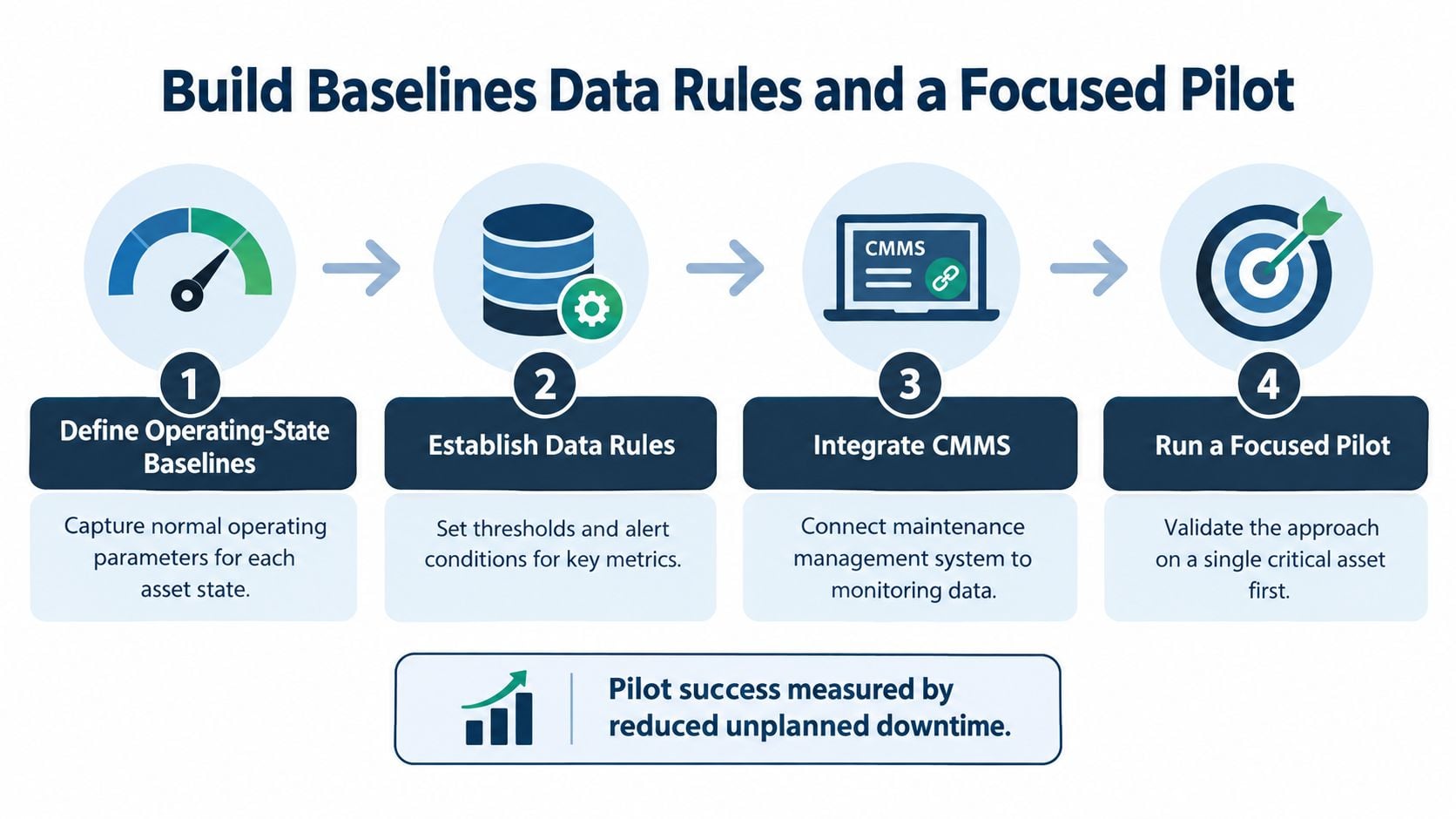
A published case reported 97.3% accuracy, yet still produced 42 false positives and 34 false negatives. The same NIST report shows why accuracy alone can conceal operational burden. The pilot must establish whether alerts help planners and technicians make timely decisions, rather than producing an attractive model score.
Measure ROI and Decide When Not to Scale
A pump trips at 2 a.m., the dashboard showed three alerts in the prior week, and none of them led to a planned job. That is the ROI test in practice. If the program creates noise that planners ignore, or sends technicians to inspect healthy assets, the savings on paper will not show up in the maintenance budget.
The business case has to compare avoided loss with the full cost of keeping the program useful. Count sensors, data handling, analysis time, integration work, training, alarm review, and the ongoing effort to keep thresholds, suppression rules, and asset context current. One avoided emergency repair does not justify a system that generates a stream of low-value inspections across pumps, motors, gearboxes, and VFD assets.
Use the right performance measures
Good ROI tracking starts with measures that reflect decisions, not just detections. Use leading indicators such as actionable alerts, false alarms per asset-month, useful lead time, and work-order conversion. Track lagging indicators too, including planned-versus-emergency work, mean time between failures, and maintenance cost impact. I also look at how often an alert gets dismissed with no finding, because that is where trust erodes first.
Benchmark evidence shows the upside, but it also shows why selective scale matters. A peer-reviewed study summarized by NIST reported that organizations relying more heavily on predictive and preventive maintenance had 52.7% less unplanned downtime and 78.5% fewer defects than the more reactive comparison group (NIST summary of maintenance performance study). In the same source, a smaller comparison found predictive maintenance outperformed preventive maintenance with 18.5% less unplanned downtime and 87.3% fewer defects. The same NIST summary cites a U.S. Department of Energy estimate that a well-designed predictive-maintenance program can reduce maintenance costs by about 30%. Those figures are benchmarks, not guarantees. Results depend on asset criticality, alarm quality, technician response, spare parts, and whether the alert path leads to planned work.
Know when to hold back
Holding back is sometimes the right strategy. A site with weak asset hierarchies, poor failure coding, or unclear cybersecurity ownership should not spread sensors across every line and hope the program settles down later. Start where failure consequences are high and response rules can be enforced. A critical pump may justify continuous monitoring with confirmation logic. A lightly loaded motor might stay on a route. A gearbox with chronic lubrication issues may need oil analysis before more vibration points. A VFD-driven asset may need operating-state filters before anyone trusts the alarm history.
The survey evidence points the same way. 94% of manufacturers experienced unexpected equipment downtime, but only 21% operated predictive maintenance at scale. The same survey reports that data quality, governance, or availability affected 41% of UK respondents, while cybersecurity and data privacy concerns reached 44% in the Middle East and DACH markets. It also found 63% had predictive maintenance only partially deployed or limited to pilots (manufacturing survey report).
For cost framing and internal justification, maintenance cost reduction is a useful internal reference. ROI of employee engagement tools adds a useful people-and-process reminder. If the craft team does not trust the alerts, the business case weakens fast.
The best ROI question is, “Can the plant act on this signal before the failure costs more than the program?”
Scale Routes Enable the Team and Avoid Costly Pitfalls
Route-based checks still matter, even in plants with continuous monitoring. Not every pump, motor, or gearbox needs a permanent sensor array, and not every failure mode justifies round-the-clock data. The smartest program uses the lightest method that still gives the team enough warning to act.
Make the alert path operational
A route program should be built around persistence and escalation rules. One noisy alarm should not trigger a shutdown discussion, but repeated evidence should move the issue toward a planner, then a supervisor, then a work order. The handoff has to be explicit, because alerts die quickly when nobody owns the next step.
Second-evidence confirmation keeps false alarms from flooding the team. A vibration alert can be checked against oil debris, thermography, ultrasound, or operator context before a repair is authorized. That discipline matters on VFD-driven assets, where operating regime shifts can make a healthy machine look unhealthy.
Train for diagnosis, not dashboard watching
Technicians need more than a screen with colors. They need to understand failure taxonomy, operating context, and the difference between a symptom and a root cause. Logs have to capture the actual failure mode, not just a generic “fixed” note, and “no fault found” needs to be a valid outcome when the alert doesn't hold up.
A metals plant pump route is a good example of the right scale. One pump may justify continuous vibration, another may only need a weekly route with ultrasound and temperature checks, and a third may stay on run-to-failure because the consequence is low and the warning period is short. The team gets better results by matching the method to the consequence than by spreading sensors everywhere.
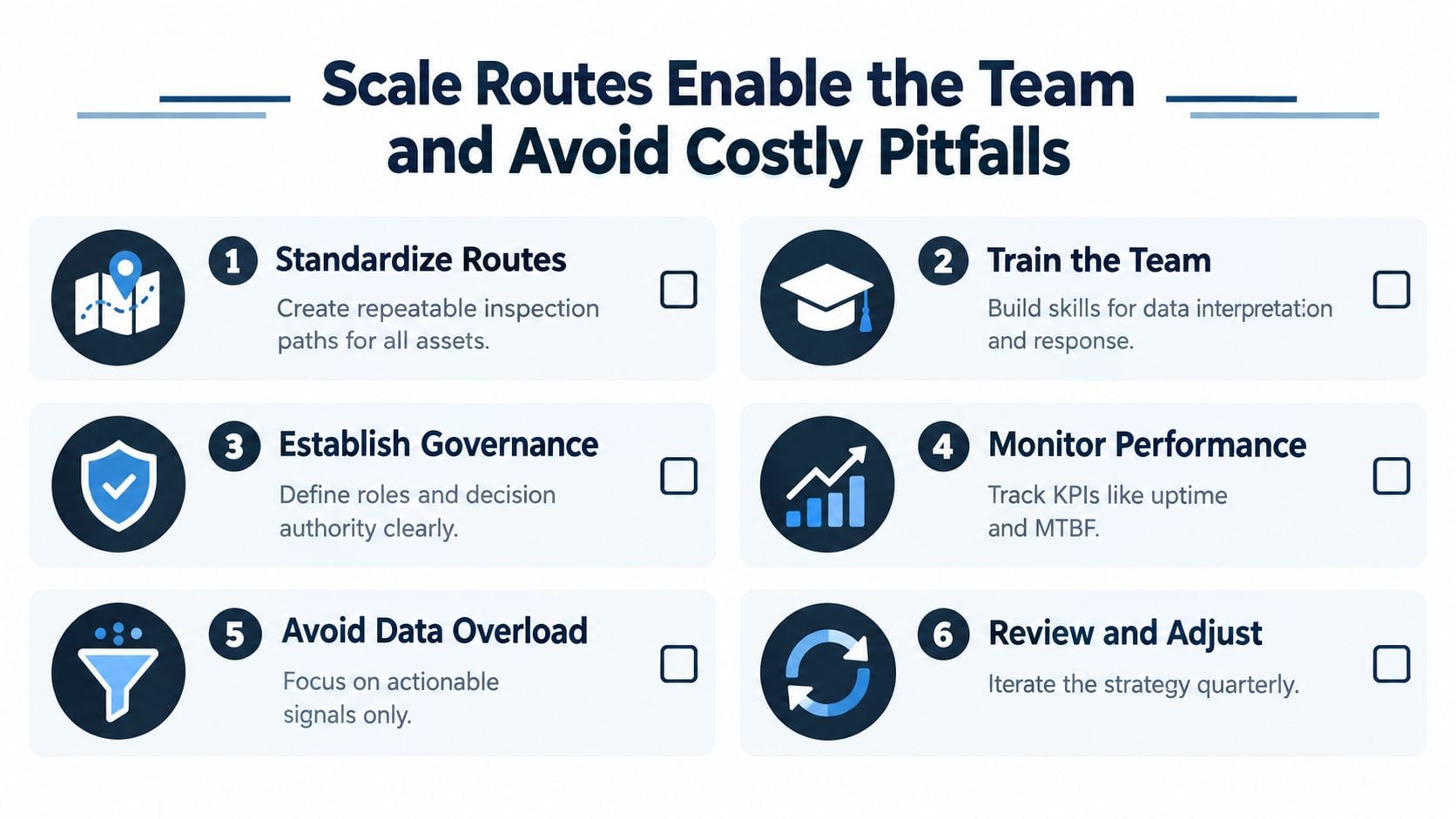
A useful internal anchor for the governance side is CMMS asset management. The work only scales when the CMMS, the routes, and the maintenance response all point in the same direction.
Avoid the common traps
High false-alarm volume usually means the model is too sensitive, the operating regimes are mixed together, or the failure evidence is weak. Over-trusting a high accuracy score causes the same problem in a different way, because the score can hide missed failures and wasted inspection effort. The better habit is to review false alarms, missed failures, and useful lead time every time the program is adjusted.
Selective scale beats blanket rollout when the plant is short on reliability staff, short on clean history, or still building confidence in the data. The goal is not to monitor everything. The goal is to get the right work planned before the machine takes control of the schedule.
Forge Reliability helps plants turn monitoring into planned work through predictive maintenance, condition monitoring, and reliability consulting for pumps, motors, gearboxes, VFD assets, and other critical equipment. For a free reliability assessment, visit Forge Reliability and have the team review high-noise alarms, failure modes, and the assets most likely to benefit from a focused predictive maintenance strategy.