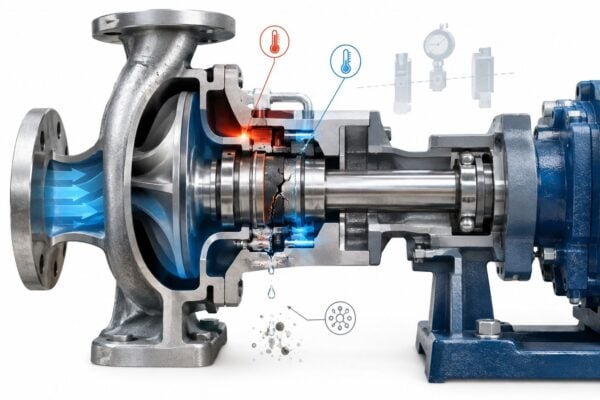
The worst plant meetings start the same way. A maintenance manager walks in with a stack of repeat repairs, operations wants the same line kept running through the next outage, and finance asks for a clean ROI case before any capital is released. That's the world of capital expenditure planning, not a budgeting exercise in a spreadsheet, but a decision process that determines which assets get repaired again, which get overhauled, and which need to be replaced before the next failure takes down production.
Industrial capex is large enough that governance matters. U.S. nonfarm business investment in 2022 reached $2,197.0 billion, with employer businesses accounting for $1,899.9 billion, or 86.5%, and spending by employer businesses rising 12.9% from $1,682.1 billion in 2021, according to the U.S. Census Bureau's Annual Capital Expenditures Survey U.S. Census Bureau ACES summary. That scale explains why plant leaders can't treat capital requests as isolated repairs. They need a multi-year discipline that connects asset condition, risk, schedule, and financing into one defensible plan.
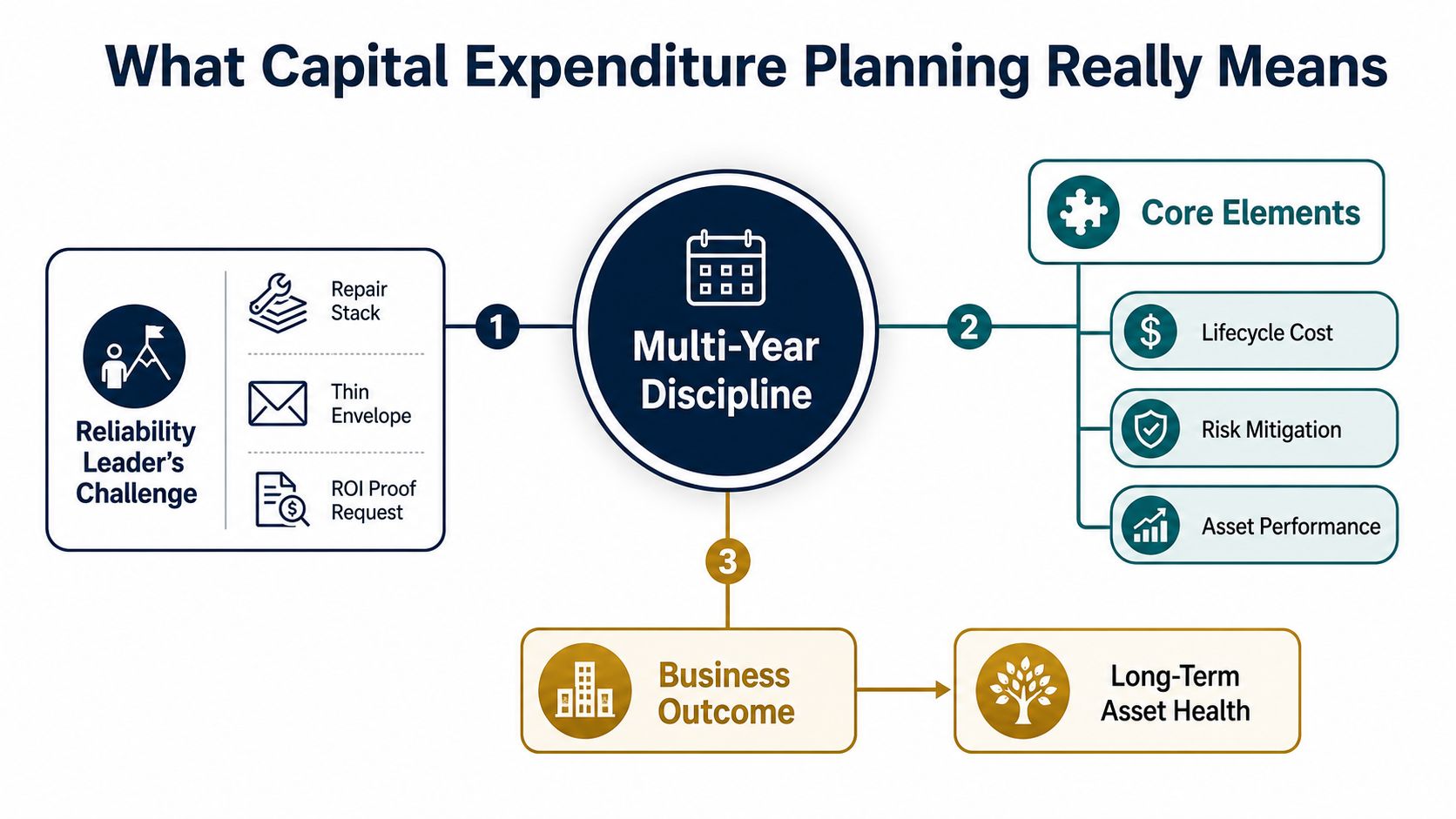
A reliability-driven plan starts with asset truth, not wishful thinking. It asks three basic questions before any dollar request goes upstairs, what is failing, how often is it failing, and what does the next failure cost in safety, throughput, quality, or energy. It then separates maintenance-driven replacement capex from growth capex, because a failing pump in a critical service is a different problem from a new line extension or utility upgrade.
The working definition is simple, capital expenditure planning is the multi-year process of deciding where capital should go, when it should be spent, and what evidence justifies the choice. That is different from opex maintenance budgeting, which pays for ongoing labor and routine parts. A strong capex plan contains an asset inventory, criticality ranking, lifecycle cost logic, execution phasing, and a post-implementation review loop. Without those pieces, the organization gets project lists. With them, it gets asset decisions.
Table of Contents
- What Capital Expenditure Planning Really Means for Reliability Leaders
- Building the Asset Inventory and Criticality Foundation
- Modeling Lifecycle Cost with Weibull, NPV, ROI, and PWB
- Feeding CMMS and Predictive Data into the Capex Decision
- Scheduling, Phasing, and Procurement Discipline
- Governance, KPIs, and Post-Implementation Review
- Turning Your Backlog into a Funded Reliability Plan
What Capital Expenditure Planning Really Means for Reliability Leaders
A gearbox shedding metal, a compressor train tripping again, or a cooling water pump waiting on another bearing set puts the reliability team in a familiar position. The failure is visible at the equipment level, but the request has to survive a finance review, so the evidence has to become a capital case, not just a maintenance complaint.
Capex planning is a reliability question disguised as finance
Capex planning earns credibility when it starts with failure behavior. Before anyone asks for approval, the team needs the asset's age, service duty, installation history, repeated maintenance actions, and any condition data that explains why the work belongs in capital rather than another work order. If the request cannot show whether the project restores reliability, adds capacity, or removes a chronic failure mode, it usually gets treated like discretionary spending.
The trade-off matters in the field. Opex maintenance keeps assets running in the short term, while capex changes the asset base itself. A leaking seal on a noncritical utility pump may justify another repair, but a seal line that fails on every shutdown in a production-critical pump can become a replacement decision, especially when the downstream consequence is lost output.
Practical rule: if the justification depends on “we've fixed this too many times already,” the team still has a maintenance story, not a capital case.
A useful capex packet starts with the minimum evidence set before the request goes forward. That usually means a clear asset register, condition ratings, repeat failure history, and a short statement of operational consequence. A lifecycle view helps too, because a low-cost repair that buys little time can cost more than a planned replacement once downtime and repeat labor are counted.
For teams building that discipline, an asset lifecycle view is a useful anchor, and asset lifecycle management guidance helps connect condition, replacement timing, and long-term asset health.
The business context is too large for ad hoc approval
Capital spending is not a side activity. Plants make these calls inside a much larger industrial economy that allocates major sums to physical assets, which is why plant governance needs a repeatable approval structure instead of a one-off justification memo.
A reliability-driven capex plan should tell leadership four things quickly, which assets are at risk, why the risk matters, what the likely cost path looks like, and whether the project is a repair, overhaul, derisking action, or full replacement. That framing keeps the discussion on asset health and business consequence instead of opinion. It also makes board review easier, because the team has already defined the problem in terms executives can test.
Building the Asset Inventory and Criticality Foundation
A capex request without a clean asset register is a guess in formal clothing. The first job is to pin down what is in the plant, where it sits, how old it is, what it has done, and how badly it hurts the operation when it fails. That inventory becomes the base layer for every replacement, overhaul, and deferral decision that follows.
Start with the register, then score what matters
The asset list should include the equipment name, service, installation date, known repair history, and a condition rating pulled from the CMMS. A good CMMS record shows whether an asset has had repeated seal changes, bearing swaps, coupling alignments, impeller work, or motor rewinds. It also shows how many work orders are symptoms of the same underlying fault, which matters more than the number of tickets.
Criticality ranking turns that raw list into something finance can audit. Reliability-centered maintenance logic and failure mode and effects analysis, or FMEA, are useful because they force the team to evaluate consequences, not just asset age. The simplest scoring model uses a 1-5 scale for safety, environment, production loss, and repair cost, then weights the result according to plant priorities. The point is not mathematical elegance, it is repeatability.
Here's the kind of matrix that works in a plant review:
| Criticality scoring matrix example | |||
|---|---|---|---|
| Criterion | Weight | Score 1, Low | Score 5, High |
| Safety impact | High | Minor exposure | Immediate personnel risk |
| Environmental impact | Medium | Contained spill potential | Reportable release risk |
| Production loss | High | Minimal interruption | Line-stopping outage |
| Repair cost | Medium | Low direct cost | Major labor, parts, and outage cost |
A useful detail is that two identical machines can score very differently depending on service. A centrifugal pump on a spare utility circuit might be a low priority if it has redundancy and short repair windows. The same pump in a critical transfer service with no spare path can move straight into replacement territory if vibration, leakage, or bearing wear is trending the wrong way. That is why age alone is a poor proxy for urgency.
If the score cannot explain why Pump A outranks Pump B, revisit the consequence definitions. A single score of 4 means nothing unless the safety and production-loss breakdown is visible behind it.
Why identical equipment can belong in different capex buckets
A centrifugal pump example makes this obvious. One pump may run on clean fluid with stable suction conditions and have a history of smooth starts and limited bearing wear. Another may run hot, cavitate during seasonal demand swings, and show recurring seal failures tied to suction instability. The hardware looks similar, but the failure modes are not.
That is where FMEA output and RCM logic change the treatment. A pump with manageable consequence and easy access to the equipment can often stay in the maintenance backlog. A pump with repeated failure, rising consequence, and no true standby path should be treated as a capital candidate even if the shell still looks serviceable. For teams that need a structured way to sharpen the failure analysis, FMEA for manufacturing is a relevant reference.
For the audit trail, the asset register should also flag whether the request is committed or conditional. Committed means the work is unavoidable and tied to a known reliability issue. Conditional means it depends on future evidence, budget release, or outage timing. That distinction matters because finance can fund committed replacement with less debate than speculative enhancement.
Modeling Lifecycle Cost with Weibull, NPV, ROI, and PWB
Once the asset is ranked, the next question is money over time. Reliability teams get challenged most often here, because a controller won't approve a replacement because a motor “looks tired.” The request has to show how the asset is likely to fail, what that failure costs, and why the replacement beats one more overhaul.
Use Weibull to convert failure behavior into timing
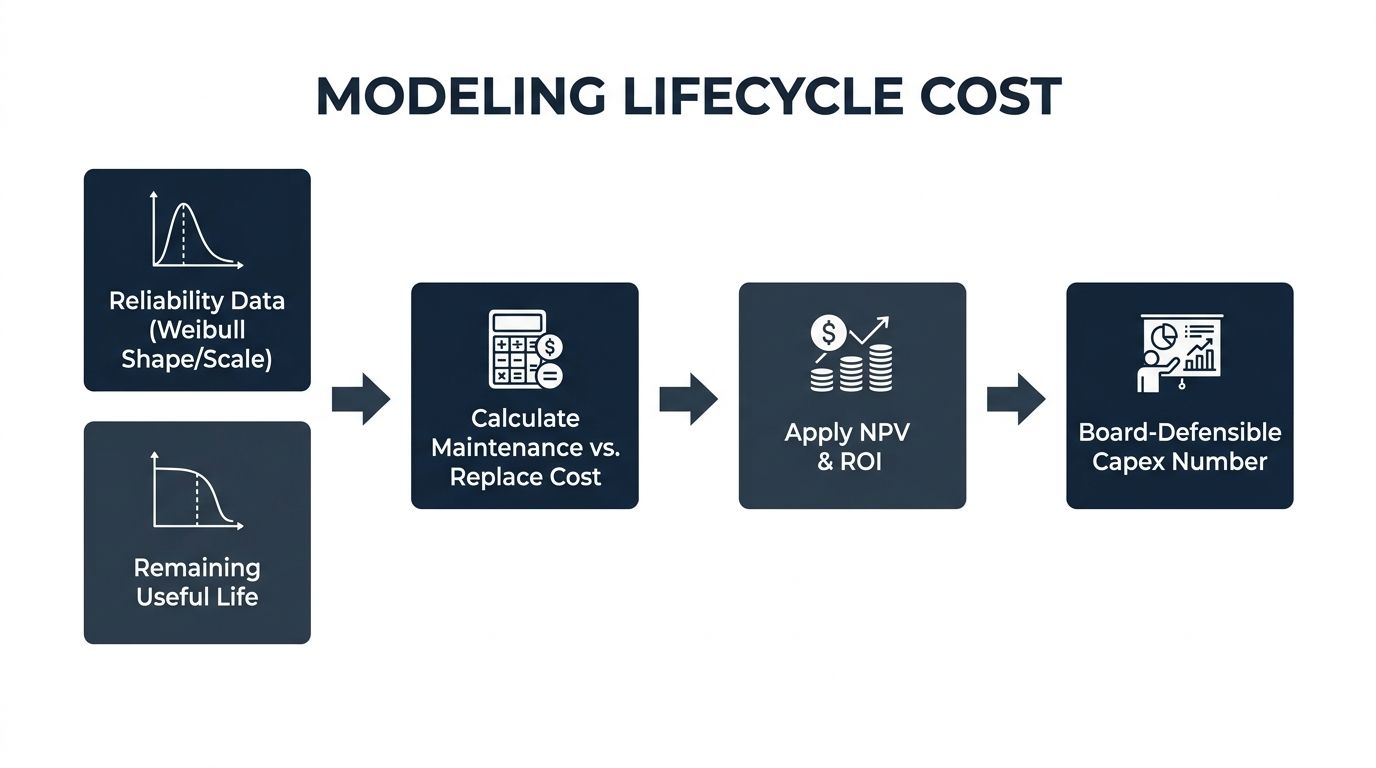
Weibull analysis is a practical way to describe how failures occur over time. The shape parameter indicates the failure pattern, whether failures are early-life, random, or wear-out dominated. The scale parameter gives a sense of the characteristic life, which helps estimate when the asset is likely to enter the steep part of the failure curve. In plain terms, it turns maintenance history into a forecast the finance team can interrogate.
That forecast feeds into remaining useful life, which is the estimated time before the asset becomes uneconomic or unreliable enough to replace. From there, planners can compare the annualized cost of another overhaul against the cost of a new asset, including labor, parts, lost production, and any reliability gain. A gearbox that needs another rebuild every time bearings start shedding metal may look cheaper today, but the lifecycle cost can flip fast once recurring outage time is counted.
The financial side is where the conversation gets serious. NPV, or net present value, compares future costs and savings in today's money. ROI compares the value gained to the money spent. PWB, or present worth of benefits, is especially useful when two projects are close on criticality but one creates more downtime avoidance or energy benefit over time.
For readers who want a clean refresher on discounting logic, AmbitionCFO's payback guide is a useful companion when building the finance narrative around timing and recovery.
Build the board case from the bottom up
A defensible replacement-versus-overhaul case usually follows a simple sequence. First, use failure history and condition data to estimate the next likely failure window. Second, price the overhaul path, including outage labor and parts. Third, price the replacement path, including installation, commissioning, and any expected reduction in maintenance burden or energy consumption.
The final comparison should show more than a purchase price. It should show what a controller cares about, the cash impact over time, the break-even logic, and the risk of being wrong if the asset fails before the next outage. That is why a reliability team should not present only first cost. First cost is what gets quoted. Lifecycle cost is what gets approved when the CFO asks hard questions.
For teams building the math in a repeatable way, Weibull analysis software can help structure the data rather than forcing every asset into a one-off spreadsheet.
Present worth is the tiebreaker
When two projects score close on criticality, PWB becomes the tiebreaker. One option may have a lower initial cost but provide weaker downtime avoidance. Another may cost more up front but remove a chronic risk, cut repeated maintenance, and stabilize the operating window. PWB makes that trade visible in the same financial frame.
If the CFO asks why the replacement won over another overhaul, the answer should be traceable to avoided failure, reduced repeated spend, and the time value of those benefits.
A good decision packet therefore includes the reliability evidence, the lifecycle model, and the business logic in one place. That combination survives scrutiny better than a purely technical recommendation or a purely financial one.
Feeding CMMS and Predictive Data into the Capex Decision
Asset age rarely tells the full story. A ten-year-old machine with clean condition data can be healthier than a six-year-old machine with repeated failures and messy work orders. The capex decision gets much sharper when CMMS history and predictive maintenance routes are used together instead of being treated as separate universes.
Reactive plants and condition-monitored plants do not score the same way
A reactive-only plant usually sees problems after the fact. The CMMS fills with emergency work orders, and the team ends up arguing from memory about how often a bearing has failed or how many times a seal has been replaced. In that environment, replacement decisions depend heavily on anecdote, because the evidence trail is incomplete.
A condition-monitored plant has more to work with. Vibration routes can show looseness, imbalance, misalignment, or bearing distress. Oil analysis can reveal wear debris, contamination, or lubrication breakdown. Thermography can expose hot electrical connections, overloaded components, or failing bearings. Motor current signature analysis can help reveal hidden electrical or mechanical load issues. Those signals don't just warn that something is wrong, they help determine whether the right move is repair, derisk, or replace.
The urgency score should rise when several indicators point the same way. A pump with climbing vibration, repeated seal failures, and increasing maintenance hours is sending a different message from one with a single isolated defect. The capex team should not wait for a catastrophic shutdown to declare the asset a replacement candidate.
A simple decision rule helps. If an asset shows chronic repeat failure, rising maintenance cost, or condition indicators that keep worsening after repairs, the request should move out of the maintenance backlog and into the capital plan. That rule is especially useful on bearings, pump trains, compressors, and motor-driven auxiliaries where failure mode recurrence is measurable.
Tie the data back to work order reality
Work order history matters because it shows how often the plant is paying to postpone the same failure. Mean time between failures, or MTBF, adds another layer by showing whether the asset is getting more or less reliable over time. Together, those records tell the story that board members need to hear, not just that the asset failed, but that the failure pattern has become persistent enough to justify capital.
A shop that uses quoting discipline well also tends to frame this better. For teams comparing a repair quote against a replacement case, a practical machine shop quoting software stack can help standardize repair pricing and turnaround assumptions so the capex conversation stays focused on total risk, not just the lowest ticket price.
For a structured way to turn the history into an asset-management workflow, CMMS asset management is a useful reference point. The goal is not more data for its own sake. The goal is a cleaner bridge from field evidence to capital priority.
Scheduling, Phasing, and Procurement Discipline
An approved project can still fail if it lands in the wrong window. A capital plan that ignores outage timing, vendor lead times, or procurement bottlenecks quickly turns into a delayed reliability risk. The execution side is where many well-scored projects get hurt.
Phase the plan around the plant, not the calendar
The strongest capex plans are rolled across a 3-to-5-year horizon instead of being locked to a single annual list. That gives planners room to align big work with planned shutdowns, budget release windows, and the actual availability of labor and materials. It also reduces the pressure to force everything through in one fiscal cycle, which is how plants end up overcommitted.
Lead time matters most on long-lead items such as motors, variable frequency drives, and compressor rotors. If those parts are ordered too late, the project may be approved on paper but miss the outage window. That creates a half-finished capital job and leaves operations carrying the old reliability risk for another cycle.
The practical sequence looks like this:
- Lock the outage window early. Match installation to the plant shutdown calendar, not the finance calendar.
- Release procurement in phases. Long-lead components should be ordered as soon as the scope is stable.
- Use a contingency reserve. Tie reserve size to project risk class and scope uncertainty.
- Re-score the project when conditions change. If vendor timing slips or scope expands, the capital case should be revisited before money is sunk.
The World Bank's analysis of capital expenditure bottlenecks is relevant here because budget planning can be undermined by cash-management constraints, procurement bottlenecks, and portfolio overcommitment. That is why phasing matters. It is risk control, not just scheduling.
Funding structure should match execution risk
Some projects should never be treated as a single all-or-nothing release. Phased funding protects the plant when scope is still moving or when shutdown access is uncertain. It also prevents a large project from crowding out smaller, higher-certainty reliability jobs that would deliver faster uptime gains.
For teams needing a financing reference when equipment purchases are part of a broader replacement package, a commercial equipment financing guide can help frame how acquisition timing and funding structure interact. The important point is that capital approval isn't the finish line. The plan still needs a procurement path that fits the plant's reality.
A disciplined schedule protects uptime because it respects the sequence of engineering, buying, delivery, installation, and commissioning. If any one of those steps is ignored, the capital case may still look strong while the execution outcome slips into the next quarter. That is usually the moment when plant leaders discover that a good project and a good outcome are not the same thing.
Governance, KPIs, and Post-Implementation Review
A capital program earns trust when people can see what happened after the project was funded. Stage-gate approvals matter because they stop weak projects from advancing on momentum alone. A documented business case matters because it gives the organization one version of the truth. A post-implementation review, or PIR, matters because it shows whether the promised reliability and financial results arrived.
What gets measured gets defended
The most useful KPIs are the ones that tie capital directly back to plant performance. Unplanned downtime percentage shows whether the asset is still hurting output. MTBF on replaced assets shows whether reliability improved. Maintenance cost per produced unit shows whether the plant is spending less to make each ton, batch, or unit. Energy per ton shows whether the capital changed operating efficiency or only moved the failure elsewhere.
A compressor overhaul is a good example. The PWB can easily favor overhaul over rebuild when downtime avoidance and avoided failure are compelling, yet the actual energy savings can miss the target if the machine was not reassembled, aligned, or operated as assumed. A PIR catches that gap. It forces the team to compare predicted savings with actual operating results and correct the assumptions that were too optimistic.
That feedback loop does more than police a single project. It improves the next capital cycle by showing which assumptions were reliable, which failure modes were misread, and which benefits were overstated. If the plant keeps the PIR honest, finance gets better forecasts, operations gets better assets, and maintenance gets a stronger case for future work.
Governance note: a capital plan that never reviews its own results eventually loses credibility, even when the projects themselves are sound.
The same discipline also helps leadership separate good execution from lucky timing. A replacement can be technically right and still underperform if startup conditions, load profile, or maintenance follow-through were weak. The PIR is where that reality shows up, before the next budget cycle repeats the same mistake.
Turning Your Backlog into a Funded Reliability Plan
A backlog only becomes a plan when the plant can rank the assets, price the risk, and show when the work will happen. The sequence is straightforward, even if the politics aren't. Build the asset register, score criticality, translate reliability data into lifecycle cost, phase the work around shutdowns, and track outcomes after commissioning.
That's the difference between a list of repairs and a funded capital program. A maintenance leader who can show which assets belong in the next cycle, which ones should be overhauled, and which ones are too risky to defer will get a much better hearing in executive review. For a structured way to decide where to put limited funds first, resource allocation optimization is a practical next reference.
The fastest way to move from backlog to action is a free reliability assessment. Forge Reliability can help score the asset register, identify which pumps, motors, compressors, and gearboxes belong in the next capex cycle, and build the evidence trail that survives finance scrutiny. Visit Forge Reliability to start a free reliability assessment and turn the next maintenance headache into a defensible capital plan.