In 2024, one hour of unplanned industrial downtime cost an average of approximately $25,000, rising above $500,000 per hour for larger organizations, according to MaintainX's 2024 State of Industrial Maintenance report. Yet a failure record that says only “pump repaired” can't tell a reliability team what caused the loss, whether the same mechanism is recurring, or if the repair changed the risk. The value of a failure reporting analysis and corrective action system, or FRACAS, depends first on the quality of its evidence.
FRACAS is a closed loop that detects, reports, analyzes, corrects, verifies, and trends failures. Software can store the record, but consistent failure definitions, mechanism-level detail, and verified closure determine whether the resulting MTBF, Weibull fits, and maintenance-interval decisions are trustworthy. A Line 3 feed pump provides a practical example of how to build that discipline without turning reporting into paperwork for its own sake.
Table of Contents
- Failure Record Fields Every FRACAS Needs
- How to Run the Closed Loop Step by Step
- Choosing Between 5-Why and Fault Tree Analysis
- Corrective Actions That Remove the Failure Mechanism
- Linking Failure Records to CMMS and ERP Work Orders
- KPIs and Review Cadence That Prove the Loop Works
- Near Misses Weak Signals and the First 30 Days
Failure Record Fields Every FRACAS Needs
A record must let a planner group repeat problems and estimate their consequences without interviewing the people who attended the breakdown. For a Line 3 feed pump, the following fields connect the event to its physical cause, operating conditions, production loss, and corrective action.
| Field | Example entry | Why it matters |
|---|---|---|
| Asset ID and hierarchy | Line 3 feed pump with site and line hierarchy | Rolls failures up to site, line, and bad-actor lists |
| Failure mode | Outer race spalling | Groups recurrences into one Pareto bar |
| Failure mechanism | Lubricant starvation at shaft seal | Explains why the failure happened, not only what broke |
| Operating context | Speed, load, and bearing temperature | Lets the team compare failures under like conditions |
| Detection method | Vibration alarm from route reading | Shows whether condition monitoring caught degradation early |
| Immediate containment | Isolate the pump and start the standby | Records what stopped the loss |
| Downtime and consequence | 6.5 hours lost and one batch scrapped | Feeds expected-loss ranking |
| Owner, due date, and verification | Reliability engineer, 30 days, 90-day vibration trend | Keeps the action open until evidence exists |
The failure mode describes what failed, such as outer race spalling. The failure mechanism describes the physical process that produced it, in this case lubricant starvation near the shaft seal. Confusing the two leaves the team with a useful symptom label but no explanation to guide a lasting intervention.
Operating context makes records comparable. A vibration event under high load and high bearing temperature shouldn't automatically be grouped with an otherwise similar event recorded at a different speed or duty. Capture the actual readings and conditions available at the time, not a general description such as “normal operation.”
Make records comparable and searchable
Use mandatory fields and controlled lists for asset identifiers, failure modes, mechanisms, and detection methods. Free-text entries such as “bearing bad,” “bearing failed,” and “bearing issue” can describe one physical problem three different ways. Once those entries accumulate, failure counts split across labels and searches miss recurrences.
A team can borrow the principles behind setting thresholds for data quality alerts: define which missing or inconsistent fields should trigger a review, and make the alert lead to a named owner who can correct the record. For example, a record without an asset ID or failure mode should remain incomplete rather than entering a monthly trend report unnoticed.
Practical test: A planner should be able to produce a bad-actor list from the records without asking anyone to interpret free text.
How to Run the Closed Loop Step by Step
A failure record starts a learning cycle, not a race to close a work order. Each handoff needs a responsible role, a clear next action, and enough evidence to distinguish the physical failure from the circumstances that caused it.
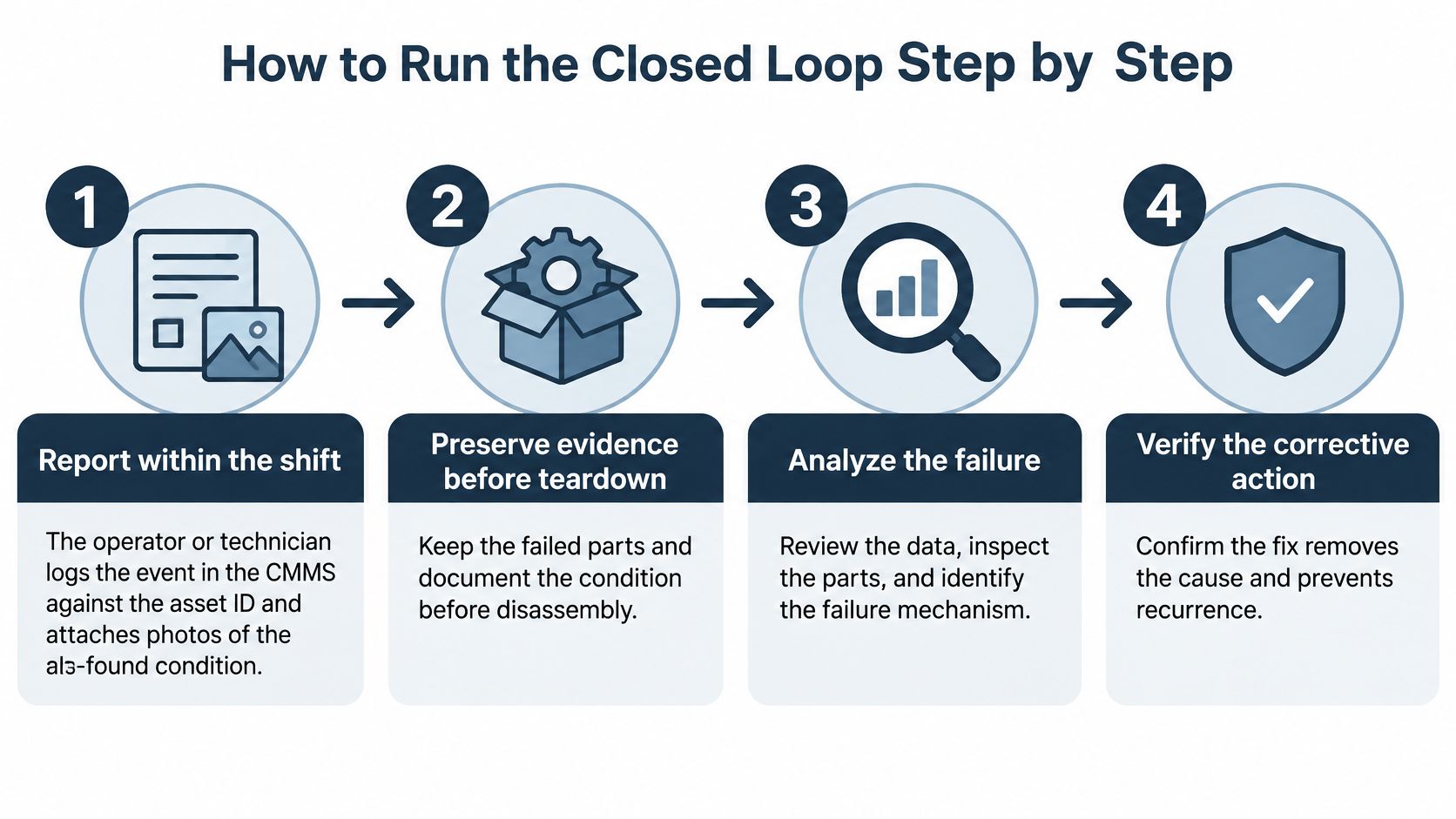
Operator or technician, report within the shift. The person who detects the event logs it in the CMMS against the asset ID and attaches photographs of the as-found condition. The report should identify the symptom and time of detection, even if the cause isn't known yet.
Technician, preserve evidence before teardown. The technician quarantines the suspect part and downloads historian traces and vibration spectra during the same shift. Teardown can erase clues, so the as-found condition and operating data need to be retained before disassembly changes the evidence.
Reliability engineer, triage by consequence. Safety, regulatory, repeat, and high-consequence failures receive engineering review the same day. Production-critical bad actors go to a weekly planner review; lower-severity events enter automated trend review.
Reliability engineer, classify the mode and mechanism. The engineer selects controlled-list codes for what failed and how it failed, rather than coding only the replaced part. A cracked impeller and the process that caused the crack are separate information.
Reliability engineer, select the investigation method. A 5-Why chain can trace a single cause path, such as a lubrication task skipped during shift change. Fault-tree analysis is better when causes combine, the event is safety-critical, or a previous fix failed. The investigation should continue past “operator error” to a process gap, such as an unclear procedure or a missing check.
Reliability engineer, assign ownership and proof. Every corrective action gets an owner, a due date, and a verification method. Forge Reliability builds programs that combine diagnostic tools with industry-specific failure-mode knowledge to turn raw equipment data into prioritized work.
Action owner, implement and document. Record implementation separately from closure. A completed part replacement proves that a repair occurred, not that the cause has been controlled.
Reliability engineer, verify under representative conditions. Retest the asset or monitor it through a duty cycle that can expose the suspected mechanism. A test that doesn't exercise the relevant load or operating condition can produce false confidence.
Plant manager, close only after the check passes. Trend recurrence at 30, 90, and 180 days, then close the record only when the agreed check passes. The plant manager is the named closer, and a finished repair alone isn't evidence of effectiveness.
Choosing Between 5-Why and Fault Tree Analysis
The investigation method should match consequence and causal complexity, not team habit. A short cause chain is efficient for a contained, single-path problem. A logic model earns its extra effort when multiple conditions combine, consequences are serious, or an earlier intervention didn't prevent recurrence.
| Criterion | 5-Why | Fault tree analysis |
|---|---|---|
| Best for | Single-path failures with one clear chain of causes | Multiple interacting causes and safety-critical events |
| Time to complete | A practical planning allowance is 30 to 60 minutes with the maintenance crew | Several days when drawings, historian data, and test results are needed |
| Output | A chain of causes ending at a process gap | A logic diagram with AND and OR gates |
| Data needed | Operator and technician knowledge | Drawings, trend data, test results, and maintenance history |
| Typical use in the FRACAS | Triage of minor repeat failures | Bad actors, critical failures, and repeats after a fix |
For 5-Why, the team follows one causal path by repeatedly asking what allowed the previous condition to occur. Suppose a bearing fails after a lubrication task is missed during shift change. The chain should examine why the task was missed, whether the handoff was clear, and whether the task was visible and verifiable, rather than ending at the name of the person who missed it.
A compressor trip can require a different approach. Suppose a seal failure and a drifted high-vibration alarm setpoint had to occur together for the trip to happen. An AND gate in a fault tree shows that both conditions were necessary; a single 5-Why chain could follow the seal problem while overlooking the alarm contribution.
Match effort to the risk
Fault-tree analysis needs more evidence and coordination, so it shouldn't become the default for every minor repair. A several-day investigation is appropriate when the potential recurrence cost justifies the effort, such as for a safety-critical event or a repeated compressor trip that survived a previous fix.
A short cause chain also needs discipline. “Operator error” isn't a useful endpoint because it assigns blame without identifying a process change that can prevent recurrence. A clearer investigation might reveal that the procedure was ambiguous, the required inspection wasn't built into the task, or the shift handoff didn't make ownership clear.
For teams investigating a complex operational incident, F1Group's guide to IT outage investigation for UK businesses offers a related perspective on structuring a cause investigation. For a mechanical event with interacting conditions, examples of fault tree analysis can help make the logic of combined causes more concrete.
Corrective Actions That Remove the Failure Mechanism
Replacing a failed part can return a gearbox to service while leaving the conditions that damaged it untouched. If tooth scuffing keeps recurring, the corrective action must address the mechanism, not just restore the hardware.
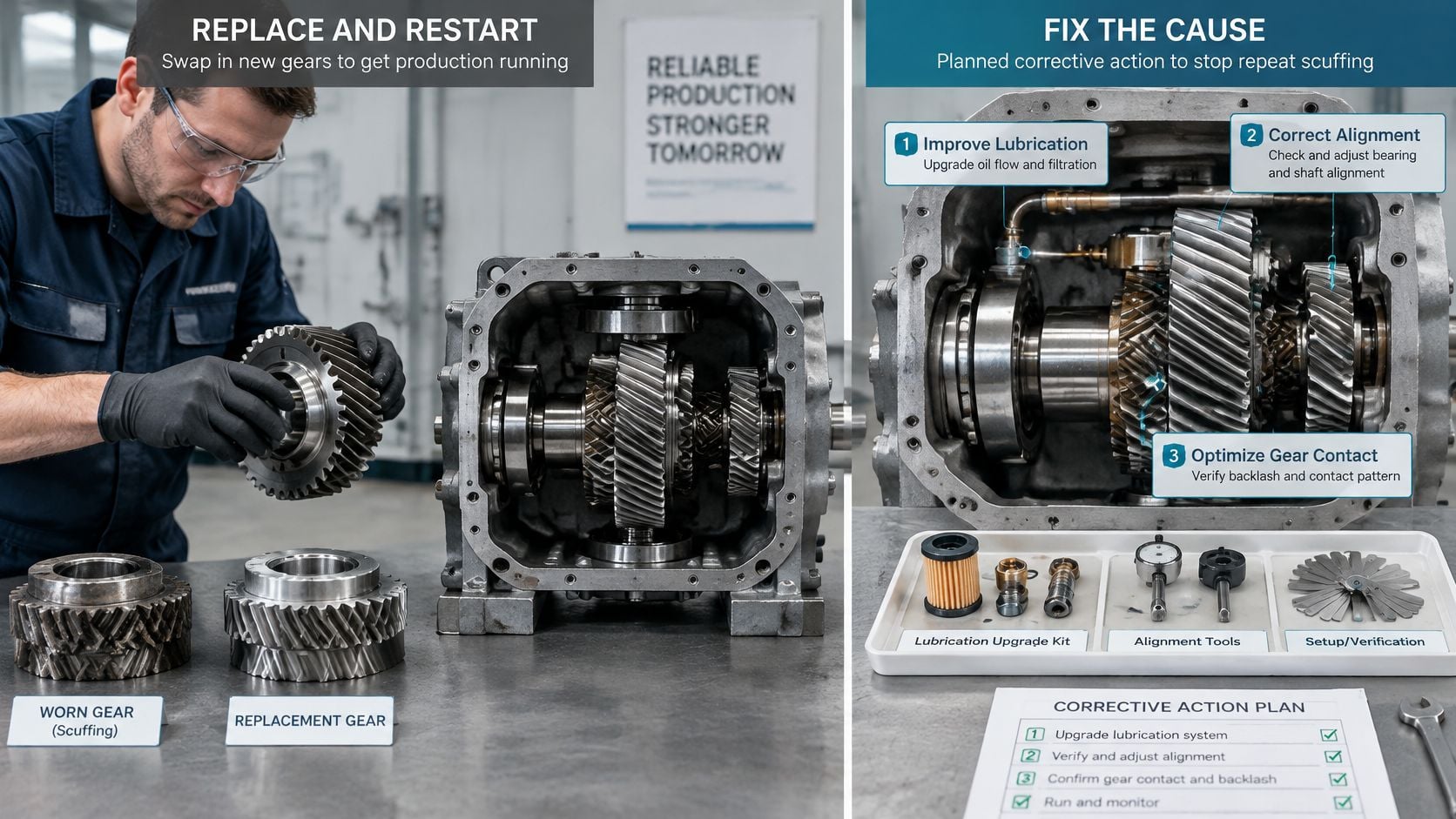
For the gearbox, a complete response could include checking that the lubricant has the correct viscosity and controlling contamination, revising the oil-change or filtration procedure, correcting shaft alignment, adding an inspection checkpoint, and updating the specified gearbox lubricant. Each action should tie to the failure mode it is intended to control. The action record also needs a named owner, a due date, and a method for showing that the change worked.
Corrective action can involve more than a component. The NASA Reliability-Centered Maintenance Guide describes actions that can include changes to design, work instructions, workmanship, training, inspections, tests, procedures, software, specifications, drawings, tools, equipment, facilities, resources, or materials when those changes prevent, minimize, or limit recurrence.
Verify the mechanism, not the paperwork
For this gearbox, evidence could include post-repair vibration trends, oil-debris analysis, temperature monitoring, and recurrence tracking over comparable operating hours. A clean work-order closeout confirms that the task was completed. It does not confirm that lubricant starvation, misalignment, or another identified mechanism is absent.
The action can also expose a cause outside the maintenance task itself. Procurement may have supplied an unsuitable lubricant, installation may have left the shafts misaligned, or operating practice may have pushed the gearbox outside its intended duty. Identifying contributing factors helps frame the investigation around the conditions that allowed the failure, rather than around the last component that was replaced.
Monday's closure rule: Close an action only when objective evidence shows that the identified mechanism has been removed or controlled. A completed repair is not enough.
Linking Failure Records to CMMS and ERP Work Orders
The CMMS manages maintenance work orders; the ERP holds cost and spares information. The FRACAS record connects the event to both systems. It shouldn't become a separate asset list with its own competing identifiers.
Follow the Line 3 feed-pump seal replacement through the records. The repair opens work order WO-2291, linked to failure record FR-0417. After the leak check passes at the agreed verification point, the planner changes the seal inspection interval in the PM routine, and the buyer updates seal demand in the ERP.
That chain is useful only if all three systems refer to the same asset and failure. A two-way data sync without shared asset IDs can duplicate history, split one failure across separate Pareto bars, and make MTBF unreliable for maintenance-interval decisions.
Set integration rules that protect the record
The working rules should make the links explicit:
- Use one asset master. Site, line, and maintainable item identifiers must match across the CMMS, ERP, and FRACAS.
- Connect every action to work. Store the work-order number on the failure record and a work-order or task number on each corrective action.
- Block incomplete records. The system should prevent saving a failure record until it points to a work order.
- Standardize failure codes. Use one controlled vocabulary for failure modes and mechanisms across pumps, motors, gearboxes, compressors, valves, and controls.
- Turn alerts into owned tasks. A condition-monitoring alert should create a review task assigned to the reliability engineer, not sit as a silent history line.
Teams planning how transactional systems should exchange information can also consult Wistec's guide to connected commerce systems. The reliability requirement remains specific: shared identifiers and linked work history must preserve one continuous event record. For the maintenance side of that chain, work-order management is where corrective tasks become traceable work rather than disconnected notes.
Forge Reliability enters each RCM change into the CMMS as a specific work-order template, PM routine, or condition-monitoring route. That makes the chosen maintenance strategy actionable in the system where planners and technicians execute work.
KPIs and Review Cadence That Prove the Loop Works
The repeat failure rate within 90 days is the first number to inspect. It tests whether corrective actions removed the failure mechanism, rather than merely closing the repair task. The other measures help diagnose whether the asset is improving, the repair process is getting faster, and the investigation records are complete enough to support those conclusions.
| KPI | Formula | Question it answers | Review cadence |
|---|---|---|---|
| MTBF | Operating hours divided by number of failures | Is this asset becoming more reliable? | Monthly |
| MTTR | Total repair hours divided by number of repairs | Are repairs getting faster? | Monthly |
| Repeat failure rate | Repeats within 90 days divided by total failures | Are corrective actions working? | Monthly |
| Action closure on time | Actions closed by due date divided by actions due | Is ownership working? | Weekly |
| Verified effectiveness | Actions with passed verification divided by actions closed | Did closure remove the mechanism? | Monthly |
| Unknown-cause share | Records classed as unknown divided by total records | Is the investigation deep enough? | Monthly |
When records use consistent failure definitions, MTBF can distinguish a real change in asset reliability from an apparent change caused by fragmented codes. MTTR can show whether repairs are becoming faster, but it shouldn't be treated as proof that recurrence risk has fallen. A guide to reliability metrics including MTBF and MTTR can support teams refining how they interpret those measures.
Rank by expected loss and review on a schedule
A Pareto chart ranks problems, but event count alone can put the wrong bad actor at the top. Rank by expected loss, combining frequency with downtime, repair cost, quality loss, energy impact, and risk exposure. A less frequent failure with severe production consequences may deserve attention ahead of a common nuisance event.
The Metrolinx FRACAS process calls for failure data to be reviewed and assessed at least monthly, with corrective-action information linked to the failure mode each action is expected to resolve. It also assigns each action a unique identifier so implementation can be tracked against expected reliability, availability, maintainability, and safety performance. Weekly reviews should still catch overdue actions and open verification; safety-critical and production-critical failures need immediate escalation.
A useful dashboard has three panels: the monthly bad-actor list, overdue actions by owner, and actions waiting for verification. For a compressor with four seal leaks in six months, the team can rank the leaks by consequence, introduce a new seal plan, and check the 90-day repeat count before deciding whether the action is effective.
Two coding errors can distort the dashboard. If every work order counts as a failure, routine maintenance inflates the failure total and obscures genuine bad actors. If “unknown cause” becomes a final code, the investigation stops; an escalation timer should require a 5-Why or fault-tree review before the next monthly assessment.
Near Misses Weak Signals and the First 30 Days
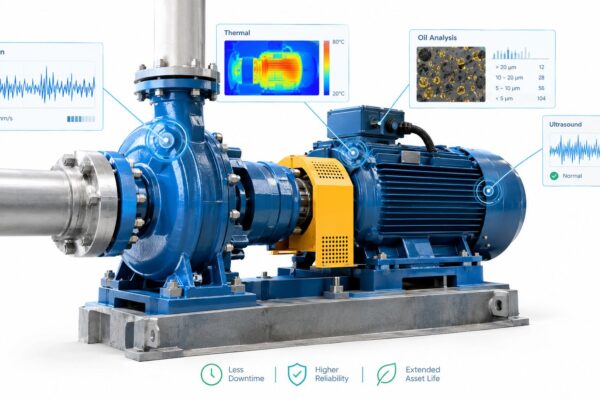
A pump doesn't need to stop before its degradation deserves attention. Rising vibration, recurring seal weepage, oil contamination, nuisance trips, and repeat temporary repairs can all signal a developing problem while the asset is still running. A FRACAS can capture those signals alongside breakdowns, giving engineers time to investigate before production loss forces the decision.
Accept condition-monitoring alerts, inspection findings, operator observations, deferred work, and known bad actors as records. A rising vibration trend should be classified with a suspected failure mode and mechanism, even if the bearing is still operating. A proof test might be a defined vibration band, a leak count, or an oil-debris result that can confirm whether the action controlled the suspected degradation.
Use consequence-based triage rather than giving every alert the same urgency. Safety or regulatory signals require same-day engineering review. Production-critical degradation belongs in the weekly review; lower-severity issues can enter the monthly trend process. Condition-monitoring systems can provide evidence for these records, but the alert must still become an owned review task with a documented outcome.
Start with a controlled pilot
During the first 30 days, the team can establish the workflow in a defined pilot:
- Export work orders for critical assets. Review the history to find repeated modes, temporary repairs, and events with high production consequences.
- Rank the top ten by expected loss. Include more than event count when comparing candidates, so a rare but costly failure isn't buried.
- Lock the mandatory fields and controlled lists. Set the asset hierarchy, failure-mode and mechanism codes, and rules for missing information.
- Pilot on one line. Keep the scope narrow enough for engineers, planners, operators, and technicians to correct data-quality problems while the process is new.
The pilot should continue until every event has a complete record, every corrective action has an owner and a verification method, and the team has a 90-day repeat count. If a condition-monitoring signal can't be tied to an asset, operating context, or accountable review, it isn't yet useful evidence for the loop.
Forge Reliability's assessment process reviews the customer's equipment and facility, then recommends a reliability program. A free reliability assessment can help plant teams map existing CMMS and condition-monitoring information into a closed loop with clear ownership and effectiveness checks.
Forge Reliability can assess recurring failure records, diagnostic data, and maintenance workflows to identify where corrective actions stop short of controlling the mechanism. Request a free reliability assessment from Forge Reliability to turn the plant's current evidence into a practical, prioritized FRACAS program.