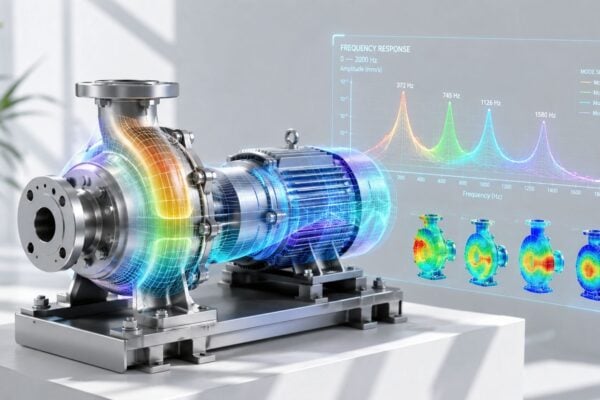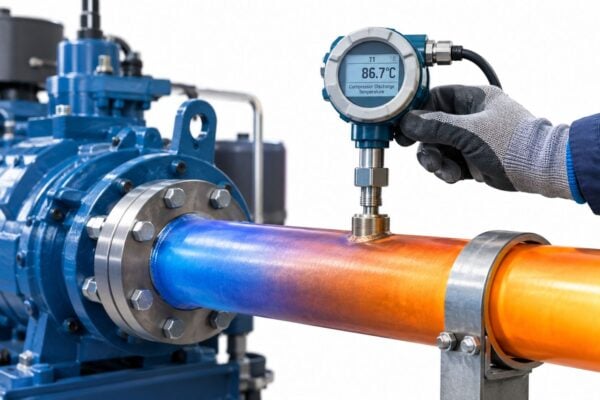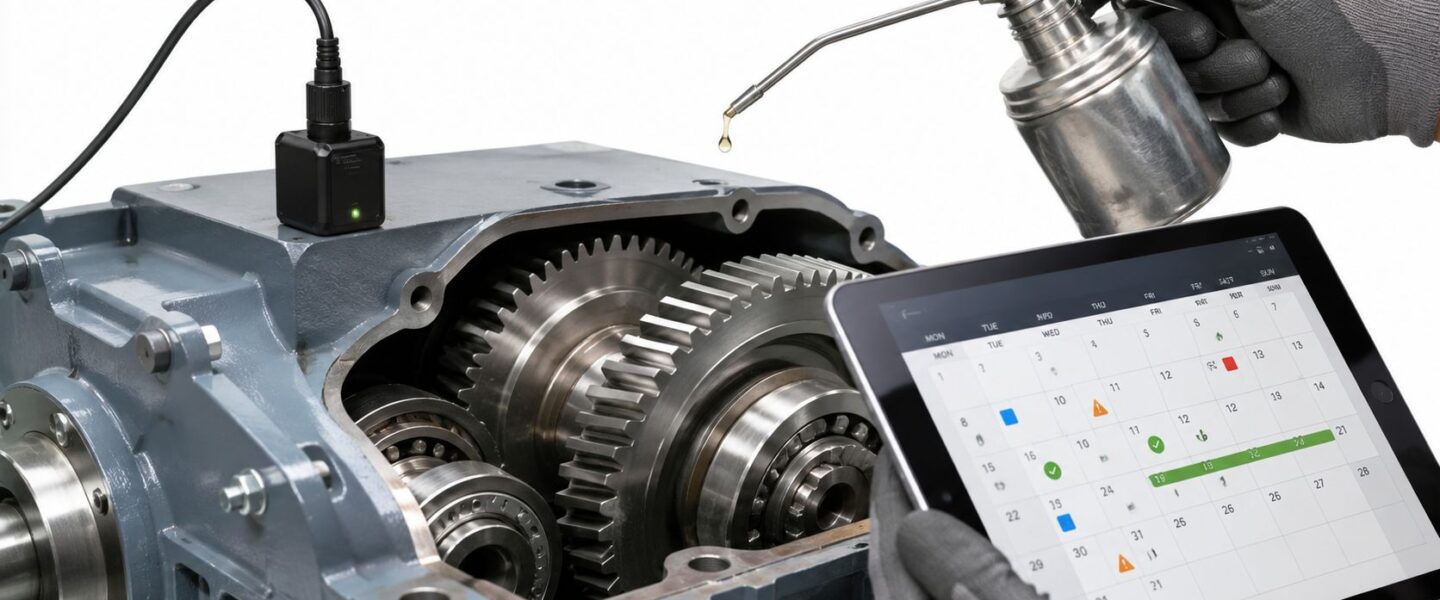
A gearbox rarely fails without warning. The warning may start as a small oil leak, a breather that no longer vents correctly, a rising bearing temperature, or a vibration trend that gets dismissed because production is still running. By the time the conveyor stops, the maintenance team may be dealing with damaged teeth, contaminated oil, bearing distress, and an outage that a better gearbox maintenance schedule could have exposed earlier.
A useful schedule is more than a list of calendar tasks. It combines failure-mode analysis, asset criticality, operating hours, load history, oil condition, vibration, temperature, and inspection findings. The practical objective is to replace calendar-based guessing with a defensible decision process that tells technicians what to check, when to check it, and what result should trigger escalation.
Table of Contents
- Why Your Gearbox Maintenance Schedule Determines Uptime
- Map Failure Modes to the Right Maintenance Tasks
- Define Tasks and Starting Frequencies That Actually Work
- Set Condition Based Triggers That Override the Calendar
- Deploy the Schedule in Your CMMS With a Usable Template
- Tune Intervals With Data and Keep the Schedule Optimized
Why Your Gearbox Maintenance Schedule Determines Uptime
A food-processing plant can have a conveyor gearbox operating through washdown, variable loading, and frequent starts and stops. A small seal leak may allow water ingress, while detergent exposure attacks the sealing environment. The gearbox may continue running until contaminated lubricant increases gear and bearing wear. If the only planned task is an annual oil change, the schedule has missed several opportunities to detect the developing fault.
Gearbox degradation is usually progressive. Lubrication breakdown, bearing wear, gear tooth pitting, contamination, and alignment drift develop through operating conditions rather than appearing at a convenient service date. A maintenance program therefore acts as a risk-control system. It gives operators and technicians repeated opportunities to detect change before a defect becomes secondary damage.
Condition-based maintenance means maintenance is initiated or adjusted from measured equipment condition, such as oil debris, vibration, temperature, or inspection findings. Reliability-centered maintenance, or RCM, is the broader decision framework used to identify functions, failure modes, consequences, and the most appropriate maintenance task. A gearbox schedule works best when RCM logic determines what must be protected and condition monitoring determines when action is justified.
The commercial link is direct. A failed gearbox can stop a conveyor, mixer, pump, or extruder, disrupt upstream and downstream equipment, and force maintenance into emergency work. Plant leaders tracking OEE improvement should treat gearbox availability as part of the production system, not as an isolated mechanical concern.
Practical rule: A gearbox schedule should make failure visible early enough for the plant to choose the repair window.
A strong program moves through a clear sequence. First, map failure modes to detectable signals. Next, assign layered frequencies based on criticality and service severity. Then define condition triggers that override the calendar. Finally, deploy the logic in the CMMS and tune it from actual operating history. That sequence prevents a common mistake, performing a technically correct task at the wrong interval or using a task that cannot detect the target failure.
Map Failure Modes to the Right Maintenance Tasks
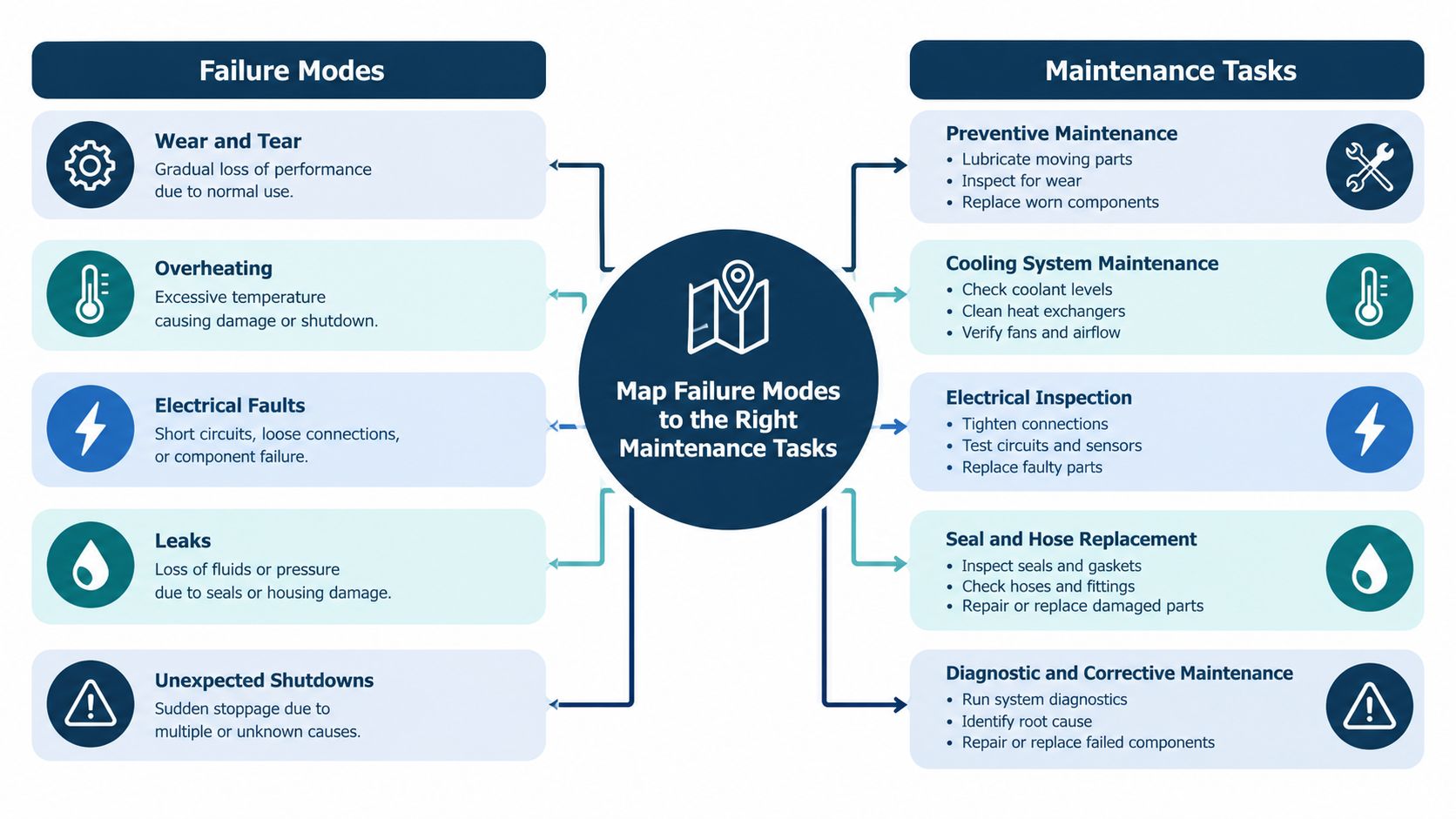
A generic「inspect gearbox」task gives technicians too little direction. A usable schedule connects each known failure mode to its earliest detectable signal, the inspection method that can find it, and the action required when the signal changes.
Start with the damage pattern
微點蝕 appears as grey or frosted patches on gear flanks. It often indicates a thin oil film or incorrect viscosity. The task should therefore include lubricant verification and oil analysis, with an internal inspection if the condition continues to trend negatively. 宏觀點蝕 produces craters or spalls and is associated with contact fatigue or misalignment. Use borescope inspection, alignment checks, vibration analysis, and load-history review together instead of treating an oil change as the complete response.
擦傷 leaves smeared surfaces on gear flanks after the lubricant film collapses. Review temperature history, oil condition, lubricant grade, overload, and sudden load changes. 磨粒磨損 causes relatively uniform material loss when hard particles circulate in the oil. The task plan must then address particle contamination, filtration, breather condition, seals, and oil cleanliness.
Match the signal to the failure
A helical gearbox driving a chemical-processing agitator shows why service history matters. Changing process viscosity and frequent load swings can produce a different pattern of gear-mesh wear and bearing fatigue from a lightly loaded, constant-speed drive. The schedule should reflect those operating conditions rather than copy a generic calendar.
Select the task according to the failure mechanism:
- 油液分析 identifies wear metals, viscosity change, water, and particle contamination before visual damage becomes obvious.
- 振動分析 helps identify bearing fatigue, gear-mesh wear, looseness, imbalance, and misalignment through changes in amplitude and frequency.
- 熱成像與溫度趨勢 expose abnormal heat linked to overload, poor lubrication, restricted cooling, or alignment problems.
- 對心檢查 verifies that shafts and couplings are not creating uneven tooth loading or excessive bearing forces.
- 呼吸器與密封件檢查 addresses moisture and dirt ingress before contaminants accelerate wear.
- 內視鏡檢查 provides an internal view of gear teeth and related components without complete disassembly.
The right task is the one that detects the intended failure early enough to support a planned response. A manufacturing FMEA framework helps document the link between each failure mode, its cause, effect, detection method, and corrective action.
Use a severity-based decision rule: identify the failure mode, find its earliest credible signal, assign the lowest-cost reliable inspection method, and define escalation before the signal appears. Oil debris, vibration changes, and load history should refine the schedule for that specific gearbox. If a task cannot detect the target failure or produce a clear decision, rewrite it before adding it to the maintenance plan.
Define Tasks and Starting Frequencies That Actually Work
A gearbox on a loaded conveyor can move from acceptable operation to tooth distress faster than a calendar task can respond. Set the starting frequency according to failure-development speed, asset criticality, and the warning quality of each inspection method. A daily sensory check may catch a new leak or abnormal sound, but it cannot replace oil analysis or an internal inspection. An annual teardown also cannot address contamination that enters the housing shortly after the shutdown.
Build a layered cadence
Use several work layers, then adjust them with oil debris, vibration behavior, and load history from that specific gearbox.
- Daily screening: Operators check for oil leaks, abnormal noise, visible damage, and unusual vibration. These checks are quick and useful for immediate risk. Record every finding in the maintenance system instead of leaving it as an informal observation.
- Monthly condition checks: Technicians record bearing-housing and oil-sump temperatures, inspect breather condition, verify oil level, and review sight-glass clarity. A temperature shift or deteriorated breather can point to thermal drift, moisture entry, or dirt contamination.
- Quarterly mechanical checks: Include fastener torque verification, backlash measurement, coupling inspection, and vibration analysis. Backlash is the clearance between mating gear teeth. A change can indicate tooth wear, looseness, or an alignment problem.
- Semi-annual lubricant checks: Laboratory oil analysis evaluates viscosity, particles, moisture, and wear metals. Trend each result against the gearbox's established condition history, not against a generic limit alone.
- Annual intrusive work: During a planned shutdown, change the oil when condition and lubricant duty justify it, then inspect the internal gears. Confirm tooth condition, contamination, mounting, alignment, and other conditions that external inspections cannot verify.
Frequency is a starting hypothesis, not a permanent rule. A gearbox operating continuously under high load may need shorter routes than a lightly loaded standby unit. Conversely, stable oil results, steady vibration, and a consistent load history can support a longer interval when the failure consequence allows it.
For critical continuous-duty gearboxes, operating-hour milestones can add structure between shutdowns. Use 8,000 operating hours, about one year, 24,000 hours, about three years, and 40,000 hours, about five years as planning points only when they fit the gearbox's duty and condition history. At the first milestone, perform a detailed noise-and-vibration survey. At the next, escalate to remote visual inspection with a fiberscope or borescope. At the later milestone, plan a full examination and inspection. Additional 16,000-hour and 32,000-hour points can support remote inspection or vibration survey, followed by full inspection and overhaul, when the asset's risk and condition justify that work. Use the industrial gearbox maintenance schedule as a reference for organizing these milestones, then validate them against plant evidence.
Operating hours, calendar age, and measured condition must work together. A fixed hour count should never override evidence of accelerating wear or a change in service severity.
Starting frequency matrix by task and criticality
| Maintenance Task | Critical Gearbox | Important Gearbox | Standard Gearbox |
|---|---|---|---|
| Operator leak, noise, and visible-condition check | Daily | Daily or route-based | Routine operator check |
| Oil level, temperature, and breather check | Monthly | Monthly | Periodic inspection |
| Vibration route | Monthly or continuous monitoring | Monthly route | Quarterly route |
| Oil analysis | Monthly or quarterly, based on failure consequence | Quarterly | Semi-annual |
| Torque, backlash, and coupling inspection | Quarterly | Quarterly | Annual or condition-triggered |
| Alignment and filter service | Semi-annual | Semi-annual or condition-triggered | Annual |
| Internal inspection or borescope examination | Annual or milestone-based | Annual or condition-triggered | Planned shutdown |
Document the criticality decision. A critical gearbox may drive a bottleneck conveyor or process agitator where failure affects safety, quality, or production. A standard gearbox may have redundancy and a manageable repair window. The oil sampling and analysis process should define the sample point, sampling method, laboratory tests, responsible owner, and response time for each tier.
Every interval needs a reason in the job plan. Record the failure mode covered, the evidence supporting the frequency, the operating severity, and the condition that should shorten the interval. If a task cannot detect its target failure early enough to support a planned response, revise the task before adding it to the maintenance plan.
Set Condition Based Triggers That Override the Calendar
A gearbox can fail before its next planned inspection, while a healthy unit may reach an oil-change date with no sign of lubricant degradation. Calendar tasks provide control, but condition triggers determine when the schedule must change. The trigger also needs an owner, a response time, and a defined work order path.
Compare calendar work with measured condition
A calendar-only instruction says, “Change oil at the planned interval.” A condition-triggered instruction checks whether viscosity has drifted, moisture has entered the housing, particle contamination is rising, or wear metals are trending upward. Calendar work is simple to administer. Condition work requires a reliable baseline, good sample quality, trained interpretation, and a rule that converts an alert into action.
The same principle applies to vibration and temperature. A single high reading may result from sensor placement, process variation, or a temporary load event. A sustained departure from the gearbox baseline is more actionable, especially when vibration, temperature, and oil results indicate the same failure mode.
Online oil-debris monitoring has a role where early warning supports a planned response. Use it with offline oil analysis and degradation trending against established baselines. Debris and vibration provide different evidence: oil particles can indicate active gear or bearing wear, while vibration can show changes in bearing condition, gear mesh, alignment, or looseness. A sound program uses both where the failure consequence justifies the added monitoring cost.
Define the action before the alert
A trigger without a response only creates another report. Build the action into the maintenance rule:
- Particle contamination rises: Verify the sample and sampling method, inspect breathers and seals, check filtration, and plan an oil change or flush if contamination is confirmed.
- Viscosity drifts: Confirm lubricant identity and temperature history, investigate oxidation or mixing, and replace the lubricant if film strength is threatened.
- Moisture appears: Inspect ingress paths, breather condition, and seals. Escalate when water threatens bearings or gear surfaces.
- Wear metals increase: Repeat or confirm the sample, compare debris type with vibration findings, and schedule a borescope inspection when the trend indicates active wear.
- Temperature or vibration departs from baseline: Check load, alignment, lubrication, mounting, and gear mesh. A rapid or severe change may require a controlled shutdown instead of continued operation.
Severity classes should account for duty cycle, operating temperature, contamination exposure, load swings, and lubricant type. High-load continuous service generally warrants tighter surveillance. Synthetic lubricant and a clean, stable environment may support a longer interval, but condition data must confirm that choice.
A thermally cycling power-generation gearbox may need a lower moisture or temperature trigger than a stable indoor drive. Repeated expansion and contraction can challenge seals and lubricant condition, so the threshold should reflect that operating history rather than a generic calendar.
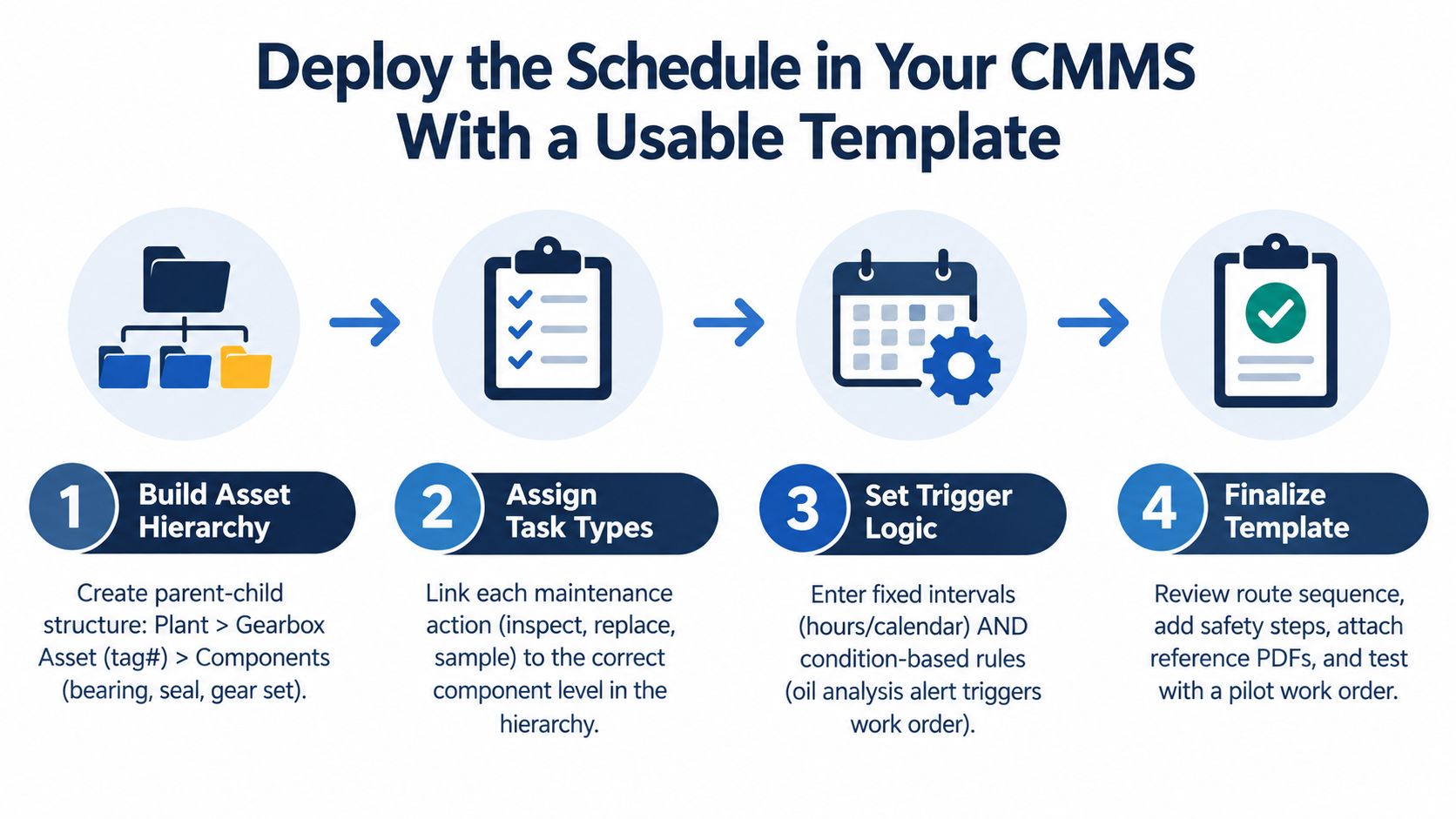
The condition-based maintenance approach turns these rules into a managed process. Record the trigger, response, priority, and responsible role in the CMMS, rather than leaving the decision in a laboratory report or technician's notebook.
Deploy the Schedule in Your CMMS With a Usable Template
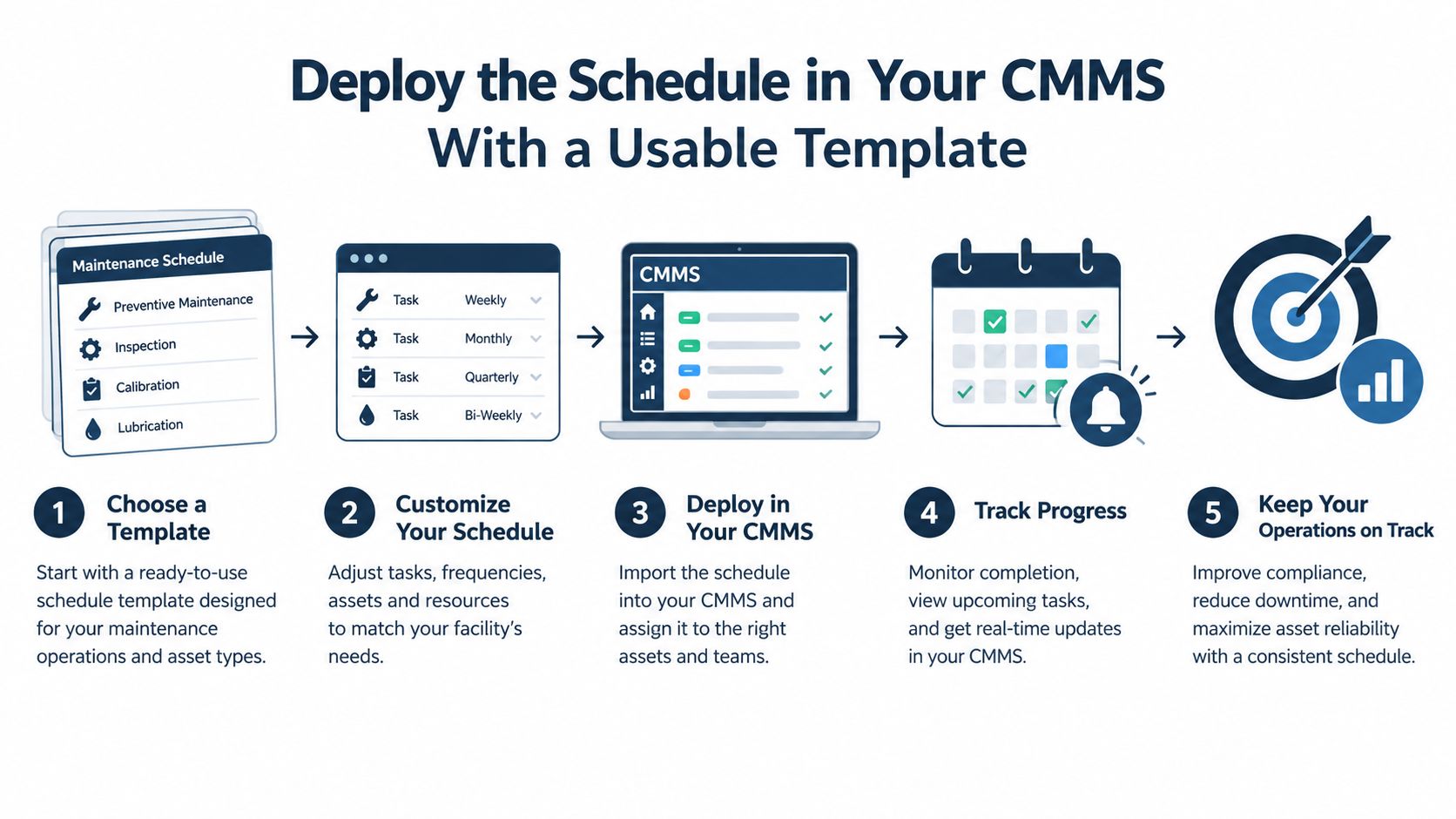
A technically sound schedule fails when technicians cannot find the task, planners cannot see why it is due, or completed work does not preserve measurement history. Configure the CMMS so each maintenance decision can be executed at the gearbox and component level.
Create the hierarchy before creating the route
Build the hierarchy from plant to gearbox, then to bearings, seals, gear sets, coupling, breather, and lubrication system. Assign vibration points to the relevant component. A route attached only to a general gearbox tag cannot distinguish a bearing measurement from a gear-mesh measurement. Oil sampling also needs a defined port and component relationship.
Rank gearboxes by criticality and link inspection, replacement, sampling, alignment, and corrective tasks to the component that can fail. Searchable history then exposes recurring problems instead of burying them in a generic asset record.
Use a task matrix planners can audit
| Task | Method | Frequency | Trigger | Responsible Role | Acceptance Criteria |
|---|---|---|---|---|---|
| Leak and noise check | Sensory route and visual inspection | Daily | Leak, abnormal sound, visible damage | Operator | No unexplained leak or abnormal condition |
| Temperature and breather check | Record temperatures and inspect breather | Monthly | Rising temperature, blocked breather, unclear sight glass | Mechanical technician | Reading and finding recorded against baseline |
| Vibration survey | Route-based measurement at defined points | Monthly or quarterly | Trend change or alarm rule | Reliability technician | Valid reading with spectrum and location |
| Oil sample | Controlled sample from defined port | Quarterly or severity-based | Moisture, particles, viscosity drift, wear metals | Lubrication technician | Sample accepted and result reviewed |
| Internal inspection | Borescope or planned opening | Annual or milestone-based | Oil, vibration, or debris escalation | Mechanical planner and technician | Teeth, bearings, and contamination documented |
Use operating-hour meters alongside calendar dates on continuous-duty gearboxes. For new or rebuilt units, the first oil change may start at 500 operating hours, followed by analysis every 2,500 hours or 6 months. Treat these values as starting references, not automatic instructions. Break-in debris, lubricant type, load, manufacturer guidance, and condition results should determine whether the interval remains appropriate.
A multi-site manufacturing group standardizing more than 20 critical gearboxes should share task libraries and acceptance fields without forcing one route on every asset. Each gearbox still needs its severity class, meter source, sample point, and escalation rule. Arrange route sequence to reduce travel, protect sample quality, and collect vibration and temperature readings under comparable load conditions.
Schedule records should capture the operating context behind every result. Asset hierarchy, work history, and measurement governance are central to CMMS asset management. A completed task should state what was measured, where, under which load or operating condition, and what decision followed. “Inspected gearbox” is not an auditable result. The record should also link oil debris, vibration findings, and load history to the next action, allowing calendar frequencies to tighten or extend as actual severity changes.
Tune Intervals With Data and Keep the Schedule Optimized
Deployment starts schedule control. Review completed work, missed findings, oil trends, vibration routes, operating hours, and failure history to decide whether each task is early, late, or correctly timed. The schedule should respond to gearbox severity, not remain tied to an unchanged OEM calendar.
RCM and FMEA outputs establish the failure logic. Weibull analysis can evaluate failure distribution when enough clean history exists. Oil debris and vibration trends then test whether the planned interval matches actual degradation. If a high-load gearbox repeatedly shows contamination before its planned sample date, shorten sampling or correct the ingress mechanism. If a stable gearbox remains healthy through documented inspections in a clean environment, evaluate extending the interval instead of changing lubricant by habit.
Interval optimization can differ sharply from generic tables. One reliability model recommended a restoration maintenance interval of about 22.28 days for a specific gearbox task. That result applies only after validating the asset's duty, failure consequences, and condition data. Do not transfer a modeled interval to another gearbox without checking its load history, contamination exposure, and degradation evidence.
Governance should include review at 1-year, 3-year, and 5-year equivalent operating milestones, aligned with the long-cycle inspection logic described earlier. Track unplanned gearbox downtime, overdue tasks, repeat failures, oil-condition alerts, vibration exceptions, and OEE impact.
Avoid three common errors:
- Rote replacement: Change oil based on contamination, viscosity, and wear evidence, rather than habit alone.
- Unowned alerts: Assign every condition alarm a named reviewer and a defined response time.
- Poor history: Record measurements, findings, operating conditions, and corrective decisions, not just task completion.
A risk-based gearbox maintenance schedule is a living control system. It combines failure-mode logic, layered inspection, condition triggers, CMMS discipline, and periodic engineering review. Use oil debris, vibration, and load history to tighten or extend calendar intervals for the specific gearbox. The goal is the earliest useful warning at a justified cost, not the most frequent maintenance.
Forge Reliability offers a free reliability assessment covering gearbox criticality, failure modes, oil analysis, vibration routes, thermography, and CMMS task logic. Visit Forge Reliability to review risk-based intervals and condition triggers against the plant's actual assets and operating severity.